HIP-3: Builder-Deployed Perpetuals Explained - Permissionless Perp DEXs on Hyperliquid
Table of Contents
- What Is HIP-3?
- How Builder Codes Work
- Staking and Activation
- Market Deployment
- Fee Structure
- Growth Mode: Bootstrapping New Markets
- Trade.xyz: The First Major Builder
- Stock Perps on a DEX
- Early Results
- Felix FLX: DeFi-Native HIP-3 Builder
- A Note on Terminology: Two Kinds of "Builder Code"
- HIP-3 by the Numbers
- HIP-3*: Optional Permissioned Markets (Testnet)
- What a HIP-3* Deployer Can Do
- Why HIP-3 Matters for the Broader Ecosystem
- Platform vs. Product
- Revenue Diversification
- Asset Class Expansion
- Sibling Standard: HIP-4 Outcome Markets
- How to Get Started
 Hyperliquid
What Is HIP-3?
HIP-3 is the Hyperliquid Improvement Proposal that turned the protocol from a single perp exchange into a permissionless platform for deploying entirely new perpetual futures markets. Before HIP-3, every perpetual contract on Hyperliquid was operated by the core validator set. After HIP-3, anyone willing to put up the stake can launch their own perp DEX - with their own markets, their own front-end, and their own fee revenue - all running natively on HyperCore's battle-tested trading engine. Every market currently deployed under HIP-3 is listed, with live volume and open interest, in the HIP-3 registry.
It went live on mainnet on October 13, 2025, and within months it has reshaped what is possible on Hyperliquid. Stock perpetuals, exotic crypto pairs, synthetic indices - HIP-3 opened the door to all of it.

The implications go beyond just more trading pairs. HIP-3 transforms Hyperliquid's economic model from a single product into a platform economy - where the protocol earns revenue from an ever-expanding universe of markets it does not have to build or maintain itself.
How Builder Codes Work
At the core of HIP-3 is the concept of a builder code. Think of it as a license to operate your own perpetual futures exchange on top of Hyperliquid's infrastructure.
Staking and Activation
To activate a builder code, a deployer must stake a minimum of 500,000 HYPE - roughly $25 million at current prices. This is not a fee that gets paid to anyone; the HYPE remains staked and serves as both a security bond and an alignment mechanism. If a deployer acts maliciously - providing manipulative oracle pricing, running harmful market configurations - up to 100% of their stake can be slashed, and the slashed tokens are burned, not redistributed.
Whatever the reasoning behind setting the bar at this level, which this site has no insight into, the practical effect is that every deployer has significant capital at risk against the markets they run.
Market Deployment
Each builder code entitles the deployer to operate one perp DEX on HyperCore. The first 3 markets per DEX are free to deploy. After that, additional market slots are allocated through a Dutch auction that runs every 31 hours — the same auction mechanic that governs HIP-1 spot token deployments — creating a gradual, market-driven expansion of the available market count.
Info
Fee Structure
Every HIP-3 market carries a deployer fee scale, one number that decides both what traders pay and how much of it the builder keeps. In August 2026 Hyperliquid opened this up: the scale is now a continuous value anywhere from 0.1 to 3, and it is set per asset rather than once per DEX. A builder can price a crowded contract like NVDA cheaply and charge more on an illiquid long-tail market, on the same DEX, and change either one later.
The formula splits at 1. Below a scale of 1, the trader pays the native rate multiplied by scale + 1 and the deployer keeps scale / (1 + scale) of it. At 1 or above, the protocol raises its own cut to match the deployer's, so the trader pays scale × 2 and the split lands at a flat 50/50.
| Fee scale | Trader pays | Perp taker | Perp maker | Deployer keeps |
|---|---|---|---|---|
| 0.1 | 1.1x native | 0.0495% | 0.0165% | 9.1% |
| 0.1111 | 1.111x native | 0.050% | 0.0167% | 10% |
| 1.0 | 2x native | 0.090% | 0.030% | 50% |
| 2.0 | 4x native | 0.180% | 0.060% | 50% |
| 3.0 | 6x native | 0.270% | 0.090% | 50% |
Native base rates are 0.045% taker and 0.015% maker at tier 0. Your own VIP tier, staking discount, and referral discount still apply on top.
Almost nobody uses the wide end of that range. Checking every builder DEX on August 31, 2026, ten are registered and five of them have markets currently trading, 144 in total. 131 of those 144 run a scale of exactly 1.0, which is where the familiar 0.09% / 0.03% figure everyone quotes comes from. Two venues sit below it:  HyENA at 0.1111 across its twelve remaining markets, which lands traders on a 0.050% taker fee and leaves the deployer with 10% of it instead of 50%, and Paragon, which runs one of its 22 markets at 0.5. Nobody is above 1.0.
Warning
isDelisted in the API and twelve were still trading. If you hold a position on hyna, the deployer's own documentation is where the timetable lives, because a builder closing its own markets does not go through the validator delisting vote that governs native perps. Treat the 0.1111 figure above as a snapshot of a venue on its way out rather than as a standing alternative to the 1.0 default.The 50% ceiling is what makes the alignment work in either direction: builders earn more when their markets attract volume, and the protocol's half feeds the HYPE buyback and burn mechanism and network validators. A builder who drops the scale is trading fee revenue for cheaper fills, betting the extra volume pays for itself.
Tip
Growth Mode: Bootstrapping New Markets
In November 2025, Hyperliquid introduced Growth Mode - a fee reduction program that slashes taker fees by over 90% on new HIP-3 markets. The logic is straightforward: new markets face a cold-start problem. Without volume, there is no liquidity. Without liquidity, there is no volume. Growth Mode breaks this cycle by making it dramatically cheap to trade on freshly deployed markets.
For traders, Growth Mode means you can explore new HIP-3 markets at a fraction of the normal cost. For builders, it means their markets have a realistic path to achieving the volume and liquidity depth needed to sustain themselves at normal fee levels.
This kind of programmatic bootstrapping is rare in DeFi. Most new perpetual markets on competing platforms launch with the same fee structure as established ones and hope for the best. Hyperliquid's approach acknowledges the cold-start problem and actively solves it.
Trade HIP-3 Markets with a Fee Discount
Builder-deployed perps on Hyperliquid unlock markets you cannot find anywhere else. Sign up with our referral code and get a 4% lifetime discount on trading fees across all Hyperliquid markets.
Start Trading with 4% Off Fees Trade.xyz: The First Major Builder
The promise of HIP-3 became real with Trade.xyz, the first major builder to deploy on the platform. Trade.xyz did something that would have been unthinkable in DeFi just a year earlier: they launched 24/7 perpetual futures markets on US stocks.
Stock Perps on a DEX
Trade.xyz deployed equity perp markets for Tesla, Apple, Nvidia, Amazon, and other major equities - all trading around the clock, including weekends and holidays, with no KYC requirement. They also created the XYZ100, a synthetic index tracking the Nasdaq 100, and in March 2026 launched the official S&P 500 perpetual with licensing from S&P Dow Jones Indices — giving traders exposure to the world's most important index through a single perpetual contract.
These are perpetual futures contracts that track the price of underlying equities using oracle feeds, rather than tokens representing shares. You can go long or short, use leverage, and trade at any hour. If you want the other thing, share-backed tokens you hold rather than a contract you margin, that is a separate product from a separate issuer: xStocks launched tokenized spot equities trading on HyperCore in August 2026, issued and administered by Backed and its distributors rather than by Hyperliquid. The two products behave nothing alike.
Early Results
The numbers validated the concept quickly. Within the first two weeks of launch, the XYZ100 synthetic Nasdaq index alone hit $80 million in daily trading volume and $70 million in open interest. These are not trivial numbers. They represent genuine demand for equity exposure in a permissionless, 24/7 DeFi environment.
Trade.xyz demonstrated that HIP-3 is not just a theoretical framework - it is a production-ready system capable of supporting entirely new asset classes on Hyperliquid's infrastructure.
 Felix FLX: DeFi-Native HIP-3 Builder
Felix Protocol, the #2 DeFi protocol on HyperEVM, also operates a HIP-3 builder-deployed dex called FLX. Felix's 14 markets span equities, commodities, and crypto - complementing their lending and borrowing products. The FLX dex demonstrates how HIP-3 enables DeFi protocols to offer integrated trading alongside their core products.
A Note on Terminology: Two Kinds of "Builder Code"
The phrase "builder code" gets used for two different things on Hyperliquid, and it is worth keeping them straight. HIP-3, covered above, is the one that lets a deployer stake HYPE and stand up an entire perp DEX. The other is an order-routing builder code — a short identifier that any front-end can attach to the orders it sends to Hyperliquid's shared order book, earning a small share of the fees on the flow it brings in. No 500,000 HYPE stake, no new markets; just a way for apps to route their users into Hyperliquid's existing liquidity and get paid for it.
That second flavor is how a growing list of outside platforms plug into Hyperliquid. In July 2026, the regulated exchange VALR rolled out a builder-code integration that lets its users trade Hyperliquid perpetuals straight from the VALR app, and founder Jeff Yan joined VALR's podcast to walk through how it works. The bridge aggregator Oku followed in the same month. It is a useful illustration of the difference: HIP-3 grows the supply of markets, while order-routing builder codes grow the demand side by pulling new front-ends and their users onto the same order book.
Over 100 teams have now integrated this way, earning more than $63.5 million in cumulative fees between them, with Phantom alone past $20 million. Our guide to Hyperliquid builder fees covers what those apps charge you and how to check what you have approved.
HIP-3 by the Numbers
As of August 2026, the HIP-3 ecosystem has grown into a significant component of Hyperliquid's overall volume:
| Metric | Value |
|---|---|
| Aggregate Open Interest | $3.60 billion (August 31, 2026) |
| Registered Builder DEXs | 10, five of them with markets currently trading |
| Live Markets | 144 |
| Mainnet Launch | October 13, 2025 |
Open interest, DEX count and market count computed from the Hyperliquid API on August 31, 2026. Nearly all of that open interest sits on one venue: trade.xyz accounts for $3.57 billion of the $3.60 billion total, with Paragon ($12.1M), EntropyIO ($11.6M, profiled in EntropyGuides' HIP-3 deployers comparison), Markets By Kinetiq ($4.3M) and HyENA ($3.6M) splitting the remainder. The count of DEXs with live markets moves as builders list and retire them, so query it yourself rather than trusting this line. Cumulative and daily volume are deliberately not quoted here, because Hyperliquid's public volume feed stopped publishing in April 2026 and this site has no verifiable current source for either, so any figure would be guesswork. Query the API or an analytics dashboard such as Dune for current numbers.
FalconX, a digital asset prime broker, has published a projection of roughly $0.8 billion in annualized incremental fees from HIP-3 activity. That is their forecast, not an outcome, and this site takes no view on whether it will be met.
HIP-3*: Optional Permissioned Markets (Testnet)
On September 3, 2026, Hyperliquid's jeff_hl account announced that a future network upgrade will give HIP-3 deployers an extra set of controls, collectively named HIP-3*. The core of it is an onchain allowlist. A deployer, or a sub-deployer it authorizes, decides which addresses are approved to trade on its markets.
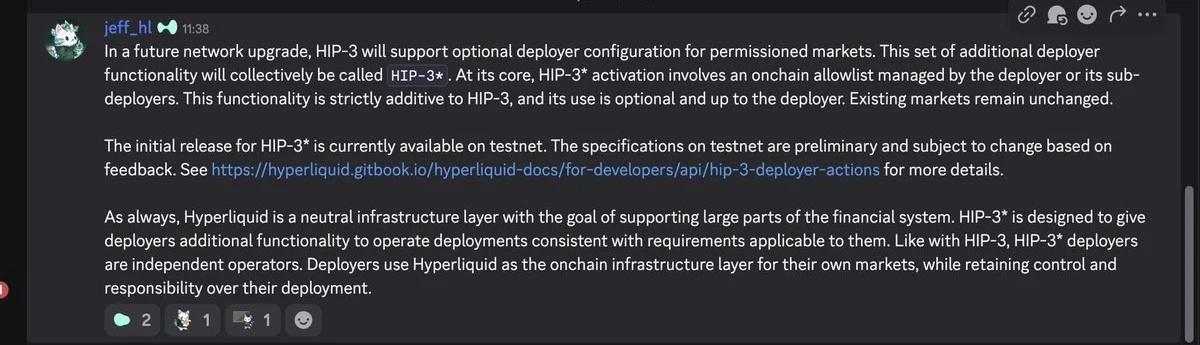
Source: announcement posted by jeff_hl, September 3, 2026. The linked specification lives in the Hyperliquid developer docs.
The qualifiers attached to it are worth more attention than the headline. Activation is up to the deployer, so nothing forces an existing builder to switch it on. The announcement states that existing markets remain unchanged, which makes HIP-3* an addition on top of HIP-3 rather than a replacement for any part of it. And the initial release is on testnet, where the specifications are described as preliminary and subject to change based on feedback. No mainnet date has been announced.
What a HIP-3* Deployer Can Do
Beyond the allowlist itself, the docs describe a set of operations a deployer can execute on an approved user's behalf on its own venue:
| Operation | What it does |
|---|---|
modifyApproval | Adds or removes an address from the venue's allowlist. Re-approving an already-approved address, or revoking one that was never approved, is a no-op |
order | Places reduce-only orders for a user |
cancel | Cancels specific resting orders, identified by asset and order id |
cancelAll | Cancels every resting order and TWAP the user has on that venue only |
sendAsset | Transfers a user's collateral to a destination address |
A deployer can hand out each of these to sub-deployers individually, through grants of the form {"hip3Star": "<operation>"}. Only the deployer and the sub-deployers it has authorized can call them.
For a trader, the reduce-only order and sendAsset operations are the ones worth reading twice. On a venue that has HIP-3* enabled, the operator has tools to act against your position and your collateral inside its own markets. That is a property of that specific venue, not of Hyperliquid, and it is the same ownership boundary described throughout this page: the deployer runs the market and carries responsibility for it, while HyperCore provides the matching engine underneath. Before trading on any permissioned venue, read what its operator has published about how it intends to use these controls.
The announcement itself frames HIP-3* as giving deployers functionality to operate "consistent with requirements applicable to them," and describes deployers as independent operators. It names no jurisdiction, no regulator and no venue. Speculation tying it to any particular market has been widespread since the post went up, and none of it comes from the announcement. For what has and has not actually been said about US access, see our tracker on whether Hyperliquid is coming to the US.
Why HIP-3 Matters for the Broader Ecosystem
HIP-3 does more than add new trading pairs. It fundamentally changes Hyperliquid's competitive positioning and economic model.
Platform vs. Product
Before HIP-3, Hyperliquid was a product - a fast perp DEX. After HIP-3, it is a platform - an infrastructure layer that other businesses build on top of. This is the same strategic shift that turned Apple from a computer maker into the App Store ecosystem, or that turned Ethereum from a cryptocurrency into a smart contract platform. Platforms scale differently because they grow through the efforts of their builders, not just their core team.
Revenue Diversification
The Hyperliquid protocol now earns fee revenue from markets it does not operate, maintain, or provide liquidity for. Every new builder that deploys on HIP-3 creates a new revenue stream for the protocol and, through the buyback and burn mechanism, for HYPE token holders. This diversification reduces the protocol's dependence on any single market or asset.
There is a trade-off worth naming, because the split cuts both ways. At the scale of 1.0 that 131 of the 144 live builder markets use, a dollar of fees earned on a builder market is worth half as much to the protocol as a dollar earned on a native perp, so as HIP-3 grows into a larger share of total activity, the blended share of fees the protocol retains falls. The per-asset fee scale gives builders a lever to soften that, since anything below 1.0 sends the protocol a bigger cut of a smaller fee, but so far only HyENA and, on a single market, Paragon have pulled it. That is visible in the data: our Hyperliquid revenue vs volume analysis tracks retained revenue dropping from 94.2% of fees in mid-2025 to 69.7% by July 2026. The diversification is real, and so is the dilution of the take rate that pays for it.
Asset Class Expansion
HIP-3 extends the range of assets that can have a perpetual market beyond crypto. Stock perps, commodity perps, FX perps, funding rate perps and bond perps, and equity perps for recent listings like SPCX (SpaceX) all become possible for any asset with a reliable oracle feed. As of August 14, 2026, trade.xyz runs 94 active markets across four asset classes (equities, commodities, indices, FX), per the Hyperliquid API ({"type":"meta","dex":"xyz"}, 109 listed less 15 delisted). Those markets are deployed and operated by trade.xyz, not by Hyperliquid.
That ownership cuts both ways when a market is retired. Hyperliquid's own perps are removed through an on-chain validator delisting vote, announced days ahead with a defined settlement price. A HIP-3 market is the deployer's to run or stop, so the notice and the mechanics come from them. Follow the deployer's channels for anything you hold on their books.
Sibling Standard: HIP-4 Outcome Markets
HIP-3 is no longer the only new instrument primitive on HyperCore. HIP-4 outcome markets went live on Hyperliquid mainnet on May 2, 2026, starting with a recurring binary outcome contract that settles daily at 06:00 UTC to the BTC mark price. Five days later, multi-outcome markets went live too - bundling related outcomes into single capital-efficient markets via split, negate, and merge operations. Where HIP-3 added a way for builders to deploy new perpetual markets, HIP-4 adds an entirely new contract type - fully collateralized, fixed-expiration outcomes useful for prediction markets and bounded options. The two standards are complementary: HIP-3 expands the universe of underlyings, HIP-4 expands the universe of payoff structures, and both run on the same shared margin and order book infrastructure.
The parallel goes deeper than the primitive. In July 2026, Hyperliquid published preliminary specs for HIP-4 permissionless deployment - the outcome-market version of builder codes, carrying the same 500,000 HYPE stake, the same 6-month lock, and the same 50% fee-share ceiling described on this page. The one addition unique to outcomes is a layer of validator-voted templates that deployers must build on, keeping event markets unambiguous and well defined. If you are weighing where prediction markets should live, our breakdown of how HIP-4 permissionless outcome markets compare to Polymarket walks through the trade-offs between an on-chain, cross-margined venue and the standalone incumbent.
Warning
Explore Builder-Deployed Markets on Hyperliquid
From crypto perps to stock futures, Hyperliquid's HIP-3 ecosystem is expanding fast. Get started with a 4% fee discount using our referral code.
Join Hyperliquid with 4% OffHow to Get Started
If you want to trade on HIP-3 markets, the process is largely the same as trading any other perp on Hyperliquid:
- Create a Hyperliquid account - if you do not have one, follow our getting started guide and use referral code Concept211 for a permanent 4% fee discount
- Deposit USDC - fund your account through the standard deposit process
- Navigate to a builder's front-end - HIP-3 markets are accessed through the builder's own trading interface (e.g., Trade.xyz for stock perps)
- Select your market - choose the perpetual contract you want to trade
- Trade - place orders just as you would on Hyperliquid's native markets
Keep in mind that HIP-3 markets use isolated margin at launch, so each position is margined independently. Review the fees guide to understand how builder market fees compare to standard markets.
New to Hyperliquid?
Get started with our step-by-step guides and save 4% on every trade with our referral code. The discount applies across all markets - including HIP-3 builder-deployed perps.
Get Your 4% Fee DiscountImportant
Frequently Asked Questions
HIP-3 is a Hyperliquid Improvement Proposal that enables permissionless deployment of perpetual futures markets. Any entity can stake a minimum of 500,000 HYPE to launch their own perp DEX on HyperCore, complete with custom markets, their own front-end interface, and up to a 50% share of all trading fees generated on their markets. It went live on mainnet in October 2025.
Deployers must stake a minimum of 500,000 HYPE to activate a builder code. At current market prices, that represents roughly $25 million in staked value. This high barrier ensures deployers have serious skin in the game and aligns their incentives with the health of the Hyperliquid network. Up to 100% of the stake can be slashed for malicious operations.
Growth Mode is a fee reduction program launched in November 2025 that cuts taker fees by over 90% on new HIP-3 markets. It is designed to bootstrap liquidity and volume for newly deployed perpetual markets by making trading dramatically cheaper during the early growth phase. This helps new builder-deployed markets compete for trader attention.
Yes. Trade.xyz, the first major HIP-3 builder, launched 24/7 perpetual futures markets for US stocks including Tesla, Apple, Nvidia, and Amazon, as well as the XYZ100 synthetic Nasdaq index. These are perpetual contracts that track stock prices - you are not buying actual shares, but you can gain leveraged price exposure to equities around the clock, including weekends.
HIP-3 volume and open interest change daily, so any figure quoted here would be stale by the time you read it. For current numbers, query the Hyperliquid API directly or use an on-chain analytics dashboard such as Dune, which has indexed HyperCore data including HIP-3 markets since July 2026. This site does not publish projections of future HIP-3 fee revenue.
HIP-3* is a set of optional extras for HIP-3 deployers, announced on September 3, 2026 for a future network upgrade. At its core is an onchain allowlist managed by the deployer or its sub-deployers, so a builder can restrict which addresses are approved to trade on its markets. Deployers can also cancel orders, place reduce-only orders and transfer collateral for approved users on their own venue. Activation is optional, the functionality is additive, and existing HIP-3 markets are unchanged. The initial release is on testnet with preliminary specifications, and no mainnet date has been announced.
The announcement says nothing about the United States or any other jurisdiction. It describes HIP-3* as giving deployers functionality to operate consistent with requirements applicable to them, and describes those deployers as independent operators responsible for their own markets. No filing, approval or launch involving any specific jurisdiction has been announced alongside it. This site does not make legal determinations about any venue or any reader.
The deployer fee scale is a number between 0.1 and 3 that sets what traders pay on a HIP-3 market and how much of it the builder keeps. Since August 2026 it is continuous and configurable per asset rather than fixed per DEX. Below a scale of 1 the trader pays the native rate times the scale plus 1, and the deployer keeps scale divided by one plus scale. At 1 or above the trader pays double the scale and the deployer keeps a flat 50%. A scale of 1 produces the widely quoted 0.09% taker and 0.03% maker rates.
Independent resource: Hyperliquid Guide is an independent, third-party resource operated by Concept211. It is not affiliated with, produced by, reviewed by or endorsed by Hyper Foundation, Hyperliquid Labs or any other Hyperliquid-ecosystem entity. "Hyperliquid" and related names and marks belong to their respective owners and are used here only to identify the platform this site documents. Read the full disclaimer.
Not advice: Nothing on this site is legal, tax, financial or investment advice. Descriptions of regulatory status, tax treatment and market availability are general information that varies by jurisdiction and changes over time. Confirm anything that matters to you with a qualified professional and against primary sources. Trading perpetual futures involves substantial risk of loss, and past performance does not indicate future results.
Disclosure: this site contains referral links. Signing up through the 4% lifetime fee discount link earns us a share of the trading fee Hyperliquid already charges, at no extra cost to you.
Ready to Start Trading?
Join Hyperliquid with our referral link and get a 4% lifetime fee discount. No KYC, no email - just connect your wallet and trade.
Start Trading - Save 4%