HIP-1 Explained: Hyperliquid's Native Token Standard
Table of Contents
- What a Deployer Actually Specifies
- The Slot Has to Be Won First
- HIP-2: Liquidity Without a Market Maker
- Deployer Fee Shares, and What Deployers Actually Choose
- The Parts Nobody Mentions Until They Bite
- What's Proposed Next: `scaleWei`
- The Caveat Everyone Skipped
- Why Equity Tokens Are the Obvious Use Case
- How to Read a HIP-1 Token Before You Buy It
 Hyperliquid
HIP-1 is Hyperliquid's native token standard, the spot-side equivalent of ERC-20. The difference that matters: a HIP-1 token is not a smart contract. It lives in HyperCore's own state, and the protocol gives it a real order book quoted against USDC the moment it exists. As of August 12, 2026 there are 485 HIP-1 tokens trading across 324 spot pairs.
It is also the least-discussed of Hyperliquid's standards, which is odd, because HIP-3 and HIP-4 both get written about constantly and HIP-1 is the one that every spot balance on the exchange actually runs on. That includes HYPE, PURR, the Unit assets, and the xStocks equity tokens listed in August 2026.
What a Deployer Actually Specifies
Deployment is a sequence, and only the first step is on a clock. The genesis transaction locks in the token's identity:
| Parameter | What it does | Constraint |
|---|---|---|
| name | The ticker | Six characters maximum, and not required to be unique |
| weiDecimals | Conversion from the integer unit to a human-readable amount | Most tokens use 8 |
| szDecimals | Smallest tradable increment on the book | szDecimals + 5 <= weiDecimals |
| maxSupply | Initial and maximum supply | Can only fall afterward, through burns or fees |
| initialWei | Genesis balances to specific addresses | Optional |
| anchorTokenWei | Genesis balances distributed to holders of an existing HIP-1 token | Recipients need at least 0.0001% of the anchor's supply |
| hyperliquidityInit | Seeds the automated book (see below) | Or pass noHyperliquidity |
Two of those deserve a closer look.
Ticker names are not unique. The standard imposes no uniqueness constraint, so nothing at the protocol level stops someone deploying a second token called HYPE. Checking the 485 tokens live today, no collisions exist yet, which is a fact about who has bothered rather than a guarantee. Verify the token index or contract, not the three letters in the interface, before you buy anything unfamiliar.
anchorTokenWei is the interesting one, because it is the seed of everything in the last section of this article. It lets a new token's genesis supply be sprayed across the holders of an existing token, in proportion to their balances, with no claim step. Airdrop as a protocol primitive. Its limitation is that it fires exactly once, at genesis, and never again.
The measurements that come out of these choices are dull but load-bearing. Lot size on a book is 10 ** (weiDecimals - szDecimals), which is why 327 of 485 tokens use weiDecimals of 8 and 343 use szDecimals of 2. Get the combination wrong relative to your supply and the deployment can wedge, at which point the HYPE you paid is gone. Hyperliquid's own documentation tells deployers to rehearse the exact deployment on testnet first.
The Slot Has to Be Won First
You cannot deploy a HIP-1 token by paying a flat fee. Slots are sold through a 31-hour Dutch auction paid in HYPE, opening at twice the last clearing price and decaying linearly to a floor of 500 HYPE. When this article was written the live auction sat at 668 HYPE, down from a 1,000 HYPE start.
The same auction mechanic governs HIP-3 perp market slots, and our Hyperliquid auctions explainer covers the pricing dynamics, historical clearing levels, and where to watch both auctions live. The short version of why it exists: a free listing standard becomes a spam listing standard, and a fixed price is either too high in a bear market or too cheap in a mania. The auction lets the market set it.
Trade Spot on Hyperliquid with 4% Off
Every HIP-1 token trades on a real central limit order book, not an AMM. Sign up with our referral code for a permanent 4% discount on all trading fees.
Get the 4% DiscountHIP-2: Liquidity Without a Market Maker
A brand-new token with no market maker has no book, and a token with no book has no price. HIP-2 hyperliquidity solves this inside the protocol rather than outsourcing it.
The deployer seeds a starting price, a number of levels, an order size, and how many bid levels to fund. From there the protocol runs the strategy itself as part of block transition logic. Each price level sits roughly 0.3% above the last (px_i = round(px_{i-1} * 1.003)), and the ladder refreshes on any block at least three seconds after the previous update. Fills on one side rotate into orders on the other.
There is no operator, no keeper bot, and no off-chain process. The same consensus that matches trades also maintains these orders, which means the strategy cannot be turned off, front-run by its own operator, or quietly abandoned when the team loses interest. Manual market makers coexist with it in the same book and can tighten the spread whenever they want to.
Info
noHyperliquidity and let real market makers price it instead. That is why several of the xStocks equity tokens currently have no bids at all.Deployer Fee Shares, and What Deployers Actually Choose
A HIP-1 deployer can keep a slice of the trading fees generated on their token's book, up to half of what traders pay. Two rules constrain it: the share can only be ratcheted down once set, never back up, and anything the deployer declines is burned rather than redirected to the protocol or to liquidity providers.
That second rule makes the setting a genuine choice rather than a formality, and the distribution across all 485 live tokens shows deployers treat it as close to binary:
| Deployer fee share | Tokens |
|---|---|
| Maximum (1.0) | 274 |
| Zero (0.0, fees burned) | 202 |
| Anything in between | 9 |
Nine tokens out of 485 picked a middle value. Everyone else either takes everything available or takes nothing and sends the fees to the burn. If you have ever wondered whether a token's team is monetizing your trades, that number is public and worth checking.
This is the spot analogue of the HIP-3 deployer fee scale, which since August 2026 has been a continuous value from 0.1 to 3 set per asset. Spot and perps use the same underlying formula but different ranges, and the full fee guide has the numbers for both.
The Parts Nobody Mentions Until They Bite
Dust gets swept daily. At 00:00 UTC the protocol collects balances smaller than one lot size and worth a dollar or less, market sells them together, and redistributes the USDC proportionally to the people who were dusted. Balances too small to sell are burned. The sweep skips tokens with one-sided books, or when total dust exceeds 3,000 USDC (10,000 for PURR). What you get back can be less than the mid-price implied, because the aggregate sale eats slippage.
165 of 485 tokens are linked to HyperEVM. Linking assigns the token a system address, and an ERC-20 transfer to that address moves the balance to HyperCore, with the reverse also true. This is the mechanism behind Unit's uBTC and uETH, behind bridged stablecoins, and behind the wrapped equity tokens. It is also the reason the next section comes with a caveat.
Supply can fall but never rise. maxSupply is fixed at genesis. Inflation is not a feature a HIP-1 token can add later.
What's Proposed Next: scaleWei
In August 2026, Hyperliquid founder Jeff Yan posted a HIP-1 extension in Discord, describing it as a response to builder feedback and inviting more. It is a single deployer-controlled function:
scaleWei { token, totalWei, referenceToken, systemAddress }
Here is the announcement in full, since the details matter and most of the commentary has been secondhand:
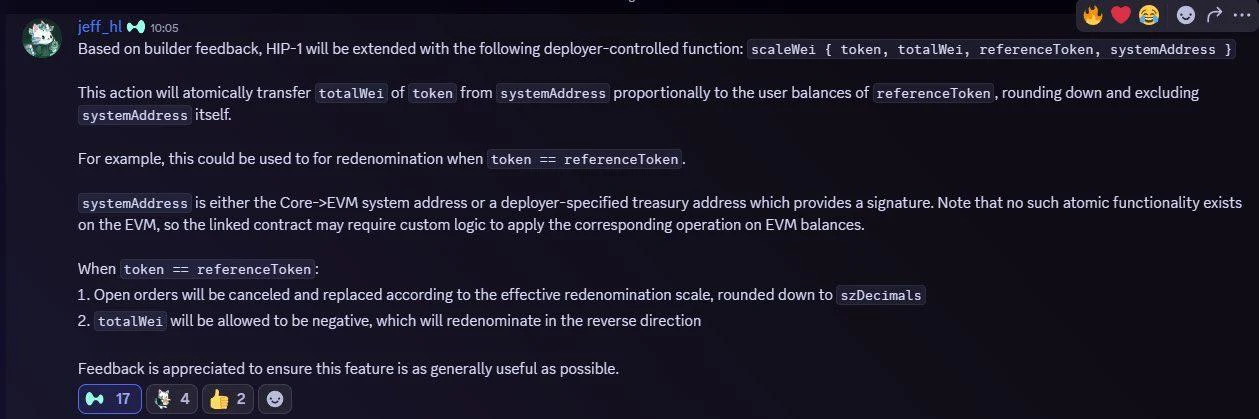
Source: Jeff Yan (jeff_hl) in the Hyperliquid Discord, August 2026, used under fair use for educational purposes
The function atomically transfers totalWei of token out of systemAddress and distributes it across every holder of referenceToken, in proportion to their balances, rounding down and excluding the system address itself.
Warning
scaleWei does not appear in Hyperliquid's HIP-1 documentation and no deployer can call it today. Feedback was explicitly requested "to ensure this feature is as generally useful as possible," which means the parameters can still move before it lands.Read the signature twice and the scope becomes clear. It is anchorTokenWei freed from genesis and made repeatable.
When token and referenceToken are different, you are paying holders of one asset in another asset. That is a dividend. It is also an airdrop, a revenue share, a staking distribution, or a rebate, depending on what you call it in your announcement.
When they are the same, the token is scaling against itself, which is a redenomination. A positive totalWei is a stock split. And because the proposal explicitly allows totalWei to be negative, the reverse works too: a reverse split. In that case open orders are canceled and replaced at the new effective scale, rounded down to szDecimals, so the book survives the operation instead of being left quoting stale prices. Call it repeatedly on a small scale and you have a rebasing token.
None of these require the user to do anything. No claim page, no gas, no deadline, no forgotten allocation sitting in a contract for two years.
The Caveat Everyone Skipped
The announcement says plainly that no equivalent atomic functionality exists on the EVM, and that a linked contract may need custom logic to apply the same operation to HyperEVM balances.
That matters more than it sounds. A third of live HIP-1 tokens are EVM-linked. If a token's supply is split between HyperCore balances and HyperEVM balances, and half of it is sitting in a lending market or an LP position on the EVM side, then a scaleWei call updates one half cleanly and leaves the other half to whatever the token's contract was built to handle. "No claiming required" is true on HyperCore. It is a design problem everywhere else.
Worth noting too: the tokens come out of a systemAddress the deployer funds, either the Core-to-EVM system address or a treasury address that signs off. This is redistribution of something that already exists, not minting. And because the split rounds down, the arithmetic leaves dust behind.
Why Equity Tokens Are the Obvious Use Case
Speculation about tokenized stocks followed the announcement within hours, and the logic holds up. Real shares do things tokens historically could not: they split, they reverse split, and they pay dividends. Every one of those is a balance-level operation applied to all holders at once, which is exactly the shape of scaleWei.
Hyperliquid now hosts ten share-backed equity tokens on spot. Those instruments will eventually face a corporate action, and the alternatives today are a claim contract or a manual redeployment. Whether this proposal was written with them in mind is not something the announcement says, and the function is general enough to be useful without them.
Start Trading Hyperliquid Spot
485 HIP-1 tokens, real order books, no AMM slippage. Join through our referral link for 4% off every trade, permanently.
Join HyperliquidHow to Read a HIP-1 Token Before You Buy It
The standard gives you more public information than most chains do. Use it.
Check the ticker is the token you think
Names are capped at six characters and are not required to be unique. Match the token index, not the label.
Look at the deployer fee share
Whether the team keeps the maximum or burns it is visible in the API and tells you something about how they think about holders.
Check whether the book is real
A hyperliquidity ladder is not the same as market maker interest. Look at actual depth and 24-hour volume before assuming you can exit. See the spot trading guide.
Find out if it is EVM-linked
A linked token has a second life on HyperEVM, which affects where its supply sits and how future protocol changes reach it.
Remember supply only falls
There is no inflation switch in HIP-1. If a project promises future emissions, ask which mechanism delivers them.
Important
scaleWei is an unshipped proposal and its final form may differ from what is described here. HIP-1 tokens include everything from major assets to worthless meme coins, and the standard makes no judgment about which is which. Do your own research and never trade more than you can afford to lose.Frequently Asked Questions
HIP-1 is Hyperliquid's native token standard, the spot equivalent of ERC-20 on Ethereum. A HIP-1 token lives directly in HyperCore's state rather than in a smart contract, and every one gets a native order book quoted against USDC the moment it is deployed. As of August 12, 2026 there are 485 HIP-1 tokens trading across 324 spot pairs.
You win a spot deployment slot in a 31-hour Dutch auction paid in HYPE, then submit a genesis transaction specifying the token name (six characters maximum), weiDecimals, szDecimals and max supply. After that you allocate genesis balances, optionally configure hyperliquidity, and set your deployer trading fee share. Only the first step is time-sensitive, and gas is not refundable if the deployment gets stuck.
scaleWei is a proposed extension to HIP-1, announced by Hyperliquid founder Jeff Yan in August 2026 and not yet shipped. It would let a deployer atomically distribute a token to holders of another token, proportional to their balances. That single function covers dividends, airdrops, stock splits, reverse splits and rebasing, all settled at the balance level with no claim transaction from the user.
Yes, up to half of the fees traders pay on their token's book. The share can only be ratcheted down after it is set, never back up, and whatever the deployer does not take is burned rather than paid to anyone else. In practice the choice is close to binary: of 485 tokens, 274 take the maximum and 202 take nothing, with only nine anywhere in between.
HIP-2 is an automated market making strategy built into Hyperliquid's block transition logic, with no operator and no off-chain component. A deployer seeds a price range at launch and the protocol maintains ladder orders roughly 0.3% apart, refreshed on any block at least three seconds after the last update. It exists so a brand-new HIP-1 token has a working book on day one.
Independent resource: Hyperliquid Guide is an independent, third-party resource operated by Concept211. It is not affiliated with, produced by, reviewed by or endorsed by Hyper Foundation, Hyperliquid Labs or any other Hyperliquid-ecosystem entity. "Hyperliquid" and related names and marks belong to their respective owners and are used here only to identify the platform this site documents. Read the full disclaimer.
Not advice: Nothing on this site is legal, tax, financial or investment advice. Descriptions of regulatory status, tax treatment and market availability are general information that varies by jurisdiction and changes over time. Confirm anything that matters to you with a qualified professional and against primary sources. Trading perpetual futures involves substantial risk of loss, and past performance does not indicate future results.
Disclosure: this site contains referral links. Signing up through the 4% lifetime fee discount link earns us a share of the trading fee Hyperliquid already charges, at no extra cost to you.
Ready to Start Trading?
Join Hyperliquid with our referral link and get a 4% lifetime fee discount. No KYC, no email - just connect your wallet and trade.
Start Trading - Save 4%