Felix Protocol Guide - DeFi Lending, feUSD Stablecoin & Perps on Hyperliquid
Table of Contents
- What Is Felix Protocol?
- feUSD: The CDP Stablecoin
- How Minting Works
- The Redemption Mechanism (Hard Peg)
- Collateral Types
- Vanilla Markets: Lending and Borrowing
- How Vanilla Markets Works
- Why Vanilla Markets Matters
- Stability Pools
- How Stability Pools Work
- What Yields Actually Look Like
- FLX Dex: HIP-3 Perpetual Futures
- What Markets Are Available
- USDhl: Fiat-Backed Stablecoin
- On-Chain Reserve Attestations
- How to Use Felix Protocol
- Step 1: Connect Your Wallet
- Step 2: Transfer Funds to HyperEVM
- Step 3: Choose Your Product
- Step 4: Monitor Your Positions
- Risks and Considerations
- Smart Contract Risk
- Collateral Volatility
- Liquidation Risk
- Redemption Risk
- Oracle and Price Feed Risk
- Felix in the Hyperliquid Ecosystem
 Felix
Felix
What Is Felix Protocol?
Felix Protocol is one of the largest DeFi protocols on HyperEVM. Its combined CDP and lending system crossed $1 billion in total value locked in late 2025 (per Felix's own announcement and DefiLlama); the live figure fluctuates with HYPE's price and borrowing demand, so check the current number on DefiLlama before quoting it. Felix is not a single product - it is a full financial suite built natively on Hyperliquid that spans lending, borrowing, stablecoins, and perpetual futures trading. As of June 2026 the suite has also expanded into tokenized U.S. stocks and ETFs through an Ondo Finance integration, putting real-world assets alongside its crypto-collateralized products.
At its core, Felix is a Liquity V2 fork - a collateralized debt position (CDP) protocol that lets you deposit crypto assets and mint feUSD, a dollar-pegged stablecoin. But Felix has expanded well beyond that original blueprint. The protocol now includes Vanilla Markets (Morpho-powered lending pools), FLX Dex (builder-deployed perpetual futures), and USDhl (a fiat-backed stablecoin through M0).
If you are active in the Hyperliquid ecosystem, Felix is one of the first protocols you will encounter. It provides the infrastructure for leveraging your HYPE holdings, earning yield on stablecoins, and accessing markets that do not exist anywhere else.
Worth separating from the outset: Felix competes with other HyperEVM protocols, not with HyperCore's own borrow and lend book. That one lives inside the exchange, is limited to Portfolio Margin accounts, prices on a fixed formula, and does not tokenize your position.
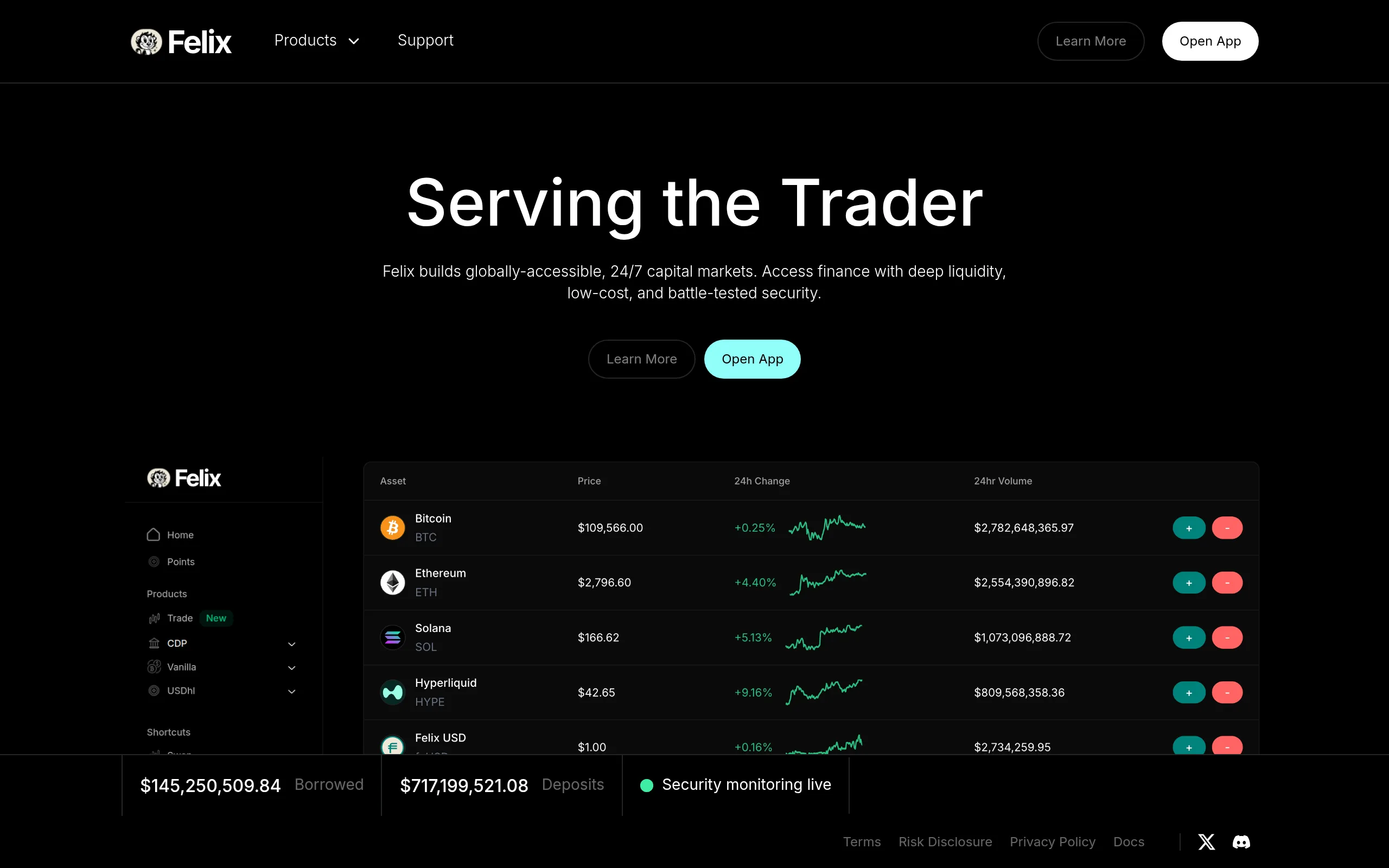
Start Using Felix Protocol
Mint feUSD, lend in Vanilla Markets, or trade perps on FLX Dex - all on Hyperliquid's native EVM layer. Get started with Felix Protocol today.
Open Felix ProtocolfeUSD: The CDP Stablecoin
feUSD is the flagship product of Felix Protocol. It is an overcollateralized stablecoin that you mint by locking up crypto collateral in a CDP - sometimes called a "Trove" in Liquity terminology. The design is straightforward: deposit collateral worth more than the feUSD you want to mint, and the protocol issues new feUSD tokens to your wallet.
How Minting Works
The process follows a simple flow:
- Deposit collateral - Choose from HYPE, UBTC, kHYPE (Kinetiq liquid staking token), or wstHYPE (wrapped staked HYPE).
- Set your interest rate - Unlike most lending protocols where rates are algorithmically determined, Felix lets borrowers choose their own interest rate. Lower rates mean cheaper borrowing but higher liquidation priority if the system needs to redeem collateral.
- Mint feUSD - The protocol issues feUSD against your collateral at a loan-to-value ratio of approximately 40%, meaning you need roughly $2.50 in collateral for every $1 of feUSD minted.
- Use feUSD - Deploy it across the Hyperliquid ecosystem: trade with it, provide liquidity, deposit into Stability Pools for yield, or use it as you would any other stablecoin.
Info
The ~40% LTV ratio means Felix is significantly more conservative than many lending protocols. This wide collateral buffer protects the system during market downturns but also means you need substantially more collateral per dollar borrowed compared to protocols that offer 75-80% LTV.
The Redemption Mechanism (Hard Peg)
What makes feUSD genuinely different from many DeFi stablecoins is its hard peg mechanism. Every feUSD token is always redeemable for exactly $1 worth of underlying collateral. This is not a soft peg maintained by market incentives alone - it is an arbitrage-enforced guarantee built into the smart contracts.
If feUSD ever trades below $1, arbitrageurs can buy it at the discounted price and redeem it for $1 of collateral, pocketing the difference. This buying pressure pushes feUSD back to peg. Conversely, if feUSD trades above $1, borrowers are incentivized to mint more (since each $1 of feUSD costs less than $1 to mint), increasing supply and bringing the price back down.
This dual-sided arbitrage mechanism is what Liquity V2 was designed around, and it has proven effective across multiple market conditions.
Collateral Types
Felix supports four collateral assets, each serving different user profiles:
| Collateral | Description | Use Case |
|---|---|---|
| HYPE | Hyperliquid's native token | Core collateral for HYPE holders who want liquidity without selling |
| UBTC | Bitcoin bridged onto Hyperliquid via Unit | Bitcoin exposure with feUSD borrowing |
| kHYPE |  Kinetiq liquid staking token Kinetiq liquid staking token | Earn staking yield while using HYPE as collateral |
| wstHYPE | Wrapped staked HYPE | Another liquid staking derivative for capital-efficient collateral |
Tip
Using kHYPE or wstHYPE as collateral is particularly capital-efficient because you continue earning staking rewards while your tokens are locked as collateral. Your collateral grows in value over time, effectively reducing your LTV ratio automatically.
Felix crossed $100 million in outstanding loans (per The Defiant), demonstrating significant real-world adoption of the CDP system. The protocol was audited by Three Sigma in July 2025 (case study), covering the core CDP contracts and redemption logic.
 Vanilla Markets: Lending and Borrowing
While CDPs are the original Felix product, Vanilla Markets has become the protocol's largest component by TVL - exceeding $750 million in deposits. Vanilla Markets is a set of variable-rate lending pools powered by Morpho, one of the most respected lending protocol designs in DeFi.
How Vanilla Markets Works
Vanilla Markets operates on a straightforward lending pool model:
- Suppliers deposit assets into pools and earn interest from borrowers. Rates are variable and determined by utilization - the more of a pool that is borrowed, the higher the interest rate.
- Borrowers deposit collateral and borrow against it. Unlike the CDP system where you mint feUSD, Vanilla Markets lets you borrow existing assets from pools.
- P2P Matching - Morpho's architecture includes peer-to-peer rate matching. When a supplier's rate and borrower's rate can be matched directly, both sides get a better deal than the pool rate - suppliers earn more, borrowers pay less.
This is a fundamentally different product from the CDP side of Felix. CDPs let you create new stablecoins. Vanilla Markets lets you borrow and lend existing assets in a traditional money-market structure.
Info
Think of it this way: if you want to borrow dollars against your HYPE, you have two paths on Felix. The CDP route mints new feUSD. The Vanilla Markets route borrows existing stablecoins from a pool of depositors. Different mechanics, different rate structures, different trade-offs.
Why Vanilla Markets Matters
The $750M+ in TVL tells the story. Variable-rate lending pools are the bread and butter of DeFi - they are how most users earn yield on idle assets and how most borrowers access leverage. Having this infrastructure natively on HyperEVM, without needing to bridge funds to Ethereum or Arbitrum, is a significant piece of the Hyperliquid ecosystem puzzle.
For users coming from Aave or Compound on other chains, Vanilla Markets will feel immediately familiar. The key difference is that everything operates on HyperEVM with sub-second finality and low gas costs.
Stability Pools
Stability Pools are Felix's mechanism for handling liquidations and distributing yield to feUSD holders. If you hold feUSD and want to earn passive income, Stability Pools are the primary way to do it.
How Stability Pools Work
The concept is simple:
- Deposit feUSD into a Stability Pool (each collateral type has its own pool - WHYPE, UBTC, kHYPE, wstHYPE).
- Earn yield from three sources: streaming borrower interest, a share of up-front borrowing fees, and event-driven liquidation gains.
- Withdraw your feUSD plus accumulated earnings at any time, with no lock-up.
When a borrower's collateral ratio falls below the liquidation threshold, the Stability Pool's feUSD is used to repay the debt, and the pool receives the borrower's collateral at a discount. This discount is the liquidation gain - it is essentially buying collateral below market price. Per Felix's documentation, the protocol routes roughly 75% of borrower interest to the Stability Pool tied to each collateral type, which is the steady, day-to-day component of the yield independent of any liquidation events.
The mix of yield sources means Stability Pool returns tend to spike during market volatility - exactly when liquidations are most frequent. This creates a natural hedge: if you hold HYPE and are worried about a price drop, depositing feUSD into the Stability Pool means you earn more precisely when HYPE prices are falling and liquidations are triggering.
What Yields Actually Look Like
Stability Pool APY is a moving target - it rises with borrowing demand and spikes during liquidation cascades, then settles back during calm periods. As of June 2026, the WHYPE Stability Pool was paying around 4.7% APY per DefiLlama's yield tracker, with the algorithm projecting it would hold above roughly 3.8% over the following four weeks. That is a real come-down from the double-digit prints (10%+) the pools showed in early 2025 when feUSD borrowing was new and demand outstripped supply - a normal maturation as TVL grew and rates compressed. Treat any single figure as a snapshot: check the live number on Felix's earn page before depositing.
In practice, depositing and withdrawing feel like any other HyperEVM money-market action - approve feUSD, deposit, and the position starts accruing on the next block; withdrawals settle in seconds with no queue, since the pool isn't lending out your feUSD the way a utilization-based pool would. The thing worth watching is that during liquidation events part of your feUSD balance is swapped into the collateral asset (HYPE, UBTC, etc.) at a discount - so after a volatile stretch you may find your "feUSD" deposit is now partly HYPE. That is the design working as intended, not a bug, but it does mean the position carries some collateral price exposure rather than being pure stablecoin yield. feUSD itself held its $1 peg tightly through the HYPE drawdowns this cycle, with the redemption arbitrage keeping deviations to fractions of a cent on-chain.
Earn Yield on feUSD in Stability Pools
Deposit feUSD to earn from borrower interest and liquidation gains. Felix Protocol's Stability Pools offer dual-source yield on Hyperliquid's native EVM layer.
Explore Felix Stability Pools FLX Dex: HIP-3 Perpetual Futures
FLX Dex is Felix's expansion into perpetual futures trading, built using Hyperliquid's HIP-3 builder code system. HIP-3 allows third-party builders to deploy their own perpetual futures markets on Hyperliquid's infrastructure, and Felix has used this to launch 14 markets spanning asset classes you will not find on most crypto exchanges.
What Markets Are Available
FLX Dex markets include:
- Equities - Perpetual contracts tracking major stock prices. For a deep dive on equity perps, see our equity perps guide.
- Commodities - Exposure to physical commodity prices through perpetual contracts. Our commodity perps guide covers this category in detail.
- Crypto - Additional cryptocurrency markets beyond what Hyperliquid's core order book offers.
All 14 markets are builder-deployed, meaning they run on Hyperliquid's native order book infrastructure with the same sub-second finality and deep liquidity as the core platform. The key difference is that FLX (as the builder) sets the fee structure and market parameters. With 14 markets live, Felix has already gone well past the three free deployment slots — every additional market past slot three was won in a HIP-3 Dutch auction.
Tip
If you are new to perpetual futures, start with our leverage trading guide to understand the mechanics before trading on FLX Dex or any perps platform.
FLX Dex is still the newest piece of the Felix suite, but it represents an interesting strategic direction - a DeFi protocol that started with lending and stablecoins expanding into derivatives trading using Hyperliquid's native infrastructure.
USDhl: Fiat-Backed Stablecoin
USDhl is Felix's fiat-backed stablecoin, created in partnership with M0 - a protocol that issues wholesale dollars backed by U.S. Treasury bills. This is a fundamentally different product from feUSD.
Where feUSD is a crypto-collateralized stablecoin (minted against HYPE, UBTC, etc.), USDhl is backed by real-world assets - specifically T-bill-backed wholesale dollars issued by M0. This means USDhl's backing does not fluctuate with crypto market prices.
On-Chain Reserve Attestations
One of USDhl's distinguishing features is on-chain reserve attestations. Rather than relying on periodic audit reports (which is how most fiat-backed stablecoins handle transparency), USDhl provides cryptographic proof of its reserves directly on-chain. This allows anyone to verify, at any time, that USDhl is fully backed.
This is worth comparing to the broader stablecoin landscape on Hyperliquid. The ecosystem now has USDH (Hyperliquid's native aligned stablecoin backed by Treasuries via BlackRock and Superstate), feUSD (Felix's crypto-collateralized stablecoin), and USDhl (Felix's fiat-backed stablecoin via M0). Each serves a different purpose and carries different risk profiles.
Info
USDhl and feUSD are complementary, not competing. feUSD is for users who want to borrow against crypto collateral. USDhl is for users who want a fiat-backed stablecoin with on-chain transparency. Felix offers both because different use cases demand different designs.
How to Use Felix Protocol
Getting started with Felix requires a funded wallet on HyperEVM. If you have not set up your Hyperliquid account yet, follow our deposit guide and beginner guide first.
1Connect Your Wallet
Navigate to Felix Protocol and connect your wallet. Felix supports standard EVM wallets ( MetaMask,
  Rabby, etc.) connected to HyperEVM. Make sure your wallet is set to the Hyperliquid EVM network.
2Transfer Funds to HyperEVM
If your funds are on HyperCore (the trading side), you need to transfer them to HyperEVM. In Hyperliquid's interface, use the transfer function to move HYPE or other assets from your trading account to your HyperEVM wallet address.
3Choose Your Product
Felix offers multiple paths depending on your goal:
- Want to borrow stablecoins against HYPE? Open a CDP and mint feUSD. Navigate to the "Borrow" section, select your collateral type, deposit your assets, set your interest rate, and mint feUSD.
- Want to earn yield on idle assets? Go to Vanilla Markets and supply assets to lending pools. You will earn variable interest from borrowers.
- Want yield on feUSD specifically? Deposit feUSD into a Stability Pool to earn from borrower interest and liquidation gains.
- Want to trade perps? Head to FLX Dex to access the 14 builder-deployed markets.
4Monitor Your Positions
If you have open CDPs, monitor your collateral ratio regularly. Market volatility can push your LTV toward liquidation thresholds. Felix provides a dashboard showing all your positions, current collateral ratios, and proximity to liquidation.
Warning
Liquidation on Felix is not gradual - if your collateral ratio falls below the threshold, your entire position can be liquidated. The Stability Pool absorbs your debt and receives your collateral. Set up price alerts for your collateral assets and maintain a healthy buffer above the minimum ratio.
New to Hyperliquid?
Before using Felix or any HyperEVM protocol, you need a funded Hyperliquid account. Sign up with our referral code for a 4% lifetime discount on all trading fees.
Get Started with 4% Off FeesRisks and Considerations
Felix Protocol has strong fundamentals - $1B+ TVL, a battle-tested Liquity V2 design, and a Three Sigma audit. But no DeFi protocol is risk-free. Here is what you should understand before committing capital.
Smart Contract Risk
Felix is a Liquity V2 fork, which means it inherits a well-audited codebase, but the fork itself introduces changes that may contain undiscovered vulnerabilities. The Three Sigma audit (July 2025) covers the core contracts, but audits are not guarantees - they reduce risk, they do not eliminate it. Vanilla Markets adds Morpho's smart contract surface area as an additional dependency.
Collateral Volatility
HYPE, UBTC, kHYPE, and wstHYPE are all volatile crypto assets. A sharp drawdown in collateral prices can push CDPs toward liquidation faster than users can react, especially during flash crashes or periods of extreme volatility. The ~40% LTV provides a significant buffer, but crypto markets have historically produced drawdowns that can blow through even conservative ratios in hours.
Liquidation Risk
If your CDP's collateral value drops below the liquidation threshold, you lose your collateral. Unlike some protocols that offer partial liquidations, the Liquity V2 design can liquidate entire positions. The Stability Pool mechanism is efficient but unforgiving.
Redemption Risk
The feUSD redemption mechanism means that borrowers with the lowest interest rates get redeemed first. If you set a very low interest rate to minimize costs, your collateral may be partially redeemed (returned to you minus the debt portion) even if your LTV is healthy. This is a feature of the system, not a bug - it maintains the peg - but it can be surprising to new users.
Oracle and Price Feed Risk
CDP protocols depend on accurate price feeds for collateral valuation. If the oracle feeding HYPE or UBTC prices to Felix delivers incorrect data - due to manipulation, network issues, or oracle downtime - liquidations could trigger incorrectly or fail to trigger when they should. This is an inherent risk in all CDP and lending protocols.
Felix in the Hyperliquid Ecosystem
Felix occupies a central position in the HyperEVM DeFi stack. As the #2 protocol by TVL, it provides critical infrastructure that other protocols and users depend on:
- feUSD acts as a native stablecoin within the HyperEVM DeFi ecosystem, serving as a trading pair, liquidity pool asset, and yield-bearing deposit.
- Vanilla Markets provides the lending and borrowing infrastructure that enables leverage across the ecosystem.
- FLX Dex expands the range of tradeable markets beyond what Hyperliquid's core order book offers, using the HIP-3 builder code framework.
- USDhl adds a fiat-backed stablecoin option alongside feUSD, giving users multiple stablecoin choices with different risk profiles. (Hyperliquid's original native stablecoin, USDH, has since sunset under AQAv2.)
The protocol's breadth is unusual for DeFi on any chain - most protocols focus on one vertical. Felix's strategy of combining CDPs, lending pools, perps, and fiat-backed stablecoins under one roof mirrors the "super app" approach that Hyperliquid itself takes to exchange design.
For traders who are active on Hyperliquid's core platform, Felix provides the tools to put idle HYPE to work without leaving the ecosystem. Deposit HYPE, mint feUSD, earn yield in Stability Pools, or supply to Vanilla Markets - all without bridging to another chain. For a step-by-step walkthrough of supplying, borrowing, and Stability Pool strategies, see our lending and borrowing guide. To see how Felix lending compares against HLP, community vaults, and other yield options, check our guide to earning USDC on Hyperliquid.
Try Felix Protocol on HyperEVMFrequently Asked Questions
Felix Protocol is one of the largest DeFi protocols on HyperEVM; its combined CDP and lending system crossed $1 billion in total value locked in late 2025, per DefiLlama and Felix's own figures, though the live number fluctuates with HYPE's price and demand. It is a suite of financial products including a CDP stablecoin (feUSD), Morpho-powered lending pools (Vanilla Markets), HIP-3 perpetual futures (FLX Dex), tokenized stocks and ETFs via Ondo Finance, and the fiat-backed USDhl stablecoin. It is built natively on Hyperliquid's EVM layer.
To borrow on Felix, connect your wallet to usefelix.xyz, deposit collateral (HYPE, UBTC, kHYPE, or wstHYPE), and mint feUSD against it. You set your own interest rate and maintain a loan-to-value ratio around 40%. Alternatively, you can use Vanilla Markets for variable-rate borrowing from lending pools.
feUSD is Felix Protocol's overcollateralized stablecoin minted through collateralized debt positions (CDPs). It is always redeemable for $1 worth of collateral, which creates a hard price peg. feUSD is backed by HYPE, UBTC, kHYPE, and wstHYPE deposits on HyperEVM.
Felix Protocol was audited by Three Sigma in July 2025 and is a fork of Liquity V2, a battle-tested CDP design. Its combined system has crossed $1 billion in TVL and $100 million in outstanding loans. That said, all DeFi protocols carry smart contract risk, collateral volatility risk, and liquidation risk. Users should understand these before depositing funds.
Felix accepts four collateral types for minting feUSD: HYPE (Hyperliquid's native token), UBTC (wrapped Bitcoin on HyperEVM), kHYPE (Kinetiq liquid staking token), and wstHYPE (wrapped staked HYPE). Each collateral type has its own stability pool and risk parameters.
Independent resource: Hyperliquid Guide is an independent, third-party resource operated by Concept211. It is not affiliated with, produced by, reviewed by or endorsed by Hyper Foundation, Hyperliquid Labs or any other Hyperliquid-ecosystem entity. "Hyperliquid" and related names and marks belong to their respective owners and are used here only to identify the platform this site documents. Read the full disclaimer.
Not advice: Nothing on this site is legal, tax, financial or investment advice. Descriptions of regulatory status, tax treatment and market availability are general information that varies by jurisdiction and changes over time. Confirm anything that matters to you with a qualified professional and against primary sources. Trading perpetual futures involves substantial risk of loss, and past performance does not indicate future results.
Disclosure: this site contains referral links. Signing up through the 4% lifetime fee discount link earns us a share of the trading fee Hyperliquid already charges, at no extra cost to you.
Ready to Start Trading?
Join Hyperliquid with our referral link and get a 4% lifetime fee discount. No KYC, no email - just connect your wallet and trade.
Start Trading - Save 4%