Hyperliquid Auctions Explained: How Spot Tokens and Perp Markets Get Listed
Table of Contents
- The Dutch Auction Mechanic in One Paragraph
- HIP-1: Spot Token Auctions
- What the Winner Locks In
- Fee Splits
- Payment in HYPE (Since May 2025)
- Recent and Notable Winners
- HIP-3: Perp Market Slot Auctions
- The First Three Markets Are Free
- Same Hyperparameters as HIP-1
- Reserve Slots for Deployers
- Fee Split for the Deployer
- Why the Auction Exists
- Spam Resistance
- Value Accrual to HYPE
- Self-Pricing
- Where to Track Auctions Live
- perptickers.com
- Hyperliquid API
- What This Means for Traders
 Hyperliquid
Hyperliquid does not have a listing team. There is no application form, no business development pipeline, and no committee that decides which tokens get a spot market or which perpetual contracts go live. Every new ticker on the platform — whether it is a spot token or a builder-deployed perp — comes into existence through the same mechanism: a 31-hour Dutch auction open to anyone with enough HYPE to bid.
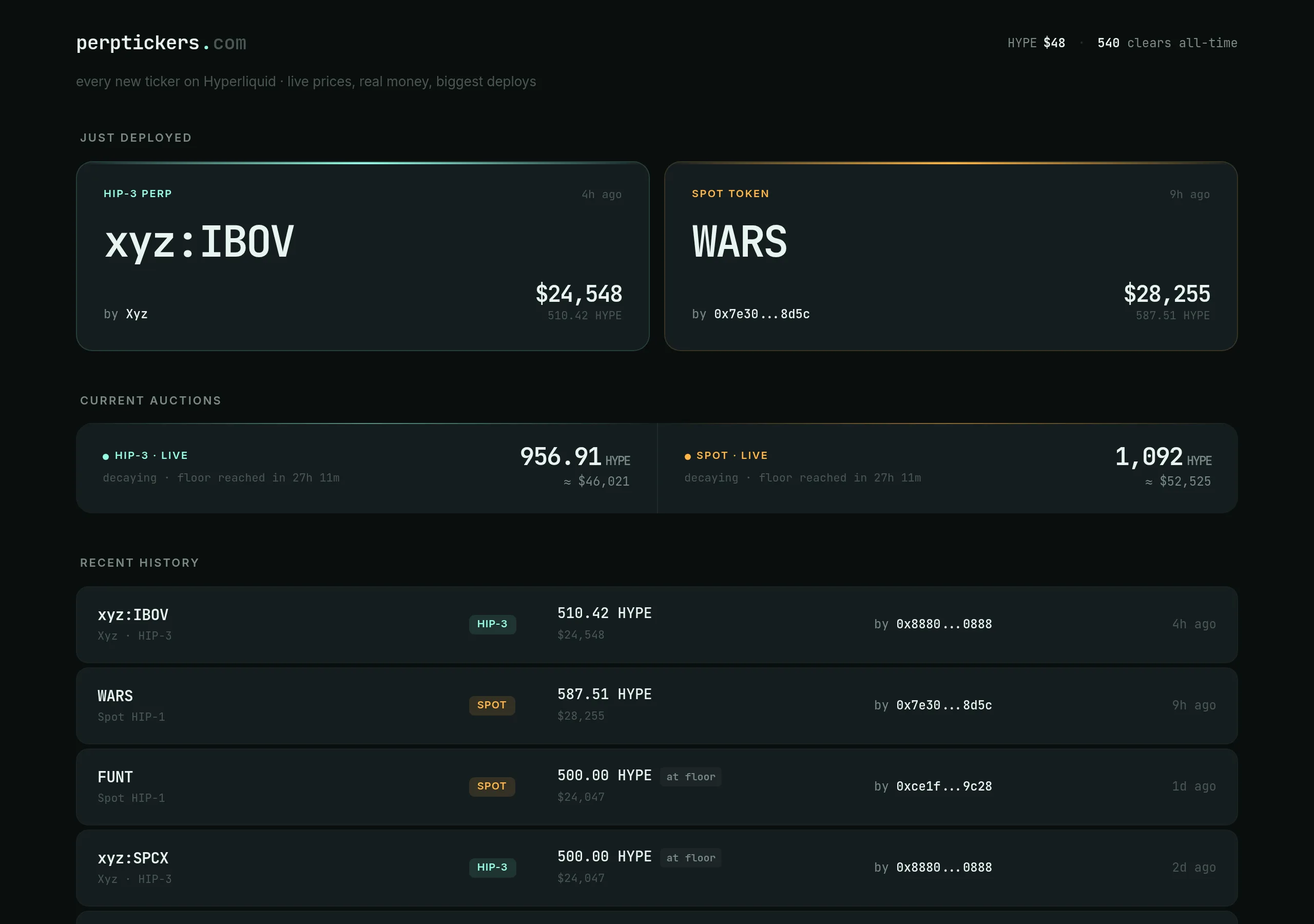
Source: perptickers.com — live tracker showing both auction queues and recent winners
This is a fundamentally different listing model from every other major exchange. Binance, Coinbase, and OKX run private listing pipelines where teams pitch, negotiate, and pay opaque fees. Hyperliquid puts the entire process on-chain and lets the market decide what gets listed and at what price. The result is one of the most transparent — and most economically meaningful — primitives on the protocol.
The Dutch Auction Mechanic in One Paragraph
A Dutch auction starts at a high price and decays over time until someone is willing to pay. The Hyperliquid version runs for 31 hours per slot. The starting price for each auction is set to 2x the previous winning bid, decaying linearly down to a hard floor of 500 HYPE. The first bidder to accept the current price wins, the auction immediately ends, and a new one starts at 2x whatever just cleared. If the auction reaches its 31-hour deadline without a bidder, it ends at the floor and the next auction starts at 500 HYPE.
This design is self-pricing: heavy demand pushes the next start price up; weak demand pulls it back down to the floor. There is no fixed price list. The mechanism alone determines what a deployment is worth at any moment.
HIP-1: Spot Token Auctions
HIP-1 is the Hyperliquid Improvement Proposal that defines how spot tokens are created. It was the first of the HIP standards and has been live since the protocol launched its spot market in early 2024. This page covers the auction; the HIP-1 explainer covers what the winner does with the slot afterward, including hyperliquidity, fee shares, and the proposed scaleWei extension.
What the Winner Locks In
When a bidder wins a HIP-1 auction, they pay the current auction price in HYPE and immediately receive the rights to deploy a single token. The auction itself only fixes a small but critical set of parameters:
- Ticker name — up to 6 characters. Names are not required to be unique at the protocol level; the unique identifier is the on-chain hash, not the label.
szDecimals— the smallest tradable order size (in powers of ten).weiDecimals— the conversion between display units and the smallest indivisible unit. Must satisfyszDecimals + 5 <= weiDecimals.- A globally unique on-chain hash that identifies the token forever.
After the auction is won, the deployer has unlimited time to complete the rest of the deployment — setting maxSupply, distributing the initial balance, configuring the trading fee share, and seeding liquidity. The 31-hour auction window only applies to the gas-bid step itself.
Fee Splits
The protocol takes a 100% fee share on the quote asset side of every spot pair. For native USDC pairs, all spot trading fees on the quote side route to the Assistance Fund — the on-chain treasury that funds HYPE buybacks. Quote-token deployers cannot configure their fee share.
On the base asset side, the deployer keeps up to 100% of the fee share by default and can configure any lower percentage. Whatever they do not claim is burned. This is one of the more underrated economic levers in HIP-1: a deployer who anticipates real spot volume on their token can capture meaningful long-term revenue, but the bias is toward burning supply rather than enriching teams who never delivered.
Payment in HYPE (Since May 2025)
Until May 22, 2025, auctions were settled in USDC. That changed when the protocol switched the deployment gas token to HYPE, and the change had two important effects:
- Every winning bid is burned, making auction proceeds one of the largest structural sinks for HYPE supply.
- Pricing is now denominated in HYPE units, so the dollar cost of a listing moves with the HYPE market price. With HYPE around $48, the 500 HYPE floor equals roughly $24,000, while a 1,000 HYPE auction clears around $48,000.
In the USDC era, auctions had peaked dramatically — SOVRN cleared at $260K, MON at over $487K, and the implied starting prices for the following auctions ran near $1M. The post-May 2025 HYPE-denominated auctions have generally cleared closer to the 500 HYPE floor, but the underlying mechanic — Dutch decay, 2x reset — is unchanged.
Info
Recent and Notable Winners
The HIP-1 queue has cleared 540+ tickers all-time as of May 2026. Recent activity from the perptickers dashboard:
| Ticker | Winning Bid | Approx. USD |
|---|---|---|
| WARS | 587.51 HYPE | $28,255 |
| FUNT | 500.00 HYPE (at floor) | $24,000 |
| MON (USDC era) | — | $487,936 |
| SOVRN (USDC era) | — | $260,000 |
The contrast between the USDC-era peaks and the current HYPE-era clears tells a clear story: in 2024, when memecoin and asset deployments on Hyperliquid were the hottest narrative in DeFi, the market would pay hundreds of thousands of dollars for a 6-character ticker. As the listing universe has matured and saturated, auctions now clear close to the floor — but every cleared auction still burns the deployment cost out of HYPE supply forever.
HIP-3: Perp Market Slot Auctions
The second auction queue is governed by HIP-3, the standard that enables permissionless deployment of perpetual futures dexs on top of HyperCore. The auction mechanic here is more nuanced because HIP-3 introduces two-tier access.
The First Three Markets Are Free
A HIP-3 deployer — anyone who has staked the required 500,000 HYPE to activate a builder code — can deploy their first three perpetual markets without paying any auction fee. This is a deliberate design choice: it lowers the marginal cost of bootstrapping a new dex enough that builders can launch a coherent product (for example, three flagship equity perps) without immediately competing in the auction queue.
After those first three slots, every additional market requires winning a slot in the HIP-3 auction queue.
Same Hyperparameters as HIP-1
The HIP-3 auction queue uses exactly the same parameters as HIP-1: 31-hour duration, 500 HYPE floor, 2x last-winner starting price, linear decay. The two queues run independently — a HIP-1 winner has no effect on the next HIP-3 starting price and vice versa — but the decay curves look identical.
This is by design. Sharing hyperparameters means traders, builders, and observers only need to understand one mechanic to understand both queues. It also means a hot HIP-3 cycle (lots of new equity or commodity perps coming online) cannot artificially inflate spot listing costs, and vice versa.
As of this writing, the live HIP-3 auction is sitting at 956.91 HYPE (~$46,021) decaying from a 1,020.85 HYPE start. The live HIP-1 auction is at 1,092 HYPE (~$52,525) decaying from 1,175 HYPE. Both have roughly 27 hours left until they hit floor.
Reserve Slots for Deployers
To reduce friction for builders who need predictable timing, each HIP-3 deployer receives 7 reserve slots that let them deploy a market at the current auction price without waiting for the queue. This is meaningful for builders who want to launch a market at a specific moment — for example, Felix Protocol deploying a new commodity perp ahead of a known economic event, or trade.xyz launching a new equity perp the morning of an earnings release.
Reserve slots still cost the auction price — they just bypass the timer.
Fee Split for the Deployer
HIP-3 deployers keep up to a 50% share of trading fees on their markets, set through a per-asset deployer fee scale that ranges from 0.1 to 3. At a scale of 1.0, the setting almost every live builder uses, user-facing fees on builder-deployed perps are 2x the rate of validator-operated perps (3 bps maker / 9 bps taker base) and the deployer keeps half. Below 1.0 the trader pays less and the deployer keeps proportionally less. Either way the protocol-level fee — and therefore the HYPE buyback flow — is never smaller than it would be on a native perp.
Info
Trade Builder-Deployed Perps with a 4% Discount
HIP-3 markets unlock asset classes you cannot find anywhere else — stocks, commodities, FX, even pre-IPO names. Sign up with our referral code and get a permanent 4% off all Hyperliquid trading fees, including HIP-3 markets.
Join Hyperliquid with 4% OffWhy the Auction Exists
The auction is not just a listing mechanism. It is a sybil-resistance layer with a side effect of routing significant value to HYPE holders.
Spam Resistance
Without a cost to deploy, the ticker namespace would be flooded. Even at the 500 HYPE floor (~$24K), deploying a token requires meaningful capital commitment. This is enough to deter spam and low-effort projects while keeping the door open to anyone with a serious deployment in mind. There is no gatekeeper deciding who "deserves" to list — only the market deciding what it is worth right now.
Value Accrual to HYPE
Every HYPE token paid in auction is burned, not redistributed. With 540+ all-time HIP-1 clears averaging well above the floor for much of the auction's history, the cumulative burn from listing gas alone runs into tens of thousands of HYPE — pure deflationary pressure on supply that does not appear in fee revenue or buyback figures.
This is on top of the other HYPE sinks: trading fee buybacks via the Assistance Fund, staking lockups, and the aligned quote asset mechanism for USDH-quoted spot pairs.
Self-Pricing
The 2x reset rule makes the auction a continuous price-discovery process. If a market is willing to pay $500K for a deployment, the next auction starts at $1M — high enough that all but the most premium use cases will wait for decay. If a market is only willing to pay the floor, the next auction starts at $24K and likely clears at floor again. The system rebalances automatically without protocol intervention.
Where to Track Auctions Live
There are two practical ways to watch the auction queues:
perptickers.com
perptickers.com is the cleanest live dashboard. It shows:
- The current HIP-1 (spot) and HIP-3 (perp) auction prices in both HYPE and USD
- Time remaining until each auction hits floor
- A "just deployed" panel showing the most recent winner on each queue
- Recent history (40+ entries) showing winning bids and deployer addresses
- All-time clear count (540+ as of writing)
It is built as a React SPA that pulls directly from the Hyperliquid API, so the data is real-time.
Hyperliquid API
For programmatic access, the Hyperliquid info API exposes the auction state directly:
# HIP-1 spot deployment auction
curl -X POST https://api.hyperliquid.xyz/info \
  -H "Content-Type: application/json" \
  -d '{"type":"spotDeployState","user":"0x0000000000000000000000000000000000000000"}'

# HIP-3 perp deployment auction
curl -X POST https://api.hyperliquid.xyz/info \
  -H "Content-Type: application/json" \
  -d '{"type":"perpDeployAuctionStatus"}'
Both endpoints return the same shape: startGas, currentGas, startTimeSeconds, and durationSeconds. You can compute the live price client-side by linear interpolation from startGas to the 500 HYPE floor over durationSeconds from startTimeSeconds.
Tip
What This Means for Traders
Even if you never bid in an auction, the auction queues are worth watching because they tell you something concrete about ecosystem activity:
- HIP-1 clears above the floor signal real demand for new spot token deployments. When you see a string of 600+ HYPE clears, there is genuine project deployment activity, which tends to coincide with broader Hyperliquid volume cycles.
- HIP-3 clears above the floor signal that builders are willing to pay for additional market slots beyond their first three. This is a leading indicator that HIP-3 dexs (Felix, trade.xyz, and others) are scaling their product surfaces.
- All-floor periods can mean either saturation (most useful tickers are already deployed) or quiet markets. The two are hard to distinguish without context, but extended periods at floor on both queues are unusual.
The auctions are also a good proxy for HYPE token sink rates. Every clear above the floor adds incremental burn on top of the regular fee-buyback flow and any staking inflows.
Start Trading on Hyperliquid
Whether you are eyeing a HIP-3 builder market or a freshly deployed spot ticker, sign up with our referral code for a permanent 4% fee discount across every market on the protocol.
Get 4% Off Trading FeesImportant
Frequently Asked Questions
Every new spot token on Hyperliquid is listed through a permissionless 31-hour Dutch auction defined by HIP-1. The starting price equals 2x the last winning bid (or 500 HYPE if the previous auction failed), then decays linearly toward a 500 HYPE floor. The first bidder to hit the current price wins the right to deploy the ticker. There is no listing committee, no application, and no approval — just whoever pays the auction price.
A Hyperliquid Dutch auction lasts 31 hours from start to floor. Both HIP-1 (spot tokens) and HIP-3 (perp market slots beyond the first three) use the same 31-hour duration, the same 500 HYPE floor, and the same 2x-last-winner starting price formula. The two auction queues run independently but share hyperparameters.
Cost depends on demand. The auction floor is 500 HYPE — currently around $24,000 with HYPE at $48. When demand is strong the price can clear well above the floor: recent winners have paid between 500 and 600 HYPE for spot tickers. Historically, when auctions were paid in USDC (before May 2025), peaks reached $480K+ for SOVRN and MON. Payments switched from USDC to HYPE in May 2025, and all HYPE paid for deployment is burned.
A HIP-1 winner locks in the token ticker name (up to 6 characters), the szDecimals and weiDecimals parameters, a globally unique on-chain hash, and the right to set their initial supply distribution and trading fee share on the asset. For HIP-3, the winner gets one additional perp market slot on a deployed dex — the right to spin up a new perpetual contract on top of an existing builder-deployed exchange.
perptickers.com is the most readable live tracker — it shows the current HIP-1 and HIP-3 auction prices, time remaining, recent winners, and historical clear data for both queues on a single dashboard. For raw data, the Hyperliquid info API exposes the auction state directly via the spotDeployState and perpDeployAuctionStatus endpoints.
Independent resource: Hyperliquid Guide is an independent, third-party resource operated by Concept211. It is not affiliated with, produced by, reviewed by or endorsed by Hyper Foundation, Hyperliquid Labs or any other Hyperliquid-ecosystem entity. "Hyperliquid" and related names and marks belong to their respective owners and are used here only to identify the platform this site documents. Read the full disclaimer.
Not advice: Nothing on this site is legal, tax, financial or investment advice. Descriptions of regulatory status, tax treatment and market availability are general information that varies by jurisdiction and changes over time. Confirm anything that matters to you with a qualified professional and against primary sources. Trading perpetual futures involves substantial risk of loss, and past performance does not indicate future results.
Disclosure: this site contains referral links. Signing up through the 4% lifetime fee discount link earns us a share of the trading fee Hyperliquid already charges, at no extra cost to you.
Ready to Start Trading?
Join Hyperliquid with our referral link and get a 4% lifetime fee discount. No KYC, no email - just connect your wallet and trade.
Start Trading - Save 4%