Liquid Staking on Hyperliquid: kHYPE, wstHYPE & Kinetiq Guide
Table of Contents
- What Is Liquid Staking on Hyperliquid?
- How Native HYPE Staking Works
- The Basics
- Reward Rate Mechanics
- Validator Requirements
- Kinetiq and kHYPE
- How kHYPE Works
- Automated Validator Management
- Unstaking from Kinetiq
- wstHYPE: Wrapped Staked HYPE
- How wstHYPE Differs from kHYPE
- Where wstHYPE Is Used
- Why Liquid Staking Matters for DeFi
- The Capital Efficiency Argument
- Real Use Cases on Hyperliquid
- How to Stake with Kinetiq: Step-by-Step
- Prerequisites
- Step 1: Navigate to Kinetiq
- Step 2: Connect Your Wallet
- Step 3: Enter the Amount
- Step 4: Confirm the Transaction
- Step 5: Decide What to Do with kHYPE
- Using kHYPE in DeFi
- Felix Protocol: CDP Collateral
- Lending and Borrowing
- Liquidity Provision
- Yield Tokenization
- Risks of Liquid Staking on Hyperliquid
- Smart Contract Risk
- Slashing Risk
- Exchange Rate Risk (De-peg)
- Composability Risk
- Validator Concentration
- Who Should Use Liquid Staking?
 Kinetiq
What Is Liquid Staking on Hyperliquid?
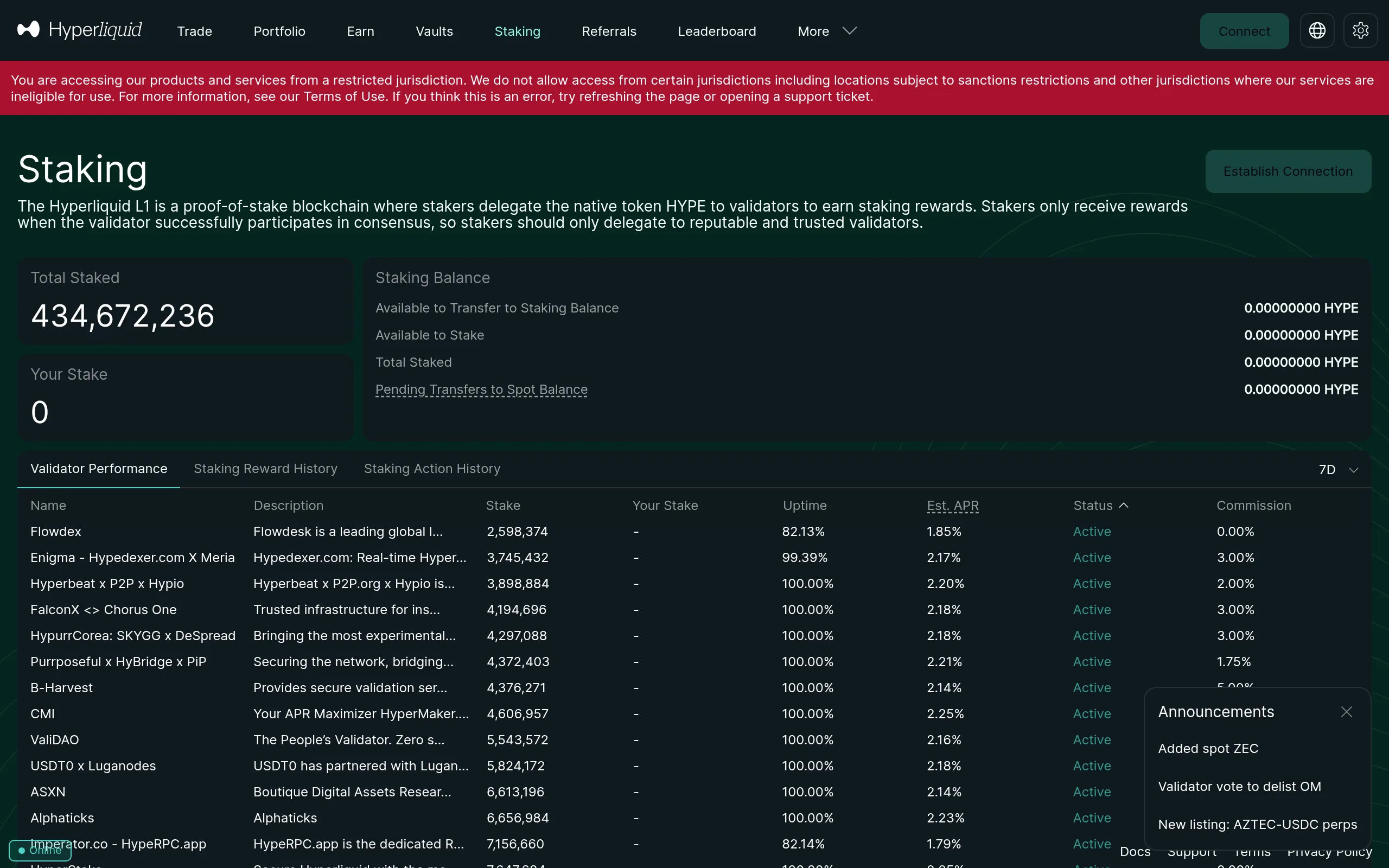
Staking HYPE secures the Hyperliquid network and earns you rewards - roughly 2.37% APY at current staking levels. The catch is that natively staked HYPE is locked. You cannot trade it, use it as collateral, or deploy it into DeFi protocols while it is earning validator rewards. And when you want it back, you wait seven days.
Liquid staking eliminates that trade-off. Instead of delegating directly to a validator and locking your tokens, you deposit HYPE into a liquid staking protocol and receive a derivative token - a liquid staking token (LST) - that represents your staked position. That LST is freely transferable, tradeable, and composable with DeFi protocols across HyperEVM. Meanwhile, the underlying HYPE continues earning staking rewards as if you had delegated it yourself.
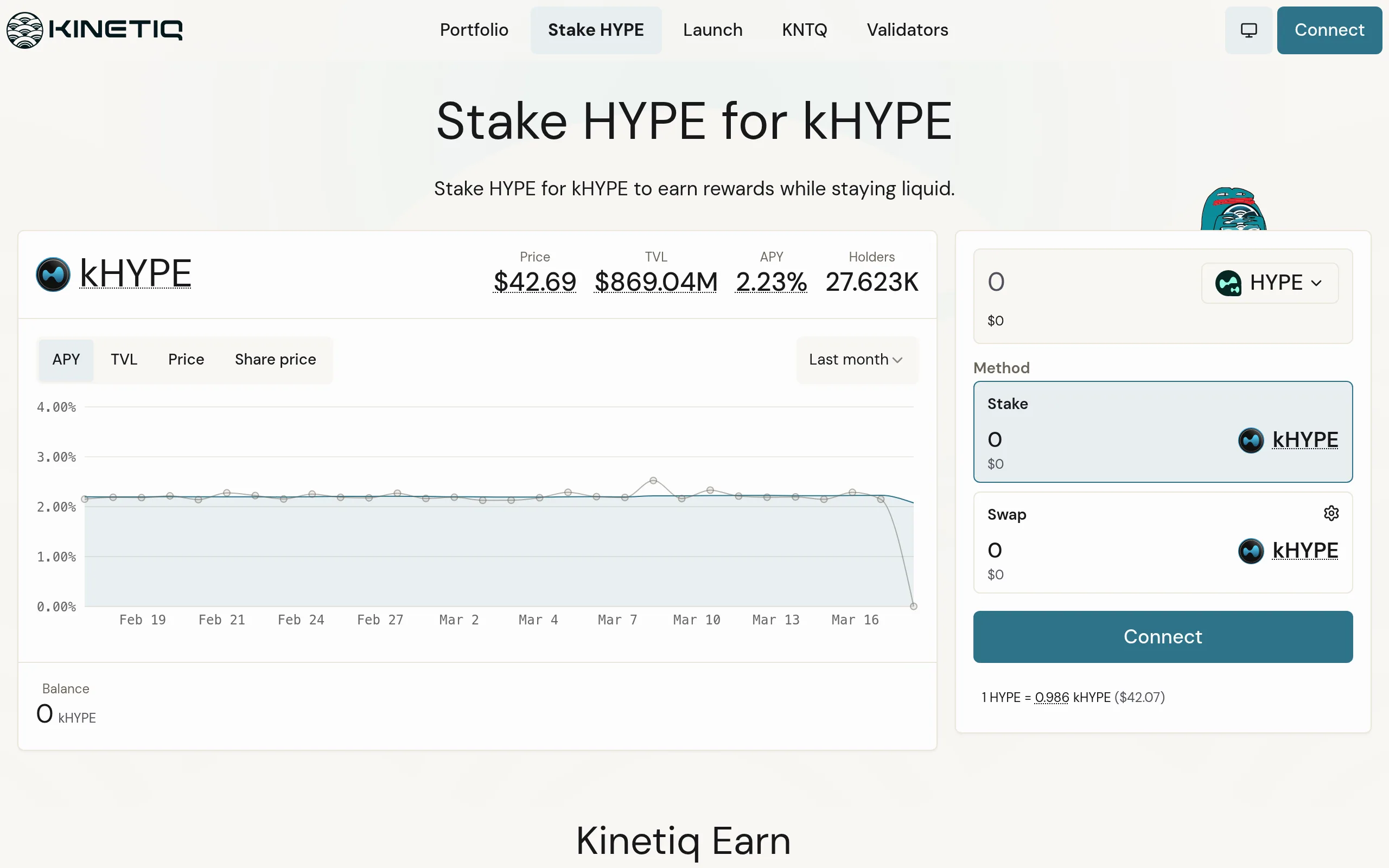
On Hyperliquid, the dominant liquid staking protocol is Kinetiq, and its LST is called kHYPE. With over $639 million in TVL and 82.5% market share of Hyperliquid's liquid staking ecosystem, Kinetiq is the standard that most DeFi protocols on HyperEVM integrate with.
How Native HYPE Staking Works
Before diving into liquid staking, it helps to understand the native staking mechanism it builds on. HYPE is the native token of Hyperliquid's Layer 1 blockchain, which uses a delegated proof-of-stake consensus model called HyperBFT.
The Basics
Native staking works as follows:
- Transfer HYPE to your staking account - Move tokens from your spot account to your staking account within the Hyperliquid interface.
- Delegate to validators - Choose one or more validators and delegate your HYPE to them. You can split your stake across multiple validators.
- Earn rewards - Rewards accrue every minute and are distributed daily. They automatically compound through redelegation, meaning your staked balance grows without manual intervention.
- Unstake when ready - When you want your HYPE back, you initiate an undelegation. There is a 7-day unstaking queue before tokens return to your spot account, plus a 1-day lockup on individual delegations before they can be undelegated.
Reward Rate Mechanics
The HYPE staking reward rate follows a formula inspired by Ethereum: the annual yield is inversely proportional to the square root of total HYPE staked. At approximately 400 million HYPE staked across the network, this produces an annualized rate of ~2.37%. As more HYPE enters staking, the per-token yield decreases; as HYPE leaves staking, the per-token yield increases. Rewards are funded from the future emissions reserve, which accounts for roughly 38.888% of the total 1 billion HYPE supply.
Validator Requirements
Active validators must maintain a 10,000 HYPE self-delegation locked for one year. If a validator's self-delegation drops below this threshold, they enter "undelegate-only mode" - existing delegators can leave but no new delegations are accepted. Validators may charge commissions on delegator rewards, capped at 1% for new rate increases.
Info
Each address can have up to 5 pending withdrawal requests at a time during the 7-day unstaking queue. Plan your undelegations accordingly if you need to exit multiple validator positions.
Kinetiq and kHYPE
Kinetiq is the leading liquid staking protocol on Hyperliquid. It accepts HYPE deposits, delegates them to high-performing validators, and issues kHYPE - a liquid token that represents your staked position plus accumulated rewards.
How kHYPE Works
The mechanics are straightforward:
- Deposit HYPE - You send HYPE to Kinetiq's StakingManager contract. The minimum deposit is 5 HYPE.
- Receive kHYPE - The contract mints kHYPE at the current exchange rate. This rate is not 1:1 - it reflects the accumulated rewards in the system. If 1 kHYPE is currently worth 1.03 HYPE, depositing 10.3 HYPE gets you 10 kHYPE.
- Rewards accrue automatically - As validators earn rewards, the kHYPE-to-HYPE exchange rate increases. Your kHYPE balance stays constant, but each token becomes redeemable for more HYPE over time.
- Use kHYPE freely - Trade it, supply it as collateral on Felix Protocol, add it to liquidity pools, or hold it in your wallet.
This is a non-rebasing design. Unlike rebasing tokens (where the quantity in your wallet changes to reflect rewards), kHYPE keeps your balance constant and reflects yield through price appreciation. This makes it simpler for DeFi integrations and avoids potential tax complications that arise from changing token quantities.
Automated Validator Management
One of Kinetiq's key differentiators is its StakeHub system - an autonomous validator selection and management layer. Rather than requiring users to manually research and pick validators, StakeHub:
- Evaluates performance metrics including uptime, commission rates, and historical reliability
- Diversifies stake across multiple validators to reduce single-point-of-failure risk
- Continuously monitors validator behavior and automatically rebalances delegations if a validator underperforms
- Manages over 5% of the total HYPE network stake
This removes the operational burden of validator selection from users while maintaining the decentralization benefits of delegating across multiple validators.
Unstaking from Kinetiq
You have two options to exit your kHYPE position:
| Method | Timeline | Fee | When to Use |
|---|---|---|---|
| Direct unstaking | ~8-9 days (24-hour lock + ~7-day queue) | 0.10% | When you can wait and want the best rate |
| Market swap | Instant | Variable spread/slippage | When you need liquidity immediately |
Direct unstaking through Kinetiq follows the same unstaking queue as native HYPE staking, plus a 24-hour initial lock period. The 0.10% fee is deducted in kHYPE. Alternatively, you can swap kHYPE for HYPE instantly on decentralized exchanges, though you may face some spread depending on liquidity conditions.
Start Trading on Hyperliquid
Get access to 100+ perpetual futures markets with deep liquidity and low fees. Sign up with our referral link for a 4% lifetime discount on trading fees.
Get Started with 4% Off FeeswstHYPE: Wrapped Staked HYPE
Alongside kHYPE, you will encounter wstHYPE (wrapped staked HYPE) across the Hyperliquid DeFi ecosystem. wstHYPE is a wrapped version of staked HYPE designed for maximum DeFi compatibility.
How wstHYPE Differs from kHYPE
Both kHYPE and wstHYPE represent staked HYPE positions that earn the same underlying validator rewards. The distinction is in their token standard implementation:
- kHYPE is Kinetiq's native LST with a non-rebasing exchange rate model. It is the most widely held and traded liquid staking token on Hyperliquid.
- wstHYPE is a wrapped representation optimized for integration with DeFi protocols that require a standardized ERC-20 interface. Some protocols and smart contracts handle wrapped tokens more predictably than exchange-rate-based tokens.
In practice, both tokens serve the same fundamental purpose: they let you hold a liquid, yield-bearing representation of staked HYPE. The choice between them often depends on which token a specific DeFi protocol accepts.
Where wstHYPE Is Used
Felix Protocol accepts both kHYPE and wstHYPE as collateral for minting feUSD. Each collateral type has its own stability pool and risk parameters, along with dedicated price feeds (KHYPEPriceFeed and WSTHYPEPriceFeed) sourced through Redstone oracles. Both tokens are also found in lending pools, liquidity pairs, and other DeFi protocols across the Hyperliquid DeFi ecosystem.
Tip
If you are unsure which to use, start with kHYPE. It is the most liquid, most widely integrated, and most straightforward to acquire directly through Kinetiq. You can always wrap it to wstHYPE later if a specific protocol requires it.
Why Liquid Staking Matters for DeFi
Liquid staking is not just a convenience feature - it is a foundational DeFi primitive that unlocks capital efficiency across the entire Hyperliquid ecosystem.
The Capital Efficiency Argument
Without liquid staking, HYPE holders face a binary choice: stake for security rewards or use tokens in DeFi. With kHYPE, that choice disappears. Consider the math:
- Native staking only: Earn ~2.37% APY. Your HYPE is locked and unproductive beyond the base yield.
- Liquid staking + DeFi: Earn ~2.37% APY from staking plus whatever additional yield your kHYPE generates in DeFi - lending interest, liquidity pool fees, or leverage strategies.
This stacking of yield sources is called composability, and it is why liquid staking tokens have become the backbone of DeFi on every major blockchain.
Real Use Cases on Hyperliquid
The most practical application today is using kHYPE as collateral on Felix Protocol:
- Stake HYPE through Kinetiq - Receive kHYPE earning ~2.37% APY.
- Deposit kHYPE into Felix CDP - Mint feUSD (a dollar-pegged stablecoin) at ~40% loan-to-value.
- Deploy feUSD - Deposit into Stability Pools for additional yield, supply to lending markets, or use as trading capital.
The result: your HYPE is simultaneously securing the network (earning staking rewards), serving as collateral (enabling you to borrow), and the borrowed capital is itself generating yield. Three layers of productivity from a single asset.
Info
Using kHYPE as collateral on Felix is particularly elegant because staking rewards continuously increase the value of your collateral. Your loan-to-value ratio improves automatically over time without any action, giving you a growing safety buffer against liquidation.
There is also over $180 million in kHYPE collateral already deposited across DeFi protocols on HyperEVM, and Pendle saw $40 million in kHYPE TVL within weeks of launching its Hyperliquid integration. These are not theoretical use cases - they are live, battle-tested deployments.
How to Stake with Kinetiq: Step-by-Step
Prerequisites
- A Web3 wallet connected to HyperEVM (MetaMask, Rabby, or similar)
- HYPE tokens in your wallet (minimum 5 HYPE)
- A small amount of HYPE for gas fees on HyperEVM
If you are new to Hyperliquid, start with our beginner guide to set up your account and fund your wallet.
1Navigate to Kinetiq
Go to kinetiq.xyz/stake in your browser. This is the official staking interface. Verify the URL carefully - phishing sites targeting liquid staking protocols are common.
2Connect Your Wallet
Click "Connect Wallet" and authorize the connection from your wallet extension. Ensure you are connected to the HyperEVM network. If your wallet is not configured for HyperEVM, consult our HyperEVM guide for setup instructions.
3Enter the Amount
Input the amount of HYPE you want to stake. The interface will display:
- The current kHYPE-to-HYPE exchange rate
- The amount of kHYPE you will receive
- The estimated APY
Review these numbers carefully. The exchange rate will not be 1:1 - it reflects all previously accumulated rewards in the protocol.
4Confirm the Transaction
Click "Stake" and confirm the transaction in your wallet. Once the transaction is processed, kHYPE will appear in your wallet. You begin earning staking rewards immediately - there is no warmup period or activation delay.
5Decide What to Do with kHYPE
You now have several options:
- Hold - Simply holding kHYPE earns you the base staking APY with zero effort. The value of your kHYPE increases automatically relative to HYPE.
- Collateralize - Deposit kHYPE into Felix Protocol to mint feUSD or borrow against it in Vanilla Markets.
- Provide liquidity - Add kHYPE to liquidity pools on HyperEVM DEXes to earn trading fees on top of staking rewards.
- Lend - Supply kHYPE to lending protocols to earn borrowing interest.
Warning
Always verify you are interacting with the correct Kinetiq contracts. The official kHYPE contract address is 0xfD739d4e423301CE9385c1fb8850539D657C296D. Bookmark the official site and double-check contract addresses before approving any transactions.
New to Hyperliquid?
Before staking HYPE or using HyperEVM protocols, you need a funded Hyperliquid account. Sign up with our referral link for a 4% lifetime discount on all trading fees.
Get Started with 4% Off FeesUsing kHYPE in DeFi
 Felix Protocol: CDP Collateral
The highest-impact use of kHYPE today is as collateral on Felix Protocol. Felix is the #2 DeFi protocol on HyperEVM with over $1 billion in TVL. By depositing kHYPE (or wstHYPE), you can:
- Mint feUSD at roughly 40% LTV - borrow $1 of feUSD for approximately $2.50 of kHYPE collateral
- Set your own interest rate - Felix's Liquity V2 design lets borrowers choose their borrowing cost
- Earn staking yield on your collateral - Your locked kHYPE continues appreciating as validator rewards accrue
This creates a leveraged staking position: you earn staking rewards on your kHYPE while simultaneously deploying borrowed feUSD for additional yield.
 Lending and Borrowing
kHYPE is accepted as collateral and supply on lending protocols across HyperEVM, including Felix's Vanilla Markets (Morpho-powered lending pools with $750M+ TVL). Supplying kHYPE to lending pools earns borrowing interest on top of staking rewards. Borrowing against kHYPE gives you leverage without selling your staked position.
Liquidity Provision
kHYPE liquidity pools on HyperEVM DEXes (including Curve integrations) let you earn trading fees from kHYPE/HYPE swaps. This is particularly relevant because every user who wants instant liquidity from their kHYPE position drives swap volume through these pools.
Yield Tokenization
Pendle's integration with Hyperliquid brought yield tokenization to kHYPE, reaching over $40 million in TVL shortly after launch. This lets advanced users trade the future yield of their kHYPE separately from the principal - useful for locking in fixed rates or speculating on future staking yield changes.
Risks of Liquid Staking on Hyperliquid
Liquid staking adds yield and composability, but it also introduces risks beyond those of native staking. Understand these before committing capital.
Smart Contract Risk
Kinetiq's StakingManager, StakeHub, and StakingAccountant contracts are the infrastructure layer between your HYPE and the underlying validators. A vulnerability in any of these contracts could put deposited funds at risk. Kinetiq has undergone security audits, but audits reduce risk - they do not eliminate it. The protocol's $639M+ in TVL makes it a high-value target for exploits.
Slashing Risk
As of March 2026, Hyperliquid has no active slashing mechanism. Validators cannot currently have their stake reduced as punishment for misbehavior. However, the Hyperliquid documentation leaves the door open for slashing to be implemented in the future. If slashing is activated, validators that Kinetiq delegates to could theoretically lose a portion of their stake, which would reduce the kHYPE exchange rate and impact all holders.
Exchange Rate Risk (De-peg)
The kHYPE-to-HYPE exchange rate on secondary markets can diverge from the protocol's redemption rate during periods of market stress. If a large number of holders try to exit kHYPE simultaneously, the market price of kHYPE may drop below its fair redemption value. This discount is typically temporary - arbitrageurs will buy cheap kHYPE and redeem through the protocol - but it can create short-term losses for users who need immediate liquidity during a panic.
Composability Risk
Using kHYPE in DeFi protocols stacks smart contract risks. If you deposit kHYPE as collateral on Felix and Felix experiences a vulnerability, your kHYPE is at risk regardless of whether Kinetiq itself is sound. Each additional protocol layer adds a new surface area for potential loss.
Validator Concentration
Although Kinetiq's StakeHub diversifies across multiple validators, the protocol controls over 5% of the total HYPE network stake. This concentration creates systemic risk: if Kinetiq's validator management system malfunctions, a significant portion of the network's staked HYPE could be affected.
Warning
Never deposit your entire HYPE holdings into any single protocol. Diversify between native staking (direct validator delegation), liquid staking (kHYPE), and liquid holdings. This limits your exposure to any single point of failure in the DeFi stack.
Who Should Use Liquid Staking?
Liquid staking is not for everyone. Here is a simple framework:
Liquid staking makes sense if you:
- Plan to hold HYPE long-term and want to earn staking rewards
- Want to use your staked HYPE in DeFi (collateral, lending, liquidity provision)
- Prefer automated validator management over manually selecting validators
- Value instant liquidity over the 7-day unstaking queue
Native staking may be better if you:
- Want direct control over which validators receive your delegation
- Prefer to minimize smart contract exposure
- Are staking very large amounts where the 0.10% Kinetiq fee matters
- Do not plan to use your staked tokens in DeFi
For most users who are active in the Hyperliquid DeFi ecosystem, liquid staking through Kinetiq offers a meaningfully better experience than native staking. The base yield is the same, but the optionality to deploy kHYPE across DeFi makes it the more capital-efficient choice.
Trade Perpetuals on Hyperliquid
Access 100+ perpetual futures markets with up to 40x leverage, deep liquidity, and the lowest fees in DeFi. Use our referral link for 4% off all trading fees.
Start Trading on HyperliquidFrequently Asked Questions
kHYPE is Kinetiq's liquid staking token on Hyperliquid. When you stake HYPE through Kinetiq, you receive kHYPE in return. It represents your staked HYPE plus accumulated rewards. The kHYPE-to-HYPE exchange rate increases over time as validator rewards accrue, so the number of tokens in your wallet stays constant but each kHYPE becomes redeemable for more HYPE.
HYPE staking currently earns approximately 2.37% APY. This rate is determined by a formula inspired by Ethereum where the reward rate is inversely proportional to the square root of total HYPE staked. At around 400 million HYPE staked, the annualized yield settles near 2.37%. Rewards are sourced from the future emissions reserve in the HYPE token allocation.
kHYPE is Kinetiq's native liquid staking token that appreciates in value relative to HYPE as staking rewards accumulate. wstHYPE (wrapped staked HYPE) is a wrapped version designed for broader DeFi compatibility. Both represent staked HYPE positions and earn the same underlying staking yield, but wstHYPE is optimized for integration with protocols that require a standard ERC-20 interface. Both are accepted as collateral on Felix Protocol.
Yes. kHYPE and wstHYPE are both accepted as collateral on Felix Protocol, the second-largest DeFi protocol on HyperEVM. You can deposit kHYPE to mint feUSD (Felix's CDP stablecoin) or supply it to Vanilla Markets lending pools. This is particularly capital-efficient because your collateral continues earning staking rewards while locked, effectively reducing your loan-to-value ratio over time.
Liquid staking on Hyperliquid carries several risks. Smart contract risk exists in the Kinetiq protocol itself. Slashing risk is currently minimal because Hyperliquid has no active slashing mechanism, though this could change in the future. The kHYPE-to-HYPE exchange rate on secondary markets can temporarily deviate from the redemption rate during periods of high volatility. Kinetiq has undergone security audits, but no DeFi protocol is risk-free.
Independent resource: Hyperliquid Guide is an independent, third-party resource operated by Concept211. It is not affiliated with, produced by, reviewed by or endorsed by Hyper Foundation, Hyperliquid Labs or any other Hyperliquid-ecosystem entity. "Hyperliquid" and related names and marks belong to their respective owners and are used here only to identify the platform this site documents. Read the full disclaimer.
Not advice: Nothing on this site is legal, tax, financial or investment advice. Descriptions of regulatory status, tax treatment and market availability are general information that varies by jurisdiction and changes over time. Confirm anything that matters to you with a qualified professional and against primary sources. Trading perpetual futures involves substantial risk of loss, and past performance does not indicate future results.
Disclosure: this site contains referral links. Signing up through the 4% lifetime fee discount link earns us a share of the trading fee Hyperliquid already charges, at no extra cost to you.
Ready to Start Trading?
Join Hyperliquid with our referral link and get a 4% lifetime fee discount. No KYC, no email - just connect your wallet and trade.
Start Trading - Save 4%