Lend and Borrow on HyperEVM: Felix Protocol and HyperLend Guide
Table of Contents
- DeFi on Hyperliquid
- Lending & Borrowing at a Glance
- Where to Lend & Borrow: Felix Protocol
- CDP Market - Mint feUSD
- Vanilla Markets - Variable-Rate Lending
- How to Lend on Hyperliquid (Step-by-Step)
- Step 1: Fund Your Hyperliquid Account
- Step 2: Bridge to HyperEVM
- Step 3: Connect to Felix
- Step 4: Supply Assets to Vanilla Markets
- Step 5: Monitor Your Position
- How to Borrow on Hyperliquid
- Option A: Mint feUSD via CDP
- Option B: Borrow from Vanilla Markets
- Key Concepts Every Borrower Must Understand
- Yield Strategies on Hyperliquid
- Strategy 1: Vanilla Market Lending
- Strategy 2: Stability Pool Deposits
- Strategy 3: Leverage Loop
- HyperLend: Variable-Rate Lending on HyperEVM
- How HyperLend Differs from Felix
- Key HyperLend Features
- When to Use HyperLend vs Felix
- Risks of Lending & Borrowing on Hyperliquid
- Liquidation Risk
- Smart Contract Risk
- Collateral Volatility
- Liquidity Risk
- Summary
 Felix
Felix
DeFi on Hyperliquid
One thing to settle before anything else, because it now trips people up. This guide is about the smart contract protocols on HyperEVM: Felix, HyperLend and their peers, each setting its own rates and listing its own collateral. Hyperliquid also runs a separate lending book inside HyperCore itself, with a rate formula fixed by the protocol and five reserves at the last reading. Standard and Unified accounts use it through a manual borrow action; Portfolio Margin accounts borrow from it automatically. If that is what you are after, our HyperCore borrow and lend guide covers the reserves, the rate formula and a table setting out which venue fits which job. The two are not substitutes.
Hyperliquid is known for its perpetual futures exchange - sub-second execution, deep liquidity, and fully on-chain order books. But the platform is more than a trading venue. With the launch of HyperEVM, Hyperliquid gained a full EVM-compatible smart contract layer, opening the door to the same DeFi primitives you find on Ethereum and other chains: lending, borrowing, stablecoins, and yield strategies.
This matters because it means you can now put idle capital to work without leaving the Hyperliquid ecosystem. Instead of letting HYPE, USDC, or UBTC sit in your wallet between trades, you can lend those assets out and earn interest. Or you can borrow against your holdings to access liquidity without selling.
According to DefiLlama, Felix Protocol and HyperLend collectively account for the majority of HyperEVM lending TVL as of June 2026; Felix's combined CDP and Vanilla Markets system crossed $1 billion in deposits in late 2025, though the live total moves with HYPE's price and borrowing demand. Felix's documentation describes its dual architecture: CDP-based feUSD minting and Morpho-powered Vanilla Markets for variable-rate lending.
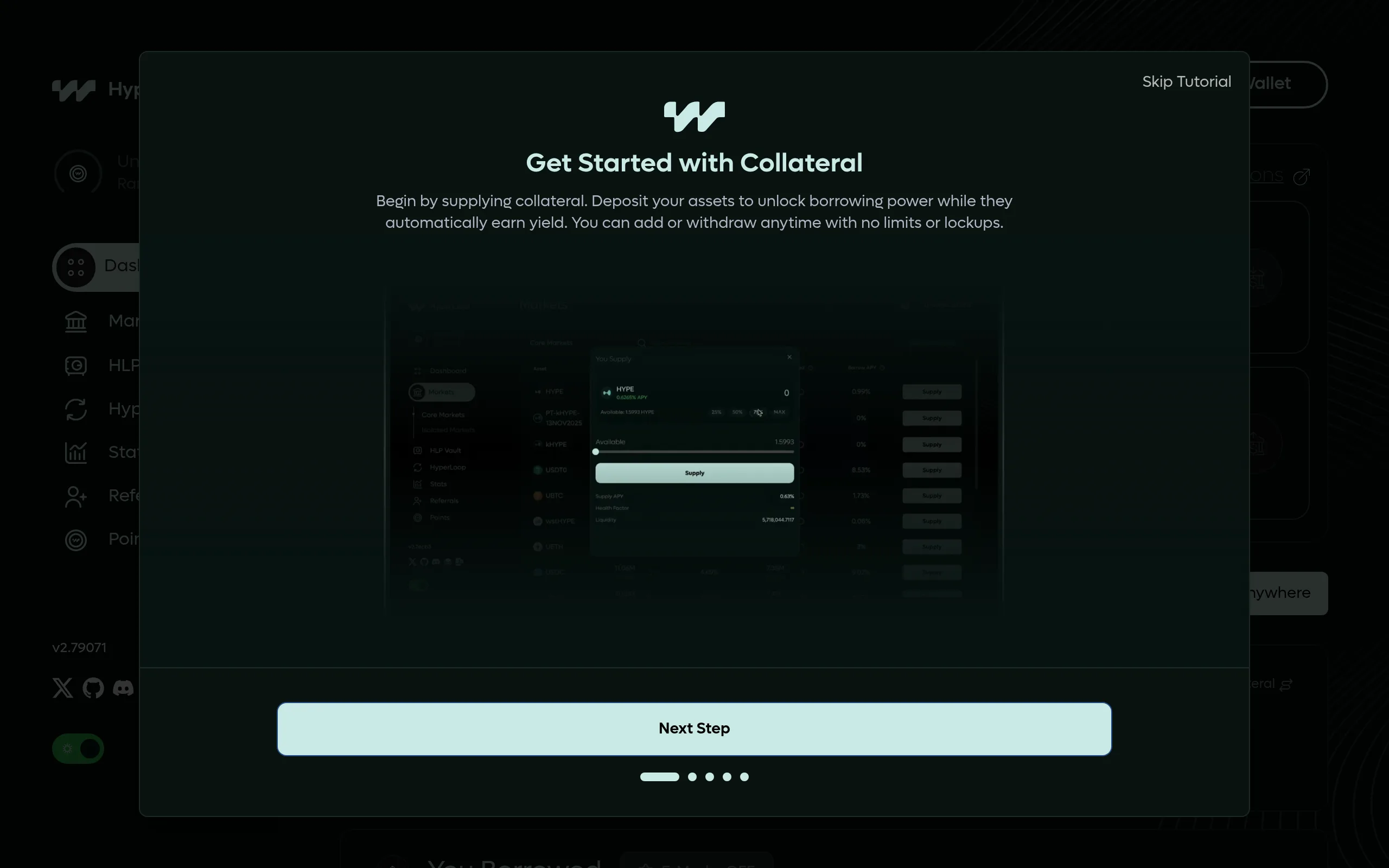
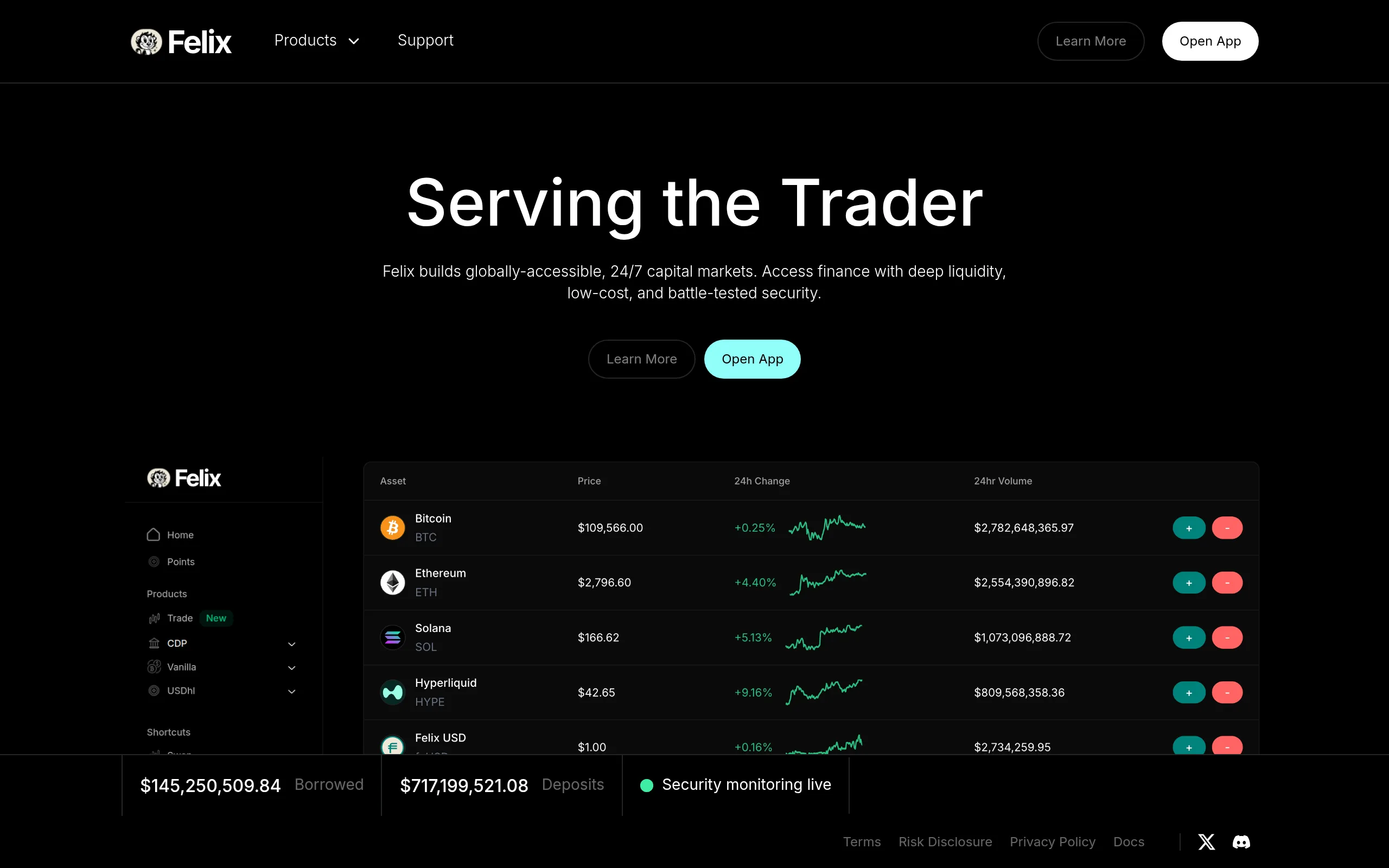
This guide walks through how lending and borrowing actually work on Hyperliquid, step by step. We cover Felix Protocol, the dominant venue for CDP-based lending, and HyperLend, an alternative that offers traditional pooled lending markets. Both are built on HyperEVM and offer different approaches to the same goal - putting your capital to work.
Lending & Borrowing at a Glance
The table below summarizes approximate lending and borrowing rates across the most popular assets on Hyperliquid's DeFi protocols. Rates are variable and fluctuate with market conditions — always check the live dashboards on Felix and HyperLend for current numbers.
| Asset | Lending APY (approx.) | Borrowing APY (approx.) | Max LTV | Notes |
|---|---|---|---|---|
| USDC | 3–8% | 5–12% | 90% | Highest demand; rates spike during volatile markets |
| HYPE | 1–5% | 4–10% | 65% | Popular collateral for feUSD minting on Felix |
| UBTC | 0.5–3% | 2–6% | 80% | Lower utilization keeps rates modest |
| ETH / wstHYPE | 1–4% | 3–8% | 75% | Liquid staking derivatives accepted on Felix CDPs |
| feUSD | ~4–6% (Stability Pool) | N/A | N/A | Earned via Stability Pool deposits, not standard lending. Spikes higher during liquidation events |
Rates shown are approximate ranges based on recent market conditions (the feUSD WHYPE Stability Pool was near 4.7% as of June 2026, per DefiLlama, down from double-digit prints in early 2025). Actual APYs change continuously based on supply, demand, and pool utilization.
If you are brand new to the platform, start with our beginner guide to trading on Hyperliquid first.
Where to Lend & Borrow: Felix Protocol
Felix Protocol is the primary lending and borrowing platform on Hyperliquid's HyperEVM. With over $1 billion in total value locked, it is the second-largest DeFi protocol on HyperEVM and the go-to venue for anyone looking to earn yield or access leverage through lending markets.
Felix offers two distinct products:
CDP Market - Mint feUSD
The CDP (Collateralized Debt Position) system lets you deposit collateral and mint feUSD, a synthetic stablecoin pegged to $1. Think of it like taking a loan against your crypto. You lock up assets like HYPE, UBTC, kHYPE, or wstHYPE, and in return you receive feUSD that you can use freely - trade it, provide liquidity, or deploy it in other strategies.
The loan-to-value ratio sits around 40%, meaning you need roughly $2.50 in collateral for every $1 of feUSD minted. This conservative ratio helps protect the system against collateral volatility.
 Vanilla Markets - Variable-Rate Lending
Vanilla Markets are Felix's Morpho-powered lending pools with over $750 million in TVL. These work like traditional DeFi lending markets: you supply assets to earn interest, or post collateral to borrow. Supported assets include HYPE, USDC, UBTC, and others.
Interest rates are variable, adjusting automatically based on supply and demand. When borrowing demand is high, rates increase to attract more lenders. When demand is low, rates decrease.
For a deeper dive into all of Felix's features, mechanics, and advanced strategies, read our complete Felix Protocol guide.
Start Earning Yield on Hyperliquid
Felix Protocol is the largest lending venue on HyperEVM with over $1B in TVL. Supply assets to earn variable-rate interest or mint feUSD against your collateral.
Open Felix ProtocolHow to Lend on Hyperliquid (Step-by-Step)
Lending on Hyperliquid through Felix is straightforward once your funds are in the right place. Here is the full process.
1Fund Your Hyperliquid Account
Before you can interact with any HyperEVM protocol, you need assets on Hyperliquid. The easiest path is depositing USDC from an external chain.
If you have not done this yet, follow our step-by-step deposit guide. You can bridge USDC from Arbitrum, Ethereum, and several other chains directly to Hyperliquid.
2Bridge to HyperEVM
Hyperliquid has two layers: the L1 (where perpetual trading happens) and HyperEVM (where DeFi protocols like Felix live). Your funds land on the L1 by default, so you need to bridge them to HyperEVM before you can use Felix.
This is a quick internal transfer, not a cross-chain bridge - it takes seconds and costs minimal fees. You can initiate the transfer from the Hyperliquid app under the portfolio section. For a full walkthrough, see our bridge to HyperEVM guide. For more detail on how the two layers interact, see our HyperEVM explainer.
3Connect to Felix
Navigate to usefelix.xyz and connect the same wallet you use for Hyperliquid. Felix will detect your HyperEVM assets automatically.
Make sure your wallet is configured for the Hyperliquid network. If you have been using Hyperliquid's trading interface, your wallet is likely already set up correctly.
4Supply Assets to Vanilla Markets
Once connected, head to the Vanilla Markets section. You will see a list of available lending pools - HYPE, USDC, UBTC, and others - with their current supply APYs displayed.
To lend:
- Select the asset you want to supply (e.g., USDC or HYPE)
- Enter the amount you want to deposit
- Approve the token spending (first time only)
- Confirm the supply transaction
Your assets begin earning interest immediately. The rate is variable, meaning it can change as market conditions shift, but you can withdraw at any time - there is no lock-up period.
5Monitor Your Position
After supplying, you can track your position directly on the Felix dashboard. Key metrics to watch include:
- Current APY - Your effective annualized yield, which fluctuates with demand
- Accrued interest - The interest you have earned so far
- Utilization rate - How much of the pool's supply is currently being borrowed (higher utilization generally means higher yields, but also lower immediate withdrawal liquidity)
Tip
How to Borrow on Hyperliquid
Borrowing lets you access liquidity without selling your assets. On Hyperliquid, Felix Protocol offers two borrowing mechanisms, each suited to different needs.
Option A: Mint feUSD via CDP
The CDP approach is best when you want to borrow a stablecoin against your crypto holdings. Here is how it works:
- Navigate to the CDP section on Felix (usefelix.xyz)
- Choose your collateral - HYPE, UBTC, kHYPE, or wstHYPE
- Deposit your collateral into the CDP
- Mint feUSD - up to roughly 40% of your collateral's value
- Use the feUSD however you want - swap it, deploy it in yield strategies, or hold it
The feUSD you mint is your loan. To get your collateral back, you repay the feUSD debt plus any accrued interest. If the value of your collateral drops below the required ratio, your position is subject to liquidation - the protocol sells your collateral to cover the debt.
For more on feUSD and how it fits into Hyperliquid's stablecoin landscape, see our USDH stablecoin guide.
Option B: Borrow from Vanilla Markets
Vanilla Markets offer a more traditional borrowing experience. Instead of minting a stablecoin, you borrow the asset directly:
- Supply collateral to a Vanilla Market lending pool
- Select the asset you want to borrow (e.g., borrow USDC against your HYPE collateral)
- Choose your borrow amount - stay well within the collateral limits
- Confirm the transaction
Interest on Vanilla Market borrows is variable. You repay whenever you want, but interest accrues continuously until you do.
Key Concepts Every Borrower Must Understand
Collateralization ratio. This is the value of your collateral relative to your loan. Felix CDPs require roughly 250% collateralization (40% LTV). If your ratio drops too low due to collateral price declines, you face liquidation.
Liquidation. When your collateral value falls below the minimum threshold, the protocol automatically sells some or all of your collateral to repay the debt. This is not a margin call with a grace period - it happens automatically and can result in significant losses. Always maintain a healthy buffer above the minimum ratio.
Interest rates. CDP borrowing and Vanilla Market borrowing have different fee structures. CDP fees tend to be more predictable, while Vanilla Market rates fluctuate with supply and demand. Factor borrowing costs into any strategy you build.
Warning
New to Hyperliquid?
Get started with our step-by-step guides and save 4% on every trade with our referral code. The discount applies to all perpetual and spot markets.
Start Trading on HyperliquidYield Strategies on Hyperliquid
Once you understand the basic mechanics of lending and borrowing, you can combine them into more sophisticated yield strategies.
Strategy 1: Vanilla Market Lending
The simplest approach. Supply USDC, HYPE, UBTC, or other supported assets to Vanilla Markets and earn variable interest. This is passive income with no active management required. Risk is relatively low - your main exposure is smart contract risk and the possibility of temporarily reduced withdrawal liquidity during high-utilization periods.
Best for: Conservative users who want yield without complexity.
Strategy 2: Stability Pool Deposits
Felix's Stability Pool is where you deposit feUSD to backstop the CDP system. When borrowers get liquidated, Stability Pool depositors receive discounted collateral from the liquidation. You also earn a share of borrower interest payments - Felix routes roughly 75% of borrower interest to the Stability Pool tied to each collateral type (per Felix's docs), which is the steady baseline of the yield, on top of liquidation gains and a slice of up-front borrowing fees.
The return profile is different from straight lending. You earn from those sources - ongoing interest and periodic liquidation gains - but your feUSD deposits are converted to collateral assets during liquidation events, which introduces price exposure to those assets. Yields are not fixed: the WHYPE Stability Pool was paying around 4.7% APY as of June 2026 per DefiLlama, well below the 10%+ levels seen in early 2025 when feUSD borrowing demand first ramped. In practice the deposit and withdraw flow is clean - the position accrues from the next block and withdrawals settle in seconds with no utilization queue, since the pool isn't lending your feUSD out. The catch to watch is that after a volatile stretch you may find part of your "feUSD" balance has been swapped into HYPE or UBTC at a liquidation discount; feUSD itself held its $1 peg tightly through the HYPE drawdowns this cycle. For the full mechanics, see our Felix Protocol guide.
Best for: Users who are comfortable holding a mix of feUSD and collateral assets, and who want exposure to liquidation premiums.
Strategy 3: Leverage Loop
This is the advanced strategy. The basic loop:
- Deposit HYPE (or another supported collateral) into a Felix CDP
- Mint feUSD against it
- Swap feUSD for more HYPE (on a HyperEVM DEX)
- Deposit the new HYPE back into the CDP
- Mint more feUSD
- Repeat
Each loop increases your effective exposure to HYPE. If HYPE goes up, your gains are amplified. If HYPE goes down, your losses are amplified and you face compounding liquidation risk.
Warning
This is conceptually similar to how leverage works in perpetual futures trading. If you are familiar with leverage trading on Hyperliquid, the risk dynamics are comparable - but the execution through DeFi lending is more manual and carries additional smart contract risk.
For passive yield without the complexity or risk of leverage, consider Hyperliquid vaults as an alternative.
Explore Lending & Yield Strategies
Felix Protocol offers multiple ways to earn on your Hyperliquid assets - from simple lending to Stability Pool deposits. Over $1B in TVL and growing.
Start Earning on Felix HyperLend: Variable-Rate Lending on HyperEVM
Felix is not the only lending option on Hyperliquid. HyperLend is a decentralized money market protocol built natively on HyperEVM that takes a different approach - traditional lending pools rather than CDP-based stablecoin minting.
If you have used Aave or Compound on Ethereum, HyperLend will feel familiar. You supply assets into liquidity pools to earn interest, or post collateral to borrow assets directly. Interest rates are variable, algorithmically adjusted based on pool utilization - when borrowing demand rises, rates increase to attract more suppliers, and vice versa.
How HyperLend Differs from Felix
Felix's flagship product is the CDP system where you mint feUSD against collateral. HyperLend skips the stablecoin layer entirely. Instead, you borrow the asset you need directly from a lending pool. Want USDC? Borrow USDC. Want HYPE? Borrow HYPE. There is no intermediary stablecoin step.
This makes HyperLend a better fit for users who want straightforward lending and borrowing without the complexity of managing a CDP position or worrying about stablecoin peg mechanics.
Key HyperLend Features
- Multiple pool types - Core Pools for standard multi-asset lending, Isolated Pools for risk-segmented markets, and P2P Pools for direct loan arrangements
- Flash loans - Borrow assets without upfront collateral, provided the loan is repaid within the same transaction (useful for arbitrage and liquidation strategies)
- HyperLoop - An automated leverage tool that uses flash loans to execute looping strategies in a single transaction, simplifying what would otherwise be a multi-step manual process
- Dynamic interest rates - Rates adjust algorithmically based on supply and demand in each pool
- Health Factor monitoring - A real-time dashboard metric that shows how close your borrowing position is to liquidation
When to Use HyperLend vs Felix
Choose Felix if you want to mint feUSD against your collateral, participate in Stability Pool yields, or prefer the CDP model with borrower-set interest rates. Choose HyperLend if you prefer traditional pooled lending markets, want access to flash loans, or need to borrow specific assets directly without going through a stablecoin.
Both protocols carry the same fundamental risks - smart contract risk, liquidation risk, and interest rate variability. HyperLend has been audited and operates as a fully non-custodial protocol, but as with any DeFi protocol on a newer chain, the track record is shorter than established Ethereum lending markets.
For a full walkthrough of HyperLend's features, supported assets, and step-by-step usage, read our dedicated HyperLend guide.
Explore HyperLend
Lend and borrow on Hyperliquid with HyperLend - an alternative lending platform on HyperEVM.
Open HyperLendRisks of Lending & Borrowing on Hyperliquid
DeFi lending is not a savings account. Before committing capital, understand what can go wrong.
Liquidation Risk
If you are borrowing, your position can be liquidated when collateral values drop. This is the most immediate and common risk. Volatile assets like HYPE can move 20-30% in a single day during market stress, which can push even conservatively collateralized positions into liquidation territory if you are not monitoring.
Mitigation: Borrow well below the maximum LTV. A 40% LTV cap means the protocol allows it, not that it is safe to use the full amount. Aim for 20-25% LTV and maintain a buffer.
Smart Contract Risk
Felix Protocol and the underlying Morpho contracts are smart contracts running on HyperEVM. Despite audits and testing, smart contract bugs or exploits can result in loss of funds. This is an inherent risk of all DeFi protocols.
Mitigation: Do not put all your capital into a single protocol. Diversify across strategies and keep a portion of your funds in simpler positions (like the Hyperliquid L1 trading account) that do not depend on smart contracts.
Collateral Volatility
Even if you are only lending (not borrowing), you have exposure to the asset you are supplying. If you lend HYPE and its price drops 40%, your HYPE is still there earning interest, but its dollar value has declined substantially. The interest earned may not compensate for the price decline.
Mitigation: Consider lending stablecoins like USDC if you want yield without price exposure. If you lend volatile assets, do so with a long-term thesis on the asset's value.
Liquidity Risk
During high-utilization periods, you may not be able to withdraw your supplied assets immediately. If 95% of the pool is borrowed, only 5% is available for withdrawal. You may need to wait for borrowers to repay before you can access your funds.
Mitigation: Check the utilization rate before supplying. Pools with consistently high utilization (above 90%) carry higher liquidity risk.
Info
Summary
Lending and borrowing on Hyperliquid is now a real option thanks to HyperEVM and protocols like Felix and HyperLend. Whether you want to earn passive yield on idle assets, borrow stablecoins without selling your crypto, or build leveraged strategies, the tools are available.
The key steps are straightforward: fund your Hyperliquid account, bridge to HyperEVM, and connect to the protocol that fits your needs. Felix is the go-to for CDP-based borrowing and feUSD minting. HyperLend is the choice for traditional pooled lending and features like flash loans. Start with simple lending if you are new to DeFi, and only move to CDPs, leverage loops, and advanced strategies once you are comfortable with the mechanics and risks.
As always in DeFi - start small, understand the risks, and never commit more capital than you can afford to lose.
Frequently Asked Questions
Yes. Hyperliquid supports lending through DeFi protocols built on HyperEVM, its EVM-compatible smart contract layer. Felix Protocol is the largest lending venue, with over $1 billion in TVL. You can supply assets like HYPE, USDC, and UBTC to Felix's Vanilla Markets to earn variable-rate interest, or deposit feUSD into Stability Pools to earn yield from borrower interest and liquidation gains.
Lending yields on Hyperliquid vary by asset and market conditions. Felix Protocol's Vanilla Markets offer variable interest rates on supplied assets like HYPE, USDC, and UBTC - rates fluctuate based on supply and demand. Stability Pool depositors earn a combination of borrower interest payments (Felix routes about 75% of borrower interest to the pools) and liquidation gains; as of June 2026 the feUSD WHYPE Stability Pool was paying roughly 4.7% APY per DefiLlama, down from double-digit levels in early 2025. Actual APYs change frequently, so always check the current rates on usefelix.xyz before committing capital.
Borrowing on Hyperliquid works through Felix Protocol in two ways. First, the CDP (Collateralized Debt Position) system lets you deposit collateral like HYPE or UBTC and mint feUSD, a synthetic stablecoin, at roughly 40% loan-to-value. Second, Vanilla Markets powered by Morpho offer variable-rate borrowing where you supply collateral and borrow assets like USDC directly. Both methods require over-collateralization and carry liquidation risk if your collateral value drops below the required threshold.
Felix Protocol is the largest lending protocol on Hyperliquid's HyperEVM, with over $1 billion in total value locked. It offers both CDP-based stablecoin minting and variable-rate lending markets. HyperLend is another major option, providing traditional lending pool mechanics with features like flash loans and HyperLoop leverage. The best choice depends on whether you prefer CDP-style borrowing (Felix) or pooled lending markets (HyperLend).
Independent resource: Hyperliquid Guide is an independent, third-party resource operated by Concept211. It is not affiliated with, produced by, reviewed by or endorsed by Hyper Foundation, Hyperliquid Labs or any other Hyperliquid-ecosystem entity. "Hyperliquid" and related names and marks belong to their respective owners and are used here only to identify the platform this site documents. Read the full disclaimer.
Not advice: Nothing on this site is legal, tax, financial or investment advice. Descriptions of regulatory status, tax treatment and market availability are general information that varies by jurisdiction and changes over time. Confirm anything that matters to you with a qualified professional and against primary sources. Trading perpetual futures involves substantial risk of loss, and past performance does not indicate future results.
Disclosure: this site contains referral links. Signing up through the 4% lifetime fee discount link earns us a share of the trading fee Hyperliquid already charges, at no extra cost to you.
Ready to Start Trading?
Join Hyperliquid with our referral link and get a 4% lifetime fee discount. No KYC, no email - just connect your wallet and trade.
Start Trading - Save 4%