HyperLend Guide (2026): How to Lend & Borrow on HyperEVM
Table of Contents
- What Is HyperLend?
- How HyperLend Works
- Supplying (Lending)
- Borrowing
- Dynamic Interest Rates
- Key Features
- Multiple Pool Types
- Flash Loans
- HyperLoop
- Supported Assets
- HyperLend vs Felix Protocol
- How to Use HyperLend (Step-by-Step)
- Step 1: Set Up Your Wallet
- Step 2: Bridge Assets to HyperEVM
- Step 3: Connect to HyperLend
- Step 4: Supply Assets
- Step 5: Borrow (Optional)
- Step 6: Monitor Your Health Factor
- Earning Yield on HyperLend
- Supply APY
- Points Program
- E-Mode
- Risks
- Smart Contract Risk
- Liquidation Risk
- Interest Rate Volatility
- Liquidity Risk
- How HyperLend Compares to Other HyperEVM Lending Protocols
- Why Choose HyperLend
- HyperLend vs Traditional Lending Platforms
- Is HyperLend Safe? Risks to Know
- Summary
- Best Lending Protocols on HyperEVM
- How to Earn Yield on HyperEVM
 HyperLend
What Is HyperLend?
HyperLend is a decentralized money market protocol built natively on HyperEVM, Hyperliquid's EVM-compatible smart contract layer. It lets you supply crypto assets to earn interest or borrow against your collateral - the same fundamental mechanic that powers Aave and Compound on Ethereum, but purpose-built for the Hyperliquid ecosystem.
Launched on mainnet in March 2025, HyperLend has grown into one of the core DeFi protocols on HyperEVM. It serves as a liquidity backbone for the ecosystem, enabling traders, market makers, and DeFi users to access capital efficiently without leaving Hyperliquid.
Unlike  Felix Protocol, which is primarily a CDP (Collateralized Debt Position) system for minting the feUSD stablecoin, HyperLend operates as a traditional pooled lending market. You deposit assets into liquidity pools, borrowers take loans from those pools, and interest flows from borrowers to lenders. There is no intermediary stablecoin - you borrow the asset you need directly.
HyperLend raised $1.7 million from investors including RockawayX, Nucleus, and Vistula Capital. The protocol is fully non-custodial, meaning your assets are managed by smart contracts rather than a centralized entity.
Start Lending on HyperLend
Supply assets to earn yield or borrow against your collateral on Hyperliquid's native lending protocol. Non-custodial, variable-rate, and built for HyperEVM.
Open HyperLendHow HyperLend Works
HyperLend follows the proven lending pool model. The core mechanics are straightforward.
Supplying (Lending)
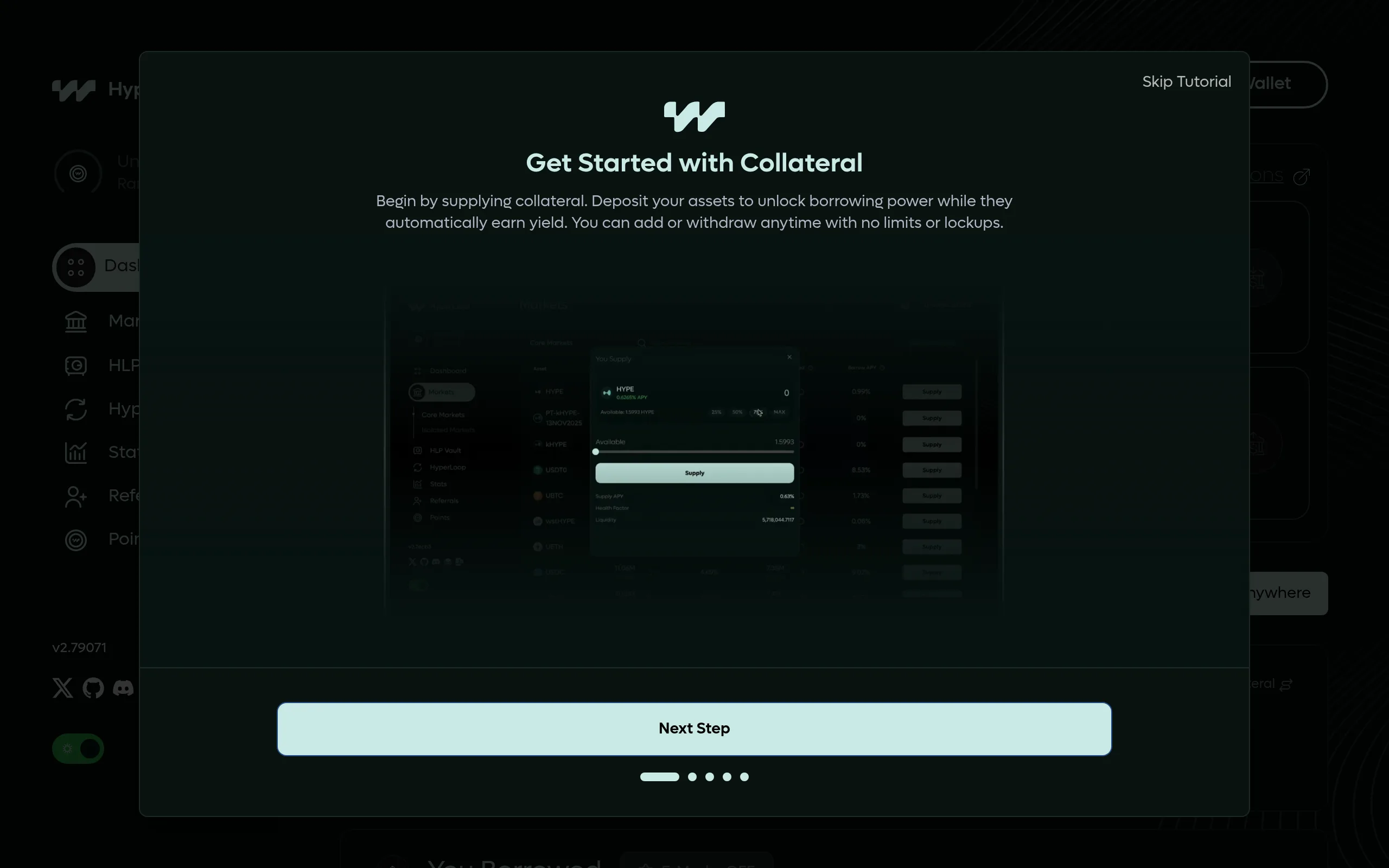
When you supply assets to HyperLend, they enter a shared liquidity pool. Borrowers draw from this pool, and the interest they pay is distributed to all suppliers proportionally. Your assets begin earning interest the moment you deposit them - there is no lock-up period, and you can withdraw at any time (subject to pool liquidity).
Borrowing
To borrow, you first deposit collateral into HyperLend. The protocol then lets you borrow other assets up to a certain percentage of your collateral value (the loan-to-value ratio). Your borrowing position is tracked through a Health Factor - a real-time metric displayed on the dashboard that shows how close you are to liquidation.
If the value of your collateral drops or your debt increases (through accruing interest), your Health Factor declines. When it falls below the liquidation threshold, your collateral is automatically sold to repay the debt.
Dynamic Interest Rates
Interest rates on HyperLend are not fixed. They are determined algorithmically based on pool utilization - the percentage of supplied assets that are currently borrowed.
- Low utilization (lots of idle supply): Rates are low to encourage borrowing
- High utilization (most supply is borrowed): Rates spike to incentivize new deposits and discourage further borrowing
This creates a self-balancing market where rates naturally find equilibrium based on supply and demand.
Info
Key Features
HyperLend goes beyond basic lending and borrowing with several features designed for capital efficiency.
Multiple Pool Types
HyperLend offers three distinct lending markets to segment risk:
- Core Pools - Multi-asset lending pools where various collateral types and borrowable assets coexist. This is the primary market for most users.
- Isolated Pools - Risk-segmented pools where specific asset pairs are kept separate from the broader market. This limits contagion risk if a particular asset experiences volatility.
- P2P Pools - Peer-to-peer loan arrangements where lenders and borrowers can set custom terms. This is more advanced and suited to users with specific lending needs.
Flash Loans
HyperLend supports flash loans - uncollateralized loans that must be borrowed and repaid within a single transaction. If the loan is not repaid by the end of the transaction, the entire operation reverts as if it never happened.
Flash loans are primarily used by developers and sophisticated traders for arbitrage opportunities, liquidation bots, and collateral swaps. They are not relevant for most retail users, but they contribute to market efficiency and protocol revenue.
HyperLoop
HyperLoop is HyperLend's automated leverage tool. It uses flash loans under the hood to execute looping strategies in a single transaction. Instead of manually depositing collateral, borrowing, swapping, redepositing, and repeating (a tedious multi-step process), HyperLoop automates the entire sequence.
This lets users build leveraged positions on their collateral more efficiently. However, leverage amplifies both gains and losses - the same risks that apply to leverage trading on Hyperliquid's perpetuals apply here.
Warning
Supported Assets
HyperLend supports lending and borrowing across multiple assets available on HyperEVM. The protocol's markets page displays each asset along with its current supply APY, borrow APY, total supplied, total borrowed, and LTV ratio.
Commonly supported assets on HyperEVM lending protocols include:
- USDC - The primary stablecoin, popular for both lending (earning yield with no price exposure) and borrowing
- HYPE - Hyperliquid's native token, used as collateral for borrowing or supplied to earn interest
- UBTC - Bitcoin brought onto Hyperliquid through Unit
- Other HyperEVM assets - The available markets expand as the ecosystem grows
Check the HyperLend app directly for the most current list of supported assets and their rates, as new markets are added over time.
HyperLend vs Felix Protocol
Both HyperLend and Felix Protocol offer lending and borrowing on Hyperliquid, but they take fundamentally different approaches.
| Feature | HyperLend | Felix Protocol |
|---|---|---|
| Model | Pooled lending markets | CDP stablecoin minting + Vanilla Markets |
| Borrowing | Borrow assets directly from pools | Mint feUSD against collateral (or borrow via Vanilla Markets) |
| Interest rates | Algorithmic, based on utilization | Borrower-set rates (CDP) or algorithmic (Vanilla Markets) |
| Flash loans | Yes | No |
| Leverage tool | HyperLoop (automated looping) | Manual leverage loops through CDPs |
| Stablecoin | None | feUSD (overcollateralized) |
| Pool types | Core, Isolated, P2P | Single pool type (Vanilla Markets) |
When to choose HyperLend: You want traditional pooled lending, need flash loan access, prefer borrowing assets directly without minting a stablecoin, or want to use HyperLoop for automated leverage.
When to choose Felix: You want to mint feUSD against your collateral, earn Stability Pool yields from liquidations, or prefer the CDP model where you set your own interest rate.
Many active DeFi users on Hyperliquid use both protocols depending on the strategy. They are complementary, not competing - different tools for different needs.
For a full guide to Felix's CDP system, Vanilla Markets, and feUSD, read our Felix Protocol guide. For a broader overview of how lending fits into Hyperliquid's DeFi stack, see our lending and borrowing guide.
How to Use HyperLend (Step-by-Step)
1Set Up Your Wallet
You need a Web3 wallet compatible with HyperEVM -  MetaMask and OKX Wallet both work. Make sure your wallet is configured for the Hyperliquid network.
If you are new to Hyperliquid entirely, start with our beginner guide to get your account set up and funded.
2Bridge Assets to  HyperEVM
HyperLend runs on HyperEVM, which is separate from Hyperliquid's L1 trading layer. You need to bridge your assets to HyperEVM using the internal transfer in the Hyperliquid app. This takes seconds and costs minimal fees. See our HyperEVM guide for details.
3Connect to HyperLend
Navigate to the HyperLend app and connect your wallet. The dashboard will show your net worth, Health Factor (if you have open positions), and available markets.
4Supply Assets
Go to the Markets section, select the asset you want to supply, enter the amount, and confirm the transaction. Your assets immediately begin earning the displayed supply APY.
5Borrow (Optional)
If you want to borrow, first ensure you have supplied collateral. Then select the asset you want to borrow, choose an amount that keeps your Health Factor at a safe level (above 1.5 is a reasonable target), and confirm. Interest accrues on your borrow position until you repay.
6Monitor Your Health Factor
If you are borrowing, watch your Health Factor closely. It is displayed prominently on the HyperLend dashboard. If it drops toward 1.0, you are approaching liquidation territory. Add more collateral or repay part of your debt to increase it.
Tip
Earning Yield on HyperLend
The simplest way to earn yield on HyperLend is to supply assets and collect interest. Here is what shapes your returns.
Supply APY
Your primary yield comes from interest paid by borrowers. The APY displayed on the Markets page reflects the current annualized rate, but it changes continuously as utilization shifts. Stablecoin pools (like USDC) tend to have more stable rates, while volatile asset pools can see wider APY swings.
Points Program
HyperLend runs a points program that rewards users for deposits, borrowing activity, and referrals. Points accumulate based on your participation and may translate to future rewards when the HyperLend token (HPL) launches. The tokenomics allocate approximately 30% of the total supply to growth incentives, suggesting meaningful rewards for early users.
E-Mode
HyperLend offers an Enhanced Mode (E-Mode) that allows higher capital efficiency when borrowing correlated assets. For example, borrowing one stablecoin against another stablecoin as collateral can offer higher LTV ratios in E-Mode since the liquidation risk is lower for correlated pairs.
Risks
HyperLend carries the same fundamental risks as any DeFi lending protocol. Understanding them before you deposit is essential.
Smart Contract Risk
HyperLend's smart contracts have been audited and the protocol runs a bug bounty program with timelock mechanisms. However, no audit eliminates risk entirely. Smart contract bugs or exploits could result in loss of funds. This risk is present in every DeFi protocol, but is amplified on newer chains like HyperEVM where the ecosystem has a shorter track record.
Liquidation Risk
If you are borrowing, your position can be liquidated when your Health Factor drops below the threshold. Liquidation means your collateral is sold (often at a discount) to repay your debt. With volatile collateral like HYPE, price swings of 20-30% can happen rapidly during market stress.
Mitigation: Borrow conservatively. Keep your Health Factor well above 1.0 - aim for 1.5 or higher. Monitor your positions during volatile markets.
Interest Rate Volatility
Since rates are variable, your supply APY could drop significantly if borrowing demand declines. Conversely, borrowers can see their costs spike during high-demand periods. There are no fixed-rate options on HyperLend.
Liquidity Risk
During periods of very high utilization, you may not be able to withdraw your supplied assets immediately. If 95% of the pool is borrowed out, only 5% is available for withdrawal. You would need to wait for borrowers to repay before accessing your full balance.
Warning
Try HyperLend
Earn yield by supplying assets or borrow against your collateral on HyperEVM. Variable rates, flash loans, and automated leverage - all in one protocol.
Open HyperLendHow HyperLend Compares to Other HyperEVM Lending Protocols
HyperEVM hosts several lending and borrowing protocols, each with a different approach. Here is how HyperLend stacks up against the main alternatives:
| Feature | HyperLend | Felix Protocol | Morpho (HyperEVM) |
|---|---|---|---|
| Model | Pooled lending (Aave-style) | CDP + Vanilla Markets | Isolated lending markets |
| Supported Collateral | HYPE, USDC, kHYPE, wstHYPE, ETH | HYPE, kHYPE, wstHYPE | Varies by market |
| Stablecoin | Borrow USDC directly | Mint feUSD (CDP) | Borrow USDC |
| Flash Loans | Yes | No | No |
| Leverage Tool | HyperLoop (one-click) | Manual | Manual |
| Liquidation Threshold | ~80-85% LTV | ~90% LTV (kHYPE) | Varies |
Why Choose HyperLend
If you want to borrow USDC directly against your crypto holdings with familiar Aave-style mechanics, HyperLend is the straightforward choice. Its flash loans and HyperLoop leverage tools are unique on HyperEVM. For traders who prefer minting a stablecoin (feUSD) against their collateral, Felix Protocol is the better fit. Both protocols accept kHYPE and wstHYPE as collateral, so your liquid-staked HYPE earns staking rewards while securing a loan on either platform.
HyperLend vs Traditional Lending Platforms
How does HyperLend compare to established DeFi lending protocols like Aave and Compound?
| Feature | HyperLend | Aave (Ethereum) | Compound (Ethereum) |
|---|---|---|---|
| Gas per transaction | ~$0.01 (HyperEVM) | $5-50 (Ethereum mainnet) | $5-50 (Ethereum mainnet) |
| Flash Loans | Yes | Yes | No |
| Supported Chains | HyperEVM only | Ethereum, Arbitrum, Polygon, etc. | Ethereum, Base, etc. |
| TVL | Growing (newer protocol) | $10B+ | $3B+ |
| Audit History | Audited (newer track record) | Multiple audits, battle-tested | Multiple audits, battle-tested |
| Unique Features | HyperLoop leverage, native Hyperliquid integration | Governance, cross-chain | Governance, COMP rewards |
HyperLend's main advantage is cost - transactions on HyperEVM cost a fraction of a cent compared to $5-50+ on Ethereum mainnet. Its native integration with the Hyperliquid trading layer means you can borrow, trade, and manage positions within one ecosystem. The trade-off is a shorter track record and smaller TVL compared to protocols that have been running since 2020.
Is HyperLend Safe? Risks to Know
No DeFi lending protocol is risk-free. Here are the specific risks to consider with HyperLend:
- Smart contract risk - HyperLend's contracts have been audited, but the protocol is newer than established platforms like Aave. Bugs or exploits, while unlikely, cannot be ruled out. Never deposit more than you can afford to lose.
- Liquidation risk - If your collateral value drops and your Health Factor falls below 1.0, your position will be partially or fully liquidated. Set conservative LTV ratios (50-60% rather than max) and monitor your positions.
- Oracle risk - HyperLend relies on price oracles to value collateral. Oracle failures or manipulation could trigger incorrect liquidations, though this risk is mitigated by using multiple oracle sources.
- Liquidity risk - During high utilization periods, you may not be able to withdraw supplied assets immediately. This is a standard risk for pooled lending protocols.
- Protocol risk - As a newer DeFi protocol on a newer chain (HyperEVM), HyperLend has a shorter operational history. The ecosystem is growing but still maturing.
Warning
Summary
HyperLend brings traditional DeFi lending mechanics to the Hyperliquid ecosystem. It fills a different niche than Felix Protocol - where Felix focuses on CDP-based stablecoin minting, HyperLend offers direct asset lending and borrowing through pooled markets, plus advanced features like flash loans and HyperLoop leverage.
For most users, the starting point is simple: supply assets you are holding anyway and earn variable-rate interest. If you want to borrow, post collateral and keep a close eye on your Health Factor. And if you are more advanced, tools like HyperLoop and flash loans open up strategies that would be impossible to execute manually.
As always with DeFi on newer ecosystems - start small, diversify across protocols, and treat any yield as compensation for real risk.
Best Lending Protocols on HyperEVM
HyperLend is the largest pooled lending protocol on HyperEVM, but it is not the only option. Here are the main lending protocols available on HyperEVM as of March 2026:
- HyperLend - Aave-style pooled lending with flash loans and HyperLoop leverage. Supports HYPE, USDC, kHYPE, wstHYPE, and ETH. Best for traders who want direct USDC borrowing against crypto collateral.
- Felix Protocol - CDP model (mint feUSD stablecoin) plus Vanilla Markets lending pools. Best for users who want to mint a stablecoin against kHYPE/wstHYPE collateral while keeping staking rewards active.
- Morpho - Isolated lending markets with customizable risk parameters. Best for advanced users who want granular control over lending terms.
For most users starting out with DeFi on HyperEVM, HyperLend is the simplest entry point - familiar mechanics, variable rates, and one-click leverage via HyperLoop.
How to Earn Yield on HyperEVM
Lending on HyperLend is one of several ways to earn yield in the Hyperliquid ecosystem. Other yield sources include depositing into the HLP vault for market-making returns, liquid staking HYPE with Kinetiq for ~2.37% APY, and running funding rate arbitrage strategies. For a comprehensive comparison of all yield options - including APY ranges, risk levels, and capital requirements - see our complete USDC earning guide.
Explore the broader Hyperliquid DeFi ecosystem to see how HyperLend fits alongside other protocols, or read our lending and borrowing guide for a side-by-side comparison with Felix.
New to Hyperliquid?
Get started with our step-by-step guides and save 4% on every trade with our referral code. The discount applies to all perpetual and spot markets.
Start Trading on HyperliquidFrequently Asked Questions
HyperLend is a decentralized lending and borrowing protocol built on Hyperliquid's HyperEVM. It operates as a money market where users supply crypto assets to earn variable-rate interest, or post collateral to borrow assets directly. It also offers flash loans and HyperLoop, an automated leverage tool. Think of it as the Aave of the Hyperliquid ecosystem.
To lend on HyperLend, connect a Web3 wallet (like MetaMask) to the HyperLend app, make sure you have assets on HyperEVM, navigate to the Markets page, select the asset you want to supply, enter the amount, and confirm the transaction. Your assets immediately begin earning variable-rate interest based on borrowing demand in that pool.
Yields on HyperLend vary by asset and market conditions. Supply APYs are determined algorithmically based on pool utilization - when more of the pool is borrowed, lenders earn higher rates. Actual rates fluctuate continuously, so check the HyperLend dashboard for current APYs before depositing. You may also earn HyperLend points that could translate to future token rewards.
HyperLend is a non-custodial protocol with audited smart contracts, a bug bounty program, and timelock mechanisms. However, all DeFi protocols carry inherent risks including smart contract vulnerabilities, liquidation risk for borrowers, and interest rate volatility. HyperLend is built on HyperEVM, which is a newer ecosystem with a shorter track record than Ethereum. Never deposit more than you can afford to lose.
Independent resource: Hyperliquid Guide is an independent, third-party resource operated by Concept211. It is not affiliated with, produced by, reviewed by or endorsed by Hyper Foundation, Hyperliquid Labs or any other Hyperliquid-ecosystem entity. "Hyperliquid" and related names and marks belong to their respective owners and are used here only to identify the platform this site documents. Read the full disclaimer.
Not advice: Nothing on this site is legal, tax, financial or investment advice. Descriptions of regulatory status, tax treatment and market availability are general information that varies by jurisdiction and changes over time. Confirm anything that matters to you with a qualified professional and against primary sources. Trading perpetual futures involves substantial risk of loss, and past performance does not indicate future results.
Disclosure: this site contains referral links. Signing up through the 4% lifetime fee discount link earns us a share of the trading fee Hyperliquid already charges, at no extra cost to you.
Ready to Start Trading?
Join Hyperliquid with our referral link and get a 4% lifetime fee discount. No KYC, no email - just connect your wallet and trade.
Start Trading - Save 4%