HLP Explained - Hyperliquid's Liquidity Provider Vault
Table of Contents
- What Is HLP?
- How HLP Works
- Order-Book Market Making, Not AMM
- On-Chain Execution on Hyperliquid L1
- How HLP Earns Revenue
- 1. Spread Capture
- 2. Maker Rebates
- 3. Liquidation Profits
- Risks of Depositing into HLP
- Inventory Risk
- Adverse Selection
- Drawdown Periods
- No Lock-Up, But Timing Matters
- How HYPE Token Relates to HLP
- How to Deposit into HLP
- Step-by-Step
- Withdrawal
- HLP Performance and Transparency
- What You Can Verify
- Historical Context
- HLP vs. Community Vaults
- The Bottom Line
 Hyperliquid
Info
Quick Summary - HLP Vault
- HLP is Hyperliquid's protocol-owned market-making vault - it provides liquidity across all perp and spot markets
- Returns are variable with no fixed APY - performance depends on trading volume and volatility
- Deposits and withdrawals are in USDC with no lock-up period
- As of March 2026, 0% profit share - unlike community vaults (10% to leader), 100% of HLP profits go to depositors
- As of March 2026, revenue sources: bid-ask spread capture, maker rebates (up to 0.003%), and liquidation proceeds
- One-click deposit from your Hyperliquid trading balance - no bridging to HyperEVM required
What Is HLP?
HLP - short for Hyperliquidity Provider - is Hyperliquid's protocol-owned market-making vault. It is the single largest source of liquidity on the Hyperliquid exchange, placing bid and ask orders across every perpetual futures and spot market on the platform. When you trade on Hyperliquid, there is a good chance HLP is on the other side of your order.
Unlike community vaults where individual traders run their own strategies, HLP is operated by the Hyperliquid protocol itself. The strategy is automated market-making - continuously quoting both sides of the order book to capture the spread between buy and sell prices. Anyone can deposit USDC into HLP and earn a proportional share of whatever the vault generates.
How HLP Works
If you have used DeFi protocols like Uniswap or Curve, you might assume HLP works like an automated market maker (AMM) with liquidity pools and bonding curves. It does not. Hyperliquid runs a central limit order book (CLOB) - the same architecture used by Binance, the NYSE, and every traditional exchange. HLP operates as an order-book market maker within that system.
Order-Book Market Making, Not AMM
HLP places discrete limit orders at various price levels on both the bid and ask side of the order book. When a trader takes a position - say, buying BTC-PERP - HLP's resting sell order gets filled. When another trader sells, HLP's resting buy order gets filled. The difference between the buy and sell prices is the spread, and capturing that spread is the core of how HLP earns.
This approach is fundamentally different from AMMs in several ways:
- Capital efficiency: HLP concentrates liquidity at specific price levels rather than spreading it across an infinite curve
- Tighter spreads: Order-book market making can offer tighter bid-ask spreads than AMM formulas
- Active management: The strategy dynamically adjusts quotes based on market conditions, inventory, and volatility
- Same playing field: HLP's orders sit on the same order book as every other trader - there is no special mechanism or separate pool
That is the main difference from house-pool designs built on top of Hyperliquid. papertrade, which launched on HyperEVM in October 2026, has its pool take the opposite side of every trade at Hyperliquid's mid price, and nobody can deposit into it. HLP competes for fills on the book like any other market maker, and anyone can deposit.
On-Chain Execution on Hyperliquid L1
Everything HLP does runs on Hyperliquid's custom L1 blockchain. Every order placement, every fill, every position change is recorded on-chain. This is not a black box running on a centralized server - it is a transparent, auditable market-making operation executing on a blockchain purpose-built for high-throughput trading.
Hyperliquid's L1 processes thousands of transactions per second with sub-second finality, which is what makes on-chain market making viable. Traditional market makers on CEXs rely on sub-millisecond latency. HLP does not need that speed because it is the native liquidity provider embedded in the protocol itself - it has structural advantages that compensate for blockchain latency.
Info
How HLP Earns Revenue
HLP's revenue comes from three primary sources. Understanding each one helps you evaluate what drives returns and what can go wrong.
1. Spread Capture
The bread and butter of any market maker. HLP quotes a bid price (where it is willing to buy) and an ask price (where it is willing to sell). When both sides get filled, HLP pockets the difference. On a BTC-PERP market with a $0.50 spread, if HLP buys at $85,000.00 and sells at $85,000.50, it earns $0.50 per BTC traded - multiplied across thousands of trades per day across dozens of markets.
Spread revenue scales with trading volume. The more people trade on Hyperliquid, the more HLP's orders get filled, and the more spread it captures. This is why HLP's performance tends to correlate with overall platform activity.
2. Maker Rebates
Hyperliquid's fee structure rewards liquidity providers. Maker orders (limit orders that add liquidity to the book) earn rebates, while taker orders (market orders that remove liquidity) pay fees. Since HLP overwhelmingly places limit orders, it collects maker rebates on a massive scale.
Rebates are not paid at the base tier, where makers pay 0.015%. They go to makers by share of total 14-day maker volume: 0.001% of notional above a 0.5% share, 0.002% above 1.5%, and 0.003% above 3%. On billions of dollars in monthly maker volume, even rebates that small add up.
3. Liquidation Profits
When a trader's leveraged position gets liquidated, someone needs to take over that position. HLP often serves as the counterparty for liquidations, absorbing the liquidated position at a price favorable to the vault. If a long position gets liquidated below the market price, HLP takes over that position at a discount - a built-in profit margin.
This is particularly significant during volatile periods when leveraged traders get wiped out. Liquidation cascades can generate substantial one-time profits for HLP, though they also come with inventory risk (more on that below).
Start Trading on Hyperliquid
Every trade you make on Hyperliquid generates volume that powers the ecosystem. Get a 4% fee discount on your first $25M of volume with our referral link.
Join HyperliquidRisks of Depositing into HLP
HLP is not a savings account and it does not offer guaranteed returns. It is a market-making operation, and market making carries specific risks that you need to understand before depositing.
Inventory Risk
Market makers accumulate positions as their orders get filled. If the market moves sharply in one direction, HLP can end up holding a large directional position on the wrong side. For example, if BTC drops 10% rapidly, HLP may accumulate a long BTC position from its bid orders getting filled - and that position loses value as the price continues to fall.
HLP's strategy includes risk management to hedge and rebalance inventory, but during extreme moves, losses from inventory exposure can exceed the spread revenue earned.
Adverse Selection
Adverse selection is the market maker's nemesis. It happens when informed traders (or fast-moving bots) take HLP's resting orders right before a large price move. HLP sells at a price that is about to move higher, or buys at a price that is about to move lower. The traders on the other side had better information about the immediate direction, and HLP absorbs the loss.
This is an inherent challenge in market making and one reason why HLP's returns are variable - some periods see heavy adverse selection that eats into profits.
Drawdown Periods
HLP has experienced drawdowns historically. These are periods where the vault's NAV (net asset value) declines - meaning depositors would withdraw less than they put in. Drawdowns typically coincide with extreme market volatility, large liquidation events, or sustained one-directional price moves.
Warning
No Lock-Up, But Timing Matters
You can withdraw from HLP at any time - there is no lock-up period. However, withdrawing during a drawdown means you crystallize losses. If HLP is in a temporary drawdown that later recovers, withdrawing early locks in the loss. This is a psychological risk as much as a financial one.
How HYPE Token Relates to HLP
HYPE and HLP are related but distinct components of the Hyperliquid ecosystem.
HLP deposits are in USDC, not HYPE. You deposit USDC into the HLP vault and your returns are denominated in USDC. HLP's market-making strategy trades across all markets on Hyperliquid - including the HYPE-PERP and HYPE spot markets - but your exposure as a depositor is to the vault's overall PnL in USDC terms.
The connection between HYPE and HLP is indirect but meaningful:
- Trading fee revenue generated across Hyperliquid (including from HLP's activity) feeds into the buyback and burn mechanism that reduces HYPE supply
- Platform growth that increases HLP's volume also increases HYPE demand through gas fees on HyperEVM and staking demand
- HLP's liquidity makes Hyperliquid a better trading venue, which attracts more users, which drives more HYPE ecosystem activity
If you hold HYPE and want to put capital to work, you have separate options - HYPE can be staked for network security rewards, used as DeFi collateral on Felix, or deposited into liquid staking via Kinetiq. HLP is a USDC-denominated market-making bet, not a HYPE staking product.
How to Deposit into HLP
Depositing into HLP is straightforward. You need a funded Hyperliquid account with USDC available.
Step-by-Step
- Connect your wallet to app.hyperliquid.xyz - if you do not have an account yet, use our referral link for a 4% fee discount on your first $25M of volume
- Ensure you have USDC in your Hyperliquid account - if not, deposit USDC first
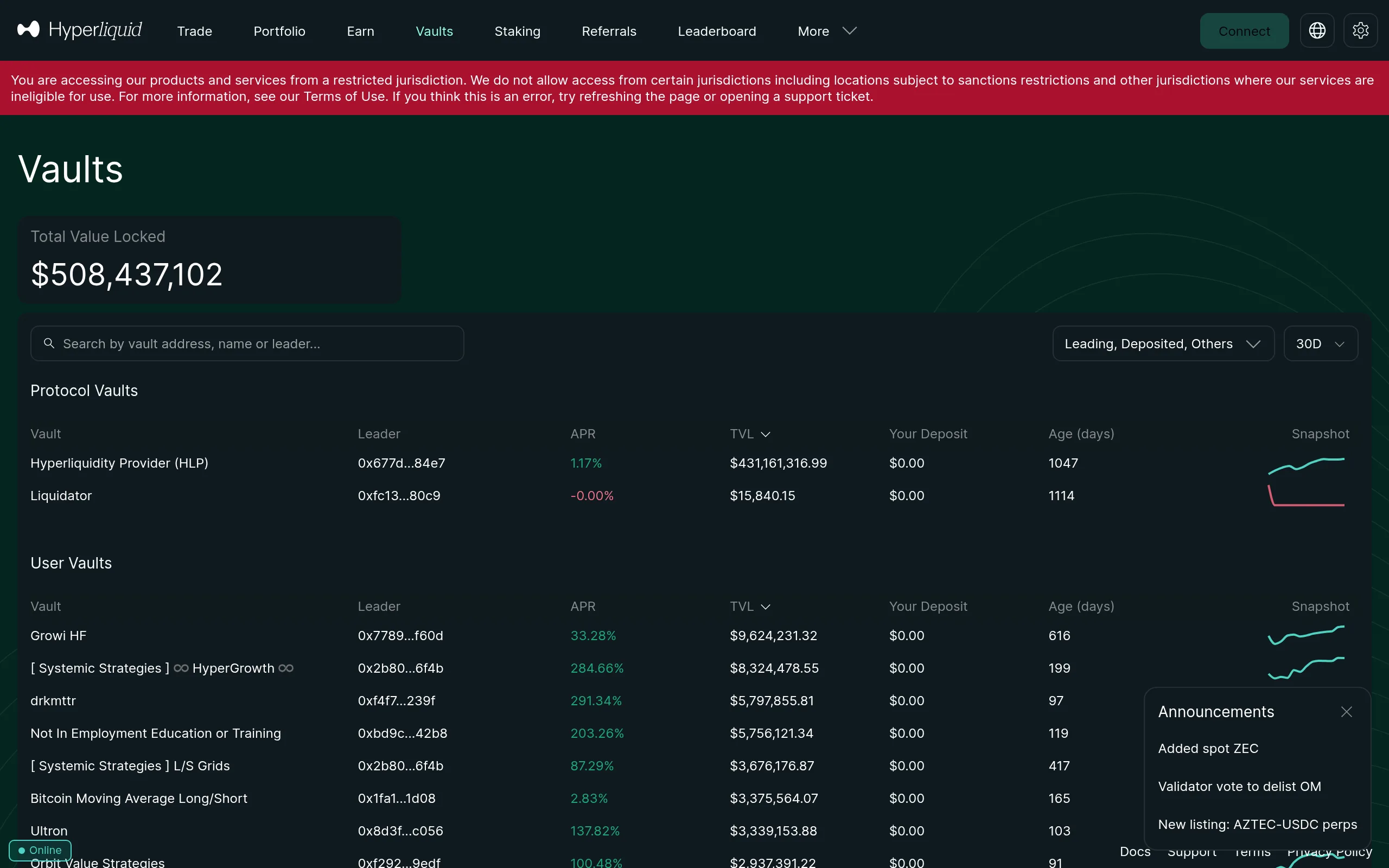
- Navigate to the Vaults section - find HLP in the vault listing (it is typically the largest vault by TVL)
- Click on HLP to view its performance dashboard - review the all-time return, recent drawdowns, current TVL, and PnL history
- Enter your deposit amount in USDC and confirm the transaction in your wallet
- Monitor your position - your share of HLP's PnL updates in real time
Tip
Withdrawal
Withdrawing is equally simple. Navigate to the HLP vault, click withdraw, enter the amount (or max), and confirm. Your withdrawal reflects your proportional share of the vault's current NAV. There is no lock-up period - you can exit at any time.
If you want to manage your Hyperliquid capital across HLP, spot positions, and perp trades from a single balance, check out the unified accounts guide to understand how cross-margin works on Hyperliquid.
HLP Performance and Transparency
One of HLP's strongest qualities is its transparency. Every aspect of the vault's operation is on-chain and auditable.
What You Can Verify
- All positions: Every open position HLP holds across every market is visible on-chain
- Every trade: The full history of HLP's trades - entries, exits, sizes, prices - is recorded on Hyperliquid's L1
- PnL in real time: The vault's equity curve and performance metrics update continuously
- TVL and depositor count: You can see exactly how much capital is in the vault and how many depositors participate
- Drawdown history: Past drawdowns are fully visible, so you can evaluate worst-case scenarios before depositing
This level of transparency is a stark contrast to off-chain market makers or centralized yield products where you have no visibility into how your capital is being used. With HLP, there is nothing hidden - the performance you see is the performance that happened.
Historical Context
HLP has been operational since Hyperliquid's early days and has processed billions of dollars in trading volume. Its performance varies by period - some months are highly profitable, others see drawdowns. The long-term track record is positive, but past performance does not guarantee future results.
You can view HLP's complete history, including its worst drawdown periods, directly on the Hyperliquid app. Third-party analytics tools also track HLP's performance over time.
HLP vs. Community Vaults
Hyperliquid offers two types of vaults: HLP (the protocol vault) and community vaults (run by individual traders). Understanding the difference helps you decide where to allocate capital.
| Feature | HLP | Community Vaults |
|---|---|---|
| Operator | Hyperliquid protocol | Individual traders |
| Strategy | Automated market making | Varies (directional, arbitrage, etc.) |
| Markets | All markets simultaneously | Trader's choice |
| Profit share | 0% to leader (protocol-owned) | 10% to vault leader |
| Risk profile | Market-making risk (spread, inventory) | Strategy-dependent risk |
| Transparency | Fully on-chain | Fully on-chain |
| TVL | Largest on the platform | Varies widely |
HLP's zero profit share is notable - since there is no individual vault leader taking a cut, 100% of profits flow to depositors. Community vaults charge a 10% profit share to the leader. However, a skilled community vault leader running a strong directional strategy could outperform HLP in favorable market conditions.
Many experienced Hyperliquid users diversify across both HLP and select community vaults, using HLP as a more neutral base allocation and community vaults for higher-risk, higher-reward strategies.
Explore Hyperliquid Vaults
Deposit USDC into HLP or community vaults and put your capital to work. Get started with a 4% fee discount.
Open HyperliquidThe Bottom Line
HLP is the backbone of Hyperliquid's liquidity infrastructure. It ensures that every market on the platform has deep, consistent liquidity - which benefits every trader, whether they deposit into HLP or not. For depositors, it offers transparent, on-chain market-making exposure with no lock-up period and no profit share taken by a vault leader.
But it is not free money. Market making carries real risks - inventory exposure, adverse selection, and drawdown periods that can erode your capital. Approach HLP as what it is: an active market-making strategy with variable returns, not a stablecoin yield product.
If you are comfortable with those risks and want to earn from Hyperliquid's trading activity without actively trading yourself, HLP is one of the most transparent and accessible ways to do so in DeFi. For a side-by-side comparison of HLP against other USDC yield options - including DeFi lending and funding rate arbitrage - see our complete guide to earning USDC on Hyperliquid.
Important
Frequently Asked Questions
HLP (Hyperliquidity Provider) is Hyperliquid's protocol-owned market-making vault. It provides liquidity across all perpetual and spot markets on the platform by placing limit orders on both sides of the order book. Anyone can deposit USDC into HLP and earn a share of the market-making profits proportional to their deposit.
HLP earns revenue from three primary sources: the bid-ask spread it captures by placing limit orders on both sides of the order book, maker rebates earned from the Hyperliquid fee structure, and liquidation profits when it takes over underwater positions at favorable prices. The combined return fluctuates depending on market volatility and trading activity.
HLP is not risk-free. As a market-making strategy, it is exposed to inventory risk (holding positions that move against it), adverse selection (getting filled on the wrong side before large moves), and drawdowns during periods of extreme volatility. HLP has experienced drawdown periods historically. You should only deposit capital you can afford to lose and treat it as risk exposure, not a guaranteed yield product.
HLP's returns are variable and not fixed. Performance depends on market conditions - periods of high volume and moderate volatility tend to produce better returns, while sudden large price moves can cause drawdowns. There is no guaranteed APY. Check the vault's real-time performance on app.hyperliquid.xyz for the most current figures.
HLP is an order-book market maker, not an automated market maker (AMM). Unlike Uniswap which uses liquidity pools and a constant product formula, HLP places discrete limit orders on a central limit order book - the same order book that retail and institutional traders use. This means HLP competes in a traditional market-making environment with tighter spreads and more capital-efficient pricing.
Independent resource: Hyperliquid Guide is an independent, third-party resource operated by Concept211. It is not affiliated with, produced by, reviewed by or endorsed by Hyper Foundation, Hyperliquid Labs or any other Hyperliquid-ecosystem entity. "Hyperliquid" and related names and marks belong to their respective owners and are used here only to identify the platform this site documents. Read the full disclaimer.
Not advice: Nothing on this site is legal, tax, financial or investment advice. Descriptions of regulatory status, tax treatment and market availability are general information that varies by jurisdiction and changes over time. Confirm anything that matters to you with a qualified professional and against primary sources. Trading perpetual futures involves substantial risk of loss, and past performance does not indicate future results.
Disclosure: this site contains referral links. Signing up through the 4% fee discount link earns us a share of the trading fee Hyperliquid already charges, at no extra cost to you.
Ready to Start Trading?
Join Hyperliquid with our referral link and get a 4% fee discount on your first $25M of volume. No KYC, no email - just connect your wallet and trade.
Start Trading - Save 4%