Hyperliquid Unified Account Guide: Account Types, Collateral & Portfolio Margin Explained
Table of Contents
- What Are Unified Accounts?
- The Three Account Types Explained
- Unified Account (Recommended for Most Users)
- Portfolio Margin (Advanced)
- Manual (For Automated Traders)
- How to Choose Your Account Type
- Account Types vs Margin Modes
- Account Types (How Your Account Is Structured)
- Margin Modes (How Individual Positions Are Margined)
- How Collateral Works - and What Changed
- Settlement-Asset Collateral (Unified Account)
- Multi-Asset Collateral and Yield (Portfolio Margin)
- HIP-3 Cross Margin: Shared Margin Across DEXs
- What This Means in Practice
- Protected Cross Margin
- Which Markets Support Cross Margin?
- The CCTP Migration: How USDC Deposits Are Changing
- What Is CCTP?
- What Changes for Traders
- HIP-4 Outcome Trading: Now Live on Mainnet
- What HIP-4 Enables
- Which Account Type Should You Use?
- Use Unified Account If:
- Use Portfolio Margin If:
- Use Manual If:
- Unified Accounts and Your Trading Workflow
- No More Balance Transfers
- Better Capital Efficiency
- Simplified Fee Tracking
- Cross-DEX Risk Management
- Summary
 Hyperliquid
What Are Unified Accounts?
Hyperliquid now defaults every new account to Unified Account mode - and when you open the Account Type selector, it is marked "Recommended." This is a fundamental change to how your balances, collateral, and margin work on the platform.
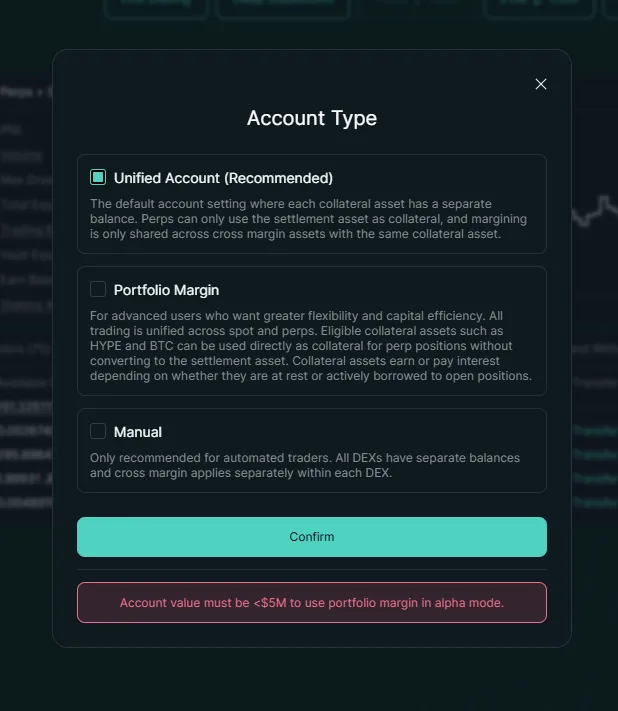
Previously, Hyperliquid treated your spot and perpetual futures balances as separate pools. You had USDC in your spot wallet and USDC in your perps wallet, and you had to move funds between them manually. With a Unified Account, each collateral asset keeps a single balance that does double duty: it is both your spot balance in that asset and the collateral for any cross-margin perp positions that use that asset.
If you already had an account from before the change, you don't have to do anything to opt in: the next time you log in, Hyperliquid shows a one-time Account Type Update dialog that explains the switch and asks you to acknowledge it before continuing. Clicking Accept moves you to Unified Account; if you'd rather keep balances separate, you can opt out afterward via the Unified button at the top right of the order form.
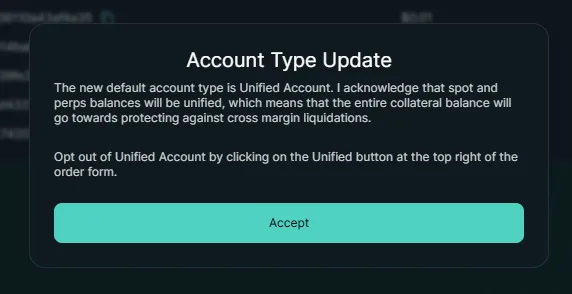
In practice, the new default means your USDC balance is available for both spot trading and perpetual futures at the same time - no more transferring between sub-accounts, and no more accidentally placing a trade only to find your funds are on the wrong side. There is one important rule to keep in mind: in Unified Account mode, perps can only use the settlement asset (USDC) as collateral. Other assets like HYPE and BTC sit in your account as spot balances - they don't back perp positions unless you step up to Portfolio Margin (covered below).
The account type you choose also changes which assets can act as collateral, whether your idle balances earn yield, how margin is shared across different DEXs, and how you deposit USDC. This guide covers all of it.
Info
Quick Summary - Hyperliquid Account Types
- Three account types: Unified Account (default/recommended), Portfolio Margin (advanced), and Manual (automated traders)
- Unified Account: one balance per asset shared between spot and cross-margin perps; perps are collateralized by the settlement asset (USDC)
- Cross-margin is shared per asset across every DEX that uses that asset as collateral - including HIP-3 markets like trade.xyz
- Portfolio Margin (advanced): lets HYPE and BTC act as perp collateral directly, and idle assets earn interest while borrowed assets pay it
- As of March 2026, fees: 0.045% taker / 0.015% maker for native perps, 0.09% taker / 0.03% maker for HIP-3 builder markets
- Switching account type is a one-click choice in Settings - applies immediately, no migration, zero downtime
- All positions, PnL, and balances are visible in one dashboard
The Three Account Types Explained
Hyperliquid's Account Type modal offers three options. Understanding what each one does - and which one to use - is essential now that the platform has consolidated around Unified Accounts.
Unified Account (Recommended for Most Users)
The default. As the modal puts it, "each collateral asset has a separate balance. Perps can only use the settlement asset as collateral, and margining is only shared across cross margin assets with the same collateral asset." In plain terms, Unified Account mode:
- Gives each asset one balance that serves both spot and cross-margin perps - so your USDC is shared across both markets with no manual transfers
- Collateralizes perps with the settlement asset (USDC) - HYPE, BTC, and other tokens stay as spot balances
- Shares cross margin per asset across every DEX that uses that asset, including builder-deployed trade.xyz HIP-3 markets
- Uses CCTP as the default USDC deposit method instead of the legacy Arbitrum bridge
- Provides a clean, simplified experience with one balance per asset to manage
This is the right choice for the vast majority of traders - from beginners to active day traders.
Portfolio Margin (Advanced)
Portfolio Margin is Hyperliquid's most capital-efficient account type. The modal describes it as "for advanced users who want greater flexibility and capital efficiency. All trading is unified across spot and perps." Where a Unified Account keeps a separate balance per asset, Portfolio Margin pulls all eligible assets into a single unified portfolio, and it changes how collateral works in two big ways:
- Multi-asset collateral - eligible assets such as HYPE and BTC can be used directly as collateral for perp positions without converting them to the settlement asset first. Each has its own loan-to-value ratio that determines how much it can back: at a reading on 8 September 2026 the API returned 0.65 for HYPE and 0.5 for UBTC.
- Interest on your balances - idle, lendable assets earn interest, and assets you borrow against to open positions pay interest, at the same rate.
Portfolio Margin is rolling out in stages, and the gate has both a floor and a ceiling. The Hyperliquid documentation currently requires the master account to have either more than $5M in weighted volume or an account value above $10k, and caps account value at $25M. That ceiling was $5M during the earlier alpha, so older write-ups (including an earlier version of this page) quote a number that has since moved. Eligible collateral and lendable assets are added progressively; five reserves were live at the September 2026 reading. Our HyperCore borrow and lend guide covers the reserves, the rate formula and the caps in detail. For more on how margin and leverage work, see our leverage trading guide.
Manual (For Automated Traders)
Manual mode keeps separate spot and perp balances, and separate balances per DEX, with cross margin applying within each DEX independently. The modal flags it as "only recommended for automated traders." It replaces the older Standard and DEX Abstraction modes.
When to use Manual mode:
- You are a market maker or high-volume automated trader who needs the highest L1 rate limits
- You are a builder or deployer who wants explicit, isolated control over each DEX
- You specifically want separate balance management for accounting or risk reasons
Info
How to Choose Your Account Type
New accounts already default to Unified Account, so most traders don't need to change anything. If you want to review or switch your account type, here is how.
Open Settings
Navigate to the Hyperliquid trading interface at app.hyperliquid.xyz and click the Settings icon (gear icon) in the top navigation.
Open the Account Type modal
In Settings, open the Account Type selector. You will see three options: Unified Account (recommended), Portfolio Margin, and Manual.
Select your account type
Choose Unified Account for the standard shared-balance experience, Portfolio Margin for multi-asset collateral and yield (gated, account value <$25M), or Manual for separate per-DEX balances.
Confirm
Review the description and click Confirm. The change applies immediately - there is no waiting period or lock-up.
Tip
Get Started with Unified Accounts
New to Hyperliquid? All new accounts default to Unified Account - the simplest way to trade. Sign up with our referral link for a 4% lifetime fee discount.
Join Hyperliquid - Save 4%Account Types vs Margin Modes
One of the most common sources of confusion on Hyperliquid is the difference between your account type and your margin mode. They are separate systems that work together.
Account Types (How Your Account Is Structured)
These determine how your balances are organized and what can act as collateral:
| Account Type | Balance Structure | Perp Collateral | Cross-Margin Scope | Best For |
|---|---|---|---|---|
| Unified Account | One balance per asset, shared spot + perps | Settlement asset (USDC) | Per asset, across DEXs | Most traders (default) |
| Portfolio Margin | One unified portfolio across eligible assets | Multi-asset (HYPE, UBTC, USDC, USDT0, USDH) | Whole portfolio | Advanced traders (gated, <$25M) |
| Manual | Separate spot/perp and separate per-DEX balances | Per DEX | Within each DEX | Market makers, bots, builders |
Margin Modes (How Individual Positions Are Margined)
These determine how collateral is allocated to your positions:
- Cross margin - Your entire available balance backs all cross-margined positions. Profits from one position can offset losses from another. Greater breathing room, but one catastrophic position can affect your whole account.
- Isolated margin - A fixed amount of margin is allocated to each position independently. If liquidated, only the isolated margin is lost. Safer for individual trades.
- Isolated-only - Forces all positions into isolated margin. No cross-margin option.
You choose an account type once (in settings), but you select a margin mode for each individual trade. For a deep dive into cross vs isolated margin and risk management strategies, see our cross vs isolated margin guide and leverage trading guide. For a detailed breakdown of how liquidation works - including formulas and worked examples - see our liquidation explained guide.
How Collateral Works - and What Changed
The biggest practical difference between the account types is what counts as collateral and whether your idle balances do anything. This is the part that changes how you manage your money on Hyperliquid.
Settlement-Asset Collateral (Unified Account)
In a Unified Account, perps are collateralized by the settlement asset - USDC. Your USDC balance is shared between spot and perps automatically, so you can buy a spot token and open a perp position from the same pool without transferring anything.
But the flip side matters: tokens like HYPE and BTC sit in your account as spot balances only. They are not backing your perp positions. If you hold a large HYPE bag and want to trade perps, that HYPE isn't doing collateral duty - you'd need USDC for margin. For most traders this is exactly the simple, predictable behavior they want.
Multi-Asset Collateral and Yield (Portfolio Margin)
Portfolio Margin changes the rules. Eligible assets are pulled into one unified portfolio, and they can back your perp positions directly. A call to allBorrowLendReserveStates on 8 September 2026 returned five reserves: HYPE and UBTC on the collateral side, and  USDC, USDT0 and USDH on the borrowable side.
- Use HYPE or BTC as collateral without selling. Each collateral asset has its own loan-to-value ratio, 0.65 for HYPE and 0.5 for UBTC at the September 2026 reading, so that share of its oracle value counts toward your margin. You keep your spot exposure while it does double duty as collateral.
- Idle balances earn, borrowed balances pay. Lendable assets that are just sitting there earn interest; when you open a position that borrows against your collateral, you pay interest at the same rate. Your capital is never fully idle.
This is a meaningful upgrade for capital efficiency - but it adds complexity. You are effectively running a margin-lending book alongside your trades, and the value of your collateral can move with the market. That is why it is gated.
Warning
HIP-3 Cross Margin: Shared Margin Across DEXs
One of the most significant implications of unified accounts is HIP-3 cross margin - the ability to share margin across perpetual contracts deployed by different third-party builders.
What This Means in Practice
Before HIP-3 cross margin, positions on builder-deployed markets (like equity perps and commodity perps on trade.xyz) were isolated from your native Hyperliquid perps. You could not share margin between a BTC-USD position on Hyperliquid and an NVDA position on trade.xyz.
With unified accounts and HIP-3 cross margin enabled, all cross-margined perps with the same collateral share one margin pool - regardless of which DEX deployed them. Your BTC long on native Hyperliquid and your NVDA short on trade.xyz draw from the same USDC balance when both are set to cross margin.
This is a massive improvement for capital efficiency. Instead of fragmenting your USDC across isolated positions on different DEXs, your entire balance supports your entire portfolio.
Protected Cross Margin
Hyperliquid implements a novel protected cross margin system for HIP-3 markets. This protects overall system solvency without sacrificing the user experience.
The key concern with cross margin across third-party markets is that a poorly designed or illiquid market could create cascading liquidations that affect the broader system. Protected cross margin addresses this by enforcing solvency safeguards at the protocol level while still allowing traders to benefit from shared margin.
Info
Which Markets Support Cross Margin?
HIP-3 cross margin is available for markets where the deployer has opted in and the asset meets Hyperliquid's eligibility criteria. As of March 2026, trade.xyz markets with adequate liquidity and oracle reliability are eligible.
Check the trading interface for each market to see whether cross margin is available. Markets that only support isolated margin will show isolated-only in the margin mode selector.
Warning
The CCTP Migration: How USDC Deposits Are Changing
Alongside unified accounts, Hyperliquid is migrating its default USDC deposit method from the Arbitrum bridge to CCTP (Cross-Chain Transfer Protocol).
What Is CCTP?
CCTP is Circle's native protocol for transferring USDC across blockchains. Instead of bridging wrapped USDC through Arbitrum, CCTP burns USDC on the source chain and mints native USDC on the destination chain. The result is native USDC on Hyperliquid - not a bridged representation.
What Changes for Traders
- Unified account users now default to CCTP for USDC deposits
- All deposit options remain available - you can still choose the Arbitrum bridge or other methods if you prefer
- This is part of a phased migration to deprecate the Arbitrum bridge entirely and move to native USDC
For most users, the change is transparent. The deposit flow in the Hyperliquid interface walks you through it. For a step-by-step deposit walkthrough, see our USDC deposit guide. If you are bridging from other chains, our bridge guide covers all available options.
Tip
Save 4% on Every Trade
Whether you trade perps, spot, or HIP-3 markets - lower fees compound into real savings. Use our referral link for a lifetime 4% discount on all Hyperliquid trading fees.
Get Your Fee DiscountHIP-4 Outcome Trading: Now Live on Mainnet
Hyperliquid's account infrastructure was built with future market types in mind, and HIP-4 has now arrived. Outcome markets went live on Hyperliquid mainnet on May 2, 2026 with a recurring binary BTC contract, and on May 7, 2026 the first multi-outcome market went live - a recurring BTC price-range contract that settles daily at 06:00 UTC with asymmetric upside, downside, and intermediate buckets.
What HIP-4 Enables
- Prediction-style binary contracts - yes/no outcomes that settle to 0 or 1, fully collateralized with no leverage and no liquidation risk
- Multi-outcome markets - bundled related outcomes traded as a single market with split, negate, and merge operations for capital-efficient bucket views
- Bounded options-like instruments - defined-risk exposure within a price range (rolling out in stages after the initial validation phase)
- Event-based contracts - any outcome with an objectively verifiable resolution
HIP-4 leverages the same HyperCore infrastructure that powers perps and spot, inheriting the speed, self-custody, and zero gas fees that define the platform. It plugs directly into unified accounts, so your USDC balance is available for outcome contracts alongside your existing perps and spot positions - no separate funding flow required.
Info
Which Account Type Should You Use?
Here is a simple decision framework:
Use Unified Account If:
- You are a new user (it is already your default)
- You trade both spot and perps and want one shared balance
- You want HIP-3 cross margin shared per asset across DEXs
- You want the simplest, most predictable experience
Use Portfolio Margin If:
- You are an advanced trader who wants HYPE or BTC to act as live collateral
- You want idle balances to earn yield while you trade
- Your account value is under the $25M ceiling and over the $10k floor (or you clear the $5M weighted-volume route), and you understand the risks of margin lending and multi-asset collateral
Use Manual If:
- You are a market maker or run automated trading bots
- You need the highest L1 rate limits for programmatic access
- You are a builder/deployer who wants explicit, isolated control over each DEX
Unified Accounts and Your Trading Workflow
With unified accounts, several aspects of your day-to-day trading change for the better:
No More Balance Transfers
Previously, if you wanted to buy a spot token and then open a perp position, you might need to transfer USDC between wallets. With unified accounts, the same balance serves both. This removes a step that was especially annoying during fast-moving markets.
Better Capital Efficiency
When your margin is pooled, you are not leaving idle USDC in a spot wallet while your perps wallet runs low (or vice versa). Your full balance is working for you across all markets.
Simplified Fee Tracking
One balance means one set of transactions to track. For traders who monitor their fee tiers and costs, unified accounts make accounting cleaner.
Cross-DEX Risk Management
With HIP-3 cross margin, you can now think about your positions holistically - a long on native BTC perps partially offsets a short on trade.xyz equity perps from a margin perspective. This opens up hedging strategies that were previously fragmented across isolated margin pools.
For a full breakdown of available order types - including stop-losses, take-profit orders, and advanced conditional orders - see our order types guide. These all work the same way under unified accounts.
Start Trading on Hyperliquid
Unified accounts, zero gas fees, 100+ markets. Get a 4% lifetime fee discount when you sign up through our referral link.
Open Your Account - Save 4%Summary
Unified Accounts represent Hyperliquid's evolution from a perpetual futures exchange into a comprehensive trading platform. By sharing balances across spot and perps, enabling cross-DEX margin, and migrating to native USDC via CCTP, the platform is removing friction at every level.
Here is what to remember:
- Unified Account is now the default for all new Hyperliquid accounts - each asset has one balance shared between spot and perps, with USDC collateralizing perps
- Three account types exist: Unified Account (recommended), Portfolio Margin (advanced - multi-asset collateral and yield, gated to <$25M), and Manual (for market makers, bots, and builders)
- Portfolio Margin lets HYPE and BTC act as collateral directly, and pays interest on idle assets while charging it on borrowed ones. The interest comes from HyperCore's native borrow and lend book. Since September 2026 Unified and Manual accounts can also borrow from that book deliberately through a manual borrow action, which Portfolio Margin accounts do not get because they borrow automatically
- Margin modes are separate from account types - cross, isolated, and isolated-only apply per position, regardless of your account type
- HIP-3 cross margin shares margin per asset across builder-deployed DEXs like trade.xyz when you use a Unified Account
- CCTP is the new default deposit method, replacing the Arbitrum bridge for a more native USDC experience
- HIP-4 outcome trading is live on mainnet - a recurring binary BTC market launched May 2, 2026 and a multi-outcome BTC price-range market followed on May 7, 2026, both running on the same unified balance
If you do not have a Hyperliquid account yet, use our referral link to get a 4% lifetime discount on all trading fees. For a complete walkthrough of getting started, see our beginner trading guide.
Frequently Asked Questions
A Unified Account is Hyperliquid's default account type. Each collateral asset keeps a single balance that does double duty - it is both your spot balance in that asset and the collateral for your cross-margin perp positions that use that asset. In practice your USDC is shared between spot and perps automatically, so there are no more manual transfers between them. New accounts default to Unified Account.
Unified Account keeps a separate balance per asset and only lets perps use the settlement asset (USDC) as collateral, with cross margin shared per asset. Portfolio Margin goes further: it unifies all spot and perps trading into one portfolio and lets eligible assets like HYPE and BTC be used directly as collateral for perps without converting to USDC. Idle assets earn interest and borrowed assets pay it. Portfolio Margin is an advanced, capital-efficient mode that is gated: the docs require either more than $5M in weighted volume or an account value above $10k, and cap account value at $25M.
Yes, but only in Portfolio Margin mode. In Unified Account mode, perps can only use the settlement asset (USDC) as collateral, so HYPE and BTC sit as spot balances. In Portfolio Margin mode, eligible collateral assets such as HYPE and BTC can directly back perp positions without first converting them to USDC. Each carries its own loan-to-value ratio; a reading of the API on 8 September 2026 returned 0.65 for HYPE and 0.5 for UBTC.
Manual mode keeps separate spot and perp balances and separate balances per DEX, with cross margin applying within each DEX independently. It replaces the older Standard and DEX Abstraction modes and is recommended only for market makers, high-volume automated traders, and builders who need explicit, isolated control over each DEX.
Open the Account Type modal from Settings in the Hyperliquid interface. You will see three options: Unified Account (the recommended default), Portfolio Margin (advanced, gated), and Manual (for automated traders). Select one and confirm - the change applies immediately with no lock-up. Most traders should stay on Unified Account.
Independent resource: Hyperliquid Guide is an independent, third-party resource operated by Concept211. It is not affiliated with, produced by, reviewed by or endorsed by Hyper Foundation, Hyperliquid Labs or any other Hyperliquid-ecosystem entity. "Hyperliquid" and related names and marks belong to their respective owners and are used here only to identify the platform this site documents. Read the full disclaimer.
Not advice: Nothing on this site is legal, tax, financial or investment advice. Descriptions of regulatory status, tax treatment and market availability are general information that varies by jurisdiction and changes over time. Confirm anything that matters to you with a qualified professional and against primary sources. Trading perpetual futures involves substantial risk of loss, and past performance does not indicate future results.
Disclosure: this site contains referral links. Signing up through the 4% lifetime fee discount link earns us a share of the trading fee Hyperliquid already charges, at no extra cost to you.
Ready to Start Trading?
Join Hyperliquid with our referral link and get a 4% lifetime fee discount. No KYC, no email - just connect your wallet and trade.
Start Trading - Save 4%