Hyperliquid Isolated vs Cross Margin: Which Should You Use?
Table of Contents
- What Is Isolated Margin on Hyperliquid?
- What Is Cross Margin on Hyperliquid?
- Side-by-Side Comparison
- Which Should You Choose? Practical Guidance
- Scenario 1: Single Directional Trade (Use Isolated)
- Scenario 2: Hedged Pair Trade (Cross Can Work)
- Scenario 3: Multiple Independent Altcoin Positions (Use Isolated)
- How to Set Your Margin Mode
- Related Guides
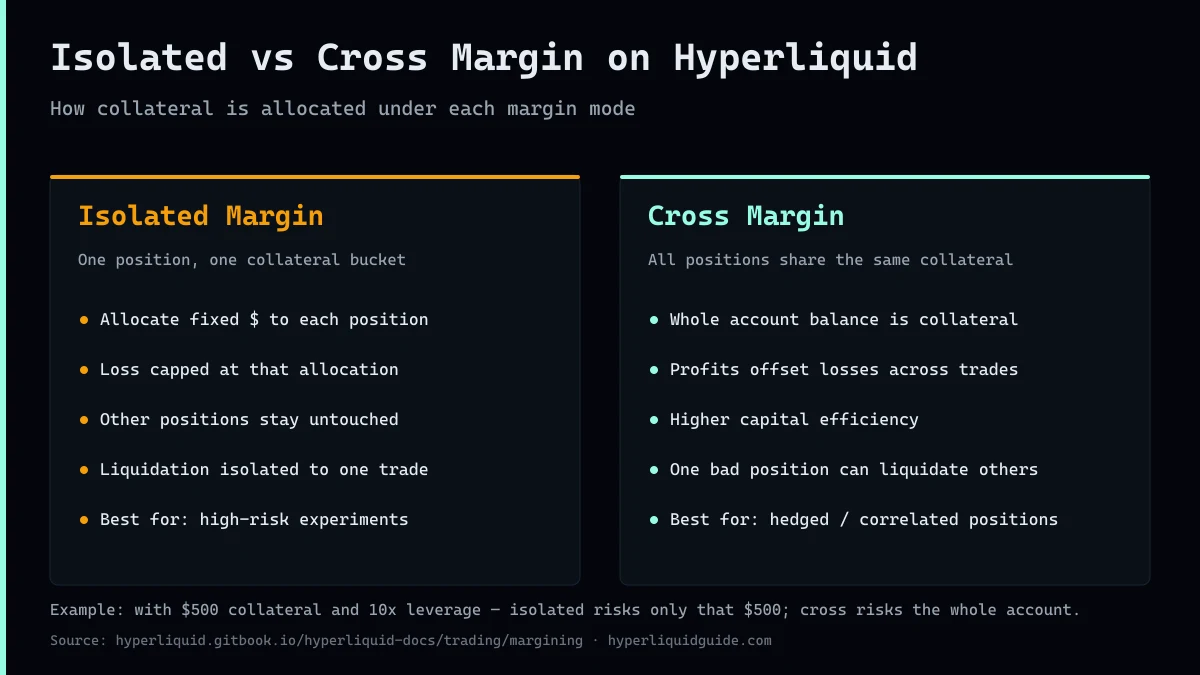
Isolated vs cross margin in one paragraph. On Hyperliquid, every leveraged position uses one of two margin modes. Isolated margin ring-fences a specific amount of USDC to a single position — if that trade is liquidated, you lose only the allocated margin and nothing else. Cross margin pools your entire USDC balance as shared collateral across all open positions — capital-efficient because unrealized gains on one trade cushion losses on another, but dangerous because a single large loss can cascade and drain your whole account. You select the mode per market in the leverage selector on app.hyperliquid.xyz before opening a position. The default recommendation for most traders is isolated margin — it enforces a hard cap on loss per trade and prevents one bad position from destroying your account.
What Is Isolated Margin on Hyperliquid?
Isolated margin means you assign a fixed amount of USDC collateral to a single position. That collateral — and only that collateral — backs the trade. The rest of your account balance is completely walled off.
How it works in practice: You have $10,000 in your Hyperliquid account and want to open a 10x long on ETH. You set isolated margin and allocate $2,000 as margin, giving you a $20,000 notional position. If ETH drops far enough to trigger liquidation, you lose $2,000. Your remaining $8,000 is untouched.
This is the margin mode you should start with. The loss ceiling is explicit and predetermined — there are no surprises. You know the worst case before you click "Buy."
When isolated margin liquidation triggers:
- The mark price moves against your position.
- Your unrealized loss consumes the allocated margin down to the maintenance margin level.
- Hyperliquid's liquidation engine closes the position automatically.
- You lose the isolated margin. The rest of your account is unaffected.
Tip
You can set isolated margin on some markets and cross margin on others simultaneously. A common pattern: isolated margin on speculative altcoin trades, cross margin on a hedged BTC/ETH book. Hyperliquid does not force one mode account-wide.
What Is Cross Margin on Hyperliquid?
Cross margin pools your entire USDC balance as shared collateral for all positions running in cross mode. Every cross-margin position draws from — and contributes to — the same margin pool. Exactly which balance counts as that pool depends on your account type: a Unified Account uses your shared USDC, while Portfolio Margin can also count assets like HYPE and BTC as collateral.
How it works in practice: Same $10,000 account, same 10x long ETH at $20,000 notional. But now you also have a 5x short SOL position worth $15,000. In cross mode, both positions share the full $10,000 balance. If your ETH long is profitable while SOL drops, the ETH gains offset the SOL losses in real time, keeping your overall margin healthy.
That sounds efficient — and it is. Cross margin gives you a larger buffer against liquidation on any individual position because the entire account balance absorbs losses. But the tradeoff is severe: if the market moves hard against multiple positions at once (a correlation shock), the losses compound against the same shared pool and can wipe out everything.
Warning
Cascade liquidation risk. In cross margin, one losing position can drain margin from winning positions. If your ETH long drops sharply, the losses reduce the shared collateral backing your SOL short too. If the account equity drops below the combined maintenance margin requirement, the liquidation engine starts closing positions — beginning with the largest loser and potentially cascading through the rest.
When cross margin liquidation triggers:
- Losses across all cross-margin positions reduce total account equity.
- Account equity falls below the combined maintenance margin requirement.
- The liquidation engine closes the largest loss-making position first.
- If that is not enough to restore the margin ratio, it continues closing positions until the account is above maintenance or fully liquidated.
Side-by-Side Comparison
| Feature | Isolated Margin | Cross Margin |
|---|---|---|
| Collateral pool | Fixed amount per position | Entire USDC balance shared |
| Maximum loss per trade | Only the allocated margin | Up to your full account |
| Liquidation trigger | Position margin falls below maintenance | Account equity falls below combined maintenance |
| Cascade risk | None — other positions unaffected | Yes — one loss can liquidate others |
| Capital efficiency | Lower — margin sits idle per trade | Higher — unused balance cushions all positions |
| Unrealized PnL offsetting | No — each position is independent | Yes — gains on one offset losses on another |
| Best use case | Directional bets, speculative trades, learning | Hedged portfolios, correlated pairs, experienced traders |
| Recommended for | Beginners and most traders | Intermediate+ traders running multi-leg strategies |
There is a third tier above both of these, and it is worth knowing exists even if you never switch to it. Portfolio Margin margins your entire account together, spot balances and perp positions across every DEX, rather than per position or per asset. It also lets HYPE and BTC act as collateral directly and pays interest on idle balances through HyperCore's native borrow and lend book. It is gated by account size and it changes how liquidation works, so read the account types guide before considering it.
Start Trading on Hyperliquid
Sign up with our referral and get a 4% lifetime fee discount on every trade.
Join HyperliquidWhich Should You Choose? Practical Guidance
The right margin mode depends on your trading style and experience level. Here are three common scenarios with clear recommendations.
Scenario 1: Single Directional Trade (Use Isolated)
You have $5,000 in your account and want to go 10x long on BTC because you expect a breakout. You are risking $1,000 on this trade.
- Set isolated margin with $1,000 allocated.
- Your $10,000 notional BTC position has a liquidation price roughly 9.5% below entry.
- Worst case: you lose $1,000. Your remaining $4,000 is safe.
- Place a stop-loss above the liquidation price to exit with a smaller, controlled loss.
This is the correct default for any trade where the thesis is independent and directional. There is no reason to risk your entire account on a single idea.
Scenario 2: Hedged Pair Trade (Cross Can Work)
You are long BTC and short ETH — a spread trade betting that BTC outperforms ETH. Both legs move together most of the time, so losses on one are partially offset by gains on the other.
- Cross margin lets the unrealized PnL from both legs net against each other.
- Your effective margin requirement is lower because the positions are inversely correlated.
- If the spread moves in your favor, you never risk liquidation on either leg individually.
Cross margin is defensible here because the positions are designed to hedge each other. The cascade risk is lower (though not zero — correlation can break during black swan events).
Scenario 3: Multiple Independent Altcoin Positions (Use Isolated)
You are long DOGE, long AVAX, and short LINK — three unrelated trades with different theses. These positions are not hedging each other. In cross margin, a flash crash in DOGE could drain margin from AVAX and LINK, liquidating positions that were otherwise healthy.
- Set isolated margin on each position with a defined risk budget.
- If DOGE gets liquidated, AVAX and LINK are completely unaffected.
- Total risk is the sum of your three isolated allocations — never more.
The simple rule: Use isolated margin unless you have a specific reason to use cross. Isolated is the safer default because it makes your maximum loss per trade explicit and prevents cascade liquidations. Graduate to cross margin only when you are running hedged or correlated positions where netting unrealized PnL is a deliberate part of your strategy.
How to Set Your Margin Mode
On app.hyperliquid.xyz, click the leverage chip above the order panel (it shows your current leverage, e.g. "5x"). A modal opens with two toggles — Cross and Isolated — plus a leverage slider. Select your preferred mode, set the leverage level, and confirm. The setting applies per market, and you must choose before opening a position. To switch modes on an existing position, close it first and reopen with the new mode.
For a full step-by-step walkthrough of the leverage modal, see the leverage guide. If you are new to perpetual futures, start there.
Related Guides
- Leverage Guide — how to set leverage, max leverage by asset, and position sizing
- Leverage Trading Guide — full tutorial for placing your first leveraged trade
- Liquidation Explained — how liquidation works, formulas, and five strategies to avoid it
- Order Types Guide — stop-loss, take-profit, and all order types on Hyperliquid
- Perpetuals Explained — what perps are and how they work
- Fees Explained — fee tiers, maker/taker rates, and how to save on trading fees
Trade with a 4% Lifetime Fee Discount
Lower fees mean more margin in your account. Sign up through our referral to save on every trade.
Get StartedFrequently Asked Questions
No. You must set your margin mode before opening a position. To change margin mode on an existing position, close it first and reopen with the new mode selected. You can set different margin modes on different markets simultaneously.
If your total account equity falls below the maintenance margin requirement across all cross-margin positions, the liquidation engine closes positions starting with the largest loss-making one. This can cascade — one losing position can drain margin from winning positions.
Yes. All positions set to cross margin share the same collateral pool (your USDC balance). Unrealized gains on one position can offset losses on another, but severe losses on any position can trigger liquidation across all cross-margin positions.
Yes. Isolated margin caps your maximum loss to the specific margin you allocate to each position. Your remaining account balance is protected. This makes it the recommended default for new traders learning leverage.
Independent resource: Hyperliquid Guide is an independent, third-party resource operated by Concept211. It is not affiliated with, produced by, reviewed by or endorsed by Hyper Foundation, Hyperliquid Labs or any other Hyperliquid-ecosystem entity. "Hyperliquid" and related names and marks belong to their respective owners and are used here only to identify the platform this site documents. Read the full disclaimer.
Not advice: Nothing on this site is legal, tax, financial or investment advice. Descriptions of regulatory status, tax treatment and market availability are general information that varies by jurisdiction and changes over time. Confirm anything that matters to you with a qualified professional and against primary sources. Trading perpetual futures involves substantial risk of loss, and past performance does not indicate future results.
Disclosure: this site contains referral links. Signing up through the 4% lifetime fee discount link earns us a share of the trading fee Hyperliquid already charges, at no extra cost to you.
Ready to Start Trading?
Join Hyperliquid with our referral link and get a 4% lifetime fee discount. No KYC, no email - just connect your wallet and trade.
Start Trading - Save 4%