Hyperliquid Leverage Trading: Up to 40x, How Margin & Liquidation Work (2026)
Table of Contents
- What Is Leverage Trading?
- What Does 50x Leverage Mean?
- How Leverage Works on Hyperliquid
- Available Leverage
- How Margin Relates to Leverage
- How USDC Collateral Works on Hyperliquid
- Cross Margin vs Isolated Margin
- Cross Margin
- Isolated Margin
- Setting Your Leverage on Hyperliquid
- Understanding Liquidation
- What Triggers Liquidation
- What Happens During Liquidation
- How to Avoid Liquidation
- Risk Management Strategies
- Position Sizing: The 1-2% Rule
- Start Low, Scale Slowly
- Always Use Stop-Losses
- Keep Dry Powder
- Funding Rates Explained
- What Are Funding Rates?
- How Funding Affects Your Positions
- Checking Funding Rates
- Common Mistakes Beginners Make
- Using Maximum Leverage
- Ignoring Funding Rates on Long Holds
- Revenge Trading After Liquidation
- Not Understanding Cross vs Isolated Mode
- Sizing Positions Based on Conviction, Not Math
- Summary
What Is Leverage Trading?
Leverage trading lets you control a larger position than your account balance would normally allow. If you have $1,000 and use 10x leverage, you control a $10,000 position. Your $1,000 acts as margin - collateral that backs the leveraged position.
The appeal is obvious: if that $10,000 position gains 5%, you make $500 - a 50% return on your $1,000 margin. Without leverage, a 5% gain on $1,000 is just $50.
But leverage is a double-edged sword. That same 5% move against you means a $500 loss - 50% of your margin, gone. At 10x leverage, a 10% adverse move wipes out your entire margin and triggers liquidation, where your position is forcibly closed.
Important
Understanding how leverage, margin, and liquidation work is not optional - it is the difference between growing an account and blowing one up. This guide explains the mechanics on Hyperliquid so you can use leverage intelligently. If any term is unfamiliar, check our trading glossary for quick definitions.
What Does 50x Leverage Mean?
50x leverage means your margin controls a position fifty times its size: $1,000 of USDC collateral opens a $50,000 position. The multiplier applies to position size, not to your returns. A 1% move in your favor is still 1% of $50,000, which happens to be 50% of the $1,000 you put up.
The same arithmetic runs the other way, and that is the part worth internalizing. A 1% move against you costs half your margin. A 2% move erases it and triggers liquidation. On a liquid crypto pair, 2% is an ordinary hour.
Worth knowing before you go looking for it: Hyperliquid's native crypto perps do not offer 50x. Reading the Hyperliquid API on 22 September 2026, the highest setting on any of the 234 native markets was 40x, on BTC alone, with ETH at 25x and most altcoins between 3x and 10x. The 50x tier does exist on the exchange, but on the trade.xyz HIP-3 venue and on currency pairs rather than crypto: JPY carried a 50x maximum on the same reading. Every market shows its own live ceiling in the leverage selector.
How Leverage Works on Hyperliquid
Hyperliquid is a perpetual futures exchange, and every perpetual futures trade involves leverage. Even "1x leverage" is technically a leveraged trade - you are trading a derivatives contract, not buying the underlying asset. If you want to own tokens outright without leverage, see our spot trading guide.
Available Leverage
The maximum leverage varies by asset based on liquidity and volatility:
| Asset Tier | Examples | Max Leverage |
|---|---|---|
| Major pairs | BTC-USD | Up to 40x |
| Large caps | ETH-USD, SOL-USD, XRP-USD | Up to 20-25x |
| Mid caps | ARB-USD, OP-USD, INJ-USD | Up to 5-10x |
| Small caps / new listings | Various altcoins | Up to 3-5x |
These tiers cover crypto pairs. Hyperliquid also offers commodity and equity perpetuals which follow similar leverage structures. While Binance Futures offers up to 125x on BTC, Hyperliquid's 40x cap covers the vast majority of prudent strategies — see our Hyperliquid vs Binance Futures comparison for the full leverage and fee breakdown.
The exact maximum leverage for each market is displayed in the trading interface when you click the leverage selector.
How Margin Relates to Leverage
Your margin is the amount of collateral backing your position. The relationship is straightforward:
Position Size = Margin x Leverage
So with $500 margin and 20x leverage, your position size is $10,000. The higher the leverage, the less margin you need for the same position size - but the closer your liquidation price.
Example: You want a $10,000 long on ETH-USD at $2,500.
| Leverage | Margin Required | Liquidation Distance |
|---|---|---|
| 2x | $5,000 | ~50% drop ($1,250) |
| 5x | $2,000 | ~20% drop ($2,000) |
| 10x | $1,000 | ~10% drop ($2,250) |
| 25x | $400 | ~4% drop ($2,400) |
At 25x leverage, which is the most ETH allows, a $2,500 entry liquidates on a drop to roughly $2,400. ETH can move $100 in a single volatile session.
How USDC Collateral Works on Hyperliquid
All margin on Hyperliquid is denominated in USDC. When you deposit USDC into your Hyperliquid account, it becomes your available collateral - the capital backing every leveraged position you open. Here is how USDC collateral works:
- Single collateral currency. Unlike exchanges that accept multiple collateral types (BTC, ETH, stablecoins), Hyperliquid uses USDC exclusively as margin collateral for perpetual trading. This simplifies risk calculations and eliminates collateral volatility.
- Cross-margined by default. Your entire USDC balance serves as collateral across all open positions in cross margin mode. Unrealized profits on one position can offset margin requirements on another.
- No conversion fees. Since everything is settled in USDC, there are no hidden currency conversion costs that some exchanges charge when using non-USD collateral.
- Instant collateral. Deposited USDC is immediately available as trading collateral - no waiting period, no staking requirement.
Your available collateral determines your maximum position size: at 10x leverage, $5,000 in USDC collateral lets you open up to $50,000 in positions. To deposit USDC, bridge from Arbitrum or use a cross-chain bridge from 22+ networks.
Cross Margin vs Isolated Margin
Hyperliquid supports both cross margin and isolated margin modes. Understanding the difference is critical before you open any leveraged position. Note that how cross margin works also depends on your account abstraction mode - unified accounts enable cross margin across HIP-3 DEXs as well.
Cross Margin
In cross margin mode, your entire available account balance serves as collateral for all of your open positions. This means:
- All positions share the same margin pool
- Unrealized profits from one position can offset unrealized losses from another
- You have more total collateral backing each position, so liquidation prices are farther from your entries
- But if one position blows up badly enough, it can drain your entire account balance and trigger liquidation of your other positions
When to use cross margin: When you want maximum breathing room on your positions and you are comfortable with the risk that one bad trade can affect your whole portfolio. Cross margin is common among experienced traders who actively manage their risk. Active multi-market traders should also read up on Hyperliquid's unified account margin model, which lets cross-margin collateral flow not just across native perps but across HIP-3 builder markets (trade.xyz equity and commodity perps) as well — a meaningful capital-efficiency boost when running paired crypto + equity positions.
Isolated Margin
In isolated margin mode, you allocate a fixed amount of margin to each position independently. This means:
- Each position is ring-fenced from the rest of your account
- If a position is liquidated, you only lose the margin allocated to that specific trade
- Your remaining account balance and other positions are unaffected
- But your liquidation price is closer because you are using less total collateral
When to use isolated margin: When you want to strictly limit the damage from any single trade. Isolated margin is generally recommended for beginners and for higher-risk trades where you want to cap your maximum loss.
Warning
Example comparison:
You have a $5,000 account and open a $10,000 BTC long at 10x leverage.
- Cross margin: Your entire $5,000 balance backs the position. Liquidation price is very far away. But if BTC crashes and your unrealized loss exceeds $5,000, your whole account is wiped.
- Isolated margin (with $1,000 allocated): Only $1,000 backs the position. Liquidation is closer, but your maximum loss on this trade is $1,000 - the other $4,000 is safe no matter what happens.
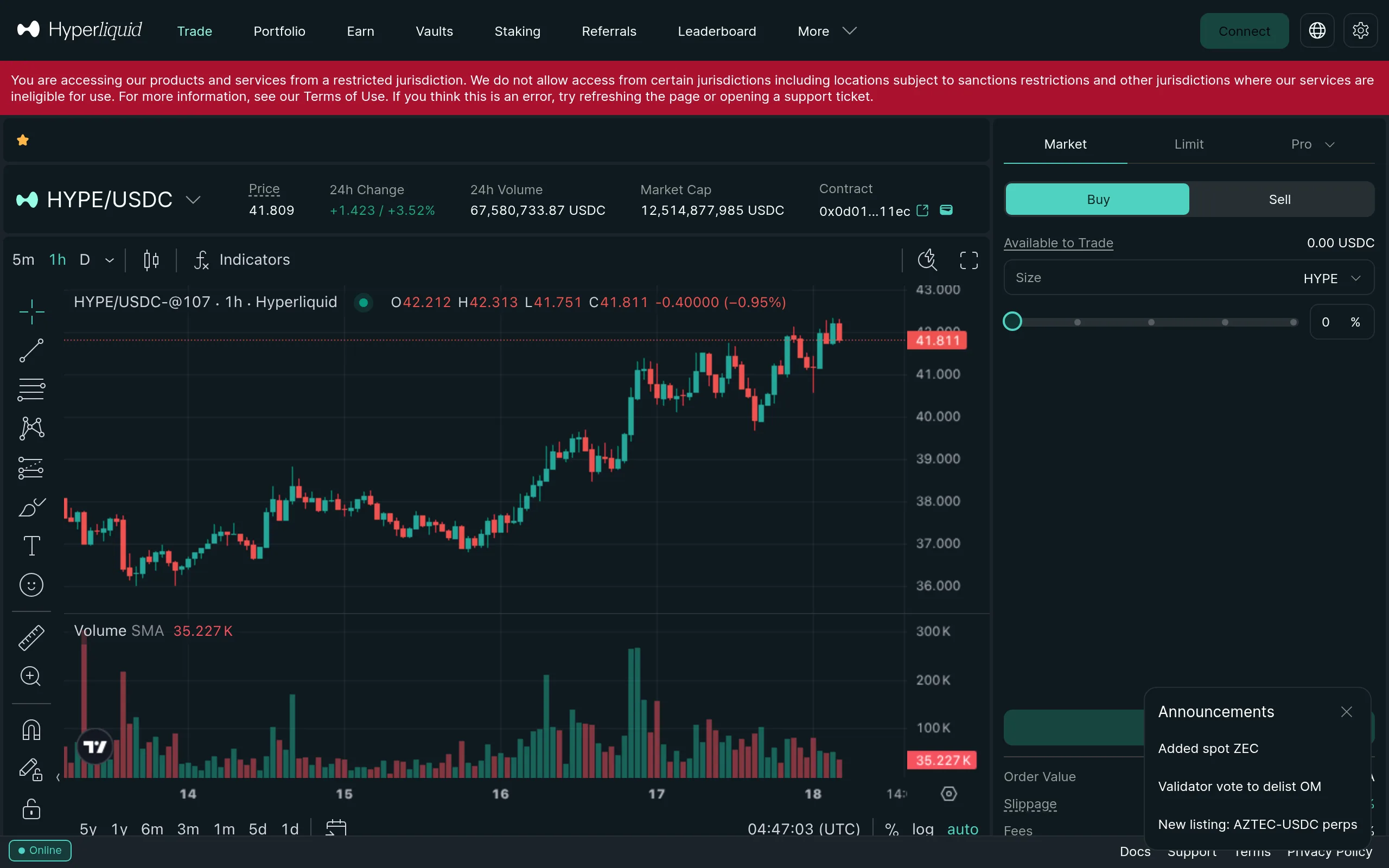
Setting Your Leverage on Hyperliquid
Adjusting leverage on Hyperliquid is straightforward:
- Select your market - Choose the asset you want to trade (e.g., BTC-USD)
- Click the leverage indicator - You will see a leverage button or slider near the order entry panel, typically showing your current leverage setting
- Adjust the leverage - Use the slider or type in your desired leverage (e.g., 5x)
- Select margin mode - Choose Cross or Isolated from the margin mode toggle
- Place your order - Enter your order details and confirm
Tip
Understanding Liquidation
Liquidation is the event every leveraged trader dreads - and the one you need to understand completely.
What Triggers Liquidation
Every leveraged position has a maintenance margin requirement. This is the minimum amount of margin that must back the position. When your position's unrealized loss erodes your margin below this maintenance threshold, Hyperliquid's liquidation engine closes your position automatically.
The liquidation price is calculated based on:
- Your entry price
- Your leverage
- Your margin (isolated) or account balance (cross)
- The maintenance margin rate for the asset
Hyperliquid displays your liquidation price clearly in the positions panel for every open trade. Always know where it is.
Tip
What Happens During Liquidation
- Your position is taken over by Hyperliquid's liquidation engine
- The engine closes the position at market price
- You lose the margin backing that position (in isolated mode) or the loss is deducted from your account (in cross mode)
- A liquidation fee is charged
You never owe more than your account balance on Hyperliquid. There is no concept of negative balance or owing the exchange money. The worst-case scenario is losing your deposited margin - not ending up in debt.
Important
How to Avoid Liquidation
- Use lower leverage - The most effective prevention. At 3x leverage, the market needs to move 33% against you before liquidation. At 40x, it only needs to move 2.5%.
- Set stop-losses well above your liquidation price - Your stop-loss should trigger long before liquidation is even a possibility. A 10x leveraged position liquidates at ~10%, so set your stop-loss at 3-5%.
- Monitor your margin ratio - Hyperliquid shows your margin health in the portfolio tracker. When it gets low, reduce position size or add margin.
- Avoid holding through major events - Scheduled events like FOMC meetings, CPI releases, or token unlocks can cause violent price swings. Use a VPN and follow security best practices to protect your wallet and trading activity.
Save on Every Leveraged Trade
Lower fees mean your leverage works harder for you. Sign up through our referral link for a 4% lifetime discount on all trading fees - market, limit, and stop orders.
Get Your 4% Fee DiscountRisk Management Strategies
Leverage is a tool. Like any tool, it can build or destroy depending on how you use it. Here are the risk management practices that keep leveraged traders in the game long term.
Position Sizing: The 1-2% Rule
Never risk more than 1-2% of your total account on a single trade. This means your stop-loss should be placed so that if it triggers, you lose no more than 1-2% of your account balance.
Example: You have a $5,000 account. Your maximum risk per trade is $100 (2%).
- If you are using 10x leverage on a BTC trade with a stop-loss 1% away from entry, your position size should be $10,000 (because 1% of $10,000 = $100 loss).
- If your stop-loss is 2% away, your position size should be $5,000 (because 2% of $5,000 = $100 loss).
This formula keeps you in the game even through a long losing streak. Ten consecutive losses at 2% risk per trade only costs you 18.3% of your account - painful but recoverable.
Start Low, Scale Slowly
There is no reason to use high leverage when you are learning. Start at 2-3x and increase only after you have a proven, profitable strategy over at least 50-100 trades. Many successful traders never go above 5x. Once you have a system that works, our Hyperliquid trading strategies guide covers how to systematize it with automated market-making, funding arbitrage, and hard risk controls.
Always Use Stop-Losses
On leveraged trades, a stop-loss is not optional - it is survival. Without one, a normal market correction can liquidate a high-leverage position before you even open your laptop. Set your stop-loss before or immediately after entering every trade. See our order types guide for details on stop-market vs stop-limit orders.
Warning
Keep Dry Powder
Do not use all your margin on a single position. Keep at least 50% of your account balance available as unused margin. This gives you flexibility to take new opportunities and provides a buffer if existing positions move against you in cross margin mode.
Funding Rates Explained
If you hold a leveraged perpetual futures position for any length of time, you need to understand funding rates. They are an ongoing cost (or income) that directly affects your PnL.
What Are Funding Rates?
Perpetual futures do not expire like traditional futures. To keep the perpetual price anchored to the spot price, exchanges use funding rate payments exchanged between long and short holders every hour on Hyperliquid.
- Positive funding rate: Longs pay shorts. This happens when the perpetual price is trading above the spot price (bullish market conditions). Learn more in our short selling guide.
- Negative funding rate: Shorts pay longs. This happens when the perpetual price is below spot (bearish conditions).
How Funding Affects Your Positions
Funding is charged based on your position size, not your margin. At 10x leverage, the funding cost is amplified 10x relative to your margin.
Example: You hold a $50,000 long position on BTC with a funding rate of 0.01% per 8 hours (a common rate in moderately bullish conditions).
- Funding cost per 8 hours: $50,000 x 0.01% = $5
- Daily cost: $15
- Monthly cost: $450
On a $5,000 margin (10x leverage), that is 9% of your margin eaten by funding in a single month. This is a meaningful cost for longer-term positions. Note that funding payments are also taxable events - see our tax reporting guide for details on how to track and report them.
Checking Funding Rates
Hyperliquid displays the current funding rate for each asset directly on the trading interface. You can see:
- The current predicted funding rate
- Historical funding rates
- Whether you would be paying or receiving funding based on your position direction
Info
Tip
Monitor real-time open interest and market positioning with our Open Interest Tracker. High open interest combined with extreme funding rates often signals potential liquidation cascades - critical data for managing leveraged positions.
Common Mistakes Beginners Make
Using Maximum Leverage
On BTC the leverage slider goes to 40x, but that does not mean you should use it. Maximum leverage is designed for experienced traders making very short-term trades with tight stop-losses. For beginners, the top of the slider almost guarantees liquidation.
Ignoring Funding Rates on Long Holds
Holding a leveraged position for days or weeks during a trending market can rack up significant funding costs that eat into or eliminate your profits. Always check the current funding rate before opening a position you plan to hold.
Revenge Trading After Liquidation
Getting liquidated feels terrible. The natural urge is to immediately open another position with higher leverage to "make it back." This almost always leads to a second liquidation and an emotional spiral. After a liquidation, step away from the screen for at least an hour. If you find yourself making emotional trades, consider shifting a portion of your capital to passive strategies — copy trading on Hyperliquid lets experienced traders or curated vaults handle the execution while you step back from active position management.
Not Understanding Cross vs Isolated Mode
Opening a high-leverage trade in cross margin mode can put your entire account at risk if the trade goes wrong. Know which mode you are in before every trade.
Sizing Positions Based on Conviction, Not Math
"I really believe ETH is going up" is not a position sizing strategy. Size your positions based on your stop-loss distance and your maximum acceptable loss per trade. Conviction is for your trade direction - math is for your position size.
Start Your Leverage Trading Journey
No KYC, zero gas fees, and a 4% lifetime discount on [trading fees](/guides/fees/fees-explained) when you sign up through our referral link. Trade perpetual futures on 200+ markets with up to 40x leverage.
Open Your Account - Save 4%Summary
Leverage is the most powerful - and most dangerous - tool in a futures trader's kit. On Hyperliquid, you have access to up to 40x leverage across 200+ perpetual futures markets, with both cross and isolated margin modes.
The key principles to remember:
- Higher leverage does not mean higher profits. It means the same position with less margin and less room for error.
- Use isolated margin until you fully understand how cross margin risk works.
- Set stop-losses on every trade well above your liquidation price.
- Follow the 1-2% rule - never risk more than 1-2% of your account on a single trade.
- Start with 2-3x leverage and only increase after proving consistent profitability.
- Factor in funding rates on any position you plan to hold for more than a few hours.
For advanced trading terminals and analytics tools built specifically for Hyperliquid, see our trading tools guide.
If you do not have a Hyperliquid account yet, use our referral link to get a 4% lifetime discount on all trading fees. Lower fees compound into real savings over hundreds of leveraged trades. For a complete walkthrough of getting started, see our beginner trading guide.
Frequently Asked Questions
On Hyperliquid's native crypto perps the ceiling is 40x, and only BTC carries it. Reading the Hyperliquid API on 22 September 2026, ETH was capped at 25x, four large caps including SOL and XRP at 20x, and the remaining 200-plus markets between 3x and 10x. A 50x tier does exist on the exchange, but on the trade.xyz HIP-3 venue and on currency pairs rather than crypto. The maximum available leverage is shown in the trading interface for each market.
When your position's unrealized loss causes your margin to drop below the maintenance margin requirement, Hyperliquid's liquidation engine automatically closes your position. In isolated margin mode, you lose the margin allocated to that specific position. In cross margin mode, the liquidation draws from your entire account balance, which means other positions can be affected. You never owe more than your account balance - there is no negative balance on Hyperliquid.
Cross margin uses your entire available account balance as collateral for all open positions. This gives you more breathing room before liquidation but means a large loss on one position can affect your whole account. Isolated margin allocates a fixed amount of margin to each position independently. If that position gets liquidated, only the isolated margin is lost - the rest of your account is protected.
USDC is the sole collateral currency on Hyperliquid. When you deposit USDC, it becomes your available margin for opening leveraged perpetual positions. Your entire USDC balance acts as collateral in cross margin mode, while isolated margin lets you allocate specific amounts per position. There are no collateral conversion fees and deposited USDC is instantly available for trading.
Beginners can use leverage on Hyperliquid, but should start with very low leverage (2-3x) and small position sizes. The most common mistake new traders make is using too much leverage, which leads to rapid liquidation from normal market volatility. Learn the mechanics with small positions before scaling up. Always use stop-losses and never risk more than 1-2% of your account on a single trade.
Independent resource: Hyperliquid Guide is an independent, third-party resource operated by Concept211. It is not affiliated with, produced by, reviewed by or endorsed by Hyper Foundation, Hyperliquid Labs or any other Hyperliquid-ecosystem entity. "Hyperliquid" and related names and marks belong to their respective owners and are used here only to identify the platform this site documents. Read the full disclaimer.
Not advice: Nothing on this site is legal, tax, financial or investment advice. Descriptions of regulatory status, tax treatment and market availability are general information that varies by jurisdiction and changes over time. Confirm anything that matters to you with a qualified professional and against primary sources. Trading perpetual futures involves substantial risk of loss, and past performance does not indicate future results.
Disclosure: this site contains referral links. Signing up through the 4% lifetime fee discount link earns us a share of the trading fee Hyperliquid already charges, at no extra cost to you.
Ready to Start Trading?
Join Hyperliquid with our referral link and get a 4% lifetime fee discount. No KYC, no email - just connect your wallet and trade.
Start Trading - Save 4%