Hyperliquid vs Binance Futures (2026): Fee Breakdown, Leverage & Custody Compared
Table of Contents
- Hyperliquid vs Binance Futures: A Focused Comparison for Perps Traders
- Quick Comparison: Hyperliquid vs Binance Futures
- Fee Structure: A Detailed Breakdown
- Base Tier Fees
- Fee Discounts and Stacking
- Monthly Fee Comparison for Active Traders
- Leverage and Available Markets
- Maximum Leverage
- Market Coverage
- KYC and Account Setup
- Hyperliquid: Zero KYC, Instant Access
- Binance Futures: Full KYC Required
- Custody and Fund Safety
- Self-Custody on Hyperliquid
- Exchange Custody on Binance
- Collateral System: Unified USDC vs USDT-M / COIN-M Split
- Hyperliquid: One Pool, All Markets
- Binance Futures: Choose Your Margin Product
- Liquidity and Execution
- Order Book Depth
- Execution Speed
- Funding Rates
- Who Should Choose Hyperliquid
- Who Should Stay on Binance Futures
- Making the Switch: Hyperliquid Onboarding
 Hyperliquidvs
 Binance
Info
Last verified: May 2026. All fee figures, leverage limits, and product details confirmed against current Binance Futures and Hyperliquid documentation. This article focuses specifically on Binance's futures products (USDT-M and COIN-M). For the broader Hyperliquid vs Binance comparison covering spot, ecosystem, and general features, see our full Hyperliquid vs Binance guide.
Hyperliquid vs Binance Futures: A Focused Comparison for Perps Traders
If you trade perpetual futures — and futures specifically — this is the comparison that matters. Binance is the world's largest exchange, but its futures product has become increasingly complex: two separate margin systems (USDT-M and COIN-M), tiered fee structures that reward BNB holdings, and full KYC requirements that gate access to advanced features.
Hyperliquid takes the opposite approach. One collateral type (USDC), one margin pool, one fee schedule, no KYC, and full self-custody. It processes over ~$7B in daily volume with 200+ perpetual pairs available — all running on a purpose-built Layer 1 blockchain with sub-second finality.
Binance is not the only book worth measuring Hyperliquid against. If you are weighing the on-chain venues instead, see how Lighter compares on the same fee and depth measures.
Lower Fees, Self-Custody, No KYC
Hyperliquid undercuts Binance Futures on fees while keeping your funds in your own wallet. Use code Concept211 for a 4% lifetime discount.
Start Trading on HyperliquidQuick Comparison: Hyperliquid vs Binance Futures
| Hyperliquid | Binance Futures | |
|---|---|---|
| Maker Fee (Base) | 0.015% | 0.02% (USDT-M) / 0.012% (COIN-M) |
| Taker Fee (Base) | 0.045% | 0.05% (USDT-M) / 0.03% (COIN-M) |
| Gas/Network Fees | Zero | Zero (internal) |
| KYC Required | None | Full ID + face scan |
| Custody | Self-custody (your wallet) | Exchange custody |
| Max Leverage | 50x | 125x (BTC) |
| Collateral | Unified USDC | USDT-M or COIN-M (separate) |
| Perp Pairs | 200+ | 300+ |
| Referral Discount | 4% lifetime | Up to 20% (varies) |
| Token Discount | Up to 40% (HYPE staking) | 10% (BNB payment) |
| Commodity/Equity Perps | Yes (gold, silver, stocks) | No |
Fee Structure: A Detailed Breakdown
Fees are the single largest recurring cost for active futures traders, and the difference between these two platforms adds up quickly.
Base Tier Fees
Hyperliquid charges a flat 0.015% maker / 0.045% taker on all perpetual futures. There is no distinction between asset classes — BTC, altcoins, and even commodity and equity perps all use the same fee schedule.
Binance Futures splits into two products with different fee structures:
- USDT-M (stablecoin margined): 0.02% maker / 0.05% taker
- COIN-M (crypto margined): 0.012% maker / 0.03% taker
At first glance, Binance's COIN-M fees look competitive. But COIN-M requires you to hold the base cryptocurrency as margin, exposing you to directional risk on your collateral. If you hold BTC as margin and BTC drops 20%, your margin value drops 20% — compounding your losses on leveraged positions. Most traders prefer stablecoin margin for this reason.
Comparing apples to apples — stablecoin-margined futures — Hyperliquid wins on both sides:
| Metric | Hyperliquid | Binance USDT-M | Savings |
|---|---|---|---|
| Maker fee | 0.015% | 0.02% | 25% lower |
| Taker fee | 0.045% | 0.05% | 10% lower |
| $10K maker trade | $1.50 | $2.00 | $0.50 saved |
| $10K taker trade | $4.50 | $5.00 | $0.50 saved |
For a detailed breakdown of every fee tier and stacking mechanism, see our Hyperliquid fees explained guide.
Fee Discounts and Stacking
Hyperliquid offers two stackable discounts:
- Referral discount: 4% lifetime reduction (code: Concept211) — claim here
- HYPE staking discount: 5% to 40% depending on stake size (see HYPE token guide)
These stack multiplicatively. A trader with the referral discount and Gold HYPE staking tier (10% discount) pays an effective taker fee of approximately 0.039% — undercutting even Binance's BNB-discounted rate.
Binance Futures offers:
- BNB fee payment: 10% discount when paying fees in BNB
- VIP tiers: Volume-based reductions (requires $15M+ in 30-day volume for VIP 1)
- Referral codes: Variable, typically 10-20% for new users
Binance's VIP system favors very high-volume traders (VIP 1 starts at $15M/month), while Hyperliquid's HYPE staking discount is accessible to anyone willing to stake the token — you can get meaningful discounts at much lower capital thresholds.
Monthly Fee Comparison for Active Traders
For a trader doing $500K in monthly volume (mixed maker/taker, 40/60 split):
| Platform | Monthly Fees | With Best Discount |
|---|---|---|
| Hyperliquid (base) | $165 | ~$112 (referral + HYPE Gold) |
| Binance USDT-M (base) | $190 | ~$152 (BNB + VIP 1*) |
| Binance COIN-M (base) | $114 | ~$92 (BNB discount) |
*VIP 1 requires $15M/month volume — most traders at $500K/month do not qualify.
Get 4% Lifetime Fee DiscountLeverage and Available Markets
Maximum Leverage
Binance Futures offers higher maximum leverage:
- Binance: 125x on BTC, 100x on ETH, 50-75x on major alts, 20-25x on smaller pairs
- Hyperliquid: 50x on BTC/ETH, 20-50x on major alts, 3-20x on smaller pairs
Tip
Higher leverage availability is not an advantage for most traders. Using 100x+ leverage on a volatile asset means a 0.8% adverse move liquidates your position. Professional traders rarely exceed 10-20x regardless of what the platform allows. Hyperliquid's 50x cap covers all prudent leverage trading strategies.
Market Coverage
Binance Futures offers 300+ perpetual pairs across USDT-M and COIN-M products, covering most tokens listed on Binance's spot market.
Hyperliquid offers 200+ perpetual pairs and is expanding rapidly. What Hyperliquid offers that Binance does not:
- Commodity perpetuals: Gold, silver, crude oil, natural gas — via HIP-3 builder markets
- Equity perpetuals: NVDA, TSLA, AAPL, MSFT, and an index tracking the Nasdaq 100 — see our equity perps guide
- Prediction markets: Binary outcome contracts via HIP-4
These non-crypto markets are unique to Hyperliquid's ecosystem and represent a category of trading Binance simply does not offer.
KYC and Account Setup
Hyperliquid: Zero KYC, Instant Access
Getting started on Hyperliquid takes under five minutes:
- Connect an Ethereum-compatible wallet (MetaMask, Rabby, or similar)
- Deposit USDC to your margin account
- Start trading
No email, no phone number, no identity documents, no waiting. Visit app.hyperliquid.xyz and you are live. There are no geographic restrictions on the primary frontend, and no features locked behind verification gates.
For a complete walkthrough, see our first trade guide.
Binance Futures: Full KYC Required
Binance requires comprehensive identity verification before you can trade futures:
- Create an account with email and phone
- Submit government-issued photo ID
- Complete facial recognition scan
- In some jurisdictions: provide proof of address and source of funds documentation
- Wait for verification (minutes to days depending on queue)
- Pass a futures quiz to unlock futures trading
- Accept futures trading agreement
Beyond the onboarding friction, Binance Futures is outright unavailable in certain jurisdictions. US residents must use Binance.US (which has a reduced feature set), and various other countries face service restrictions that change with evolving regulations.
Warning
Binance has historically frozen accounts and restricted withdrawals during regulatory disputes. With exchange custody, your ability to access your own funds depends on Binance's continued cooperation. On Hyperliquid, withdrawals are permissionless — no entity can block you from moving your own assets.
Custody and Fund Safety
This is the most fundamental structural difference between these two platforms.
Self-Custody on Hyperliquid
On Hyperliquid, you maintain full self-custody at all times. Your funds are secured by your own private keys and the protocol's on-chain smart contract logic. There is no centralized pool of assets that can be hacked, frozen, or misappropriated. No entity — not even the Hyperliquid team — can prevent you from withdrawing your funds.
The risk model is personal: if you lose your private keys, there is no recovery mechanism. You bear full responsibility for your own operational security.
Exchange Custody on Binance
On Binance, you deposit funds into the exchange's wallets. Binance controls the private keys. Your assets are pooled with every other user's funds in Binance-controlled infrastructure. Binance implements security measures (cold storage, SAFU insurance fund, multi-sig), but the fundamental dynamic is counterparty risk: you trust Binance to keep your money safe and to let you withdraw when you ask.
The history of crypto exchange failures — Mt. Gox, QuadrigaCX, FTX — demonstrates that this trust is not always well-placed. While Binance has never lost customer funds at scale, it has faced:
- Regulatory actions in multiple jurisdictions
- Temporary withdrawal restrictions during high-volatility events
- A $570M bridge exploit in 2022 (covered by insurance)
Your Keys, Your Coins, Your Trades
Trade perpetual futures without handing custody to a third party. Hyperliquid combines CEX-level performance with full self-custody.
Trade with Self-CustodyCollateral System: Unified USDC vs USDT-M / COIN-M Split
One of Hyperliquid's clearest UX advantages is its unified collateral model.
Hyperliquid: One Pool, All Markets
Hyperliquid uses USDC as the sole collateral for all perpetual futures. You deposit USDC once, and that balance serves as margin for every position across every market — BTC, altcoins, commodities, equities. Portfolio margining means your unrealized gains on one position can effectively collateralize another.
This simplicity matters in practice: no juggling between margin wallets, no deciding which token to post as collateral, no separate balances to manage.
Binance Futures: Choose Your Margin Product
Binance splits futures into two entirely separate products:
USDT-M Futures: Margined in USDT. Most traders use this. Fees are 0.02% maker / 0.05% taker.
COIN-M Futures: Margined in the base cryptocurrency (BTC, ETH, etc.). Lower fees (0.012% maker / 0.03% taker) but your collateral value fluctuates with the underlying asset. If you are long BTC on COIN-M and BTC drops, you face a double loss: your position loses money AND your margin value decreases.
These two products have:
- Separate margin wallets
- Separate fee tiers and VIP levels
- Separate volume tracking
- Different available pairs
This creates operational complexity. Volume on USDT-M does not count toward COIN-M VIP tiers. You cannot use your USDT-M margin to cover a COIN-M position. For traders running diversified portfolios, this fragmentation is a genuine friction point that Hyperliquid's unified system eliminates entirely.
Liquidity and Execution
Order Book Depth
Binance Futures has deeper order book liquidity on major pairs (BTC, ETH). On BTC/USDT perpetual, Binance typically shows $50M+ of bids and asks within 0.1% of mid-price. Hyperliquid's BTC book is thinner but has grown substantially — adequate for six-figure orders without meaningful slippage, though seven-figure orders may see more impact than on Binance.
For altcoins and mid-cap pairs, the gap narrows significantly. Hyperliquid's HLP (Hyperliquidity Provider) vault system provides consistent liquidity across all listed pairs.
Execution Speed
- Binance: Microsecond-level matching engine. The fastest in centralized crypto infrastructure.
- Hyperliquid: Sub-second finality on its custom L1 blockchain. Orders confirm in under one second.
For manual traders, the difference is imperceptible. Both feel instant. The gap only matters for ultra-low-latency HFT strategies that compete on microsecond timing — a small fraction of the trading population.
Funding Rates
Both platforms use perpetual funding rates to keep futures prices anchored to spot. Funding is calculated and paid every hour on Binance, every eight hours on Hyperliquid (though the effective rate is comparable). Both platforms have competitive funding rates with no structural advantage on either side.
Who Should Choose Hyperliquid
Hyperliquid is the better choice if you:
- Value self-custody and do not want a third party holding your trading capital
- Want privacy — no KYC, no identity documents, no data collection
- Trade commodity or equity perps — gold, silver, stocks are only on Hyperliquid
- Prefer unified collateral — one USDC balance for everything
- Want lower fees without needing to hold a separate exchange token (BNB) or hit massive volume thresholds
- Live in a restricted jurisdiction where Binance is unavailable or limited
- Are a maker-heavy trader — Hyperliquid's 0.015% maker fee is 25% lower than Binance USDT-M
Who Should Stay on Binance Futures
Binance Futures remains the better choice if you:
- Need 100x+ leverage — Binance offers up to 125x on BTC
- Require maximum liquidity depth on BTC/ETH for very large orders ($1M+)
- Want COIN-M products to use crypto as collateral without stablecoin conversion
- Trade options — Binance offers crypto options; Hyperliquid does not
- Need integrated fiat on-ramps — Binance supports card purchases and bank transfers
- Already have VIP status with meaningful fee reductions from high volume history
- Are an institutional trader requiring regulated infrastructure and compliance documentation
Tip
Many traders use both platforms strategically: Hyperliquid for the majority of perpetual futures trading (lower fees, self-custody) and Binance for deep-liquidity BTC/ETH execution on very large positions or for products Hyperliquid doesn't offer (options, fiat on-ramp).
Making the Switch: Hyperliquid Onboarding
If you are coming from Binance Futures, the transition to Hyperliquid is straightforward:
- Set up a wallet: MetaMask or Rabby (recommended for DeFi)
- Get USDC: Withdraw USDC from Binance to Arbitrum, or bridge from any chain
- Deposit to Hyperliquid: Follow our deposit guide — takes under 2 minutes
- Apply referral code: Use Concept211 at hyperliquidguide.com/referral for 4% lifetime discount
- Place your first trade: Step-by-step walkthrough
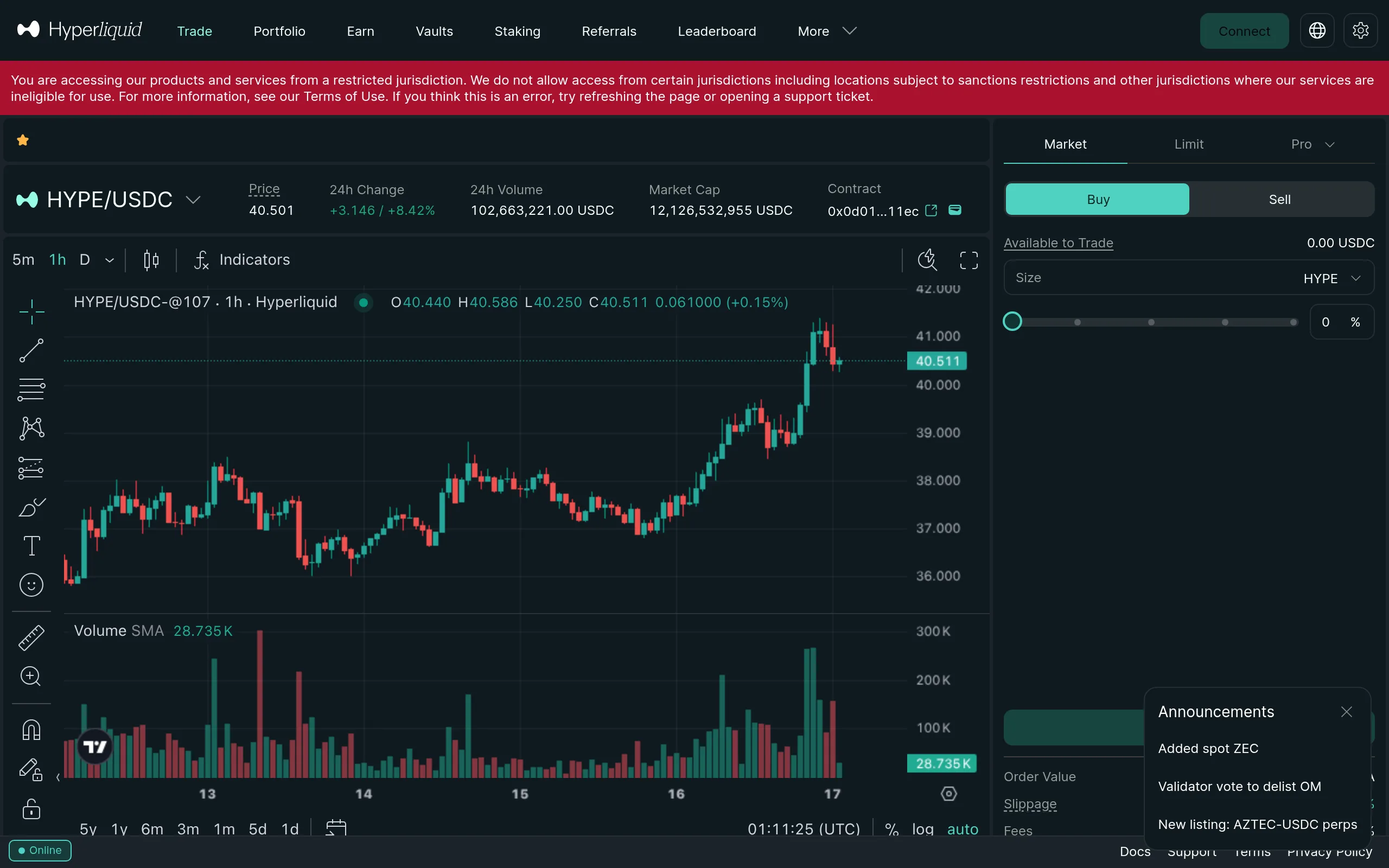
The trading interface will feel familiar — Hyperliquid uses the same order book, chart, and order panel layout that Binance traders are accustomed to. The main differences are wallet-based authentication (no login/password) and USDC-only collateral.
Ready to Switch?
Join thousands of traders who moved from centralized exchanges to Hyperliquid for lower fees, self-custody, and no KYC. 4% lifetime fee discount with our referral.
Start Trading on HyperliquidFrequently Asked Questions
Hyperliquid charges 0.015% maker and 0.045% taker at base tier. Binance Futures USDT-M charges 0.02% maker and 0.05% taker. Hyperliquid wins on both sides. With the 4% referral discount and up to 40% HYPE staking discount, Hyperliquid's effective cost is significantly lower for most traders. Binance's BNB 10% discount and VIP tiers can narrow the gap but rarely close it completely.
Yes. Binance Futures offers up to 125x leverage on BTC and 100x on many altcoins, while Hyperliquid caps at 50x. However, higher leverage is not necessarily better - most professional traders use 5-20x regardless of the cap because higher leverage dramatically increases liquidation risk. Hyperliquid's 50x cap covers the vast majority of trading strategies.
No. Hyperliquid requires no KYC, no email, and no account creation. You connect a crypto wallet and start trading in under five minutes. Binance Futures requires full identity verification with government ID, face recognition, and in some jurisdictions proof of address. This process can take hours to days.
Binance splits perpetual futures into two products: USDT-M (margined in USDT) and COIN-M (margined in the base cryptocurrency like BTC or ETH). Each has separate margin pools and fee structures. Hyperliquid uses a unified USDC margin system where one collateral pool covers all positions across all pairs. This simplifies portfolio management and eliminates the need to choose between margin types.
Hyperliquid uses self-custody: your funds stay in your wallet secured by your private keys and the protocol's on-chain logic. No third party can freeze your account or lose your money. Binance Futures uses exchange custody where Binance holds your assets. While Binance has strong security infrastructure, exchange custody carries counterparty risk — the same category of risk that led to the FTX collapse. The trade-off is that self-custody requires you to secure your own keys.
Independent resource: Hyperliquid Guide is an independent, third-party resource operated by Concept211. It is not affiliated with, produced by, reviewed by or endorsed by Hyper Foundation, Hyperliquid Labs or any other Hyperliquid-ecosystem entity. "Hyperliquid" and related names and marks belong to their respective owners and are used here only to identify the platform this site documents. Read the full disclaimer.
Not advice: Nothing on this site is legal, tax, financial or investment advice. Descriptions of regulatory status, tax treatment and market availability are general information that varies by jurisdiction and changes over time. Confirm anything that matters to you with a qualified professional and against primary sources. Trading perpetual futures involves substantial risk of loss, and past performance does not indicate future results.
Disclosure: this site contains referral links. Signing up through the 4% lifetime fee discount link earns us a share of the trading fee Hyperliquid already charges, at no extra cost to you.
Ready to Start Trading?
Join Hyperliquid with our referral link and get a 4% lifetime fee discount. No KYC, no email - just connect your wallet and trade.
Start Trading - Save 4%