Hyperliquid Funding Rates Explained: How They Work & How to Profit (2026)
Table of Contents
- What Are Funding Rates?
- How Hyperliquid Funding Rates Work
- Hourly Settlement
- The Displayed Rate vs Actual Hourly Rate
- The Funding Formula
- How Your Funding Payment Is Calculated
- How to Read Funding Rates on Hyperliquid
- When Funding Rates Matter for Your Position
- Holding Positions Overnight or Longer
- High Leverage Positions
- Extreme Market Events
- Positive for Income Strategies
- Funding Rate Arbitrage Strategy
- The Basic Setup
- Worked Example
- When to Enter and Exit
- Historical Funding Rate Patterns
- Bull Markets (Strong Positive Funding)
- Bear Markets and Corrections (Negative Funding)
- Sideways / Low Volatility (Near-Zero Funding)
- Asset-Specific Patterns
- Tips for Managing Funding Costs
- 1. Check Funding Before Entering a Trade
- 2. Time Your Entries Around Funding
- 3. Use Funding as a Sentiment Indicator
- 4. Compare Across Exchanges
- 5. Account for Funding in Leverage Decisions
- 6. Use Funding to Your Advantage in Vaults
- Related Guides
Funding rates are the invisible tax - or income stream - built into every perpetual contract position you hold on Hyperliquid. Whether you are paying funding or collecting it depends on your position direction and current market conditions. Understanding this mechanism is essential for any serious perp trader, because funding can quietly erode your edge over time or, if you know what you are doing, become a reliable source of yield.
This guide breaks down how Hyperliquid funding rates work, how they are calculated, where to monitor them, and how to build strategies around them.
Info
Quick Summary - Hyperliquid Funding Rates
- Funding settles every hour (not every 8 hours like Binance/Bybit)
- Displayed rate is the predicted 8-hour rate - divide by 8 for the hourly cost
- Positive rate = longs pay shorts; negative rate = shorts pay longs
- Funding is charged on notional position size, not margin - leverage amplifies the impact
- As of March 2026, max 8-hour rate is capped at +/- 0.375% for most assets
- Compare live rates across exchanges at /tools/funding-rates
Key facts about Hyperliquid funding rates:
- Funding settles every hour (not every 8 hours like most exchanges)
- The displayed rate is the predicted 8-hour rate - divide by 8 for hourly cost
- Positive rate = longs pay shorts; negative rate = shorts pay longs
- Funding is paid on your notional position size, not your margin
- Rates are calculated per-asset based on the premium/discount vs spot index
- You can compare live rates across exchanges using the funding rates tool
What Are Funding Rates?
Perpetual contracts have no expiry date, unlike traditional futures. That is their appeal - you can hold a leveraged position indefinitely without rolling contracts. But without an expiry, there is no natural mechanism forcing the perp price to converge with the spot price. Funding rates solve this problem.
A funding rate is a periodic payment between long and short traders, calculated based on whether the perpetual price is trading at a premium or discount to the underlying spot index price. When the perp price trades above spot (bullish crowd), the funding rate turns positive: longs pay shorts. This incentivizes new shorts (and disincentivizes new longs), pushing the perp price back toward spot. When the perp trades below spot, the opposite happens - shorts pay longs.
The mechanism is elegant: no central party sets rates or takes fees from funding. It is a pure peer-to-peer transfer between the long side and the short side of the market. The exchange simply calculates the rate and facilitates the settlement.
Info
How Hyperliquid Funding Rates Work
Hyperliquid's funding mechanism has several characteristics that distinguish it from other perpetual exchanges.
Hourly Settlement
Most exchanges (Binance, Bybit, OKX) settle funding every 8 hours at fixed timestamps. Hyperliquid settles every hour, making it one of the most granular funding systems in the market. This hourly cadence means:
- Funding costs and income accumulate smoothly rather than in large 8-hour chunks
- You can enter and exit positions between settlement times with less funding risk
- The displayed 8-hour rate is a prediction - actual hourly settlements may differ slightly as market conditions change within that window
The Displayed Rate vs Actual Hourly Rate
When you see a funding rate of +0.0100% on the Hyperliquid trading interface, that is the predicted 8-hour rate. Since funding settles hourly, each settlement is approximately one-eighth of that displayed value:
Hourly funding = Displayed 8-hour rate / 8
Example: 0.0100% / 8 = 0.00125% per hour
Over a full day (24 settlements), a consistent +0.0100% 8-hour rate translates to:
Daily funding = 0.0100% × 3 = 0.0300% per day
Annual funding = 0.0300% × 365 = 10.95% annualized
That 10.95% annual rate on a leveraged position is significant - it can either work for you or against you depending on which side you are on.
The Funding Formula
Hyperliquid calculates the funding rate using a premium-based approach:
Premium = (Mark Price − Index Price) / Index Price
The mark price is the current perpetual contract price, and the index price is a time-weighted composite of the spot price across reference exchanges. The funding rate is then derived from a time-weighted average of this premium, clamped within predefined bounds to prevent extreme rates.
Funding Rate = clamp(Premium TWAP, -maxRate, +maxRate)
The clamp ensures that even during extreme market dislocations, funding rates stay within reasonable bounds. For most assets on Hyperliquid, the maximum 8-hour rate is capped at ±0.375%, though this varies by asset.
How Your Funding Payment Is Calculated
Your actual funding payment depends on your notional position size, not your margin:
Funding Payment = Position Size × Mark Price × Funding Rate
If you are long 1 BTC at a mark price of $85,000 and the hourly funding rate is +0.00125%:
Funding Payment = 1 × $85,000 × 0.0000125 = $1.0625 per hour
At 10x leverage, your margin for that 1 BTC position is $8,500. That $1.0625 hourly payment represents 0.0125% of your margin per hour - ten times the rate applied to notional. This is why funding is particularly impactful for highly leveraged positions.
Leverage amplifies funding impact. A +0.01% 8-hour rate costs 0.01% on notional value, but at 10x leverage it costs 0.10% of your margin per 8-hour period. At 50x leverage, the same rate costs 0.50% of your margin every 8 hours - that is 5.5% of your margin per day in funding alone.
How to Read Funding Rates on Hyperliquid
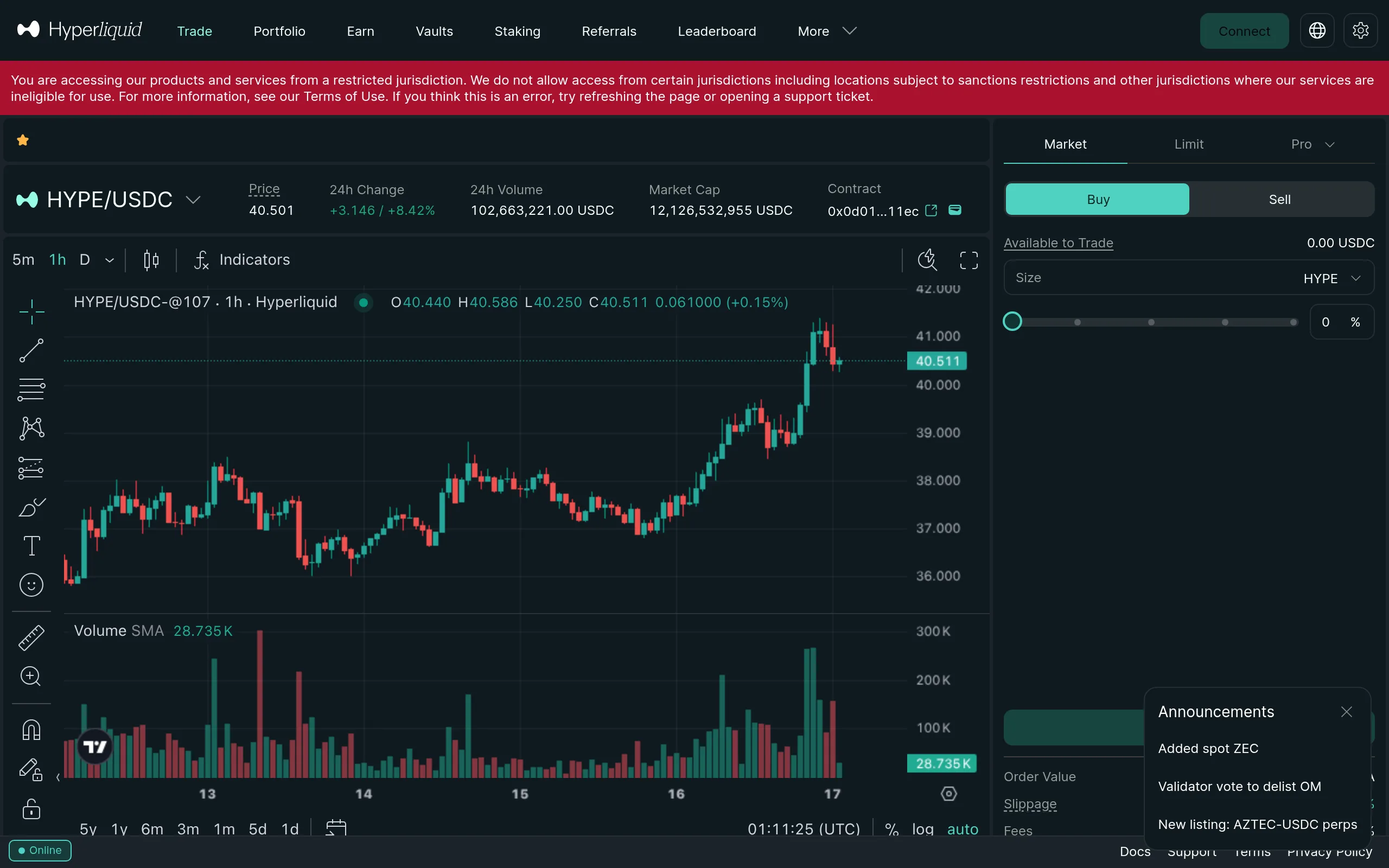
On app.hyperliquid.xyz, funding rate information is displayed in several places:
-
Trading interface header - Next to the asset pair name, you will see the current predicted funding rate. Green indicates a positive rate (longs pay shorts), and red indicates negative (shorts pay longs).
-
Market info panel - Expanding the asset details shows the current funding rate alongside other stats like open interest, 24h volume, and mark/index price.
-
Position panel - When you have an open position, the funding tab shows accumulated funding payments for that position.
For cross-exchange comparison, the live funding rates tool on this site shows rates across Hyperliquid, Binance, and Bybit side by side - useful for spotting arbitrage opportunities.
Tip
When Funding Rates Matter for Your Position
Funding is not always material. A 0.0010% 8-hour rate on a small position held for a few hours is negligible. But in several scenarios, funding becomes a critical factor:
Holding Positions Overnight or Longer
If you hold a position for days or weeks, funding accumulates. A consistent +0.01% 8-hour rate means you pay 0.03% per day as a long. Over 30 days, that is 0.9% of your notional - roughly equivalent to 20 round trips of taker fees at the base tier. For swing traders, this is a real cost of carry.
High Leverage Positions
As noted above, leverage multiplies the margin impact. A day trader using 20x leverage on a position held through a 0.02% 8-hour rate period pays 0.40% of their margin per 8-hour window. Two windows in a day costs 0.80% of margin - a meaningful drag.
Extreme Market Events
During sharp rallies, funding rates can spike to 0.1% or higher per 8 hours. In the 2024-2025 BTC rally cycles, rates exceeded 0.3% on multiple occasions. Being on the wrong side of a funding spike can cost more than the trade itself is worth.
Positive for Income Strategies
When funding is consistently positive and elevated, the short side earns that rate. This is the basis of funding rate arbitrage - you earn the funding by shorting the perp while hedging your directional risk through a corresponding long spot position.
Start Trading on Hyperliquid
Access 150+ perpetual markets with hourly funding settlements and the lowest fees in DeFi. Get a 4% lifetime fee discount.
Join HyperliquidFunding Rate Arbitrage Strategy
Funding rate arbitrage is one of the most popular delta-neutral strategies in crypto. The concept is straightforward: collect funding payments while hedging away directional risk. If you plan to run it as an automated bot, our trading strategies guide covers how funding arb fits alongside market-making and trend strategies, plus the risk controls it needs to run unattended.
The Basic Setup
-
Identify an asset with elevated positive funding - Check the funding rates tool for assets where the 8-hour rate is significantly above 0.01% on Hyperliquid.
-
Short the perpetual on Hyperliquid - Open a short perp position on the asset. Since funding is positive, shorts receive the funding payment.
-
Buy the equivalent spot position - Purchase the same amount of the asset on spot (either on Hyperliquid's spot market or another exchange). This hedges your short perp against price movements.
-
Collect funding - As long as funding remains positive, your short perp earns hourly payments. Your spot long offsets any price-based P&L on the short.
Worked Example
Suppose ETH has a funding rate of +0.03% per 8 hours on Hyperliquid, and you want to deploy $10,000.
Step 1: You split your capital. $5,000 goes to margin on Hyperliquid for a short ETH perp (at 2x leverage, controlling $10,000 notional). $5,000 buys ETH on spot.
Step 2: Calculate expected yield:
Daily funding income = $10,000 × 0.03% × 3 = $9.00 per day
Monthly = $9.00 × 30 = $270.00
Annualized = $270 × 12 = $3,240 (32.4% APR on $10,000 capital)
Step 3: Costs to subtract:
- Trading fees to open: ~$4.50 (taker on perp) + spot purchase fees
- Trading fees to close: similar
- Spot slippage
- Opportunity cost of capital
Step 4: Net yield after costs is still attractive if funding stays elevated. The risk is that funding drops to zero or turns negative, at which point you unwind the position.
Warning
When to Enter and Exit
- Enter when the annualized funding rate exceeds 15-20% and has been stable for several hours
- Exit when the rate drops below 5% annualized or turns negative
- Monitor your liquidation price on the short side - keep it far from the current price
- Consider hedging costs - if you hold spot on another exchange, you have counterparty risk and transfer costs
For more yield strategies on the Hyperliquid ecosystem, see the yield strategies guide and the earn USDC guide.
Historical Funding Rate Patterns
Funding rates follow predictable patterns tied to market sentiment and positioning:
Bull Markets (Strong Positive Funding)
During the late 2024 and early 2025 BTC rally, 8-hour funding rates on BTC-USD regularly exceeded +0.05%, with spikes above +0.15% during parabolic moves. ETH and altcoins saw even more extreme rates, with some mid-cap perps hitting +0.30% during peak euphoria. These periods are the most profitable for short-side funding arb.
Bear Markets and Corrections (Negative Funding)
When markets sell off sharply, funding often turns negative as shorts dominate positioning. During corrections, BTC funding has dropped to -0.03% or lower. In this environment, longs collect funding - but holding a long position during a bear market requires strong conviction or a hedge.
Sideways / Low Volatility (Near-Zero Funding)
In ranging markets, funding hovers between -0.005% and +0.005% - too low to justify arb positions after accounting for trading fees. These periods are best for directional trading where funding is negligible.
Asset-Specific Patterns
- BTC/ETH: Most stable funding, rarely extreme. Typical range: +0.005% to +0.02%
- Mid-cap alts (SOL, DOGE, AVAX): More volatile funding, better arb opportunities
- Low-cap / new listings: Can have extreme funding (0.1%+) due to one-sided positioning. Higher risk but higher yield potential
- HIP-3 builder markets: Assets like equity perps on trade.xyz can exhibit unique funding dynamics separate from crypto market sentiment
The best funding arb opportunities appear at extremes. When an asset's annualized funding exceeds 30%, the market is paying you handsomely to take the other side. But extreme funding also signals extreme positioning - monitor open interest and liquidation levels closely.
Tips for Managing Funding Costs
Whether you are actively farming funding or simply trying to minimize its drag on directional trades, these principles apply:
1. Check Funding Before Entering a Trade
Before opening any position you plan to hold for more than a few hours, check the current funding rate. A 0.03% 8-hour rate against your position costs 0.09% per day - almost a full round trip of trading fees every day. Factor this into your expected P&L. We measured how that compounds in practice: 90 days of funding across 20 Hyperliquid markets shows what holding actually cost in each one, and how many hours a position has to stay open before funding overtakes the fee.
2. Time Your Entries Around Funding
If you are going long and funding is elevated, consider waiting for a pullback that often follows high positive funding (as arb traders short the perp). Conversely, if you want to go short with negative funding, the same logic applies.
3. Use Funding as a Sentiment Indicator
Extreme positive funding means the market is crowded long. Extreme negative funding means it is crowded short. Crowded positioning tends to unwind violently. Use this as a contrarian signal - not for exact timing, but for risk management. If funding is +0.10% and you are long, tighten your stops.
4. Compare Across Exchanges
Funding rates vary between exchanges. If Hyperliquid shows +0.03% and Binance shows +0.01% for the same asset, you can short on Hyperliquid (earning more) while longing on Binance (paying less). The funding rates tool makes this comparison easy.
5. Account for Funding in Leverage Decisions
Higher leverage magnifies funding's impact on margin. If you are using 20x leverage and funding is +0.02%, you lose 0.40% of your margin per 8-hour period as a long. At that rate, even a profitable trade direction can net negative after holding for a day. Consider reducing leverage or switching to limit orders to reduce entry costs and offset funding drag.
6. Use Funding to Your Advantage in Vaults
Some Hyperliquid copy trading vaults specifically target funding rate strategies. If you want exposure to funding arb without managing the positions yourself, check vault performance and strategies in the vault marketplace.
Tip
Related Guides
- Hyperliquid Fee Structure Explained - Understand taker/maker fees, VIP tiers, and how to minimize costs
- Live Funding Rates Tool - Compare real-time rates across Hyperliquid, Binance, and Bybit
- Leverage Trading Guide - Master margin, leverage, and position sizing
- Liquidation Explained - How liquidation works, formulas, and strategies to avoid it
- Portfolio Tracking Guide - Monitor positions, PnL, margin usage, and export trade history
- Order Types Guide - Use limit orders, TP/SL, and advanced order types
- Yield Strategies on HyperEVM - Explore DeFi yield opportunities in the Hyperliquid ecosystem
- How to Earn USDC on Hyperliquid - Lending, vaults, and staking strategies
Trade with the Lowest Fees
Hyperliquid offers the tightest spreads and most competitive funding rates in DeFi. Start with a 4% lifetime fee discount.
Get StartedFrequently Asked Questions
Funding rates on Hyperliquid are periodic payments exchanged between long and short traders to keep perpetual contract prices anchored to the spot index price. When the funding rate is positive, longs pay shorts. When negative, shorts pay longs. Hyperliquid settles funding every hour, and rates vary by asset based on market conditions.
Hyperliquid settles funding payments every hour. The displayed rate on the interface is the predicted 8-hour rate, but actual settlements happen hourly at one-eighth of that rate. This hourly settlement means funding costs and income accumulate more smoothly compared to exchanges that settle every 8 hours.
Yes. Delta-neutral funding rate arbitrage is a common strategy. You hold a position on Hyperliquid while taking the opposite position on spot or another exchange, collecting the funding payments while being hedged against price moves. This works best during periods of elevated positive or negative funding.
You can view live funding rates directly on the Hyperliquid trading interface next to each asset pair. For cross-exchange comparison, use the Hyperliquid Guide funding rates tool at /tools/funding-rates, which shows real-time rates across Hyperliquid, Binance, and Bybit side by side.
Hyperliquid calculates funding rates based on the premium or discount of the perpetual price relative to the spot index price. The formula uses a time-weighted average of the premium, clamped within bounds to prevent extreme rates. The base rate adjusts dynamically to market conditions, incentivizing traders to take the side that brings the perp price back in line with spot.
Independent resource: Hyperliquid Guide is an independent, third-party resource operated by Concept211. It is not affiliated with, produced by, reviewed by or endorsed by Hyper Foundation, Hyperliquid Labs or any other Hyperliquid-ecosystem entity. "Hyperliquid" and related names and marks belong to their respective owners and are used here only to identify the platform this site documents. Read the full disclaimer.
Not advice: Nothing on this site is legal, tax, financial or investment advice. Descriptions of regulatory status, tax treatment and market availability are general information that varies by jurisdiction and changes over time. Confirm anything that matters to you with a qualified professional and against primary sources. Trading perpetual futures involves substantial risk of loss, and past performance does not indicate future results.
Disclosure: this site contains referral links. Signing up through the 4% lifetime fee discount link earns us a share of the trading fee Hyperliquid already charges, at no extra cost to you.
Ready to Start Trading?
Join Hyperliquid with our referral link and get a 4% lifetime fee discount. No KYC, no email - just connect your wallet and trade.
Start Trading - Save 4%