Hyperliquid Copy Trading Guide: Vaults, Copin & Third-Party Tools
Table of Contents
- Copy Trading on Hyperliquid
- Method 1: Hyperliquid Vaults
- How Vaults Work
- Pros of Vault Copy Trading
- Cons of Vault Copy Trading
- Method 2: Third-Party Copy Trading Platforms
- Copin
- HyperDash
- WunderTrading
- Other Notable Tools
- How to Copy Trade on Hyperliquid: Step by Step
- Option A: Using Hyperliquid Vaults
- Option B: Using Copin
- Evaluating Traders to Copy
- Win Rate (With Context)
- Maximum Drawdown
- Consistency Over Time
- Sharpe Ratio
- Trade Frequency and Style
- Position Sizing Discipline
- Risk Management for Copy Trading
- Set Maximum Allocation Per Trader
- Diversify Across Traders and Strategies
- Define Exit Criteria Before You Start
- Understand Leverage Risk in Copy Trading
- Monitor Actively
- Vaults vs Third-Party Platforms: Which Should You Choose?
- Start Copy Trading on Hyperliquid
 Copin
Copin
Copy Trading on Hyperliquid
Copy trading lets you mirror the positions of other traders automatically. Instead of analyzing charts, managing entries, and timing exits yourself, you follow a trader whose strategy and track record you trust. When they open a position, you open one. When they close, you close. (If you'd rather do your own analysis, Hyperliquid markets are now chartable on TradingView — but copy trading skips that work entirely.)
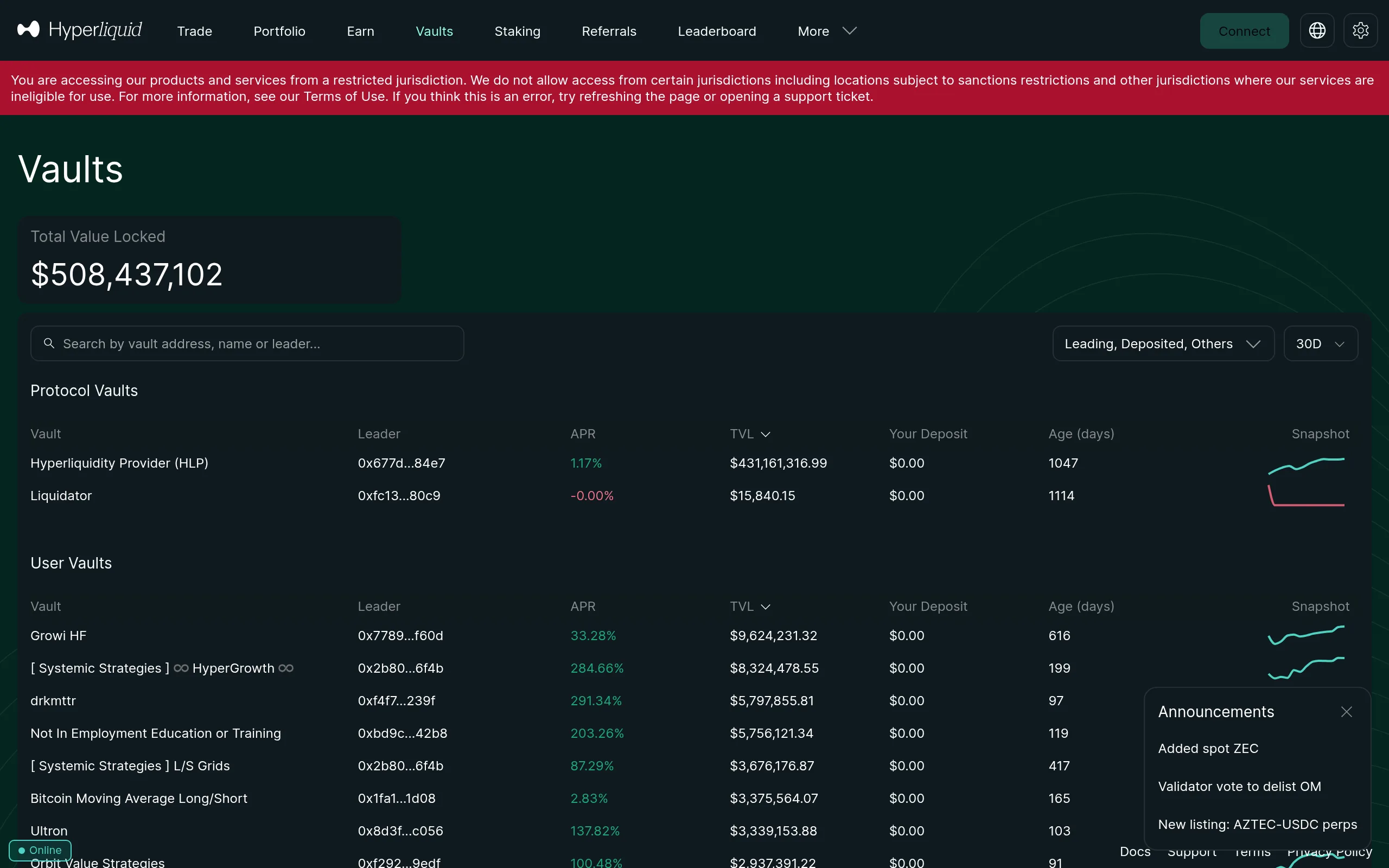
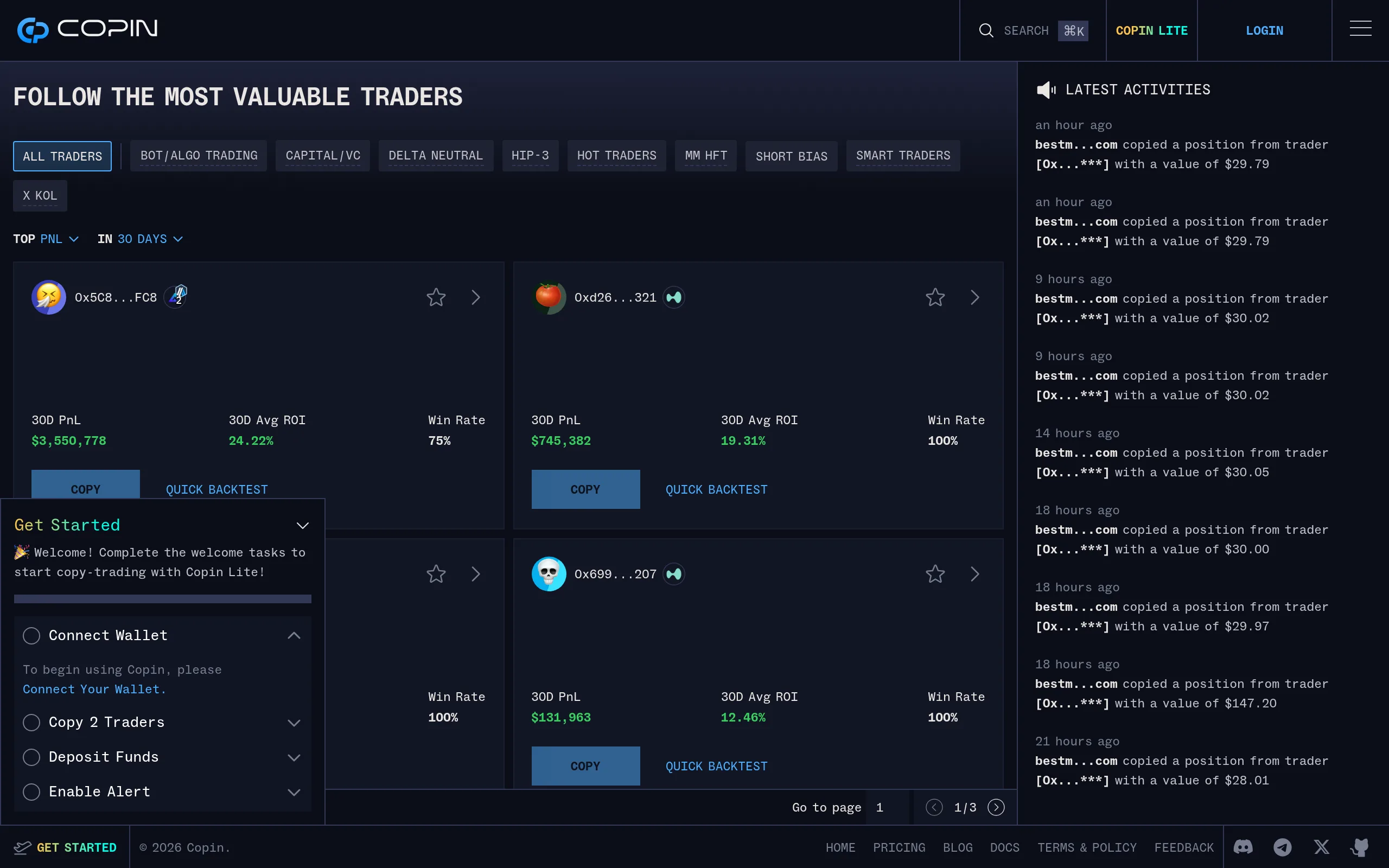
On Hyperliquid, copy trading takes two forms. The first is the platform's native vault system - on-chain pools where you deposit capital and automatically follow a vault leader's trades. The second is third-party platforms like Copin and HyperDash that connect to Hyperliquid via API and give you fine-grained control over which traders you copy and how.
Both approaches have distinct trade-offs in control, transparency, fees, and risk. This guide covers both methods in detail so you can choose the approach - or combination - that fits your goals.
If you are new to Hyperliquid, start with the beginner trading guide and make sure you have deposited USDC before setting up any copy trading.
 Method 1: Hyperliquid Vaults
Hyperliquid vaults are the simplest way to copy trade on the platform. They are built directly into Hyperliquid's L1, require no API setup, and give you fully transparent, on-chain exposure to another trader's strategy.
How Vaults Work
When you deposit USDC into a vault, you receive a proportional share of the vault's total value. The vault leader trades with the pooled capital. If the vault grows, your share grows. If the vault loses money, your share shrinks.
Vault leaders set a profit share fee - typically 10% - that they collect only when the vault is profitable. If the vault loses money, the leader earns nothing. This aligns incentives: the leader only profits when depositors profit.
There are two types of vaults:
-
HLP (Hyperliquid Liquidity Provider) - The protocol's own market-making vault. It provides liquidity across all markets and earns from bid-ask spreads and maker rebates. HLP charges no profit share fee. It is the largest and most liquid vault, but its returns are driven by market-making dynamics, not directional trading.
-
Community Vaults - Created by individual traders with their own strategies. These range from conservative delta-neutral approaches to aggressive directional bets. Profit share fees and risk profiles vary widely.
Pros of Vault Copy Trading
- No setup complexity. Connect your wallet, deposit USDC, done.
- Fully on-chain and transparent. Every trade is visible. No black box.
- Non-custodial. Your funds stay in the vault smart contract, not a third party's wallet.
- Withdraw anytime. No lock-up periods on most vaults.
Cons of Vault Copy Trading
- No granular control. You cannot adjust leverage, skip certain trades, or set stop-losses on individual positions. You get all of the leader's trades, good and bad.
- Profit share fees. Community vaults typically take 10% of profits.
- Limited trader selection. Only traders who have created vaults are available. The universe of copyable traders is smaller than on third-party platforms.
- Pooled risk. Large deposits and withdrawals from other users can affect your returns.
Info
Method 2: Third-Party Copy Trading Platforms
Third-party platforms expand your options dramatically. Instead of being limited to traders who have created vaults, you can analyze any on-chain trader's history and copy them directly via API integration. These platforms also give you control over position sizing, leverage limits, and risk parameters that vaults do not offer.
Copin
Copin is the most comprehensive on-chain trader analytics and copy trading platform available for Hyperliquid. It indexes over 700,000 on-chain traders across 20+ perpetual DEXes, including Hyperliquid, and lets you copy any of them.
Key features:
- Trader discovery and analytics. Filter traders by win rate, PnL, drawdown, Sharpe ratio, trade frequency, and dozens of other metrics. The Hyperliquid Explorer at app.copin.io/hyperliquid lets you browse every trader on the platform.
- Position mirroring. When a trader you follow opens a position, Copin automatically opens a corresponding position on your Hyperliquid account via API.
- Risk controls. Set your own leverage limits, position size caps, and stop-loss parameters independently of the trader you are copying.
- Cross-platform analysis. Compare trader performance across Hyperliquid, GMX, dYdX, and other DEXes.
Fee: Copin charges a 0.05% fee on trade size when opening copy trade positions, in addition to Hyperliquid's standard trading fees.
Limitations to know:
- You cannot close copy trade positions directly within Copin. To close, you must go to Hyperliquid directly.
- Copin uses the Pyth oracle for pricing while Hyperliquid uses its own pricing system, so temporary PnL discrepancies can appear (they resolve when positions close).
- Leverage is capped at the minimum of your setting and Hyperliquid's maximum for that pair.
HyperDash
HyperDash is a Hyperliquid-native analytics and copy trading tool. It focuses specifically on the Hyperliquid ecosystem rather than covering multiple DEXes.
Key features:
- Real-time tracking of top Hyperliquid traders
- Portfolio analytics and position tracking
- Whale alerts for large position changes
- Copy trading integration
- Clean, purpose-built interface for Hyperliquid
HyperDash is a strong choice if you want Hyperliquid-specific analytics without the broader multi-DEX scope of Copin.
WunderTrading
WunderTrading is a more established copy trading platform that has added Hyperliquid integration. It connects beginners with experienced traders through automated trading technology.
Key features:
- TradingView signal integration for automated execution
- Copy trading marketplace with trader performance metrics
- Multi-exchange support including Hyperliquid
- Bot strategies and automation tools
Other Notable Tools
- Mizar - Copy trading marketplace with Hyperliquid support and TradingView automation
- SuperX - Telegram-based tool for tracking top-performing wallets with one-click copy trading
Warning
New to Hyperliquid?
Before you can copy trade, you need a funded Hyperliquid account. Sign up with our referral link for a 4% lifetime discount on all trading fees.
Create Your AccountHow to Copy Trade on Hyperliquid: Step by Step
Option A: Using Hyperliquid Vaults
-
Connect your wallet to app.hyperliquid.xyz. If you do not have an account yet, follow the getting started guide.
-
Deposit USDC into your Hyperliquid account. You need USDC on Arbitrum - see the deposit guide for bridging instructions.
-
Navigate to Vaults at app.hyperliquid.xyz/vaults. Browse available vaults.
-
Evaluate vault performance. Look at the vault's total PnL, recent drawdowns, trade history, and how long it has been active. Avoid vaults with less than 30 days of track record.
-
Deposit USDC into your chosen vault. Enter the amount and confirm. Your capital now automatically follows the vault leader's trades.
-
Monitor regularly. Check vault performance weekly. If the vault enters a sustained drawdown or the leader's strategy changes, consider withdrawing.
Option B: Using Copin
-
Create an API wallet on Hyperliquid. Go to hyperliquid.xyz/API, connect your wallet, name the API key (e.g., "Copin_Copytrade"), generate the wallet address, and authorize it. Set the validity to the maximum (180 days). Save the private key securely.
-
Connect your API to Copin. Visit app.copin.io/wallet-management, authenticate, and select "Connect" for Hyperliquid. Enter your master account address, the API wallet's private key, and an optional wallet name. Sign with your master account wallet and accept the trading fee terms.
-
Find traders to copy. Use the Hyperliquid Explorer to browse traders. Filter by win rate, PnL, drawdown, and other metrics. Analyze their trade history in detail before committing.
-
Configure copy settings. Set your position sizing (fixed amount or percentage of the trader's size), maximum leverage, and any risk controls Copin offers.
-
Activate copy trading. Once configured, Copin will automatically mirror the trader's future positions on your Hyperliquid account.
-
Monitor and adjust. Review performance regularly. Copin provides an alert bot that tracks all positions so you do not miss changes.
Tip
Evaluating Traders to Copy
Choosing who to copy is the single most important decision in copy trading. A flashy PnL number on the Hyperliquid leaderboard tells you almost nothing useful. Here is what actually matters.
Win Rate (With Context)
A 70% win rate sounds impressive until you realize the average loss is 5x the average win. Win rate alone is meaningless - you need to see it alongside the profit factor (total gains divided by total losses). A trader with a 45% win rate and a 3.0 profit factor is far better than one with an 80% win rate and a 0.9 profit factor.
Maximum Drawdown
How much has the trader lost from peak to trough? A trader who made 200% but had a 60% drawdown along the way is extremely risky to copy. If you started copying at the peak, you would have experienced that 60% drawdown firsthand. Look for traders with max drawdowns under 20-25%.
Consistency Over Time
Does the trader produce relatively steady returns, or do they have one massive winning trade that inflates their overall PnL? Check the equity curve - a smooth upward curve is infinitely better than a flat line punctuated by one spike. Look for at least 90 days of trading history.
Sharpe Ratio
The Sharpe ratio measures return relative to risk. A higher Sharpe ratio means better risk-adjusted returns. Traders with a Sharpe ratio above 1.5 are generating solid returns relative to the volatility of their equity curve. Below 0.5 suggests the returns are not worth the risk.
Trade Frequency and Style
A trader who makes 50 trades per day will generate significant trading fees on your account. A trader who makes 2-3 trades per week may be more fee-efficient. Match the trader's frequency with your fee tolerance. Also consider whether the trader uses high leverage - if they routinely trade at 20x+, the copy will be volatile regardless of your settings on some platforms.
Position Sizing Discipline
Good traders risk a consistent percentage of their account per trade. If you see wildly varying position sizes - $500 on one trade, $50,000 on the next - that is a red flag. Inconsistent sizing often signals emotional trading or gambling behavior.
Risk Management for Copy Trading
Copy trading creates a dangerous illusion of safety. Because you are following someone who appears skilled, it is easy to over-allocate and under-manage risk. Do not fall into that trap.
Set Maximum Allocation Per Trader
Never allocate more than 10-15% of your total trading capital to any single trader. If that trader blows up, you lose a manageable amount. If you put 50% of your capital behind one trader and they hit a 40% drawdown, your account takes a devastating 20% hit.
Diversify Across Traders and Strategies
Copy 3-5 traders with different strategies. A trend-following trader, a mean-reversion trader, and a market-neutral trader will perform differently in the same market conditions. When one is losing, another may be winning. This smooths your overall equity curve.
Define Exit Criteria Before You Start
Before you copy anyone, decide when you will stop. Examples:
- Stop copying if the trader's drawdown exceeds 25%
- Stop copying if the trader changes their average leverage by more than 2x
- Stop copying if there is no activity for more than 2 weeks
- Reassess monthly regardless of performance
Write these rules down. Emotion will convince you to hold on when the numbers say to leave.
Understand Leverage Risk in Copy Trading
If the trader you follow uses high leverage, the copy trade inherits that risk profile. Some platforms let you cap leverage - use this feature. If the trader is trading at 25x and you are capped at 5x, your position will be smaller relative to the trader's, which is exactly what you want for risk management.
Important
Monitor Actively
"Set and forget" is a myth. Even with good initial trader selection, strategies degrade, market conditions change, and traders make mistakes. Review your copy trading performance at least weekly. Compare the trader's recent performance to their historical baseline. If something has shifted - higher drawdowns, different trading patterns, much larger positions - act on it.
Trade Smarter on Hyperliquid
Whether you copy trade or trade independently, start with a 4% lifetime fee discount. Every percentage point saved on fees compounds over time.
Claim Your Fee DiscountVaults vs Third-Party Platforms: Which Should You Choose?
| Feature | Hyperliquid Vaults | Third-Party Platforms (e.g., Copin) |
|---|---|---|
| Setup complexity | Very low - deposit and go | Moderate - API key creation required |
| Trader selection | Limited to vault creators | Any on-chain trader |
| Position control | None - you mirror everything | Adjustable sizing, leverage, stops |
| Transparency | Fully on-chain | Varies by platform |
| Fees | 10% profit share (community vaults) | ~0.05% per trade + platform fees |
| Risk controls | Withdraw only | Leverage caps, size limits, stop-losses |
| Custody | Non-custodial (vault contract) | API access (non-custodial, but trusting platform) |
| Best for | Passive exposure, beginners | Active management, experienced users |
Choose vaults if you want simplicity, prefer fully on-chain transparency, and are comfortable with a hands-off approach where you accept all of a leader's trades.
Choose third-party platforms if you want to pick from a much larger trader pool, need control over position sizing and leverage, and are willing to manage the additional complexity of API setup and ongoing monitoring.
Consider using both. A portion of your capital in a well-performing vault for passive exposure, and a separate allocation managed through Copin or HyperDash for more targeted copy trading with specific risk parameters.
Hyperliquid's broader DeFi ecosystem continues to grow, and copy trading tools are evolving alongside it. New platforms and vault strategies appear regularly. Whatever approach you choose, the fundamentals remain the same: evaluate traders rigorously, manage risk strictly, diversify your exposure, and never stop monitoring.
Start Copy Trading on Hyperliquid
Copy trading on Hyperliquid is more accessible and transparent than on any centralized exchange. The vault system gives you one-click, on-chain exposure to other traders' strategies. Third-party tools like Copin give you the analytics and control to be selective about who you follow and how.
But accessibility does not equal safety. The traders you copy can and will lose money at some point. Your job is not to find a perfect trader - one does not exist. Your job is to build a system: careful selection, strict allocation limits, diversification, predefined exit rules, and regular monitoring.
Start small. Observe before committing real capital. And always remember that the fastest way to lose money in copy trading is to trust someone else's skill more than your own risk management discipline.
Get Started on Hyperliquid
Create your Hyperliquid account with a 4% lifetime fee discount. Whether you trade on your own or copy the best, lower fees mean better returns.
Start Trading with 4% OffFrequently Asked Questions
Yes. You can copy trade on Hyperliquid through two methods. First, Hyperliquid's native vault system lets you deposit USDC into a vault run by a trader whose positions you automatically mirror. Second, third-party platforms like Copin, HyperDash, and WunderTrading connect to Hyperliquid via API and let you select specific traders to copy with more granular controls over position sizing, leverage, and risk parameters.
The best tool depends on your needs. For simplicity and on-chain transparency, Hyperliquid's native vaults are the easiest entry point - no API setup required. For advanced trader discovery and cross-platform analysis, Copin stands out with analytics across 700,000+ on-chain traders and 20+ DEXes. HyperDash is a strong Hyperliquid-native option with real-time tracking and whale alerts. Evaluate each tool based on your desired level of control, fee tolerance, and technical comfort.
When you deposit USDC into a Hyperliquid vault, your funds are pooled with other depositors. The vault leader trades using the pooled capital, and you automatically share in all profits and losses proportionally to your deposit size. Vault leaders set a profit share fee (commonly 10%) that they collect only on profits. You can withdraw at any time. All vault activity - every trade, every position - is fully transparent and visible on-chain.
Copy trading can be profitable, but it is not guaranteed. Your results depend entirely on the skill of the trader you follow, your entry timing, and market conditions. Past performance does not predict future returns. Many traders who show impressive short-term results blow up over longer periods. The key to profitability is rigorous trader evaluation, diversifying across multiple traders, using strict position sizing, and cutting underperformers quickly.
Independent resource: Hyperliquid Guide is an independent, third-party resource operated by Concept211. It is not affiliated with, produced by, reviewed by or endorsed by Hyper Foundation, Hyperliquid Labs or any other Hyperliquid-ecosystem entity. "Hyperliquid" and related names and marks belong to their respective owners and are used here only to identify the platform this site documents. Read the full disclaimer.
Not advice: Nothing on this site is legal, tax, financial or investment advice. Descriptions of regulatory status, tax treatment and market availability are general information that varies by jurisdiction and changes over time. Confirm anything that matters to you with a qualified professional and against primary sources. Trading perpetual futures involves substantial risk of loss, and past performance does not indicate future results.
Disclosure: this site contains referral links. Signing up through the 4% lifetime fee discount link earns us a share of the trading fee Hyperliquid already charges, at no extra cost to you.
Ready to Start Trading?
Join Hyperliquid with our referral link and get a 4% lifetime fee discount. No KYC, no email - just connect your wallet and trade.
Start Trading - Save 4%