What Is HYPE Token? Complete Guide to Hyperliquid's Native Token
Table of Contents
- What Is HYPE?
- HYPE Tokenomics and Supply
- Distribution Breakdown
- Vesting Schedules
- The HYPE Airdrop
- What Happened
- Who Received It
- Impact on the Ecosystem
- How to Stake HYPE
- How Staking Works
- Expected Yields
- Unstaking
- HYPE Utility and Use Cases
- Network Security (Staking)
- Gas Fees on HyperEVM
- Governance Potential
- Ecosystem Participation
- Buyback and Burn: How Trading Fees Support HYPE
- How It Works
- Why This Matters
- Where to Buy HYPE
- On Hyperliquid (Recommended)
- On Centralized Exchanges
- Transferring to Hyperliquid
- Through a Stock or an ETF
- The Bottom Line
What Is HYPE?
Info
Quick Summary - HYPE Token
- Max supply: 1 billion HYPE per the Hyperliquid API (
tokenDetails). The Hyper Foundation's genesis announcement set 31% for the genesis airdrop, 38.888% for future emissions and community rewards and 23.8% for core contributors - Staking reward rate: ~2.37% a year at 400M HYPE staked, per Hyperliquid's staking docs. The rate falls as total stake rises
- Used as the gas token on HyperEVM (Chain ID 999, per the HyperEVM onboarding docs), similar to ETH on Ethereum
- Buyback and burn: per Hyperliquid's fee docs, the Assistance Fund converts trading fees to HYPE and burns it
- Buy HYPE on Hyperliquid's native spot market (HYPE/USDC) - no KYC required, or see how to buy Hyperliquid and fund your account if you are still deciding between the token and a trading balance
- For liquid staking without lock-up, use Kinetiq to receive kHYPE
HYPE is the native token of Hyperliquid, the decentralized perpetual futures exchange built on its own custom Layer 1 blockchain. If you have been around DeFi long enough, you know that most protocol tokens exist primarily to be farmed and dumped. HYPE is designed differently. It serves as the backbone of Hyperliquid's network security, its gas economy, and a mechanism that ties protocol revenue directly to token value.
Think of HYPE as the equivalent of ETH for Ethereum, but for a blockchain purpose-built for high-performance trading. Every validator securing Hyperliquid's network stakes HYPE. Every smart contract execution on HyperEVM burns HYPE as gas. And a portion of every trading fee generated on the platform flows into buying back and burning HYPE from the open market.
The token launched on November 29, 2024 (the deploy time the API's tokenDetails response gives for HYPE) through one of the largest airdrops in crypto history, putting it into roughly 94,000 wallets at once. Since then, it has become central to the Hyperliquid ecosystem, powering everything from DeFi lending and options trading to prediction markets.
HYPE Tokenomics and Supply
Understanding HYPE's tokenomics is essential to understanding where value flows in the Hyperliquid ecosystem. The Hyperliquid API's tokenDetails response lists a max supply of 1 billion HYPE. On October 14, 2026 it reported a total supply of 998,861,312 HYPE, so a little over 1.1 million had been removed from supply by then. The allocation percentages below come from the Hyper Foundation's November 2024 genesis announcement.
Distribution Breakdown
| Allocation | Percentage | Details |
|---|---|---|
| Genesis Distribution (Airdrop) | 31% | Distributed November 29, 2024 to points earners |
| Future Emissions & Community Rewards | 38.888% | Reserved; staking rewards are paid from it |
| Core Contributors | 23.8% | Current and future core contributors, locked at genesis |
| Hyper Foundation Budget | 6% | Hyper Foundation operating budget |
| Community Grants | 0.3% | Grants |
| HIP-2 | 0.012% | Hyperliquidity |
Source: Hyper Foundation genesis announcement, November 2024. Genesis balances can be checked against the Hyperliquid API's tokenDetails response for HYPE.
Info
Vesting Schedules
The 23.8% core contributor allocation was not liquid at launch. The Hyper Foundation's genesis announcement said these tokens would stay locked for at least one year after the genesis event. This site has not seen a complete public vesting schedule, so treat third-party unlock calendars as estimates.
The 38.888% future emissions allocation is released over time. One confirmed use: Hyperliquid's staking docs say staking rewards come from the future emissions reserve. How and when the rest is distributed has not been published.
The HYPE Airdrop
The HYPE airdrop in November 2024 was a landmark event in crypto - not just for Hyperliquid users, but for the entire DeFi space. It stands as one of the largest and most widely distributed airdrops in crypto history. For the full story - including the points system, Season 2 speculation, and how to position yourself - see our dedicated HYPE airdrop guide.
What Happened
About 310 million HYPE (31% of supply, per the genesis announcement) went to early users of the platform. Allocations followed the points program, which Hyperliquid's points docs say ran from November 1, 2023 to May 1, 2024, then resumed for the L1 phase from May 29, 2024 until November 2024. Points went to users for their activity on the exchange rather than for one-off interactions like a single swap or bridge transaction.
Who Received It
The airdrop rewarded people who used the exchange. The distribution was broad: the genesis balances in the API's tokenDetails response for HYPE cover about 94,000 addresses. The most active points earners received the largest allocations.
Impact on the Ecosystem
If you received HYPE tokens through the airdrop, how they are taxed depends on where you live. This site does not give tax advice. Our tax reporting guide covers record-keeping, and a qualified tax professional can tell you what applies to you.
The airdrop accomplished several things simultaneously. It created a massive base of token holders who were already familiar with and invested in the platform. It generated enormous attention for Hyperliquid, driving a surge in new user registrations and trading volume. And it set a new standard for how DeFi protocols can launch tokens - by rewarding the people who actually use the product.
Start Building Your Hyperliquid History
Active traders on Hyperliquid benefit from fee discounts, potential future rewards, and ecosystem participation. Use our referral code for a 4% lifetime fee discount from day one.
Get Started with 4% Off FeesHow to Stake HYPE
Staking HYPE is how you participate in securing the Hyperliquid network and earn rewards for doing so. Hyperliquid uses HyperBFT consensus, a high-performance Byzantine Fault Tolerant consensus mechanism, and validators must stake HYPE to participate.
How Staking Works
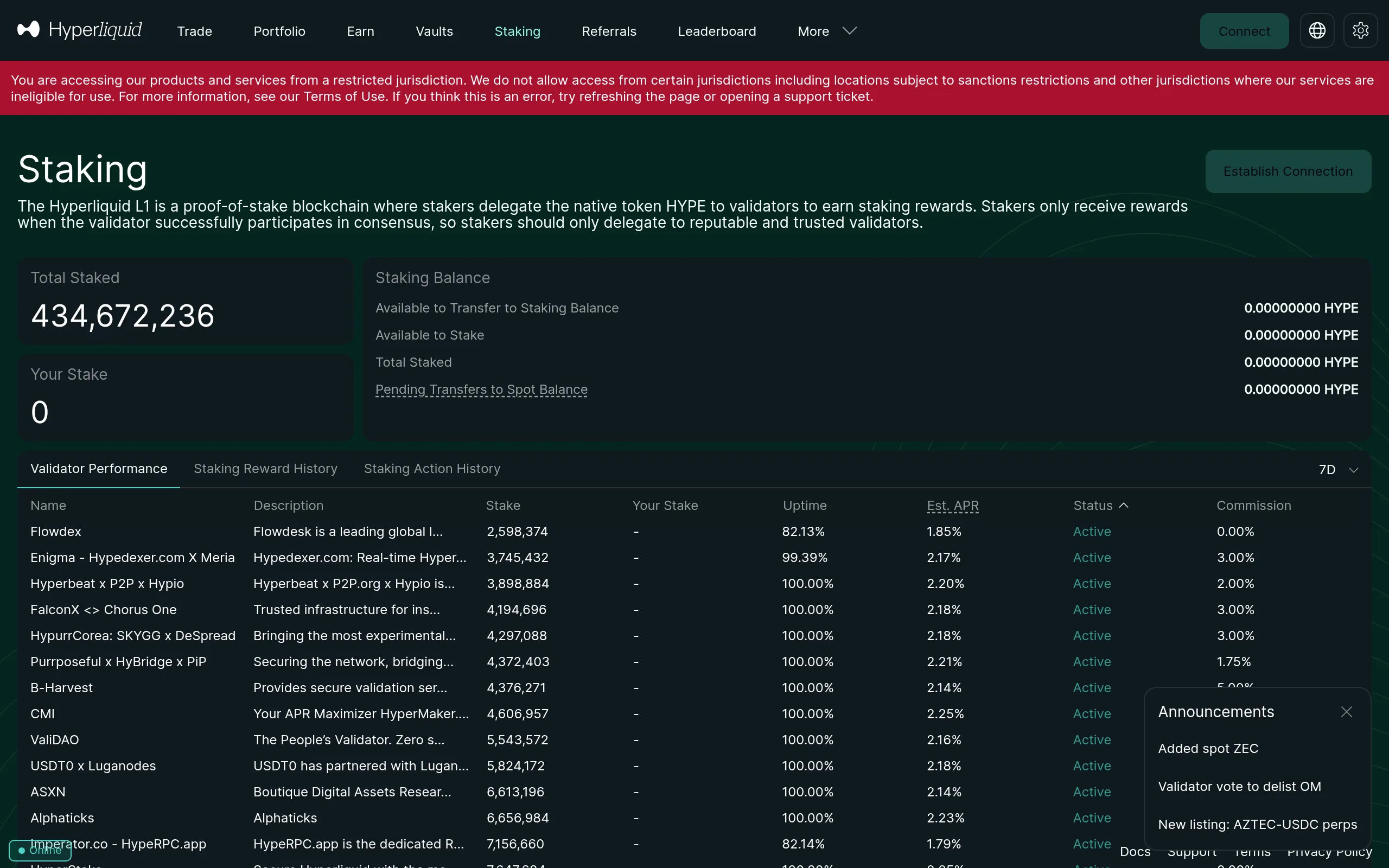
As a HYPE holder, you do not need to run a validator node yourself. Instead, you delegate your HYPE to an existing validator. Your delegated tokens contribute to that validator's stake, helping secure the network, and you receive a proportional share of the staking rewards. For a full breakdown of what you actually earn staking HYPE and how fee burns tighten supply, see our dedicated staking-yields guide.
Here is how to stake your HYPE:
- Navigate to the staking interface at app.hyperliquid.xyz and find the staking or delegation section
- Browse available validators - you will see a list of active validators along with their commission rates, total stake, and uptime
- Choose a validator - look for validators with high uptime, reasonable commission rates, and a strong track record
- Enter your delegation amount - specify how much HYPE you want to stake
- Confirm the transaction - approve the delegation in your wallet
Tip
Expected Yields
Staking yields depend on how much HYPE is staked across the network. Hyperliquid's staking docs say the reward rate is inversely proportional to the square root of total HYPE staked, and give about 2.37% a year at 400 million HYPE staked. Rewards accrue every minute, are paid daily and compound automatically. The API's validatorSummaries endpoint showed about 440 million HYPE staked on October 14, 2026, which puts the rate a little below that reference point. Check the staking interface for the current figure.
Unstaking
Unstaking has two waits. Per Hyperliquid's staking docs, a delegation is locked to its validator for 1 day, and moving HYPE from your staking balance back to spot goes through a 7-day unstaking queue (each address can have at most 5 pending withdrawals). Plan accordingly and do not stake tokens you might need right away.
If you want staking rewards without the unbonding lock, consider liquid staking with Kinetiq - you receive kHYPE tokens that earn staking yield while remaining liquid and usable as DeFi collateral.
HYPE Utility and Use Cases
HYPE is not a token that sits in your wallet doing nothing. It has concrete, functional roles within the Hyperliquid ecosystem.
Network Security (Staking)
As described above, HYPE is the staking token that secures Hyperliquid's L1 through HyperBFT consensus. Validators and their delegators stake HYPE to participate in block production and earn rewards. This is the most fundamental utility - without staked HYPE, the network does not function.
Since May 2026, per Hyperliquid's announcement of canonical outcome markets, validators also operate the automated newsfeed software that deploys and settles them. These are Hyperliquid's prediction-market layer for offchain events. Resolving canonical markets is now part of normal block production, which means HYPE stakers are economically backing prediction-market integrity alongside perp settlement. When you choose a validator to delegate to, you are implicitly endorsing their newsfeed and voting record. HYPE is also the gating asset for launching your own markets. HIP-4 permissionless market deployment lets anyone who meets the HYPE staking requirement deploy outcome markets from validator-approved templates. The mainnet announcement set that requirement at 500,000 HYPE, and the HIP-4 deployer actions docs say a deployer cannot deactivate until 183 days have passed. For a market-by-market look at how this stacks up against the category leader, see Hyperliquid's move into prediction markets vs Polymarket.
Gas Fees on HyperEVM
HyperEVM is Hyperliquid's Ethereum-compatible smart contract execution environment. Every transaction on HyperEVM - deploying contracts, executing DeFi transactions, minting NFTs - requires HYPE as gas. As the HyperEVM ecosystem grows and more dApps launch, demand for HYPE as gas increases proportionally.
Info
Governance Potential
While formal on-chain governance mechanisms are still evolving, HYPE holders are positioned to participate in protocol governance decisions as the ecosystem matures. Token-weighted governance is the standard model in DeFi, and HYPE's wide distribution from the airdrop creates a broad, decentralized governance base.
Ecosystem Participation
HYPE is increasingly integrated into the broader Hyperliquid ecosystem. DeFi protocols building on HyperEVM use HYPE as collateral, liquidity pairs, and reward tokens. Through Kinetiq liquid staking, kHYPE and wstHYPE tokens let you earn staking yield while using your HYPE as collateral on protocols like Felix. On Felix Protocol, HYPE is one of the primary collateral types for minting the feUSD stablecoin - you can deposit HYPE and borrow against it without selling your position. On Hyperliquid itself, Portfolio Margin accounts now let you use HYPE directly as collateral for perp positions without converting it to USDC. Holding and using HYPE gives you access to the full range of opportunities emerging on Hyperliquid's chain, including trading traditional markets like commodities and equities.
Buyback and Burn: How Trading Fees Support HYPE
One of HYPE's most powerful value mechanisms is the buyback and burn process, which creates a direct link between Hyperliquid's trading volume and HYPE's supply dynamics.
How It Works
Hyperliquid generates revenue from trading fees (including fees generated by the HLP market-making vault). Hyperliquid's fee docs say fees go to HLP, the Assistance Fund and deployers. The Assistance Fund, at system address 0xfefe...fefe, converts trading fees to HYPE automatically as part of L1 execution, and the docs say HYPE in the fund is burned, removing it from circulating and total supply.
As of 2026, trading fees are no longer the only inflow. Under AQAv2, Hyperliquid's aligned quote asset docs say stablecoin deployers share approximately 90% of cost-adjusted reserve yield on their Hyperliquid supply with the protocol. That revenue accrues in 30-day intervals and goes to the Assistance Fund automatically 8 days after each interval ends. For USDC, the public AQAv2 announcement named Coinbase and Circle as its deployers and gave August 26 as the start of yield accrual and October 3 as the first payment. The result is a second inflow to the Assistance Fund that grows with aligned stablecoin supply, on top of trading fees.
The mechanics are straightforward:
- Traders pay fees on every taker trade
- A portion of fee revenue flows to the Assistance Fund
- The fund buys HYPE on the open market
- Purchased HYPE is burned (permanently destroyed)
- Total circulating supply decreases over time
Why This Matters
This creates a deflationary pressure on HYPE that scales with platform usage. The more people trade on Hyperliquid, the more fees are generated, the more HYPE is bought and burned, and the scarcer the remaining supply becomes. It is a flywheel: platform success directly translates to supply reduction.
For scale, DefiLlama's fee data shows about $91 million in Hyperliquid fees in September 2026. (Hyperliquid's own public volume feed stopped updating in April 2026, so this guide does not quote a current volume figure.)
The link between volume and buyback size is real but it is not one-to-one. We track it monthly in Hyperliquid revenue vs volume, which plots protocol fees against retained revenue. In DefiLlama's fees and revenue series, the share of fees retained as revenue fell from 94.2% in June and July 2025 to 69.7% in July 2026, then recovered to 81.2% in September 2026 (checked October 14, 2026). Anyone modeling future buyback support from a 2025 run rate is working from a share the protocol has not matched since.
HYPE is also spent as listing gas in the token deployment auctions for new HIP-1 spot tickers and additional HIP-3 perp market slots. The HIP-1 docs describe a 31-hour Dutch auction with a 500 HYPE floor. Our auctions guide covers what happens to that HYPE. Burns from every source show up in the API as the gap between max supply and total supply.
Warning
Trade on Hyperliquid with Lower Fees
Every trade you make on Hyperliquid contributes to the HYPE ecosystem. Sign up with our referral code and save 4% on trading fees - permanently.
Claim Your 4% DiscountWhere to Buy HYPE
If you want to acquire HYPE, you have several options.
On Hyperliquid (Recommended)
The most direct way to buy HYPE is on Hyperliquid itself. The platform offers both spot trading (buy and hold actual HYPE tokens) and perpetual futures (trade HYPE with leverage for speculation). Buying on Hyperliquid's spot market gives you self-custody, no KYC requirement, and direct access to the most liquid HYPE market.
To buy HYPE on Hyperliquid spot:
- Deposit USDC into Hyperliquid
- Navigate to the spot trading interface
- Select the HYPE/USDC pair
- Place a market or limit order
On Centralized Exchanges
HYPE is also available on several centralized exchanges. The trade-off is that you will need to complete KYC, your tokens are held in the exchange's custody, and you will need to withdraw to a self-custody wallet if you want to stake or use HYPE on HyperEVM. For a comparison of these exchanges against Hyperliquid, see our Hyperliquid vs Binance and Hyperliquid vs Bybit guides.
Transferring to Hyperliquid
If you buy HYPE on a centralized exchange, you can transfer it to your Hyperliquid wallet for staking or use in the ecosystem. Make sure to use the correct network when withdrawing - HYPE is native to Hyperliquid's L1 chain.
Through a Stock or an ETF
Since 2026 there are also wrapped routes for accounts that cannot hold crypto directly, such as retirement accounts. Hyperliquid Strategies Inc (NASDAQ: PURR) is a treasury company whose balance sheet is almost entirely HYPE, and spot ETFs now hold the token on behalf of shareholders. Every one of these adds either an annual sponsor fee or a premium to net asset value on top of the token price, and none of them put staking rewards in your own account. We compared all of them in PURR stock vs HYPE token.
Tip
The Bottom Line
HYPE is the token that holds the Hyperliquid ecosystem together. It secures the network through staking, fuels the growing HyperEVM smart contract platform as gas, and benefits from a buyback and burn mechanism that ties protocol revenue to supply reduction. The November 2024 airdrop established one of the largest and broadest token distributions in DeFi history, and the tokenomics heavily favor community allocation over insider holdings.
Whether you are a trader looking to reduce fees through staking, a DeFi user exploring the HyperEVM ecosystem, or simply someone who wants to understand what powers one of the fastest-growing L1 blockchains, HYPE is the asset at the center of it all.
Important
Frequently Asked Questions
HYPE has a maximum supply of 1 billion tokens, per the Hyperliquid API's tokenDetails response. According to the Hyper Foundation's November 2024 genesis announcement, 31% went to users in the genesis distribution, 38.888% is reserved for future emissions and community rewards, 23.8% goes to current and future core contributors, 6% is the Hyper Foundation budget, 0.3% is for community grants and 0.012% is for HIP-2. Hyperliquid's fee docs say HYPE held by the Assistance Fund is burned.
You can stake HYPE by delegating your tokens to a validator through the Hyperliquid staking interface at app.hyperliquid.xyz. Move HYPE from your spot balance to your staking balance, choose a validator, enter the amount and confirm. Hyperliquid's staking docs say delegations have a 1-day lockup and that moving HYPE from staking back to spot goes through a 7-day unstaking queue. Your staked HYPE helps secure the network via HyperBFT consensus and earns staking rewards.
The primary place to buy HYPE is on Hyperliquid itself, both on the spot market and the perpetual futures market. HYPE is also listed on several centralized exchanges. Buying on Hyperliquid's native spot market gives you direct, non-custodial access without KYC requirements.
This guide is for educational purposes only and does not constitute investment advice. HYPE has real utility as the native token of Hyperliquid L1 - it is used for staking, gas fees, and benefits from a buyback and burn mechanism. However, all crypto assets are volatile and carry significant risk. Always do your own research and never invest more than you can afford to lose.
Independent resource: Hyperliquid Guide is an independent, third-party resource operated by Concept211. It is not affiliated with, produced by, reviewed by or endorsed by Hyper Foundation, Hyperliquid Labs or any other Hyperliquid-ecosystem entity. "Hyperliquid" and related names and marks belong to their respective owners and are used here only to identify the platform this site documents. Read the full disclaimer.
Not advice: Nothing on this site is legal, tax, financial or investment advice. Descriptions of regulatory status, tax treatment and market availability are general information that varies by jurisdiction and changes over time. Confirm anything that matters to you with a qualified professional and against primary sources. Trading perpetual futures involves substantial risk of loss, and past performance does not indicate future results.
Disclosure: this site contains referral links. Signing up through the 4% lifetime fee discount link earns us a share of the trading fee Hyperliquid already charges, at no extra cost to you.
Ready to Start Trading?
Join Hyperliquid with our referral link and get a 4% lifetime fee discount. No KYC, no email - just connect your wallet and trade.
Start Trading - Save 4%