Hyperliquid vs Bybit (May 2026) — Self-Custody DEX vs Top-3 CEX
Table of Contents
- Hyperliquid vs Bybit: On-Chain Self-Custody Meets the #3 CEX
- Security and Custody: The Defining Difference
- Bybit: Exchange Custody
- Hyperliquid: Self-Custody
- KYC and Onboarding
- Hyperliquid: Zero KYC, Instant Access
- Bybit: Full KYC Required
- Fee Comparison
- Fee Calculation: $500K Monthly Volume Trader
- Trading Features and Products
- Where Bybit Leads
- Where Hyperliquid Leads
- Speed and Execution
- Hyperliquid
- Bybit
- Does It Matter?
- Leverage Comparison
- Liquidity and Volume
- Regulatory Risk and Trust
- Bybit's Regulatory Position
- Hyperliquid's Decentralized Architecture
- Verdict: Hyperliquid vs Bybit in May 2026
- Who Should Choose Which?
 Hyperliquidvs
 Bybit
BybitInfo
Last verified: May 2026. All fee figures, leverage limits, and platform features confirmed against current Bybit and Hyperliquid documentation. Bybit's post-hack security measures and regulatory positioning updated for 2026.
Hyperliquid vs Bybit: On-Chain Self-Custody Meets the #3 CEX
Bybit has established itself as the third-largest centralized crypto exchange by trading volume, known for its perpetual futures focus and competitive fee structure. Hyperliquid, meanwhile, has redefined what a decentralized exchange can be - a fully on-chain order book with sub-second execution, zero gas fees, and no KYC requirement. Both platforms attract serious perps traders, but they take fundamentally different approaches to custody, access, and security.
The comparison became more pointed after February 2025, when Bybit suffered one of the largest exchange hacks in crypto history. The Lazarus Group exploited Bybit's infrastructure and stole approximately $1.5 billion in assets. Bybit covered user losses, but the incident underscored a risk that simply does not exist on a self-custody platform like Hyperliquid.
This guide covers every dimension that matters so you can decide which platform fits your trading needs.
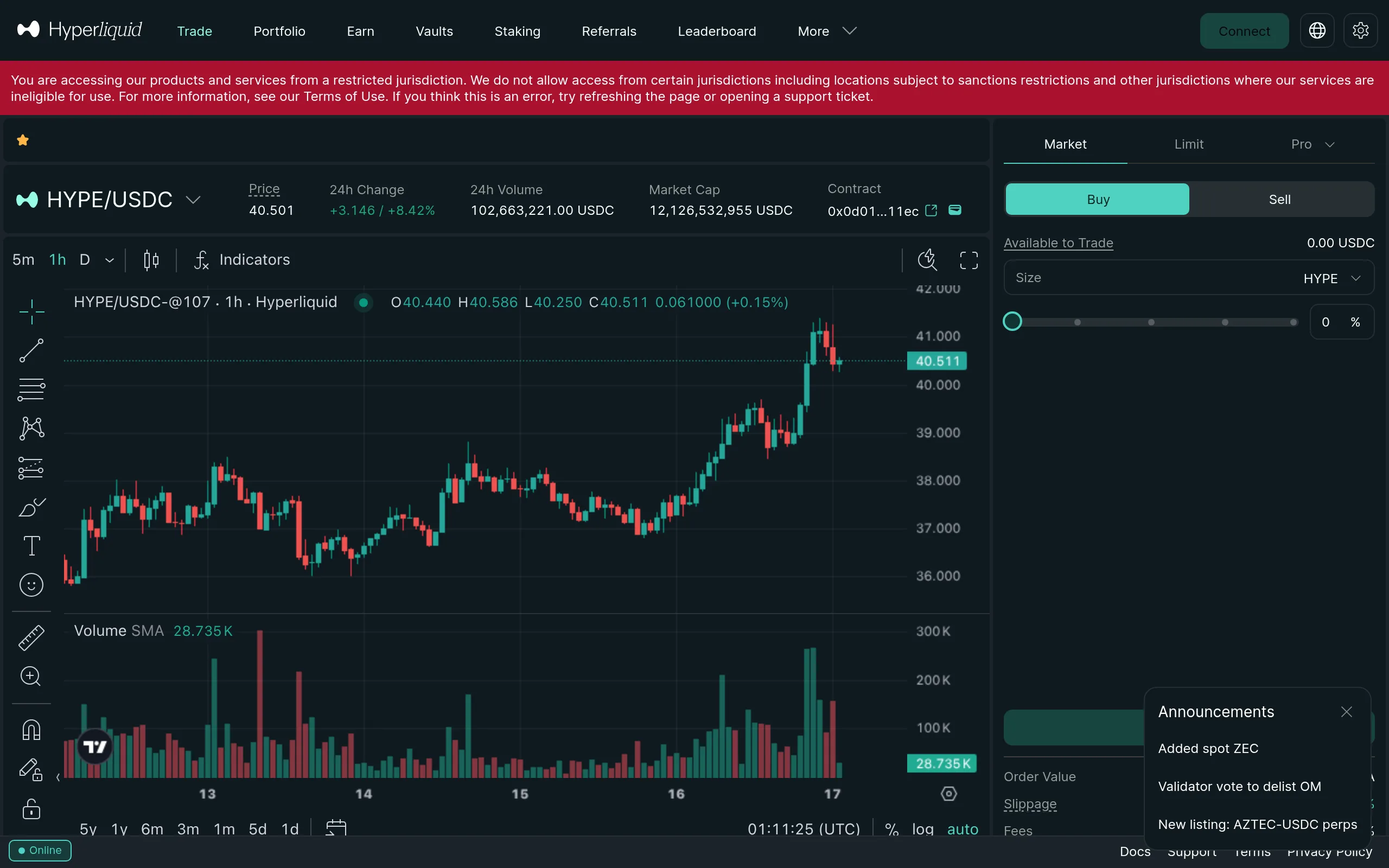
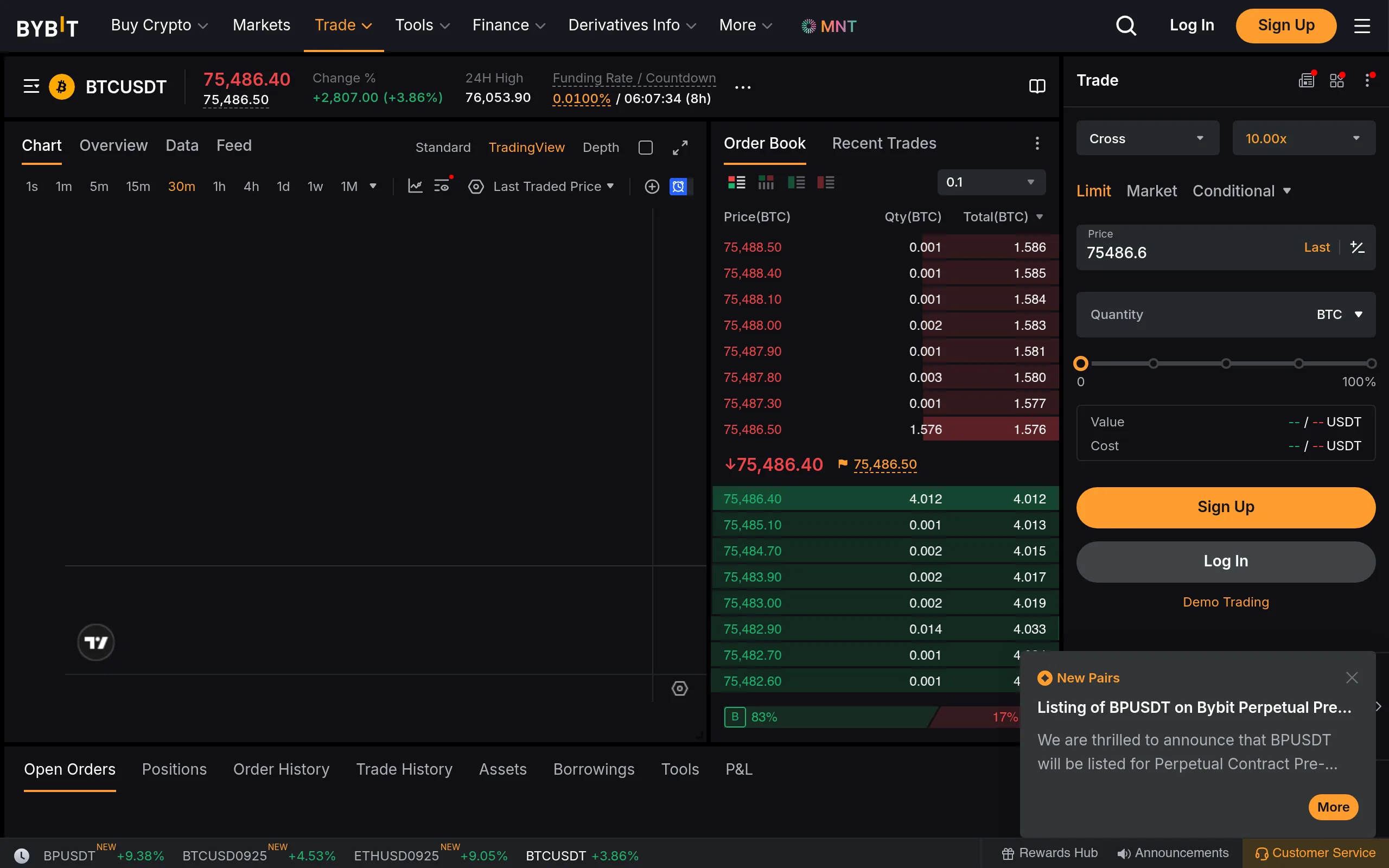
Trade Without Trusting a Third Party
Hyperliquid gives you CEX-level speed with full self-custody and lower fees than Bybit. Use our referral code for a 4% lifetime fee discount.
Try Hyperliquid - Save 4%Security and Custody: The Defining Difference
After the 2025 Bybit hack, security is no longer an abstract comparison point - it is the most concrete reason traders are reconsidering where they keep their funds.
Bybit: Exchange Custody
When you deposit funds to Bybit, the exchange takes custody of your assets. Your crypto sits in Bybit-controlled wallets, secured by their internal infrastructure. Bybit implements industry-standard security measures including cold storage, multi-signature wallets, and an insurance fund.
Despite these measures, in February 2025 the North Korean state-sponsored Lazarus Group exploited vulnerabilities in Bybit's systems and extracted roughly $1.5 billion. It was one of the largest crypto exchange hacks ever. Bybit acted responsibly - they covered all user losses and no customer funds were permanently lost - but the incident demonstrated a fundamental truth about exchange custody: no matter how good the security is, a centralized pool of billions of dollars is always a target.
Hyperliquid: Self-Custody
On Hyperliquid, you connect your own wallet (MetaMask, Rabby, Phantom, or similar) and deposit USDC to your margin account. Your funds are controlled by the protocol's on-chain logic and your private keys. There is no centralized honeypot for hackers to target, no company that can freeze your account, and no intermediary between you and your assets.
The trade-off is personal responsibility: lose your private keys and there is no customer support to call. For best practices on protecting your wallet, see our crypto security guide.
Warning
The Bybit hack is a reminder that exchange custody always carries counterparty risk. Self-custody on Hyperliquid eliminates this entire category of risk - your funds are never held by a third party.
KYC and Onboarding
Hyperliquid: Zero KYC, Instant Access
Hyperliquid requires nothing: no email, no phone number, no government ID, no selfie. Connect a wallet, bridge USDC to Hyperliquid, and you are trading within minutes. The entire onboarding process is permissionless and available globally.
Bybit: Full KYC Required
Bybit requires identity verification for full platform access. This includes government-issued photo ID and, depending on jurisdiction, additional documentation. Without completing KYC, users face restrictions on withdrawals, trading limits, and access to certain features. Bybit also restricts or blocks users from specific countries.
For traders who prioritize privacy or live in underserved jurisdictions, Hyperliquid's no-KYC permissionless model is a clear advantage.
Fee Comparison
This is where Hyperliquid pulls ahead decisively. For a complete breakdown, see our Hyperliquid fee structure guide.
| Hyperliquid | Bybit | |
|---|---|---|
| Maker Fee (Base) | 0.015% | 0.02% |
| Taker Fee (Base) | 0.045% | 0.055% |
| Gas/Network Fees | Zero | Zero (internal) |
| Withdrawal Fees | None (on-chain) | Varies by network |
| Referral Discount | 4% lifetime | Up to 20% (varies) |
| Token Discount | Up to 40% (HYPE staking) | None |
| VIP Tiers | Yes (volume-based) | Yes (volume-based) |
Hyperliquid wins on both maker and taker fees at base tier. On a $10,000 taker trade, you pay $4.50 on Hyperliquid vs $5.50 on Bybit - a 18% saving before any discounts. On maker orders, it is $1.50 vs $2.00 - a 25% saving.
The gap widens further with discounts. Hyperliquid's HYPE token staking discount (up to 40%) stacks with the 4% referral discount, driving effective fees well below Bybit's best tiers. See our VIP fee tiers guide for the full breakdown. Get Your 4% Discount
Fee Calculation: $500K Monthly Volume Trader
| Platform | Monthly Fee Cost (Taker) |
|---|---|
| Hyperliquid (base + 4% referral via Concept211) | $216 |
| Hyperliquid (base + referral + HYPE staking) | $130 - $216 |
| Bybit (base tier) | $275 |
| Bybit (VIP 1 tier) | $200 |
Even at Bybit's VIP 1 tier (requiring $10M+ monthly volume), Hyperliquid with stacking discounts is competitive or cheaper - and Hyperliquid's discounts require no volume threshold.
Lower Fees on Every Trade
Hyperliquid beats Bybit on both maker and taker fees at base tier. Stack the referral discount with HYPE staking for up to 40% additional savings.
Start Saving on FeesTrading Features and Products
| Hyperliquid | Bybit | |
|---|---|---|
| Perpetual Pairs | 200+ | 400+ |
| Spot Pairs | Growing | 600+ |
| Max Leverage | Up to 40x | Up to 100x |
| Order Types | Market, Limit, Scaling, TWAP, TP/SL | Market, Limit, Conditional, TP/SL |
| Options Trading | No | Yes (USDC options) |
| Copy Trading | Via vaults | Yes (built-in) |
| Earn Products | Via HyperEVM DeFi | Yes (savings, staking, dual asset) |
| Commodity/Equity Perps | Yes (gold, oil, stocks) | No |
| Fiat On-Ramp | No (bridge USDC) | Yes (cards, bank, P2P) |
| API Trading | Yes (REST + WebSocket) | Yes (REST + WebSocket) |
| Sub-Accounts | Yes (all users) | Yes (all users) |
Where Bybit Leads
Bybit offers a broader product suite: options trading, built-in copy trading, earn products (savings accounts, dual asset investments, liquidity mining), and fiat on-ramps through cards, bank transfers, and P2P trading. If you want a single platform for everything crypto, Bybit covers more ground. That said, Hyperliquid's copy trading vaults and growing DeFi lending ecosystem are narrowing the gap.
Bybit also offers higher maximum leverage - up to 100x on BTC compared to Hyperliquid's 40x cap. Whether this is an advantage depends on your risk management philosophy. Most experienced traders stay well below 40x regardless of what is available.
Where Hyperliquid Leads
For perpetual futures specifically, Hyperliquid matches or exceeds Bybit in several areas:
- Advanced order types: Hyperliquid's scaling orders and TWAP are sophisticated execution tools that Bybit does not offer
- Commodity and equity perps: Trade gold, silver, crude oil, NVIDIA, Tesla, and more through Hyperliquid's HIP-3 markets - a category Bybit has not entered
- Zero gas fees: Every order placement, modification, and cancellation is free. Bybit has no internal gas but charges withdrawal fees
- HyperEVM ecosystem: A growing DeFi ecosystem built on Hyperliquid's own EVM chain, offering lending, staking, and yield opportunities through protocols rather than centralized earn products
- Sub-accounts for everyone: Available to all users without VIP requirements
Speed and Execution
Hyperliquid
Hyperliquid runs on a custom Layer 1 blockchain purpose-built for trading. Orders reach finality in under one second. The experience is indistinguishable from a centralized exchange for manual traders - orders fill instantly, modifications are immediate, and there are zero gas costs for any interaction.
Bybit
Bybit runs a traditional centralized matching engine with microsecond-level order matching. At the raw infrastructure level, it is technically faster than any blockchain-based system.
Does It Matter?
For 99% of traders, no. Both platforms feel instant when clicking buttons on a trading interface. The sub-second vs microsecond difference is only relevant for high-frequency algorithmic strategies competing on raw latency. If you are a manual trader or running strategies that operate on second-level timeframes, you will not notice any difference.
Leverage Comparison
Bybit offers up to 100x leverage on BTC/USDT perpetuals, with varying maximums across other pairs. Hyperliquid caps leverage at 40x on BTC and 25x on ETH as of September 2026, with lower limits on less liquid assets.
Tip
Higher maximum leverage is not inherently better. At 100x leverage, a 1% move against your position liquidates you. Most professional traders use 5-20x leverage for sustainable risk management. Hyperliquid's 40x cap is more than sufficient for nearly all trading strategies.
Liquidity and Volume
Bybit consistently ranks among the top 3 exchanges by derivatives volume globally, processing tens of billions of dollars daily. Its order book depth on major pairs like BTC and ETH is substantial.
Hyperliquid processes approximately ~$7B in daily volume - impressive for a DEX and higher than many centralized exchanges. Spreads on major pairs are tight, and the order book handles six-figure trades without significant slippage.
For retail and professional traders executing typical position sizes, both platforms offer adequate liquidity. For institutional-sized orders on major pairs, Bybit's depth provides an edge. For mid-cap and long-tail perps, Hyperliquid's 200+ pairs ensure broad market coverage.
Regulatory Risk and Trust
Bybit's Regulatory Position
Bybit has pursued licensing in several jurisdictions but remains restricted or unavailable in others. The exchange has relocated its headquarters multiple times. While Bybit has not faced the same scale of regulatory action as some competitors, centralized exchanges in general face ongoing regulatory uncertainty.
More critically, the February 2025 hack demonstrated operational risk. Even though Bybit made users whole, the incident - the largest exchange hack in crypto history at approximately $1.5 billion - showed that centralized custody creates systemic vulnerabilities that no security audit can fully eliminate.
Hyperliquid's Decentralized Architecture
Hyperliquid operates as a decentralized protocol. There is no central entity holding user funds, no KYC database that can be breached, and no single point of failure that can be exploited for billions. Your assets remain under your control at all times.
This architectural difference is not theoretical - it is the difference between a platform that can be hacked for $1.5 billion and one where that attack vector does not exist.
Verdict: Hyperliquid vs Bybit in May 2026
As of May 2026, Hyperliquid is the better choice for perpetual futures traders who prioritize low fees, self-custody, and privacy. Hyperliquid charges 0.015% maker and 0.045% taker versus Bybit's 0.02% maker and 0.055% taker — saving traders 18-25% on every trade before additional discounts. The February 2025 Bybit hack ($1.5 billion stolen by the Lazarus Group) made the case for self-custody unavoidable: on Hyperliquid, funds never leave your wallet, eliminating exchange custody risk entirely. Hyperliquid requires no KYC, offers zero gas fees, and provides access to unique asset classes (commodity and equity perpetuals) that Bybit does not support. Bybit remains stronger for traders who need fiat on-ramps, options trading, 100x leverage, or a full-service centralized platform with earn products and copy trading.
Who Should Choose Which?
Choose Hyperliquid if you:
- Want self-custody - your keys, your crypto, no exchange risk
- Care about lower fees - Hyperliquid wins on both maker and taker at base tier
- Value privacy - no KYC, no personal data collection, no account freezes
- Trade perpetual futures primarily - Hyperliquid is purpose-built for this
- Want access to commodity and equity perps - unique to Hyperliquid's ecosystem
- Were concerned by the Bybit hack and want to eliminate custodial risk
Choose Bybit if you:
- Need fiat on-ramps - buy crypto with cards or bank transfers
- Want options trading - Bybit offers USDC-settled options
- Prefer built-in copy trading - Bybit's system is polished and established
- Need 100x leverage - Hyperliquid caps at 40x
- Want a full-service platform - earn products, launchpad, NFT marketplace
- Prioritize maximum liquidity depth on major pairs
For the growing number of traders who primarily trade perpetual futures, Hyperliquid is the stronger choice. It offers lower fees, self-custody, no KYC, innovative order types, and an expanding DeFi ecosystem - all without the custodial risk that the Bybit hack made painfully real. You can always maintain a Bybit account for fiat on-ramps or options while using Hyperliquid as your primary perps venue.
If you are currently on Bybit and have been considering alternatives since the hack, Hyperliquid addresses the core concern directly: your funds are never in someone else's hands. Sign up via our referral page for a 4% lifetime fee discount. See our guide on how to place your first trade on Hyperliquid to get started, or compare Hyperliquid against other exchanges in our Hyperliquid vs Binance, Hyperliquid vs Gate.io, Hyperliquid vs MEXC, and Hyperliquid vs Crypto.com breakdowns. For DEX alternatives, see Hyperliquid vs AsterDEX, Hyperliquid vs Lighter, and Hyperliquid vs dYdX.
Self-Custody Trading with Lower Fees
Move your perps trading to Hyperliquid - lower fees than Bybit, no KYC, and your funds stay in your wallet. Use our referral link for 4% off all trades.
Join Hyperliquid NowFrequently Asked Questions
At base tier, Hyperliquid charges 0.015% maker and 0.045% taker, while Bybit charges 0.02% maker and 0.055% taker. Hyperliquid wins on both sides. When you add the 4% referral discount and up to 40% HYPE staking discount, Hyperliquid's effective fees are significantly lower than Bybit for most traders.
No. Hyperliquid requires no KYC, no email, and no account registration. You connect a crypto wallet and start trading immediately. Bybit requires full identity verification including government ID for access to all features, and restricts users in certain jurisdictions without completed KYC.
The security models are fundamentally different. On Hyperliquid, you maintain self-custody of your funds through your own wallet, so there is no centralized pool of assets for hackers to target. Bybit suffered a major hack in 2025 where the Lazarus Group stole approximately 1.5 billion dollars. While Bybit covered user losses, the incident highlights the inherent risk of exchange custody. Self-custody on Hyperliquid eliminates this category of risk entirely.
Bybit offers more spot pairs and additional products like options, copy trading, and earn products. For perpetual futures specifically, both platforms offer extensive pair coverage. Hyperliquid has over 200 perp pairs and is expanding rapidly into commodities and equity perpetuals, which Bybit does not offer.
Yes. Bybit offers up to 100x leverage on BTC and other major pairs, while Hyperliquid caps at 40x (BTC) and 25x (ETH). However, most risk-conscious traders use 5-20x leverage regardless of the maximum available. Higher leverage availability is not necessarily an advantage since it increases liquidation risk significantly.
Independent resource: Hyperliquid Guide is an independent, third-party resource operated by Concept211. It is not affiliated with, produced by, reviewed by or endorsed by Hyper Foundation, Hyperliquid Labs or any other Hyperliquid-ecosystem entity. "Hyperliquid" and related names and marks belong to their respective owners and are used here only to identify the platform this site documents. Read the full disclaimer.
Not advice: Nothing on this site is legal, tax, financial or investment advice. Descriptions of regulatory status, tax treatment and market availability are general information that varies by jurisdiction and changes over time. Confirm anything that matters to you with a qualified professional and against primary sources. Trading perpetual futures involves substantial risk of loss, and past performance does not indicate future results.
Disclosure: this site contains referral links. Signing up through the 4% lifetime fee discount link earns us a share of the trading fee Hyperliquid already charges, at no extra cost to you.
Ready to Start Trading?
Join Hyperliquid with our referral link and get a 4% lifetime fee discount. No KYC, no email - just connect your wallet and trade.
Start Trading - Save 4%