Hyperliquid vs AsterDEX (2026): Fees, Architecture, and Which DEX Wins
Table of Contents
- Hyperliquid vs AsterDEX: Two Visions for On-Chain Trading
- Architecture: Custom L1 vs Multi-Chain Deployment
- Hyperliquid's Approach
- AsterDEX's Approach
- Why This Matters
- Fee Comparison
- Leverage: 50x vs 1001x
- Hidden Orders and Dark Pool Trading
- Markets: Breadth vs Niche Features
- Hyperliquid Markets
- AsterDEX Markets
- Liquidity and Volume
- Token Economics: HYPE vs ASTER
- HYPE Token
- ASTER Token
- User Experience and Onboarding
- Getting Started on Hyperliquid
- Getting Started on AsterDEX
- Head-to-Head Summary
- The Verdict
- Who Should Use Each Platform
 Hyperliquidvs
 AsterDEX
| Feature | Hyperliquid | AsterDEX |
|---|---|---|
| Perp Taker Fee | 0.045% | 0.035% (Pro) / 0.08% (Simple) |
| Perp Maker Fee | 0.015% | 0.01% (Pro) / 0.08% (Simple) |
| Max Leverage | Up to 50x | Up to 1001x |
| Available Markets | 200++ perps + spot | 45+ symbols |
| Chain / Network | Hyperliquid L1 (custom) | Multi-chain (BNB, Arbitrum, etc.) |
| KYC Required | No | No |
| Gas Fees | Zero | Network gas (BNB/Arbitrum) |
| Hidden Orders | No | Yes (Pro Mode) |
Tip
Why This Comparison Matters: Hyperliquid and AsterDEX take opposite architectural approaches to decentralized trading. Hyperliquid built a custom L1 for maximum throughput. AsterDEX went multi-chain for maximum accessibility. Your choice depends on whether you prioritize execution speed and deep liquidity or cross-chain flexibility and niche features like 1001x leverage.
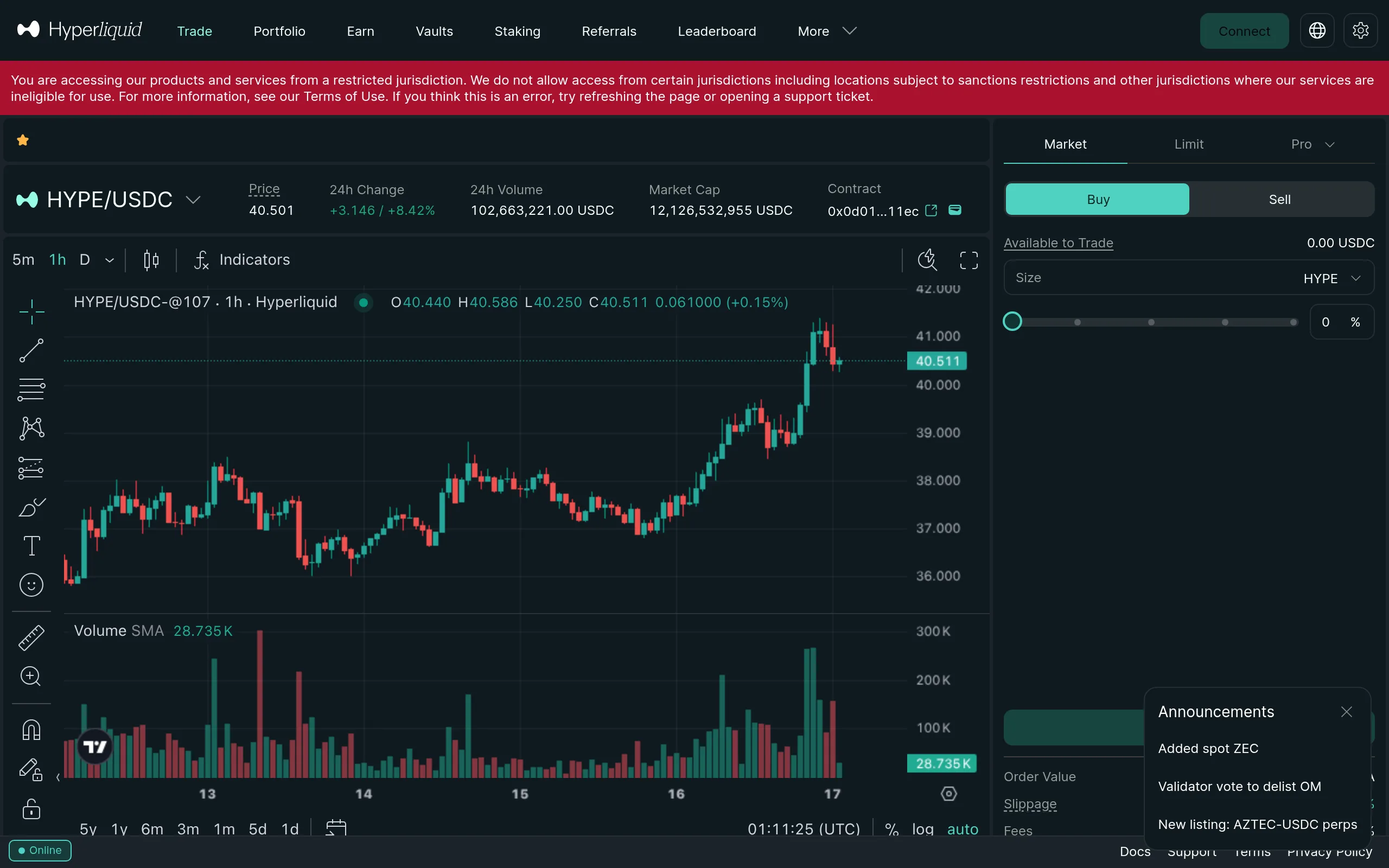
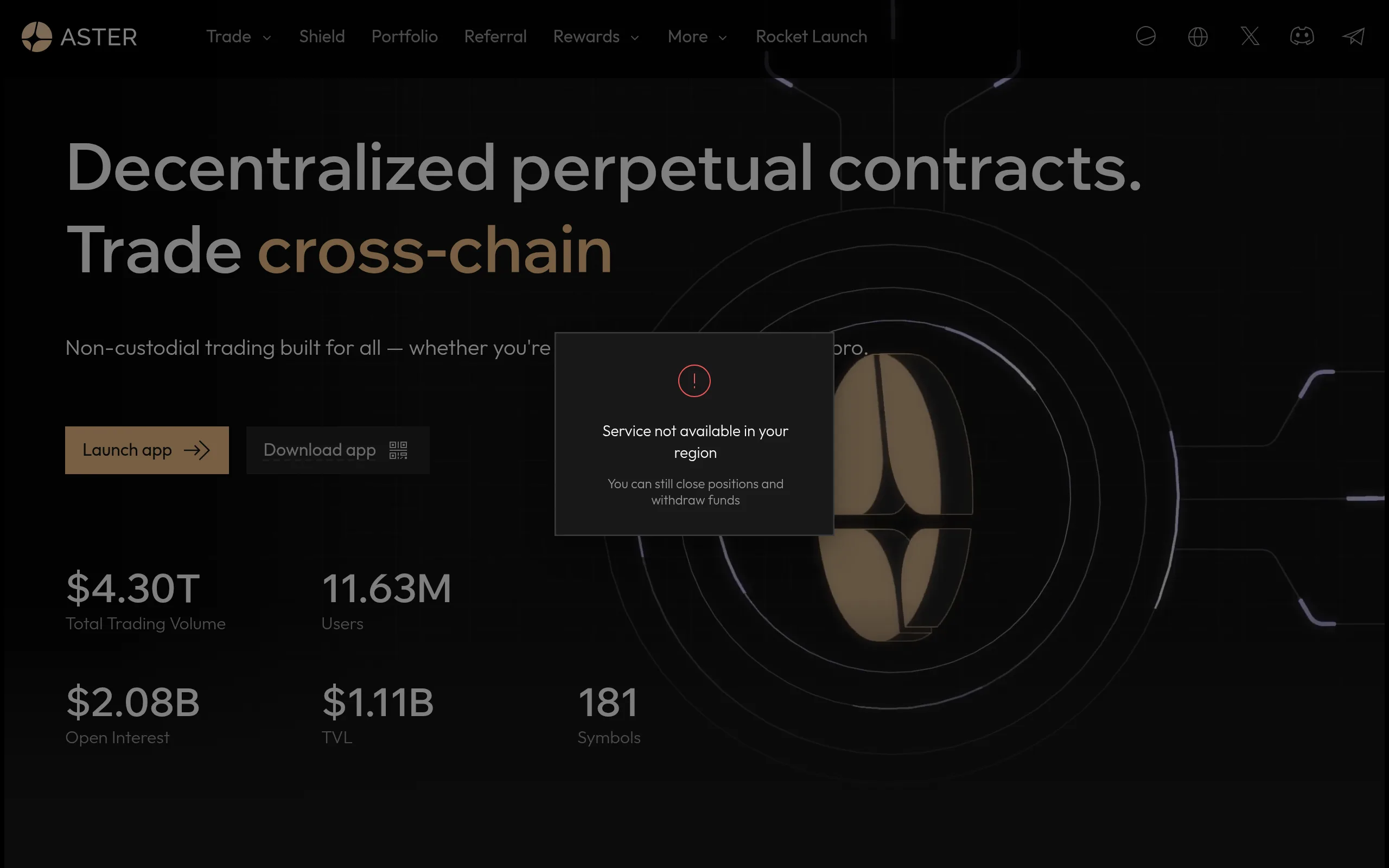
Hyperliquid vs AsterDEX: Two Visions for On-Chain Trading
The decentralized perpetuals landscape has matured rapidly. While Hyperliquid has established itself as the volume leader with its purpose-built Layer 1 blockchain, AsterDEX (formerly SynFutures) has carved out a niche with multi-chain deployment, hidden order functionality, and extreme leverage options. Both platforms let you trade perpetual futures without KYC, but they differ significantly in architecture, fees, and trading philosophy.
Hyperliquid processes over ~$7B in daily volume across 200+ perpetual pairs, making it the dominant decentralized exchange by throughput. AsterDEX counters with unique features like dark pool orders and 1001x leverage that appeal to specific trader profiles.
This guide breaks down every meaningful difference so you can pick the right platform.
Trade on Hyperliquid with Lower Fees
Sign up through our referral link and get a 4% lifetime discount on all trading fees. No KYC, no account creation — just connect your wallet.
Start Trading — Save 4% on FeesArchitecture: Custom L1 vs Multi-Chain Deployment
The fundamental architectural difference between these platforms shapes everything — from execution speed to fee structure to the overall trading experience.
Hyperliquid's Approach
Hyperliquid runs on a purpose-built Layer 1 blockchain with its own consensus mechanism (HyperBFT). The entire order book — every bid, ask, match, and settlement — lives on-chain through a fully on-chain central limit order book (CLOB). This is not an EVM fork or a repurposed chain. The team designed HyperBFT specifically for high-frequency trading, achieving over 200,000 operations per second with sub-second finality.
The result is zero gas fees on every operation. Order placements, cancellations, modifications, and settlements cost nothing. Beyond spot and perps, Hyperliquid's HyperEVM ecosystem enables DeFi protocols to build directly on the same chain — lending, staking, and yield products all live alongside the exchange.
AsterDEX's Approach
AsterDEX takes the opposite approach: deploy across multiple existing chains rather than building one from scratch. The platform operates on BNB Chain (where roughly 78% of its TVL sits), Arbitrum, Ethereum, Solana, Base, zkSync, and Scroll. This multi-chain strategy maximizes accessibility — traders can use whichever chain they already have funds on.
AsterDEX offers two distinct trading modes:
- Simple Mode — AMM-based execution with up to 1001x leverage. Quick and straightforward but with higher fees (0.08% per entry and exit).
- Pro Mode — A fully on-chain CLOB with hidden orders (dark pool functionality). Lower fees (0.01% maker / 0.035% taker) and more sophisticated execution.
AsterDEX has also announced plans for "Aster Chain," a dedicated L1 with zero-knowledge infrastructure for enhanced privacy. Until that launches, the platform remains dependent on the performance characteristics of its host chains.
Info
Researching AsterDEX in depth? Asterpedia is our dedicated AsterDEX knowledge base — full guides on Simple vs Pro mode, the ASTER token, hidden orders, fee tiers, and getting started across BNB Chain, Arbitrum, and Solana.
Why This Matters
Hyperliquid's unified architecture means consistent performance, zero gas fees, and a single deep liquidity pool. AsterDEX's multi-chain approach fragments liquidity across seven networks and subjects traders to the gas fees and block times of each underlying chain. For traders who prioritize execution quality and depth, Hyperliquid's design is structurally superior. For traders who want to trade from any chain without bridging, AsterDEX offers more flexibility.
Fee Comparison
Fees are complex here because AsterDEX charges differently depending on which trading mode you use.
| Hyperliquid | AsterDEX Pro | AsterDEX Simple | |
|---|---|---|---|
| Maker Fee | 0.015% | 0.01% | 0.08% |
| Taker Fee | 0.045% | 0.035% | 0.08% |
| Spot Maker Fee | 0.040% | 0.04% | N/A |
| Spot Taker Fee | 0.070% | 0.10% | N/A |
| Gas Fees | Zero | Network gas | Network gas |
| Referral Discount | 4% lifetime | Varies | Varies |
| Staking Fee Discount | Up to 40% (HYPE) | VIP tiers | VIP tiers |
The fee picture is nuanced. AsterDEX Pro mode technically offers lower base maker and taker fees for perpetuals (0.01% / 0.035%) compared to Hyperliquid (0.015% / 0.045%). However, there are critical caveats:
-
Gas fees eliminate the gap. Hyperliquid charges zero gas on every operation. On AsterDEX, you pay BNB Chain or Arbitrum gas on every trade, order placement, and cancellation. For active traders placing dozens of orders per day, gas costs on AsterDEX can easily exceed the nominal fee savings.
-
Simple Mode is expensive. If you use AsterDEX's Simple Mode (required for 1001x leverage), fees jump to 0.08% per entry and exit — effectively 0.16% round-trip. That is over 3.5x more than Hyperliquid's round-trip cost of 0.045% taker.
-
HYPE staking compounds the advantage. Hyperliquid's HYPE token staking tiers offer up to 40% fee discounts, which stack with the 4% referral discount. A Diamond-tier trader on Hyperliquid pays substantially less than the base rate.
For a $10,000 taker trade in Pro Mode: AsterDEX costs $3.50 in fees plus ~$0.15-0.50 gas, totaling roughly $3.65-$4.00. Hyperliquid costs $4.50 with zero gas. AsterDEX Pro is marginally cheaper per trade at base tier — but once you factor in HYPE staking discounts and the zero-gas advantage on high-frequency strategies, Hyperliquid often comes out ahead for active traders.
Using referral code Concept211 on Hyperliquid reduces fees by another 4% from day one. Claim Your 4% Discount
For a complete breakdown of Hyperliquid's fee tiers, staking discounts, and optimization strategies, see our fees explained guide.
Leverage: 50x vs 1001x
This is the most eye-catching difference between the platforms.
AsterDEX offers up to 1001x leverage on selected pairs through its Simple Mode. While the marketing appeal is obvious, 1001x leverage means a mere 0.1% adverse price movement liquidates your entire position. At that level, even normal market microstructure noise can trigger liquidation. Most professional traders view extreme leverage as a marketing gimmick rather than a practical tool.
Hyperliquid caps leverage at 50x on major pairs like BTC and ETH, with lower maximums on smaller-cap assets. This is in line with what professional traders actually use and reflects a more conservative approach to risk management.
Warning
A word on 1001x leverage: While it may sound attractive, positions at 1001x leverage are liquidated by a price move of just 0.1%. In practice, this makes it closer to a binary bet than a trading position. Hyperliquid's 50x maximum is more than sufficient for virtually all trading strategies.
Hidden Orders and Dark Pool Trading
One of AsterDEX's genuinely innovative features is hidden order support in Pro Mode. Hidden orders conceal your order details from other market participants until execution. This prevents:
- Front-running — MEV bots cannot see and jump ahead of your large orders
- Sandwich attacks — no one can exploit your pending trades
- Information leakage — your trading intentions stay private
This is real dark pool functionality on-chain, and it matters for large traders who need to execute sizable positions without moving the market against themselves.
Hyperliquid does not currently offer hidden orders. However, its custom L1 architecture mitigates many MEV concerns by design — validators run the matching engine directly, and the single-chain architecture reduces the attack surface for front-running compared to multi-chain deployments. Hyperliquid's approach to large order execution includes TWAP orders and scaling orders, which let traders distribute large positions across time and price levels to minimize market impact.
Markets: Breadth vs Niche Features
Hyperliquid Markets
Hyperliquid lists 200+ perpetual pairs alongside a growing spot market. New tokens are listed regularly through a permissionless mechanism. Beyond native crypto perps, Hyperliquid supports U.S. equities, commodities, and forex through HIP-3 builder markets on trade.xyz — including NVDA, TSLA, and AAPL, plus commodities like gold and crude oil. Those are perpetual futures rather than tokenized shares. For actual share-backed tokens,  xStocks listed ten spot equity tokens on HyperCore in August 2026, though none of them have traded yet.
The platform also features spot trading with native token launches through its HIP-1 and HIP-2 standards.
AsterDEX Markets
AsterDEX lists 45+ symbols covering crypto perpetuals, tokenized U.S. stocks, and forex pairs. The platform has accumulated $1.07 trillion in total historical volume across 2.90 million users. While the market count is smaller than Hyperliquid's, AsterDEX's inclusion of forex alongside crypto and stocks creates a diversified product offering within a single interface.
AsterDEX also supports yield-bearing collateral — traders can use assets like asBNB and USDF as margin, earning yield while their collateral is posted. This is a meaningful capital efficiency feature that Hyperliquid does not yet offer directly, though similar functionality exists through HyperEVM DeFi protocols.
Liquidity and Volume
This is where Hyperliquid dominates decisively. Hyperliquid consistently processes ~$7B in daily volume, making it the highest-volume decentralized perpetuals exchange by a significant margin.
AsterDEX's liquidity is fragmented across seven different chains. While the platform reports impressive cumulative numbers ($1.07T total volume, 2.90M users), daily volumes are substantially lower than Hyperliquid's. Fragmented liquidity across BNB Chain, Arbitrum, Ethereum, Solana, Base, zkSync, and Scroll means no single deployment has the concentrated depth that Hyperliquid offers.
For traders, this matters in practical terms: tighter spreads, better fills on large orders, and less slippage on Hyperliquid. You can monitor Hyperliquid's live depth through our funding rates and open interest tools.
Trade Where the Liquidity Is
Hyperliquid is the highest-volume decentralized exchange. Sign up with our referral link for a 4% lifetime fee discount.
Join HyperliquidToken Economics: HYPE vs ASTER
HYPE Token
HYPE is the native token of the Hyperliquid L1. It serves as the staking and gas token, and — uniquely — HYPE stakers receive direct trading fee discounts of up to 40% (Diamond tier at 500K+ HYPE staked). The token was distributed primarily through a community airdrop with zero VC allocation. This gives HYPE a direct, tangible value proposition: stake more, pay less on every trade.
ASTER Token
ASTER has a total supply of 8 billion tokens. The distribution is heavily community-oriented: 53.5% allocated to airdrops and 30% to the ecosystem. At TGE, 704 million tokens were unlocked. ASTER is used for governance and staking within the AsterDEX ecosystem, though it does not offer the same direct fee discount mechanism that HYPE provides.
Both tokens reward early users and active participants, but HYPE's fee discount utility gives it a more immediate and quantifiable benefit for traders.
User Experience and Onboarding
Getting Started on Hyperliquid
Onboarding on Hyperliquid takes under five minutes: connect any EVM wallet, deposit USDC via the Arbitrum bridge, and start trading. No email, no account creation, no KYC. The interface is minimalist and information-dense, optimized for traders who want speed and clarity. Visit app.hyperliquid.xyz to get started.
Getting Started on AsterDEX
AsterDEX also requires no KYC. You connect a wallet compatible with your chosen chain (MetaMask for BNB/Arbitrum, Phantom for Solana, etc.) and begin trading. The multi-chain flexibility is an advantage if you already have funds on a supported network — no bridging required. However, switching between Simple Mode and Pro Mode can initially confuse new users, as the fee structures and available features differ significantly between them.
Head-to-Head Summary
| Hyperliquid | AsterDEX | |
|---|---|---|
| Architecture | Custom L1 (HyperBFT) | Multi-chain (BNB, Arb, Sol, etc.) |
| Order Book | Fully on-chain CLOB | CLOB (Pro) + AMM (Simple) |
| Taker Fee | 0.045% | 0.035% (Pro) / 0.08% (Simple) |
| Maker Fee | 0.015% | 0.01% (Pro) / 0.08% (Simple) |
| Gas Fees | Zero | Network gas |
| Finality | <1 second | Chain-dependent (1-12s) |
| Daily Volume | ~$7B | Lower |
| Trading Pairs | 200+ | 45+ |
| Max Leverage | Up to 50x | Up to 1001x |
| Hidden Orders | No | Yes (Pro Mode) |
| Tokenized Stocks | Yes (via trade.xyz) | Yes |
| Yield-Bearing Collateral | Via HyperEVM DeFi | Native (asBNB, USDF) |
| Spot Trading | Yes | Yes |
| KYC Required | No | No |
| DeFi Ecosystem | HyperEVM (lending, staking, vaults) | Planned (Aster Chain) |
The Verdict
Hyperliquid wins on liquidity, speed, market breadth, and ecosystem maturity. Its custom L1 architecture delivers sub-second finality, zero gas fees, and the deepest liquidity pool in decentralized perps trading. With 200+ trading pairs, a thriving HyperEVM ecosystem, advanced order types like TWAP and scaling orders, and fee discounts through HYPE staking, Hyperliquid is the more complete platform for serious traders.
AsterDEX brings genuinely innovative features to the table. Hidden orders (dark pool) solve a real problem for large traders concerned about front-running. Multi-chain deployment eliminates bridging friction. Yield-bearing collateral improves capital efficiency. And the planned Aster Chain with zero-knowledge infrastructure could be compelling if it delivers on its privacy promises.
However, AsterDEX's advantages are niche. Most traders will never use 1001x leverage (nor should they), and the multi-chain approach fragments liquidity in a way that hurts execution quality. Hyperliquid's unified architecture and massive volume advantage mean better fills, tighter spreads, and a more reliable trading experience.
Who Should Use Each Platform
- Choose Hyperliquid if you want the deepest liquidity, fastest execution, zero gas fees, the broadest selection of trading pairs, and an established DeFi ecosystem (HyperEVM). Best for active traders at any level — from beginners to professionals.
- Choose AsterDEX if you specifically need hidden orders for large trades, want to trade from a chain you already hold funds on without bridging, or value yield-bearing collateral. Best for privacy-focused large traders and multi-chain DeFi users.
Bottom line: Hyperliquid is the stronger all-around platform. AsterDEX offers niche features that matter for specific use cases, but cannot match Hyperliquid's liquidity, speed, or ecosystem depth. See also how Hyperliquid compares to other platforms in our Hyperliquid vs Drift, Hyperliquid vs dYdX, Hyperliquid vs Binance, Hyperliquid vs GMX, Hyperliquid vs Lighter, Hyperliquid vs Bybit, and Hyperliquid vs OKX comparisons.
Ready to Try Hyperliquid?
Join with our referral link and save 4% on every trade. No KYC, no account creation — just connect your wallet and go.
Start Trading on HyperliquidFrequently Asked Questions
It depends on the trading mode. In AsterDEX Pro mode, maker fees are lower (0.01% vs 0.015%) but taker fees are slightly lower on Hyperliquid at base tier (0.045% vs 0.035%). In AsterDEX Simple mode (1001x), fees are significantly higher at 0.08% per entry and exit. Hyperliquid also charges zero gas fees, while AsterDEX incurs gas costs on BNB Chain or Arbitrum.
Yes, AsterDEX offers up to 1001x leverage on selected pairs through its Simple Mode. However, at that leverage level positions are extremely fragile and can be liquidated by tiny price moves. Hyperliquid caps leverage at 50x on major pairs, which most professional traders consider more appropriate for risk management.
AsterDEX Pro Mode supports hidden orders (dark pool functionality) where order details are concealed from other traders until execution. This prevents front-running and sandwich attacks. Hyperliquid does not currently offer hidden orders but its custom L1 architecture minimizes MEV risk through its validator design.
Both offer stock exposure, but in different forms. Hyperliquid's main route is equity perpetual futures through HIP-3 builder markets on trade.xyz, covering NVDA, TSLA, AAPL and a Nasdaq 100 index. Those track share prices through an oracle rather than holding shares. Separately, xStocks deployed ten share-backed spot equity tokens on Hyperliquid in August 2026, though those order books were still empty at launch. AsterDEX offers tokenized stocks directly on its platform.
Hyperliquid has significantly deeper liquidity and higher consistent daily volume. AsterDEX reports $1.07 trillion in total historical volume across 2.90 million users, but Hyperliquid's daily volume regularly exceeds several billion dollars, making it the highest-volume decentralized perpetuals exchange.
Neither AsterDEX nor Hyperliquid require KYC for basic trading. Both platforms allow you to connect a wallet and start trading immediately without identity verification.
Independent resource: Hyperliquid Guide is an independent, third-party resource operated by Concept211. It is not affiliated with, produced by, reviewed by or endorsed by Hyper Foundation, Hyperliquid Labs or any other Hyperliquid-ecosystem entity. "Hyperliquid" and related names and marks belong to their respective owners and are used here only to identify the platform this site documents. Read the full disclaimer.
Not advice: Nothing on this site is legal, tax, financial or investment advice. Descriptions of regulatory status, tax treatment and market availability are general information that varies by jurisdiction and changes over time. Confirm anything that matters to you with a qualified professional and against primary sources. Trading perpetual futures involves substantial risk of loss, and past performance does not indicate future results.
Disclosure: this site contains referral links. Signing up through the 4% lifetime fee discount link earns us a share of the trading fee Hyperliquid already charges, at no extra cost to you.
Ready to Start Trading?
Join Hyperliquid with our referral link and get a 4% lifetime fee discount. No KYC, no email - just connect your wallet and trade.
Start Trading - Save 4%