Hyperliquid vs OKX - Self-Custody DEX vs Top-10 CEX Compared
Table of Contents
- Hyperliquid vs OKX: Permissionless DEX Meets Global CEX
- Custody and Account Model
- Hyperliquid: Self-Custody
- OKX: Exchange Custody
- KYC and Access
- Hyperliquid: No KYC, Instant Access
- OKX: Full KYC Required
- Fee Comparison
- Fee Calculation Example: Active Trader
- Leverage and Risk
- OKX: Up to 125x Leverage
- Hyperliquid: Up to 40x Leverage
- Does It Matter?
- Trading Features and Product Breadth
- The OKX Wallet Connection
- Token Listings: Jumpstart vs HIP-1
- OKX Jumpstart
- Hyperliquid HIP-1: Permissionless Listings
- Speed and Execution
- Regulatory Landscape
- Hyperliquid
- OKX
- The Verdict
 Hyperliquidvs
 OKX
OKXHyperliquid vs OKX: Permissionless DEX Meets Global CEX
OKX is one of the world's largest centralized crypto exchanges - consistently in the top 5 by derivatives volume, with a strong presence across Asia, Europe, and the Middle East. It has built a reputation for solid perps infrastructure, a popular Web3 wallet, and an aggressive product roadmap. Hyperliquid, meanwhile, has emerged as the leading decentralized perpetual futures exchange, processing around ~$7B in daily volume on its purpose-built Layer 1 blockchain.
What makes this comparison particularly interesting is the overlap between the two ecosystems. OKX has one of the most widely used Web3 wallets in crypto, and that same wallet can be used to connect directly to Hyperliquid. Many traders actively use both platforms - OKX's centralized exchange for certain features and Hyperliquid's decentralized exchange for self-custody perps trading.
This guide compares every dimension that matters so you can decide where to trade - or how to use both effectively.
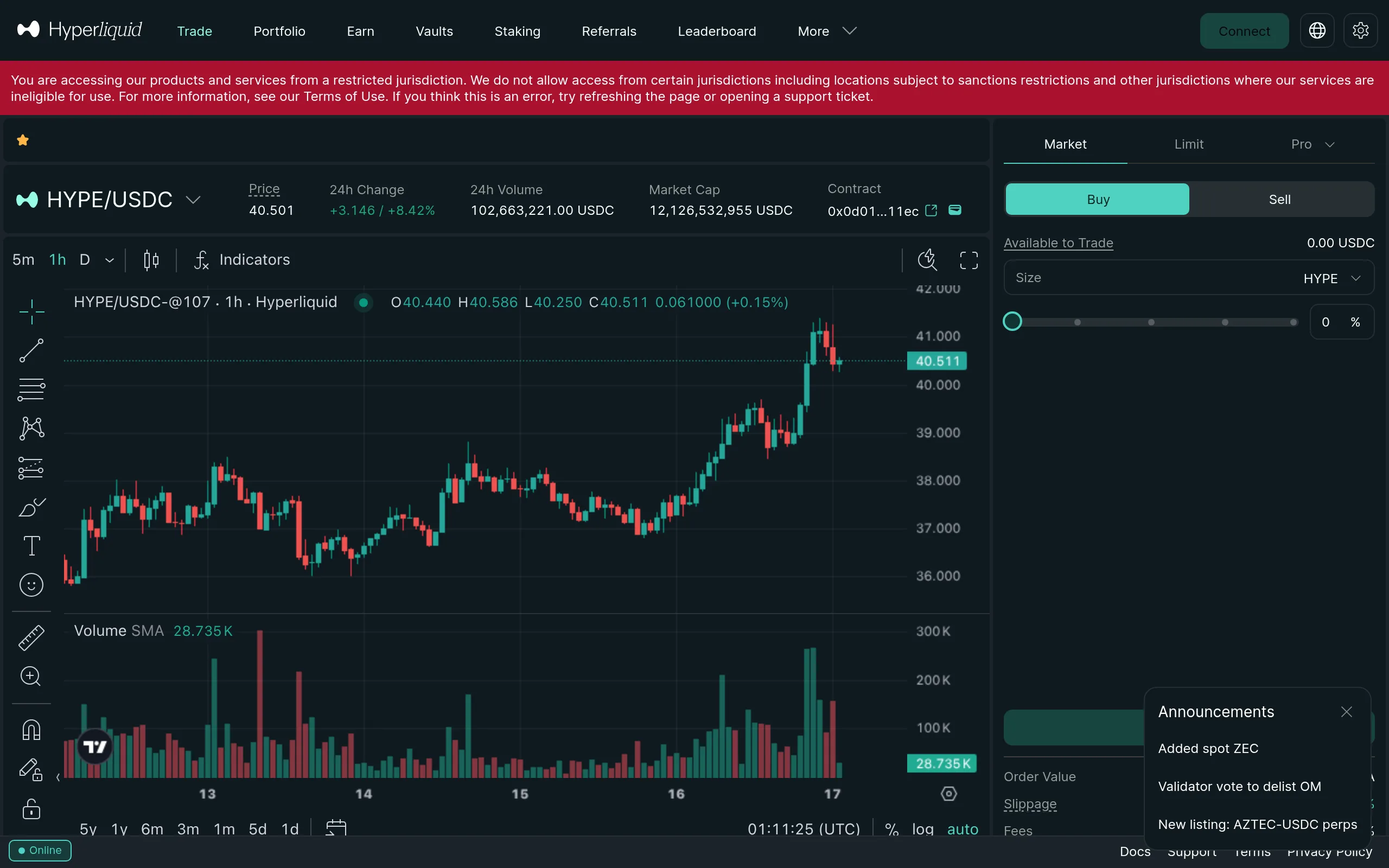
OKX perpetual futures trading interface
Trade Perps Without KYC or Custody Risk
Hyperliquid delivers CEX-level speed with full self-custody. Use our referral code for a 4% lifetime fee discount on all trades.
Try Hyperliquid - Save 4%Custody and Account Model
The foundational difference between these two platforms is who holds your funds.
Hyperliquid: Self-Custody
On Hyperliquid, you connect your own Ethereum-compatible wallet - whether that is MetaMask, Rabby, OKX Wallet, or another option - and deposit USDC to your on-chain margin account. Your funds are secured by the protocol's smart contracts and your own private keys. No intermediary can freeze your account, delay your withdrawal, or lose your funds through operational failure.
The trade-off is personal responsibility. If you lose your seed phrase, there is no customer support to recover your account. You are fully sovereign, which means fully accountable.
OKX: Exchange Custody
On OKX, you create an account, complete KYC verification, and deposit funds into exchange-controlled wallets. OKX manages the private keys, implements security measures (cold storage, multi-sig, proof of reserves), and provides customer support if something goes wrong.
This model is familiar and convenient. But it means you trust OKX with your assets. Centralized exchanges have historically been vulnerable to hacks, regulatory seizures, and operational failures. OKX has not suffered a major loss event, but the structural risk of exchange custody remains present.
Deposit flow - OKX account setup with KYC vs Hyperliquid wallet connect
KYC and Access
Hyperliquid: No KYC, Instant Access
Hyperliquid requires nothing to start trading. No email, no phone number, no government ID, no selfie. Connect a wallet, make your first trade, done. The entire onboarding takes under 5 minutes. There are no geographic restrictions on the primary frontend.
This is a decisive advantage for traders who value privacy, live in underserved jurisdictions, or simply want to start trading without a multi-day verification process.
OKX: Full KYC Required
OKX requires full Know Your Customer verification for all users. This includes government-issued photo ID, and depending on your region, proof of address and additional verification steps. The process typically takes a few hours but can stretch longer during high-demand periods.
OKX has also faced regulatory challenges in certain jurisdictions. It withdrew from select markets, adjusted available services by region, and has been subject to scrutiny around compliance practices. While OKX has actively pursued regulatory compliance, the reality is that centralized exchanges operate in a constantly shifting legal landscape that can affect user access with little warning.
Fee Comparison
Trading fees on both platforms are competitive. For a comprehensive breakdown of Hyperliquid's fee mechanics, see our fee structure guide.
| Hyperliquid | OKX Futures | |
|---|---|---|
| Maker Fee (Base) | 0.015% | 0.020% |
| Taker Fee (Base) | 0.045% | 0.050% |
| Gas/Network Fees | Zero | Zero (internal) |
| Referral Discount | 4% lifetime | Up to 20% (varies) |
| Token Discount | Up to 40% (HYPE staking) | OKB holdings + VIP tiers |
| VIP Tiers | Yes (volume-based) | Yes (volume + assets) |
At base tier, Hyperliquid wins on both maker and taker fees. Maker orders cost 0.015% on Hyperliquid vs 0.020% on OKX. Taker orders cost 0.045% on Hyperliquid vs 0.050% on OKX. On a $10,000 taker trade, that is $4.50 on Hyperliquid vs $5.00 on OKX.
Hyperliquid's discount stacking is particularly powerful. The 4% referral discount via code Concept211 combines with HYPE token staking discounts (up to 40% at Diamond tier), driving effective costs well below base rates. Get Your 4% Discount
OKX offers its own discount mechanisms through OKB token holdings and volume-based VIP tiers, but the stacking is less aggressive than Hyperliquid's model. OKX also charges withdrawal fees when moving crypto off-platform, a cost that does not exist on Hyperliquid where all on-chain transactions are gas-free.
Fee Calculation Example: Active Trader
For a trader doing $1M in monthly volume, mostly taker orders:
| Platform | Monthly Fee Cost |
|---|---|
| Hyperliquid (base + 4% referral) | $432 |
| Hyperliquid (base + referral + HYPE staking) | $259 - $432 |
| OKX (base tier) | $500 |
| OKX (VIP 1 tier) | $360 |
The savings add up. Over a year, the difference between Hyperliquid with stacking discounts and OKX at base tier could exceed $2,000.
Lower Fees, Zero Gas, Full Self-Custody
Hyperliquid beats OKX on both maker and taker fees at base tier - and the gap widens with HYPE staking discounts. Sign up with our referral link for an immediate 4% off.
Start Trading on HyperliquidLeverage and Risk
OKX: Up to 125x Leverage
OKX offers up to 125x leverage on major pairs like BTC-USDT and ETH-USDT. This is among the highest leverage available at any exchange, centralized or decentralized. For smaller altcoin pairs, OKX typically caps leverage at 50x-75x.
Hyperliquid: Up to 40x Leverage
Hyperliquid caps maximum leverage at 40x on BTC and 25x on ETH as of September 2026, with lower limits on smaller-cap assets. Whatever the reasoning behind the caps, the practical effect is the same: at 40x a 2.5% move against you is enough to liquidate, so higher caps mostly add risk rather than opportunity.
Does It Matter?
For the vast majority of traders, the practical difference is minimal. Trading at 125x leverage means a 0.8% adverse price move liquidates your position. Most professional traders operate in the 3x-20x range. The higher ceiling on OKX is primarily relevant for very short-term scalpers who want extreme capital efficiency on tightly managed positions.
If your strategy genuinely requires more than 40x leverage, OKX is the only option here. If you trade at sensible leverage levels, both platforms serve you equally well.
Trading Features and Product Breadth
| Hyperliquid | OKX | |
|---|---|---|
| Perpetual Pairs | 200+ | 300+ |
| Spot Pairs | Growing | 700+ |
| Max Leverage | Up to 40x | Up to 125x |
| Order Types | Market, Limit, Scaling, TWAP, TP/SL, Trailing Stop | Market, Limit, Stop, OCO, Trailing, Iceberg |
| Options Trading | No | Yes |
| Copy Trading | Via vaults | Yes (built-in) |
| Earn/Lending | Via HyperEVM DeFi | Yes (built-in) |
| NFT Marketplace | No | Yes |
| Fiat On-Ramp | No (bridge USDC) | Yes (cards, P2P, bank) |
| Web3 Wallet | Connect external wallet | OKX Wallet (built-in) |
| API Trading | Yes (REST + WebSocket) | Yes (REST + WebSocket) |
| Sub-Accounts | Yes (all users) | Yes (VIP users) |
OKX is a full-service crypto platform. Beyond perps, it offers spot trading with 700+ pairs, options, structured products, earn programs, an NFT marketplace, copy trading, a launchpad (Jumpstart), and comprehensive fiat on-ramps including P2P trading. If you want everything under one roof, OKX delivers.
Hyperliquid is purpose-built for perpetual futures and on-chain spot trading. What it lacks in breadth, it compensates for in depth. Hyperliquid's scaling orders and TWAP execution are advanced tools that rival any CEX. Its vault system offers a DeFi-native alternative to copy trading. And the expanding HyperEVM ecosystem is rapidly adding DeFi functionality - lending and borrowing, liquid staking - through third-party protocols rather than centralized features.
The OKX Wallet Connection
Here is where the two platforms intersect in an interesting way. OKX Wallet is one of the most popular Web3 wallets in crypto, with tens of millions of users. It is a non-custodial, multi-chain wallet that supports Ethereum and EVM-compatible networks.
Because Hyperliquid accepts any Ethereum-compatible wallet, you can connect your OKX Wallet directly to Hyperliquid and trade with full self-custody. This means you can:
- Use OKX's centralized exchange for spot, options, and fiat on-ramps
- Use OKX Wallet as your Web3 gateway
- Connect that same wallet to Hyperliquid for self-custody perps trading
This is a genuinely practical setup. You get the best of both worlds - OKX's broad product suite where you need it, and Hyperliquid's decentralized trading engine for your perps activity.
Token Listings: Jumpstart vs HIP-1
OKX Jumpstart
OKX's launchpad, Jumpstart, is a curated program where OKX selects projects, conducts due diligence, and offers early token access to users who stake OKB. It is a centralized, gatekept process - OKX decides which tokens get listed and when. This provides some quality filtering but limits the pace and breadth of new listings.
Hyperliquid HIP-1: Permissionless Listings
Hyperliquid takes the opposite approach. Its HIP-1 standard allows permissionless token listings on the spot market through a Dutch auction mechanism. Anyone can list a token by deploying it to HyperEVM and participating in the auction process. This means new tokens appear on Hyperliquid faster and without centralized approval.
The trade-off is obvious: permissionless listings mean less curation. But it also means Hyperliquid often lists trending tokens days or weeks before centralized exchanges, giving traders earlier access to new opportunities.
Speed and Execution
Both platforms deliver excellent execution quality, but the architecture differs.
Hyperliquid processes trades on its custom L1 blockchain with sub-second finality. Every order is matched and settled on-chain. For a decentralized exchange, this performance is remarkable - the experience is virtually indistinguishable from a centralized platform for manual traders.
OKX operates traditional centralized infrastructure with matching engines processing orders in microseconds. At the absolute lowest latency level, OKX is faster.
For the 99% of traders who are not running microsecond-sensitive HFT strategies, both platforms feel instant. The practical difference is negligible.
Regulatory Landscape
Hyperliquid
As a decentralized, non-custodial protocol, Hyperliquid operates outside the traditional regulatory framework. There is no company holding user funds, no centralized entity to regulate, and no KYC requirement. This architecture provides resilience against regulatory actions but does not make it immune - frontends can theoretically be restricted. For traders concerned about regulatory risk, our security guide covers best practices.
OKX
OKX has navigated a complex regulatory environment. It has withdrawn from certain markets, adjusted services by jurisdiction, and faced scrutiny in multiple regions. OKX is actively pursuing compliance - it has obtained licenses in several jurisdictions and publishes proof of reserves regularly. But the nature of centralized exchanges means regulatory actions can directly affect user accounts, withdrawal access, and available features with limited notice.
For traders who have experienced account restrictions or withdrawal delays on centralized platforms, Hyperliquid's permissionless model offers a fundamentally different risk profile.
The Verdict
Choose Hyperliquid if you value:
- Self-custody - your keys, your funds, no counterparty risk
- No KYC - trade instantly, privately, from anywhere
- Lower fees - better maker and taker rates at base tier, plus stacking discounts via HYPE staking and the 4% referral discount
- Permissionless access - no geographic restrictions, no account freezes
- Early token access - HIP-1 permissionless listings before centralized exchanges
- On-chain transparency - every trade verifiable on the blockchain
Choose OKX if you value:
- Maximum leverage - up to 125x on major pairs
- Full product suite - options, earn, copy trading, NFTs, launchpad, fiat on-ramps
- Deep spot market - 700+ trading pairs
- Built-in Web3 wallet - OKX Wallet for DeFi across multiple chains
- Customer support - account recovery and assistance available
- Traditional exchange experience - familiar account model with unified portfolio
Use both if you want the best of each world. This is not an either/or decision for many traders. Use OKX's centralized exchange for spot, options, and fiat needs. Use OKX Wallet to connect to Hyperliquid for self-custody perps trading. You get OKX's breadth and Hyperliquid's sovereignty under the same wallet.
For perpetual futures specifically, Hyperliquid is the stronger choice. Lower fees, self-custody, no KYC, and a trading experience that matches centralized exchanges in speed and features. The comparison to Hyperliquid vs Binance tells a similar story - when the use case is perps, it is hard to beat a platform purpose-built for that exact function. See also our Hyperliquid vs MEXC and Hyperliquid vs Crypto.com comparisons for more CEX matchups.
Your Wallet, Your Rules, Your Trades
Trade perpetual futures on Hyperliquid with self-custody, zero gas fees, and lower fees than OKX. Use our referral code for an additional 4% lifetime discount.
Start Trading on HyperliquidFrequently Asked Questions
At base tier, Hyperliquid has lower maker fees (0.015% vs 0.020%) but slightly higher taker fees (0.045% vs 0.050%). Both platforms offer discount mechanisms - Hyperliquid through HYPE staking (up to 40%) and a 4% referral discount, OKX through OKB holdings and volume-based VIP tiers. For makers, Hyperliquid is cheaper. For takers, Hyperliquid is also cheaper at base tier. Overall effective costs are very competitive on both platforms.
No. Hyperliquid requires no KYC, no email, and no account creation. You connect a crypto wallet and start trading immediately. OKX requires full identity verification including government-issued ID, and in some regions additional documentation. This is one of the biggest differences between the two platforms.
Yes. OKX Wallet is an Ethereum-compatible Web3 wallet that works with Hyperliquid. You can connect your OKX Wallet to Hyperliquid and trade with full self-custody, combining OKX's popular wallet infrastructure with Hyperliquid's decentralized trading engine.
OKX offers up to 125x leverage on major pairs like BTC and ETH. Hyperliquid caps leverage at 40x (BTC). If maximum leverage is critical to your strategy, OKX offers more. However, most professional traders rarely use leverage above 20x due to the extreme liquidation risk, so the practical difference is smaller than the numbers suggest.
The safety models are fundamentally different. Hyperliquid uses self-custody where your funds remain in your own wallet and you control your private keys. OKX holds your funds in exchange-controlled wallets. Hyperliquid eliminates exchange counterparty risk but requires you to secure your own keys. OKX provides customer support and account recovery but exposes you to potential exchange hacks, freezes, or regulatory actions. Neither is universally safer - it depends on whether you trust yourself or a third party more with your assets.
Independent resource: Hyperliquid Guide is an independent, third-party resource operated by Concept211. It is not affiliated with, produced by, reviewed by or endorsed by Hyper Foundation, Hyperliquid Labs or any other Hyperliquid-ecosystem entity. "Hyperliquid" and related names and marks belong to their respective owners and are used here only to identify the platform this site documents. Read the full disclaimer.
Not advice: Nothing on this site is legal, tax, financial or investment advice. Descriptions of regulatory status, tax treatment and market availability are general information that varies by jurisdiction and changes over time. Confirm anything that matters to you with a qualified professional and against primary sources. Trading perpetual futures involves substantial risk of loss, and past performance does not indicate future results.
Disclosure: this site contains referral links. Signing up through the 4% lifetime fee discount link earns us a share of the trading fee Hyperliquid already charges, at no extra cost to you.
Ready to Start Trading?
Join Hyperliquid with our referral link and get a 4% lifetime fee discount. No KYC, no email - just connect your wallet and trade.
Start Trading - Save 4%