Hyperliquid vs GMX (2026): Fees, Liquidity & Which Wins for Perps
Table of Contents
- Verdict: Hyperliquid vs GMX in 2026
- Hyperliquid vs GMX: Order Book Meets AMM
- Architecture: CLOB vs AMM/Oracle
- Hyperliquid: On-Chain Central Limit Order Book
- GMX: Oracle-Priced AMM
- Why the Architecture Difference Matters
- Fee Comparison
- Slippage and Execution Quality
- Hyperliquid: Zero Slippage on Limit Orders
- GMX: Oracle Price with Impact Fees
- Speed and Finality
- Trading Pairs and Markets
- Capital Efficiency and Liquidity Provision
- GMX's Liquidity Model
- Hyperliquid's Vault System
- The Decentralization Question
- GMX v2 ETH Perp Liquidity vs Hyperliquid
- Head-to-Head Summary
- The Verdict
- Who Should Use Each Platform
 Hyperliquidvs
 GMX
GMXInfo
Last verified: May 2026. All fee figures, liquidity data, and market counts have been confirmed current. GMX v2 fee structure reflects changes introduced in late 2025. Hyperliquid volume data sourced from the live API.
| Feature | Hyperliquid | GMX |
|---|---|---|
| Trading Fees (Taker) | 0.045% | 0.05–0.07% |
| Trading Fees (Maker) | 0.015% | N/A (no order book) |
| Max Leverage | Up to 40x | Up to 100x |
| Available Markets | 200++ perps + spot | ~80+ assets |
| Custody Model | Self-custody (non-custodial) | Self-custody (non-custodial) |
| Chain / Network | Hyperliquid L1 (custom) | Arbitrum / Avalanche |
| KYC Required | No | No |
| Gas Fees | Zero | Arbitrum gas per trade |
Tip
Why Traders Switch to Hyperliquid from GMX: Hyperliquid's order book eliminates AMM slippage on limit orders, fees are roughly half of GMX's, and zero gas fees mean you never pay network costs on trades. The trade-off is that GMX's GLP/GM model lets passive LPs earn yield without active trading.
Verdict: Hyperliquid vs GMX in 2026
Hyperliquid wins for active perpetuals traders who prioritize fees and execution speed. Hyperliquid charges 0.015% maker / 0.045% taker with zero gas fees, versus GMX v2's 0.05%–0.07% total fees including price impact. Hyperliquid's central limit order book provides tighter spreads on major pairs (BTC, ETH) where open interest exceeds $500M. GMX v2 offers passive LP yield through its GM pool architecture, making it better suited for liquidity providers than directional traders. For traders moving from GMX to a more fee-efficient venue, Hyperliquid's no-KYC model and USDC-margined accounts are the primary advantages.
Hyperliquid vs GMX: Order Book Meets AMM
Hyperliquid and GMX represent two fundamentally different philosophies for decentralized perpetual futures trading. Hyperliquid uses a central limit order book (CLOB) on its own Layer 1 blockchain, while GMX uses an AMM/oracle-based model on Arbitrum (and Avalanche). Understanding this core architectural difference is the key to understanding everything else about how these platforms compare.
This guide covers every important dimension: fees, execution, slippage, available markets, capital efficiency, and overall trading experience.
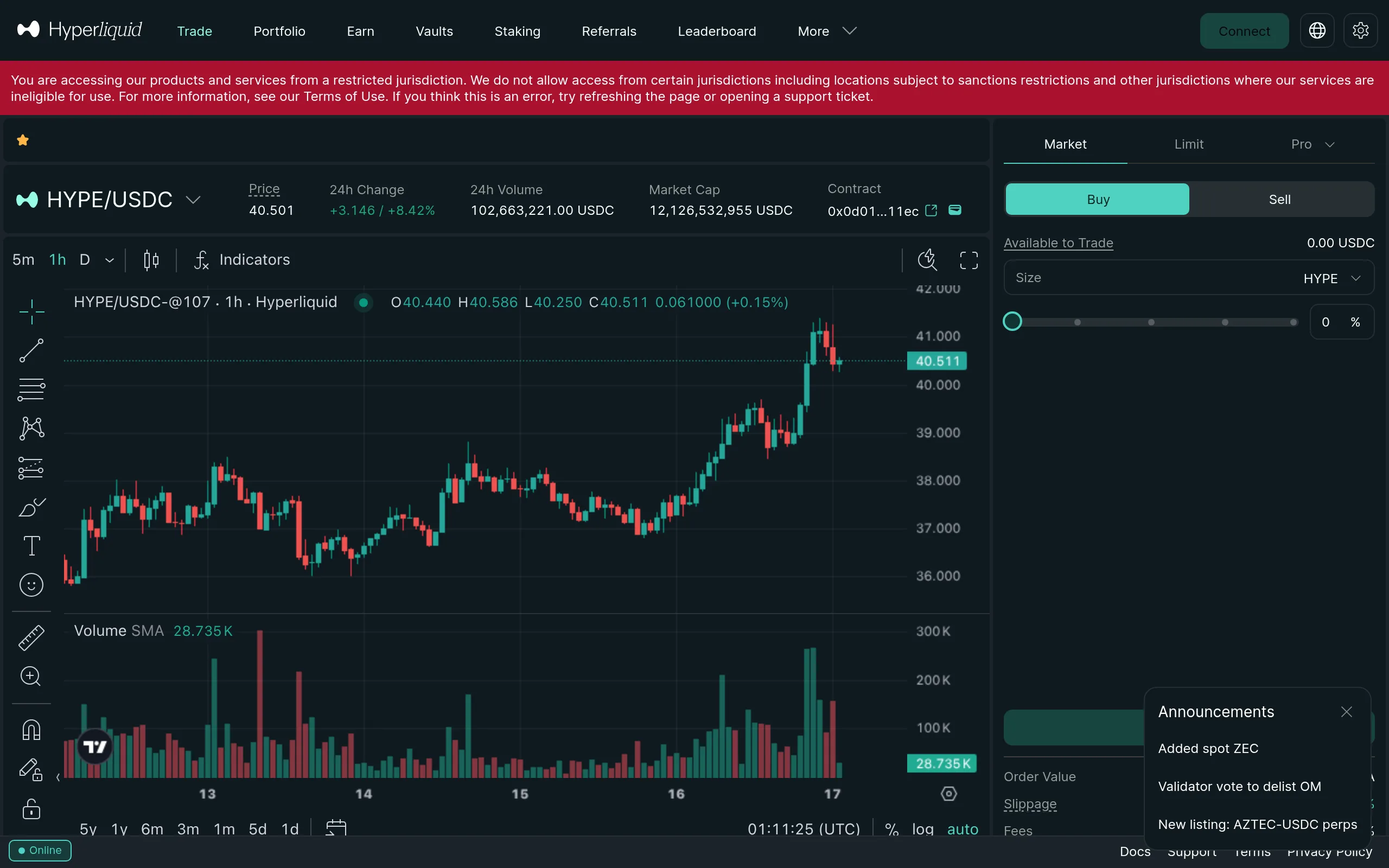
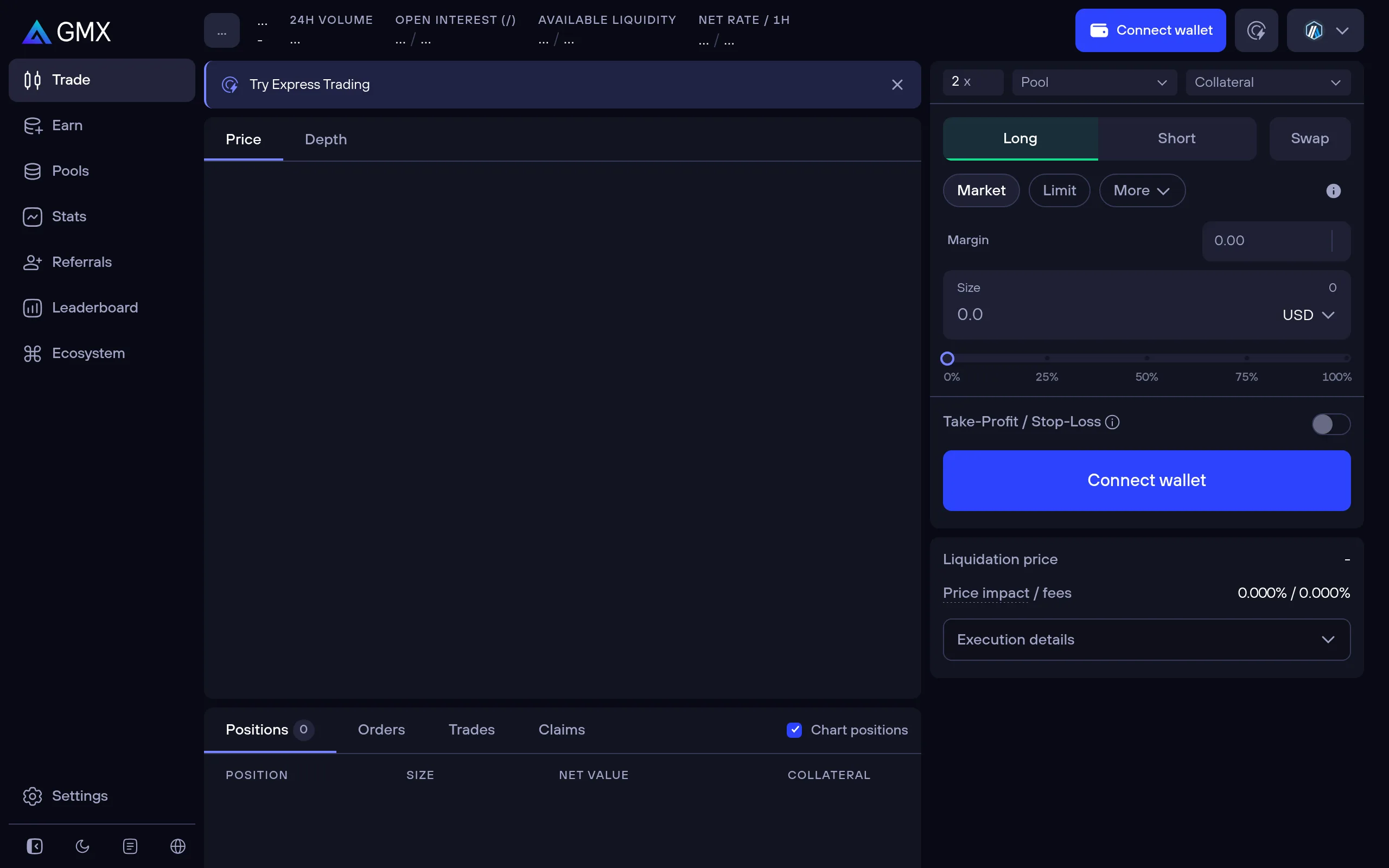
Trade with an Order Book, Not an AMM
Hyperliquid gives you CEX-grade execution with true limit orders and zero slippage. Sign up with our referral link for 4% off all trading fees.
Start Trading on HyperliquidArchitecture: CLOB vs AMM/Oracle
This is the most important difference between the two platforms, and it affects every aspect of the trading experience.
Hyperliquid: On-Chain Central Limit Order Book
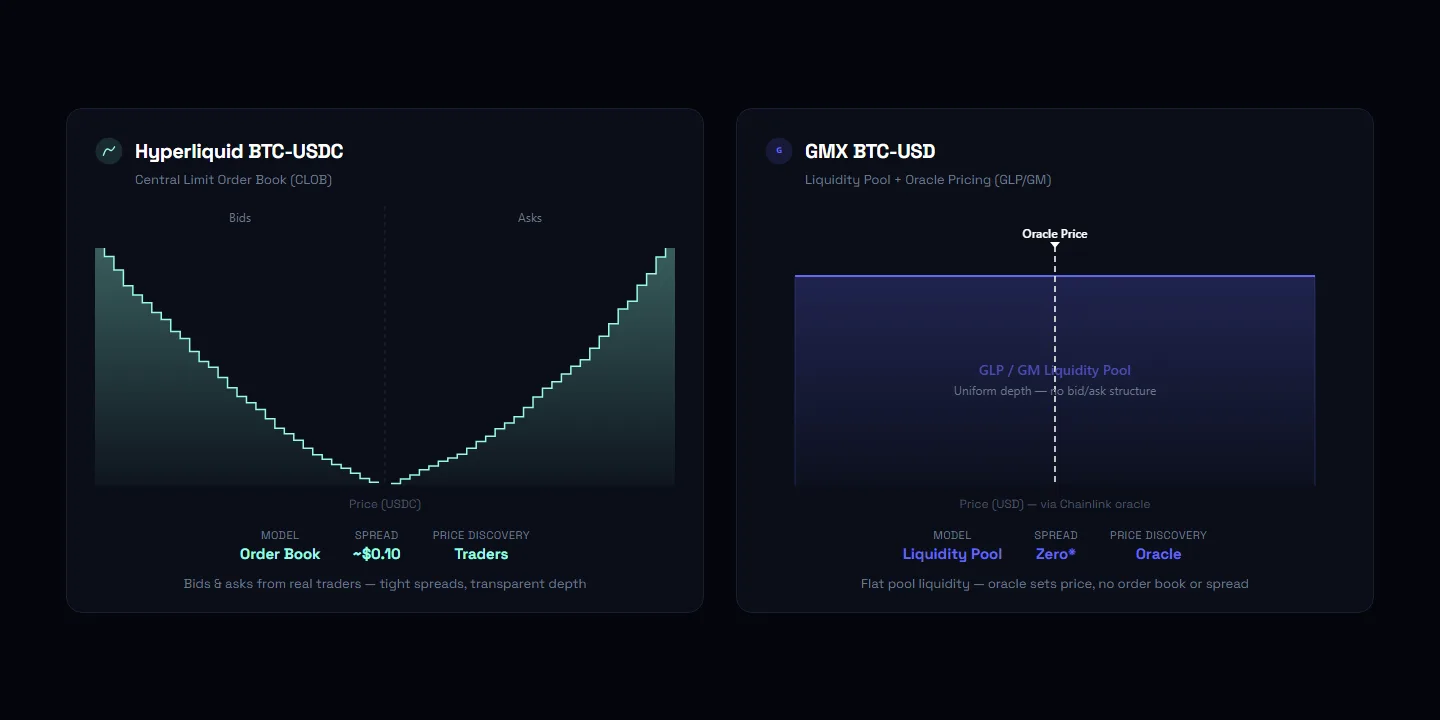
Hyperliquid operates exactly like a traditional exchange order book, except the entire thing runs on-chain. Buyers and sellers post limit orders at specific prices, and the matching engine pairs them together. When you place a limit order at a specific price, it either fills against an existing order or sits in the book waiting for a counterparty.
This is the same model that Binance, the NYSE, and every major exchange in the world uses - because it is the most efficient way to discover price and match trades. Hyperliquid simply built a blockchain fast enough to run this model on-chain with sub-second finality and zero gas fees.
GMX: Oracle-Priced AMM
GMX takes a completely different approach. Instead of matching buyers and sellers against each other, GMX lets traders open positions against a shared liquidity pool (GLP on v1, GM pools on v2). Trade prices are determined by Chainlink oracle feeds rather than by an order book.
When you go long BTC on GMX, you are not buying from another trader - you are borrowing exposure from the liquidity pool at the oracle price. The pool's liquidity providers (LPs) are the counterparty to every trade. This is an elegant DeFi-native design, but it creates trade-offs that matter for serious traders.
Why the Architecture Difference Matters
The CLOB model gives Hyperliquid traders:
- True limit orders that execute at exactly the specified price
- Zero slippage on limit order fills
- Real price discovery from actual supply and demand
- Transparent depth - you can see all open orders in the book
The AMM/oracle model gives GMX traders:
- Guaranteed execution at the oracle price (for smaller trades)
- No need for counterparties - the pool is always available
- Simpler UX for basic market orders
However, GMX's model also introduces price impact fees on larger trades, dependence on oracle accuracy and freshness, and limited ability to use advanced order types. You cannot place a true limit order on GMX the way you can on Hyperliquid.
Fee Comparison
This is where the difference is stark.
| Hyperliquid | GMX v2 | |
|---|---|---|
| Maker Fee | 0.015% | 0.05% |
| Taker Fee | 0.045% | 0.07% |
| Gas Fees | Zero | Arbitrum gas (~$0.10-0.50) |
| Price Impact Fee | None (order book) | Variable (large trades) |
| Borrowing Fee | [Funding rate](/guides/trading/funding-rates-explained) (market-driven) | Hourly borrow fee |
| Referral Discount | 4% lifetime | 5-10% (tiered) |
According to GMX's published fee schedule, v2 taker fees range from 0.05% to 0.07% depending on whether the trade increases or decreases open interest on the side of the pool. According to Hyperliquid's official fee documentation, base-tier perpetual taker fees are 0.045% and maker fees are 0.015%, with zero gas fees on all orders.
The numbers tell a clear story. On a $10,000 taker trade:
- Hyperliquid: $4.50 in fees, $0 gas = $4.50 total
- GMX v2: $7.00 in fees + ~$0.20 gas = ~$7.20 total
That is over 60% more on GMX. For a maker order on Hyperliquid, the cost drops to just $1.50 - making it nearly 5x cheaper than a GMX trade. For a full breakdown of Hyperliquid's fee structure, including VIP tiers and maker rebates, see our dedicated guide.
For active traders placing dozens of trades per day, this gap adds up to hundreds or even thousands of dollars per month. Using referral code Concept211 on Hyperliquid reduces fees by another 4%. Get Your 4% Discount
Cut Your Trading Fees in Half
Hyperliquid's fees are less than half of what GMX charges. With our referral code, you save an additional 4% on top of already-lower rates.
Switch to HyperliquidSlippage and Execution Quality
This is arguably the biggest practical advantage of Hyperliquid's order book model over GMX's AMM design.
Hyperliquid: Zero Slippage on Limit Orders
When you place a limit order on Hyperliquid and it fills, you get exactly the price you specified. There is no slippage, no price impact, and no oracle dependency. Market orders execute against the best available prices in the order book - and because Hyperliquid has deep liquidity (~$7B daily volume), spreads are tight on major pairs.
This is exactly how professional traders expect an exchange to work.
GMX: Oracle Price with Impact Fees
GMX executes trades at the Chainlink oracle price, which sounds like zero slippage at first glance. But there are two important caveats:
-
Price impact fees: GMX v2 charges dynamic price impact fees that increase with trade size relative to pool depth. A $100,000 position on a less liquid pair can incur meaningful price impact costs that function identically to slippage.
-
Oracle latency: Chainlink oracles update on a regular cadence, not instantaneously. In fast-moving markets, the oracle price can lag behind the true market price. This creates a known issue where traders can sometimes get better or worse execution than the actual market price at the moment of the fill.
For small trades on major pairs, GMX's execution is adequate. But for larger positions or during volatile market conditions, Hyperliquid's order book delivers consistently better execution quality.
Info
Explore live Hyperliquid data: Funding Rates · Open Interest · Volume Rankings
Speed and Finality
Hyperliquid: Sub-second finality on its native L1. Orders are matched and confirmed in under one second. The experience matches centralized exchanges.
GMX: Depends on Arbitrum block times, which average around 0.25 seconds. However, GMX trades also depend on oracle price updates, which can introduce additional latency. Opening a position on GMX typically takes a few seconds from click to confirmation.
Both platforms are fast enough for most trading styles, but Hyperliquid's integrated architecture (matching engine and blockchain are the same system) provides a noticeably snappier experience.
Trading Pairs and Markets
| Hyperliquid | GMX v2 | |
|---|---|---|
| Perpetual Pairs | 200+ | ~80+ |
| Spot Trading | Yes | Swap only |
| New Listing Speed | Fast (permissionless) | Slow (governance) |
| Chains | Own L1 | Arbitrum + Avalanche |
| Max Leverage | Up to 40x | Up to 100x |
| Advanced Order Types | Scaling, TWAP, TP/SL | Market, Limit, TP/SL |
Hyperliquid offers significantly more perpetual trading pairs (200+) compared to GMX. This is partly because Hyperliquid's permissionless listing mechanism allows new markets to be added without lengthy governance votes. If a new token gains traction, Hyperliquid tends to list it faster.
Beyond perps, the spot trading experience also diverges sharply. GMX v2 offers swaps through its GM pools but no order-book spot market, while Hyperliquid runs a full on-chain CLOB for spot pairs alongside perps. Our spot trading guide walks through how Hyperliquid's spot market works, how it differs from AMM swaps like GMX's, and when each model produces better execution.
GMX does offer higher maximum leverage on select pairs (up to 100x vs Hyperliquid's 40x), which may matter to certain traders. However, the standard advice is that extremely high leverage significantly increases liquidation risk.
Hyperliquid also provides advanced order types that GMX cannot match due to its AMM architecture. Scaling orders, TWAP execution, and sophisticated TP/SL configurations are only possible on an order book exchange.
Capital Efficiency and Liquidity Provision
GMX's Liquidity Model
GMX pioneered a compelling model for DeFi liquidity provision. GLP (v1) and GM pools (v2) allow users to deposit assets and earn yields from trading fees and trader losses. According to GMX's official documentation, GM pool yields vary by market and are driven by trading volume, borrowing fees, and trader PnL. This model attracted billions in TVL and created a genuine DeFi primitive: a way for passive investors to earn yield by acting as the counterparty to leveraged traders.
The downside is that LPs can lose money when traders are profitable - LPs are effectively short volatility. GMX v2's isolated GM pools improved risk management, but the fundamental dynamic remains.
Hyperliquid's Vault System
Hyperliquid offers vaults - notably the HLP (Hyperliquid Liquidity Provider) vault - where users can deposit USDC to participate in market-making strategies. Unlike GMX's passive LP model, HLP runs active strategies on the order book, placing bids and asks to capture the spread.
The vault model is different from GMX's approach: rather than passively absorbing trader flow, Hyperliquid vaults actively trade. This can lead to different risk/reward characteristics depending on market conditions.
Both models offer yield opportunities for users who want to provide liquidity rather than (or in addition to) trading directly. For more on Hyperliquid's yield landscape - including delta-neutral vaults and funding rate arbitrage - see our HyperEVM yield strategies guide.
The Decentralization Question
Both platforms are decentralized, but in different ways.
GMX runs on Arbitrum, inheriting Ethereum's security model. Smart contracts are open-source, governance is on-chain, and the protocol has been running in production since 2021. According to DefiLlama, GMX's total value locked stands at approximately $400M–600M across Arbitrum and Avalanche as of May 2026, making it one of the larger perpetual DEX protocols by TVL. GMX has a longer track record and deeper battle-testing.
Hyperliquid runs on its own L1 with its own validator set. The trade-off is clear: Hyperliquid gains complete performance control but takes on the responsibility of securing its own chain. The validator set is growing, and the network has handled billions in daily volume without incident, but it is younger infrastructure compared to Ethereum/Arbitrum.
Both platforms are non-custodial - you trade from your own wallet in both cases.
GMX v2 ETH Perp Liquidity vs Hyperliquid
This is a key differentiator for traders sizing into ETH positions. As of May 2026, according to DefiLlama's GMX v2 pool data, the GMX v2 ETH-USD GM pool holds approximately $80–120M in total liquidity. This liquidity is shared across all ETH traders — both longs and shorts draw from the same pool, meaning available capacity depends on open interest balance.
On Hyperliquid, ETH perpetual open interest regularly exceeds $500M with tight spreads (typically 1-2 ticks on the top of book). Because Hyperliquid uses an order book rather than a pool, there is no fixed capacity ceiling — liquidity scales with active market makers. A $1M ETH market order on Hyperliquid typically experiences less than 0.01% price impact, while the same order on GMX v2 incurs a dynamic price impact fee that grows with position size relative to pool depth.
Bottom line on ETH perp liquidity: Hyperliquid offers 4–5x deeper effective liquidity for ETH perpetuals compared to GMX v2's pooled model, with better execution characteristics for positions above $100K.
Professional Trading, DeFi Principles
Get order book execution, hundreds of trading pairs, and zero gas fees. Sign up with our referral link for a 4% lifetime fee discount.
Try Hyperliquid FreeHead-to-Head Summary
| Hyperliquid | GMX v2 | |
|---|---|---|
| Architecture | On-chain CLOB (own L1) | AMM/Oracle (Arbitrum) |
| Taker Fee | 0.045% | 0.07% |
| Maker Fee | 0.015% | 0.05% |
| Slippage | Zero on limit orders | Price impact fees |
| Gas Fees | Zero | Arbitrum gas |
| Finality | <1 second | ~1-3 seconds |
| Daily Volume | ~$7B | ~$500M-1B |
| Trading Pairs | 200+ | ~80+ |
| Advanced Orders | Scaling, TWAP, TP/SL | Basic |
| LP Yield Model | Active vaults (HLP) | Passive GM pools |
| Track Record | Since 2023 | Since 2021 |
| KYC Required | No | No |
The Verdict
Hyperliquid is the better trading platform for the vast majority of perpetual futures traders. Lower fees (roughly half of GMX), zero slippage on limit orders, sub-second finality, and 200+ trading pairs make it the more practical choice for anyone who trades regularly. The order book model is simply a more efficient market structure for leveraged trading than an AMM/oracle hybrid.
GMX deserves genuine respect for pioneering DeFi perpetuals. It proved that decentralized leverage trading was viable, and its liquidity provider model created a new DeFi primitive that has been widely forked and imitated. GMX also has a longer track record and benefits from Arbitrum's established infrastructure. For users who are deeply embedded in the Arbitrum ecosystem or who want to provide passive liquidity through GM pools, GMX remains relevant.
But if your primary goal is to trade perpetual futures with the best execution, lowest fees, and widest selection of markets - Hyperliquid is the clear winner in 2026. The performance difference is not marginal; it is structural.
Who Should Use Each Platform
- Choose Hyperliquid if you want the lowest fees, zero slippage on limit orders, zero gas costs, sub-second execution, and access to 200++ trading pairs. Best for active traders, scalpers, and anyone switching from a CEX.
- Choose GMX if you want to provide passive liquidity through GM pools and earn yield without active trading, or if you are deeply embedded in the Arbitrum/Avalanche ecosystem.
Bottom line: For trading, Hyperliquid wins on every metric that matters. For passive LP yield, GMX's model remains unique. See also our comparisons against other DEXs: Hyperliquid vs Drift, Hyperliquid vs AsterDEX, Hyperliquid vs Lighter, and Hyperliquid vs dYdX.
Lower Fees. Zero Slippage. Hundreds of Pairs.
Make the switch to Hyperliquid and save on every trade. Use our referral link for an additional 4% lifetime discount on fees.
Start Trading on HyperliquidFrequently Asked Questions
For most traders, yes. Hyperliquid offers significantly lower fees (0.045% taker vs GMX's 0.07%), zero slippage through its order book model, sub-second execution, and over 200 trading pairs. GMX pioneered DeFi perps and offers a unique liquidity provider model, but its AMM/oracle design creates inherent limitations on execution quality.
GMX uses an oracle-based pricing model rather than a traditional order book. While this means trades execute at the oracle price (no traditional slippage on small orders), large trades face price impact fees that function similarly to slippage. Hyperliquid's CLOB model provides true limit orders with zero slippage when filled at your specified price.
Hyperliquid is significantly cheaper. Taker fees are 0.045% on Hyperliquid versus 0.05-0.07% on GMX (depending on the version). Hyperliquid also charges zero gas fees, while GMX trades incur Arbitrum network gas costs. For a $10,000 trade, you save roughly $2.50-$5.50 per trade on Hyperliquid.
Hyperliquid offers vaults (like the HLP vault) where users can deposit capital to market-make and earn yields. This is conceptually similar to GMX's GLP/GM pools but operates differently - Hyperliquid vaults run active trading strategies on the order book rather than passively providing liquidity to an AMM.
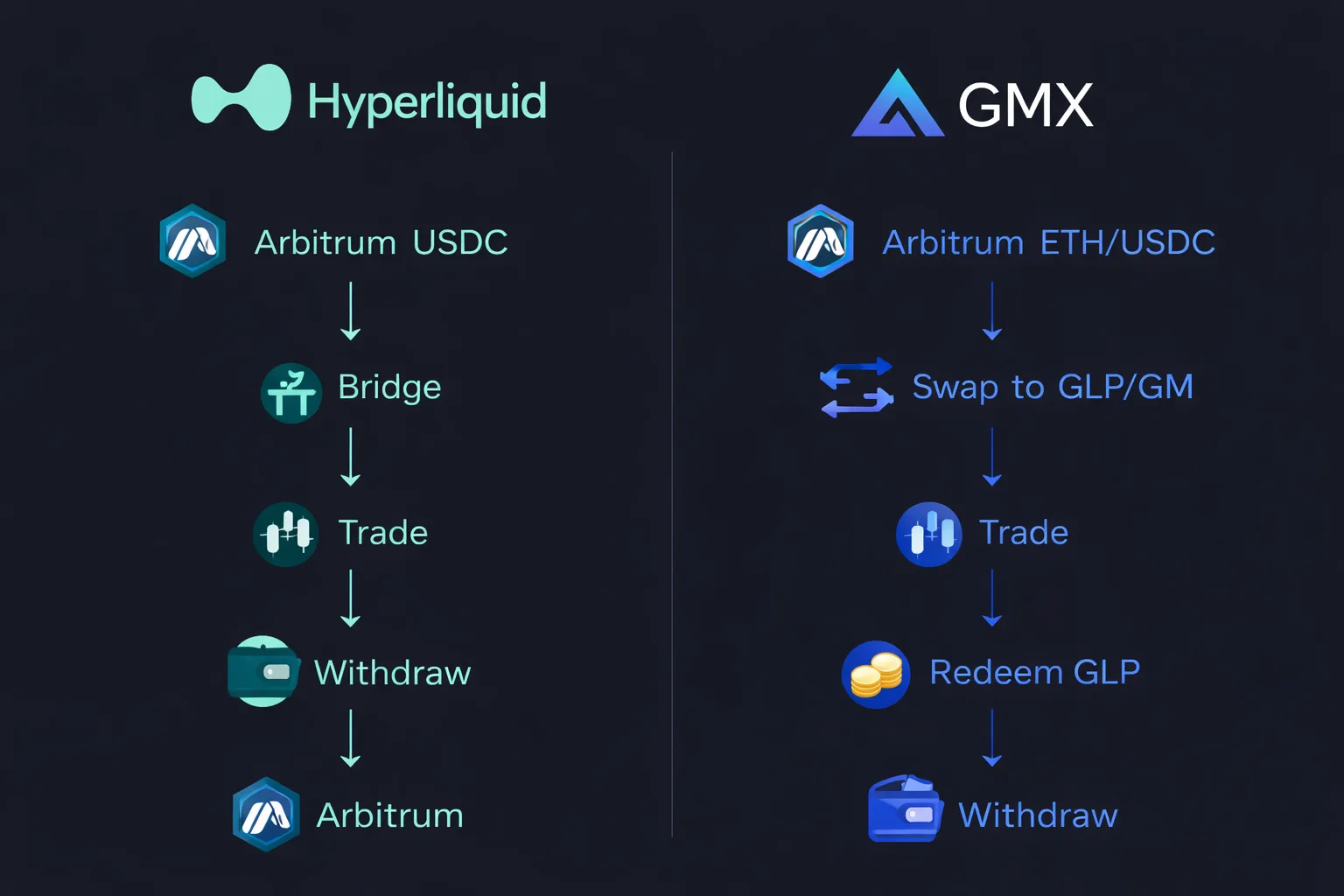
No. Hyperliquid runs on its own custom Layer 1 blockchain, not on Arbitrum or any other existing chain. This gives Hyperliquid full control over performance and fees. You bridge USDC to Hyperliquid's L1 via the Arbitrum bridge, but all trading happens on Hyperliquid's native chain.
Hyperliquid has significantly deeper liquidity. Hyperliquid regularly processes over $5 billion in daily volume across its order book, with tight spreads on major pairs like BTC and ETH. GMX v2's liquidity depends on GM pool deposits for each market, which can be thinner for less popular assets. For large position sizes, Hyperliquid's order book model provides more consistent execution with less price impact.
No. GMX v2 supports approximately 80+ perpetual markets, while Hyperliquid offers over 200 perpetual trading pairs plus spot markets. Hyperliquid's permissionless listing mechanism allows new markets to be added quickly without lengthy governance votes, giving it a much wider selection of tradeable assets.
Independent resource: Hyperliquid Guide is an independent, third-party resource operated by Concept211. It is not affiliated with, produced by, reviewed by or endorsed by Hyper Foundation, Hyperliquid Labs or any other Hyperliquid-ecosystem entity. "Hyperliquid" and related names and marks belong to their respective owners and are used here only to identify the platform this site documents. Read the full disclaimer.
Not advice: Nothing on this site is legal, tax, financial or investment advice. Descriptions of regulatory status, tax treatment and market availability are general information that varies by jurisdiction and changes over time. Confirm anything that matters to you with a qualified professional and against primary sources. Trading perpetual futures involves substantial risk of loss, and past performance does not indicate future results.
Disclosure: this site contains referral links. Signing up through the 4% lifetime fee discount link earns us a share of the trading fee Hyperliquid already charges, at no extra cost to you.
Ready to Start Trading?
Join Hyperliquid with our referral link and get a 4% lifetime fee discount. No KYC, no email - just connect your wallet and trade.
Start Trading - Save 4%