Hyperliquid vs Lighter (2026): Zero Fees vs Full Ecosystem — Which Wins?
Table of Contents
- Hyperliquid vs Lighter: The Complete 2026 Comparison
- Architecture: Custom L1 vs ZK-Rollup
- Hyperliquid's Custom L1
- Lighter's ZK-Rollup
- Why This Matters
- Fee Comparison: Zero vs Low
- Liquidity and Volume
- Trading Features
- Order Types
- Leverage
- Market Coverage
- Liquidity Provider Model
- Security and Trust Model
- Lighter's Verifiable Matching
- Hyperliquid's On-Chain Transparency
- The Trade-Off
- Token Economics: HYPE vs LIT
- HYPE Token
- LIT Token
- Ecosystem and Beyond-Trading Features
- User Experience and Onboarding
- Onboarding
- Interface
- Mobile
- Head-to-Head Summary
- The Verdict
- Who Should Use Each Platform
 Hyperliquidvs
 Lighter
| Feature | Hyperliquid | Lighter |
|---|---|---|
| Trading Fees (Taker) | 0.045% | 0% (standard) / 0.02% (HFT) |
| Trading Fees (Maker) | 0.015% | 0% (standard) / 0.002% (HFT) |
| Max Leverage | Up to 50x | Up to 50x |
| Available Markets | 200++ perps + spot | Growing perps list |
| Custody Model | Self-custody (non-custodial) | Self-custody (non-custodial) |
| Chain / Network | Hyperliquid L1 (custom) | ZK-Rollup on Ethereum |
| KYC Required | No | No |
| Gas Fees | Zero | Zero |
Tip
The Core Trade-Off: Lighter wins on raw fee cost with zero-fee trading for standard accounts. Hyperliquid wins on everything else — deeper liquidity, spot + perps, a full DeFi ecosystem (HyperEVM), 150+ market pairs, and proven track record as the #1 perp DEX by volume. The question is whether zero fees outweigh the depth and breadth of Hyperliquid's platform.
Hyperliquid vs Lighter: The Complete 2026 Comparison
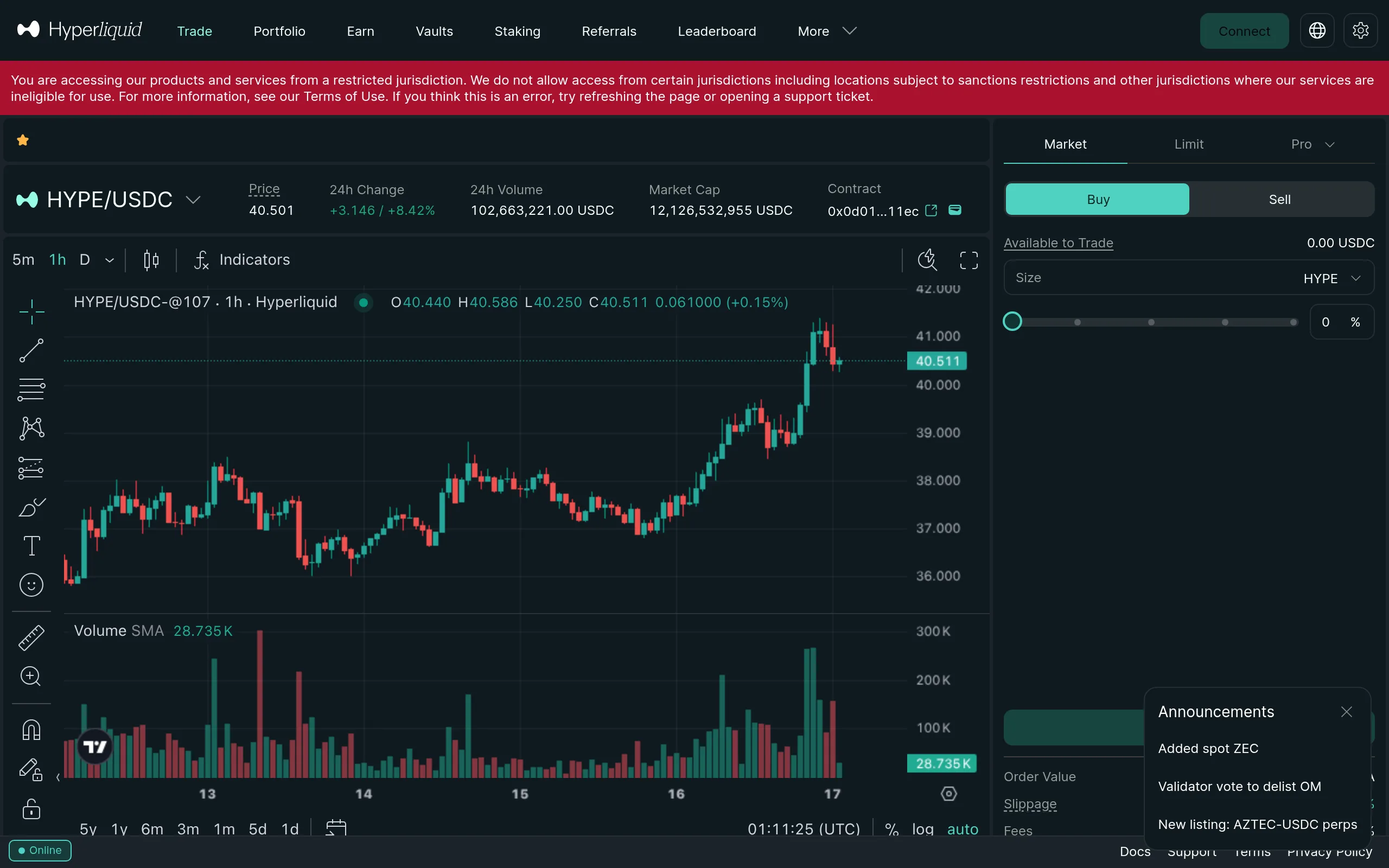
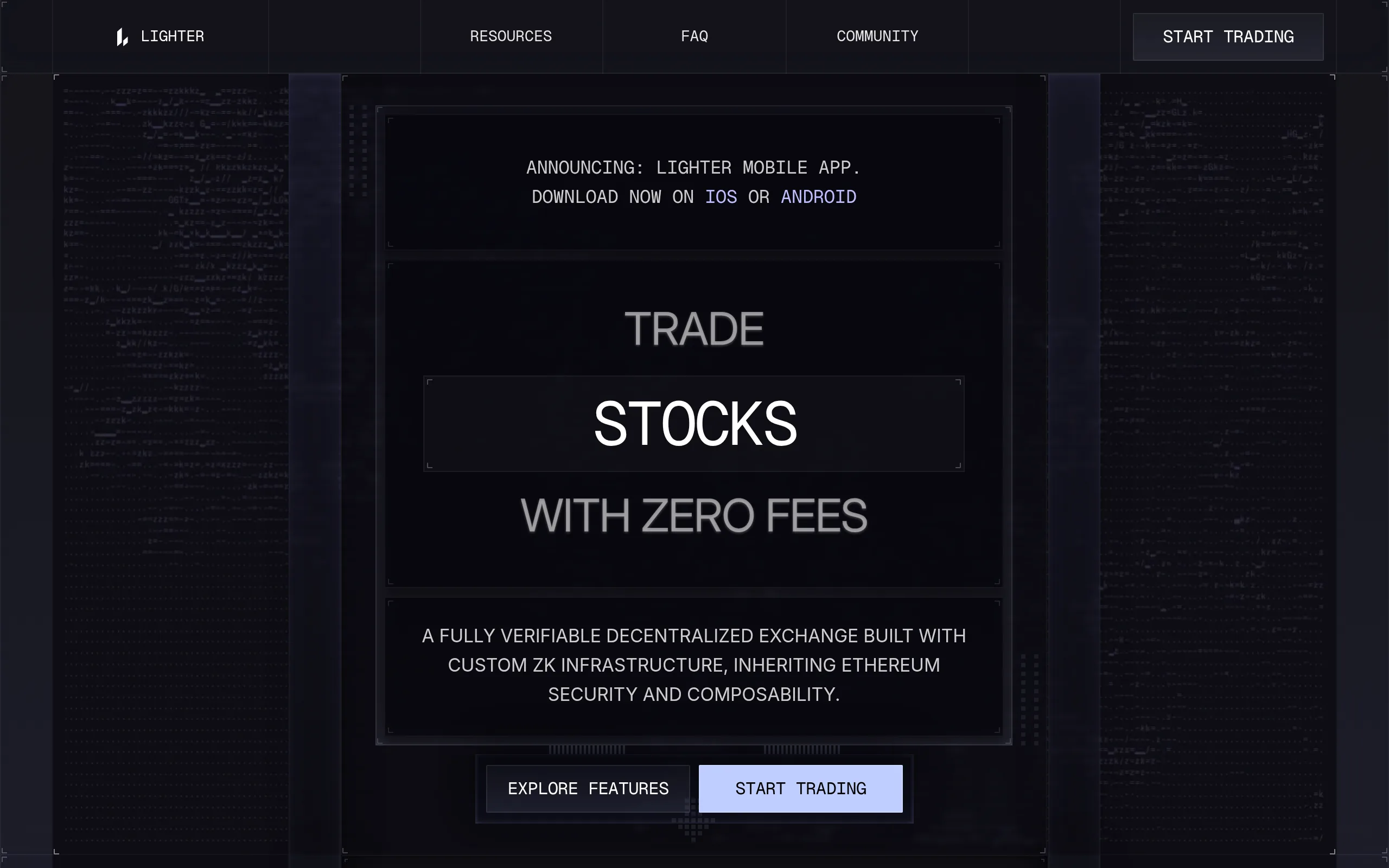
Lighter.xyz has emerged as one of the most talked-about challengers in the decentralized perpetuals space, thanks to its headline-grabbing zero-fee model and ZK-proof architecture. Meanwhile, Hyperliquid continues to dominate as the highest-volume perp DEX, processing over ~$7B in daily volume across 200+ perpetual markets.
Both platforms offer self-custody, no-KYC perpetual futures trading — but they take radically different approaches to architecture, monetization, and ecosystem building. This guide breaks down every meaningful difference so you can choose the right platform for your trading style.
Trade on the #1 Perp DEX
Sign up through our referral link and get a 4% lifetime discount on all trading fees. No KYC, no account creation — connect your wallet and trade.
Start Trading on HyperliquidArchitecture: Custom L1 vs ZK-Rollup
The most fundamental difference between these two platforms is how they are built. Each approach comes with distinct trade-offs in speed, security, and decentralization.
Hyperliquid's Custom L1
Hyperliquid runs on a purpose-built Layer 1 blockchain with its own consensus mechanism (HyperBFT). The entire order book — every bid, ask, match, and settlement — lives on-chain as a central limit order book (CLOB). This is not a fork of another chain or a generic blockchain repurposed for trading. The team built the L1 from scratch specifically for high-throughput exchange operations.
The result: sub-second finality, zero gas fees, and throughput exceeding 200,000 operations per second. The matching engine runs directly within the validator set, so there is no separation between order matching and settlement. What you see in the order book is the on-chain state.
Beyond perps, Hyperliquid's L1 powers spot trading, the HyperEVM smart contract platform, and HIP-3 builder markets — creating a full-stack financial ecosystem rather than just a single trading venue.
Lighter's ZK-Rollup
Lighter takes a fundamentally different approach. It operates as a custom ZK-Rollup settling on Ethereum L1. Every trade executed on Lighter is matched by a verifiable matching engine and proven on-chain via ZK-SNARKs. This means every order match can be cryptographically verified — you do not need to trust that the sequencer handled your order fairly, because the math proves it.
Lighter's architecture includes an escape hatch: if the sequencer ever goes offline or acts maliciously, users can withdraw their funds directly through an on-chain proof submitted to Ethereum. This provides a censorship-resistance guarantee inherited from Ethereum's security model.
The trade-off is throughput. While Lighter handles substantial volume (ranking #3 among perp DEXs), its ZK-proof generation adds computational overhead compared to Hyperliquid's native L1 execution. Lighter cannot match Hyperliquid's raw operations-per-second capacity.
Why This Matters
Hyperliquid optimizes for speed, throughput, and ecosystem breadth. Lighter optimizes for verifiability and Ethereum-aligned security. If you value a mathematically provable matching engine and Ethereum settlement guarantees, Lighter's ZK architecture is genuinely innovative. If you want the fastest execution, deepest liquidity, and a platform that goes beyond just perps, Hyperliquid's custom L1 delivers more.
Fee Comparison: Zero vs Low
This is where Lighter makes its strongest case. For a detailed breakdown of Hyperliquid's fee structure, staking discounts, and optimization strategies, see our complete fees guide.
| Hyperliquid | Lighter | |
|---|---|---|
| Maker Fee (Standard) | 0.015% | 0% (zero) |
| Taker Fee (Standard) | 0.045% | 0% (zero) |
| Maker Fee (HFT/Premium) | 0.015% | 0.002% |
| Taker Fee (HFT/Premium) | 0.045% | 0.02% |
| Gas Fees | Zero | Zero |
| Referral Discount | 4% lifetime | None |
| Staking Fee Discount | Up to 40% via HYPE | None |
| Revenue Model | Trading fees | Circle partnership (~$30-40M/yr) |
On raw numbers, Lighter wins the fee battle decisively. Zero fees for standard accounts means a $10,000 trade costs you literally nothing in execution fees. On Hyperliquid, that same trade costs $4.50 as a taker or $1.50 as a maker at base tier.
However, there are important nuances:
Lighter's zero-fee sustainability is uncertain. Lighter subsidizes fee-free trading through a partnership with Circle (the USDC issuer), reportedly generating $30-40M in annual revenue. This is a creative monetization strategy, but it depends on the continued health of that partnership. If Circle economics change, Lighter's zero-fee model may not survive. Hyperliquid's fee model is self-sustaining — the platform earns directly from trading activity.
Lighter's volume has declined significantly. Weekly perp volumes dropped from approximately $300B in November 2025 to under $50B by February 2026. Monthly revenue fell from $24M to $13M. While still substantial, this downward trend raises questions about long-term traction despite the zero-fee hook.
Hyperliquid fees can be reduced substantially. Using referral code Concept211 gives you a 4% lifetime discount, and HYPE staking tiers offer up to 40% off trading fees. A Diamond-tier staker with a referral discount pays effectively 0.024% taker — still not zero, but extremely competitive. Get 4% Fee Discount
Liquidity and Volume
This is where Hyperliquid's dominance is most visible. You can explore Hyperliquid's live market data on our funding rates and open interest tools pages.
Hyperliquid consistently processes ~$7B in daily volume and holds the #1 position among all perp DEXs. Open interest regularly exceeds $3-5B, and the platform lists 200+ perpetual pairs with deep order books on majors.
Lighter handles approximately $3.75-4.58B in daily volume with $1.53B in open interest, placing it as the #3 perp DEX. While respectable, this is meaningfully less than Hyperliquid's volume — and the gap has widened as Lighter's volumes have trended downward from their late-2025 peaks.
Higher volume translates directly to tighter spreads, less slippage on large orders, and faster fills. For traders moving any meaningful size, Hyperliquid's liquidity advantage matters more than saving a few basis points in fees. A zero-fee trade that fills 10 bps worse due to thinner books costs you more than a 4.5 bps fee with tight execution.
Info
Explore live Hyperliquid data: Funding Rates · Open Interest · Volume Rankings
Deep Liquidity, Tight Spreads
Hyperliquid is the #1 perp DEX by volume. Trade with confidence knowing you're getting the tightest spreads in DeFi. Save 4% with our referral link.
Start Trading on HyperliquidTrading Features
Order Types
Both platforms offer standard order types: market, limit, stop-market, stop-limit, and take-profit/stop-loss. Hyperliquid extends this with advanced order types not available on Lighter:
- Scaling Orders — distribute multiple limit orders across a price range automatically
- TWAP Orders — execute large positions incrementally to minimize market impact
- Advanced TP/SL — attach layered take-profit and stop-loss conditions to positions
These features are critical for professional and semi-professional traders managing larger positions. See our how to trade guide for a walkthrough of Hyperliquid's full trading interface.
Leverage
Both platforms offer up to 50x leverage on major pairs like BTC and ETH, with lower maximums on smaller-cap altcoins. The leverage mechanics are comparable.
Market Coverage
Hyperliquid lists 200+ perpetual pairs plus spot markets, and adds new listings regularly through its permissionless listing system. Lighter's market list is growing but currently smaller. Hyperliquid's HIP-3 builder markets also open the door to commodities and equities through partner protocols — something Lighter does not offer.
Liquidity Provider Model
Both platforms take different approaches to LP infrastructure:
- Hyperliquid operates the HLP vault and community vaults, where depositors provide market-making capital and earn trading PnL. This model runs active strategies on the order book.
- Lighter uses separate LLP (Lighter Liquidity Provider) buckets for different asset classes — crypto, FX, and commodities — allowing LPs to choose their risk exposure.
Both models are non-custodial and give LPs exposure to market-making returns, but Hyperliquid's vault system is more mature with a longer track record of performance data.
Security and Trust Model
Lighter's Verifiable Matching
Lighter's most distinctive feature is its verifiable matching engine. Every trade match is proven via ZK-SNARKs and verified on Ethereum L1. This means you can cryptographically confirm that the matching engine processed your order correctly — no hidden order priority, no front-running at the sequencer level.
The escape hatch mechanism adds another layer: if Lighter's sequencer fails or censors users, anyone can submit a ZK-proof to Ethereum and withdraw their funds directly from L1. This is a strong censorship-resistance guarantee that inherits Ethereum's security.
Hyperliquid's On-Chain Transparency
Hyperliquid's order book is fully on-chain, meaning every order and fill is part of the L1 blockchain state. The validator set is growing and the network is progressing toward more decentralization. While Hyperliquid does not use ZK-proofs for matching verification, the fully on-chain CLOB means the order book state is transparent and auditable.
Hyperliquid does not currently have an Ethereum-equivalent escape hatch, as it runs its own sovereign L1. Users trust the Hyperliquid validator set rather than Ethereum for settlement security.
The Trade-Off
Lighter offers mathematically verifiable matching and Ethereum settlement — strong guarantees for users who prioritize provable fairness. Hyperliquid offers a fully on-chain order book on a faster, more purpose-built chain with deeper liquidity. Both are self-custody and non-custodial. For most traders, execution quality and liquidity matter more day-to-day than settlement-layer differences, but Lighter's ZK architecture is genuinely innovative for the space.
Token Economics: HYPE vs LIT
HYPE Token
Hyperliquid's native HYPE token serves as the staking and gas token for the L1. HYPE stakers unlock trading fee discounts of up to 40% through tiered staking levels (Wood, Silver, Gold, Platinum, Emerald, Diamond). The token was distributed primarily through a community airdrop with no VC allocation — a distribution model the community considers a significant differentiator.
HYPE provides direct, tangible utility: the more you stake, the less you pay per trade. This creates a flywheel where active traders have strong incentives to hold and stake.
LIT Token
LIT launched recently with a $2.5B fully diluted valuation. The distribution allocates 50% to the ecosystem and 25% to an airdrop worth approximately $675M — the 10th largest airdrop in crypto history. LIT serves governance and ecosystem functions within Lighter.
However, LIT does not currently offer direct trading fee discounts like HYPE's staking tiers. Since Lighter already charges zero fees for standard accounts, there is less room for a fee-discount utility model. LIT's value proposition centers more on governance and ecosystem participation.
Ecosystem and Beyond-Trading Features
This is where Hyperliquid pulls furthest ahead. Hyperliquid is not just a perp DEX — it is an entire financial ecosystem:
- Spot trading with native order books and growing liquidity
- HyperEVM — a full EVM-compatible smart contract layer hosting DeFi protocols like HyperLend (lending), Felix (stablecoin), and Kinetiq (liquid staking)
- HIP-3 builder markets — enabling partner protocols to list commodities, equities, and exotic assets
- Vaults — community-managed market-making vaults with transparent performance
Lighter is focused exclusively on perpetual futures. There is no spot market, no smart contract platform, and no broader ecosystem of DeFi protocols. For traders who want a single platform for perps, spot, lending, staking, and more, Hyperliquid offers a complete stack that Lighter cannot match.
User Experience and Onboarding
Onboarding
Hyperliquid: Connect an EVM wallet, deposit USDC, start trading. No email, no account creation, no KYC. Takes under 5 minutes. Visit app.hyperliquid.xyz to get started.
Lighter: Similar flow — connect a wallet, deposit funds, begin trading. Also no KYC. The onboarding friction is comparable on both platforms.
Interface
Both platforms offer clean, professional trading interfaces optimized for perps. Hyperliquid's UI draws frequent comparisons to centralized exchanges for its information density and execution speed. Lighter's interface is also polished and functional.
Mobile
Both platforms work through mobile web browsers as progressive web apps. Neither has a native mobile app as of March 2026.
Head-to-Head Summary
| Hyperliquid | Lighter | |
|---|---|---|
| Architecture | Custom L1 (HyperBFT) | ZK-Rollup on Ethereum |
| Order Book | Fully on-chain CLOB | ZK-verified matching |
| Taker Fee | 0.045% | 0% (standard) |
| Maker Fee | 0.015% | 0% (standard) |
| Gas Fees | Zero | Zero |
| Finality | <1 second | ~1-2 seconds + ZK proof |
| Daily Volume | ~$7B | ~$3.75-4.58B |
| Open Interest | $3-5B+ | ~$1.53B |
| Trading Pairs | 200++ perps + spot | Growing perps list |
| Max Leverage | Up to 50x | Up to 50x |
| KYC Required | No | No |
| Spot Trading | Yes | No |
| Smart Contract Platform | HyperEVM | No |
| Escape Hatch | No (sovereign L1) | Yes (Ethereum L1) |
| Fee Staking Discounts | Up to 40% | None |
| DEX Ranking | #1 perp DEX | #3 perp DEX |
The Verdict
Lighter's zero-fee model is its killer feature — and it is a real advantage. If you trade exclusively perps, do not need spot markets or DeFi integrations, and want to minimize execution costs to absolute zero, Lighter delivers on that promise. The ZK-proof verifiable matching engine and Ethereum escape hatch are genuinely innovative security features that give Lighter technical credibility beyond just the fee gimmick.
But Hyperliquid wins the overall comparison. Here is why:
- Liquidity depth matters more than fees. Hyperliquid's 2-3x volume advantage means tighter spreads and better fills. Saving 4.5 bps in fees means nothing if you lose 10+ bps to slippage on thinner books.
- Ecosystem breadth. Hyperliquid offers spot trading, HyperEVM DeFi, builder markets, and a complete financial stack. Lighter is perps-only.
- Sustainability. Hyperliquid's fee-based revenue model is self-sustaining. Lighter's zero-fee model depends on a single Circle partnership. Lighter's declining volumes (from $300B weekly to under $50B) and falling revenue ($24M to $13M monthly) raise sustainability questions.
- Proven track record. Hyperliquid has operated at massive scale for longer, with a larger user base and more battle-tested infrastructure.
- Token utility. HYPE staking provides direct fee discounts (up to 40%) that compound for active traders. LIT does not offer equivalent trading utility.
Who Should Use Each Platform
- Choose Hyperliquid if you want the deepest liquidity (#1 perp DEX), a full ecosystem (spot + perps + DeFi), proven infrastructure handling billions daily, and the ability to reduce fees through HYPE staking and referral discounts. Best for traders who value execution quality and platform breadth.
- Choose Lighter if you are highly fee-sensitive and trade primarily perps in a self-directed style. Lighter's zero-fee model and ZK-verified matching are genuine differentiators for cost-conscious traders who prioritize Ethereum settlement guarantees.
Bottom line: Lighter innovates on fees and verifiability, but Hyperliquid leads on liquidity, ecosystem, features, and track record. For most traders, Hyperliquid remains the stronger platform in 2026. See also how Hyperliquid compares to other competitors in our Hyperliquid vs dYdX, Hyperliquid vs Binance, Hyperliquid vs Bybit, Hyperliquid vs AsterDEX, and Hyperliquid vs GMX comparisons.
Ready to Trade on Hyperliquid?
Join with our referral link and save 4% on every trade. No KYC, no account creation — just connect your wallet and go.
Start Trading on HyperliquidFrequently Asked Questions
For standard accounts, yes — Lighter charges 0% maker and 0% taker fees. Premium/HFT accounts pay 0.002% maker and 0.02% taker. Lighter subsidizes zero-fee trading through a partnership with Circle that generates an estimated $30-40M in annual revenue. However, Hyperliquid's base fees of 0.015% maker and 0.045% taker are already very low, and referral discounts plus HYPE staking can reduce them further.
Both platforms are self-custody and non-custodial. Lighter uses ZK-proofs verified on Ethereum L1, giving it Ethereum-level settlement security and an escape hatch for censorship resistance. Hyperliquid runs its own custom L1 with HyperBFT consensus and a growing validator set. Lighter inherits Ethereum's security guarantees, while Hyperliquid offers a more integrated trading experience on its purpose-built chain.
Hyperliquid has significantly more liquidity. It consistently processes over $4-8B in daily volume and is the number one perpetual DEX by volume. Lighter handles $3.75-4.58B daily and ranks third. Hyperliquid's deeper order books mean tighter spreads and better fills, especially on altcoin pairs.
No. Lighter currently offers perpetual futures only. Hyperliquid supports both perpetual futures and spot trading, plus HIP-3 builder markets for commodities and equities through partner protocols.
LIT is Lighter's native token, launched with a $2.5B valuation and a $675M community airdrop (the 10th largest in crypto history). HYPE is Hyperliquid's token, which offers staking fee discounts up to 40%. Both tokens serve governance and ecosystem roles, but HYPE provides more direct utility for active traders through its fee discount tiers.
Both platforms are decentralized and do not require KYC. Neither platform geo-blocks US users at the protocol level. However, regulatory status may change, so users should assess their own jurisdiction's rules. For privacy-focused access, see our VPN guide.
Independent resource: Hyperliquid Guide is an independent, third-party resource operated by Concept211. It is not affiliated with, produced by, reviewed by or endorsed by Hyper Foundation, Hyperliquid Labs or any other Hyperliquid-ecosystem entity. "Hyperliquid" and related names and marks belong to their respective owners and are used here only to identify the platform this site documents. Read the full disclaimer.
Not advice: Nothing on this site is legal, tax, financial or investment advice. Descriptions of regulatory status, tax treatment and market availability are general information that varies by jurisdiction and changes over time. Confirm anything that matters to you with a qualified professional and against primary sources. Trading perpetual futures involves substantial risk of loss, and past performance does not indicate future results.
Disclosure: this site contains referral links. Signing up through the 4% lifetime fee discount link earns us a share of the trading fee Hyperliquid already charges, at no extra cost to you.
Ready to Start Trading?
Join Hyperliquid with our referral link and get a 4% lifetime fee discount. No KYC, no email - just connect your wallet and trade.
Start Trading - Save 4%