Hyperliquid Canonical Outcome Markets - Validator-Deployed Prediction Markets on Offchain Events
Table of Contents
- Canonical Outcome Markets Are Live on Hyperliquid
- What "Canonical" Means
- The Validator Newsfeed
- What the newsfeed does
- Why this is different from an oracle
- How Validators Vote
- Deployment vote criteria
- Settlement vote criteria
- Why This Unlocks Event-Driven Trading
- Comparison: Hyperliquid vs. Polymarket vs. Kalshi
- Where AQAv2 Fits
- What This Means for HYPE Stakers
- What to Watch Next
 Hyperliquid
Canonical Outcome Markets Are Live on Hyperliquid
Hyperliquid now supports canonical outcome markets based on offchain events. The markets are published by automated newsfeed software that validators run as part of their regular chain operations. Validators vote on deployment and settlement of each market based on a variety of factors — including unambiguous rules, correctness of the reference data, and the subjective quality of the proposed market.
This expands what prediction markets on Hyperliquid can cover. The HIP-4 outcome primitive shipped on May 2, 2026 with a recurring binary BTC market that settles to the on-protocol mark price, so it carried no oracle dependency — and correspondingly could only settle questions Hyperliquid already produces data for. Canonical markets lift that constraint by routing offchain resolution through validator consensus.
Corporate news is the obvious category to follow sports and scheduled economic releases. A validator newsfeed that can settle "did this company announce that, before this date" answers a question no price feed answers on its own. The effect is largest on smaller listed names, where one headline can matter more to the chart than the quarter's numbers do. That group includes the BB perpetual market on Hyperliquid, and a trader with a view on a specific announcement would rather price the announcement than the drift around it.
Event markets also sit naturally alongside the equity perps already listed through trade.xyz. A trader holding Oracle (ORCL) on Hyperliquid into an earnings date, or the SpaceX perpetual on Hyperliquid into a launch window, can now express the event itself in the same wallet instead of approximating it with a directional position. Sector contracts work the same way. Someone following the DRAM market page through a memory pricing cycle could pair that perp with an event question about one specific supply announcement, and the same pairing works on the single name behind it, since the Hyperliquid Hynix (SKHY) market trades on the same HBM supply headlines. Commodities land in the scheduled-release category rather than the corporate one. Anyone watching the Hyperliquid natural gas price into a Thursday EIA storage report could price the print itself instead of trading only the reaction to it.
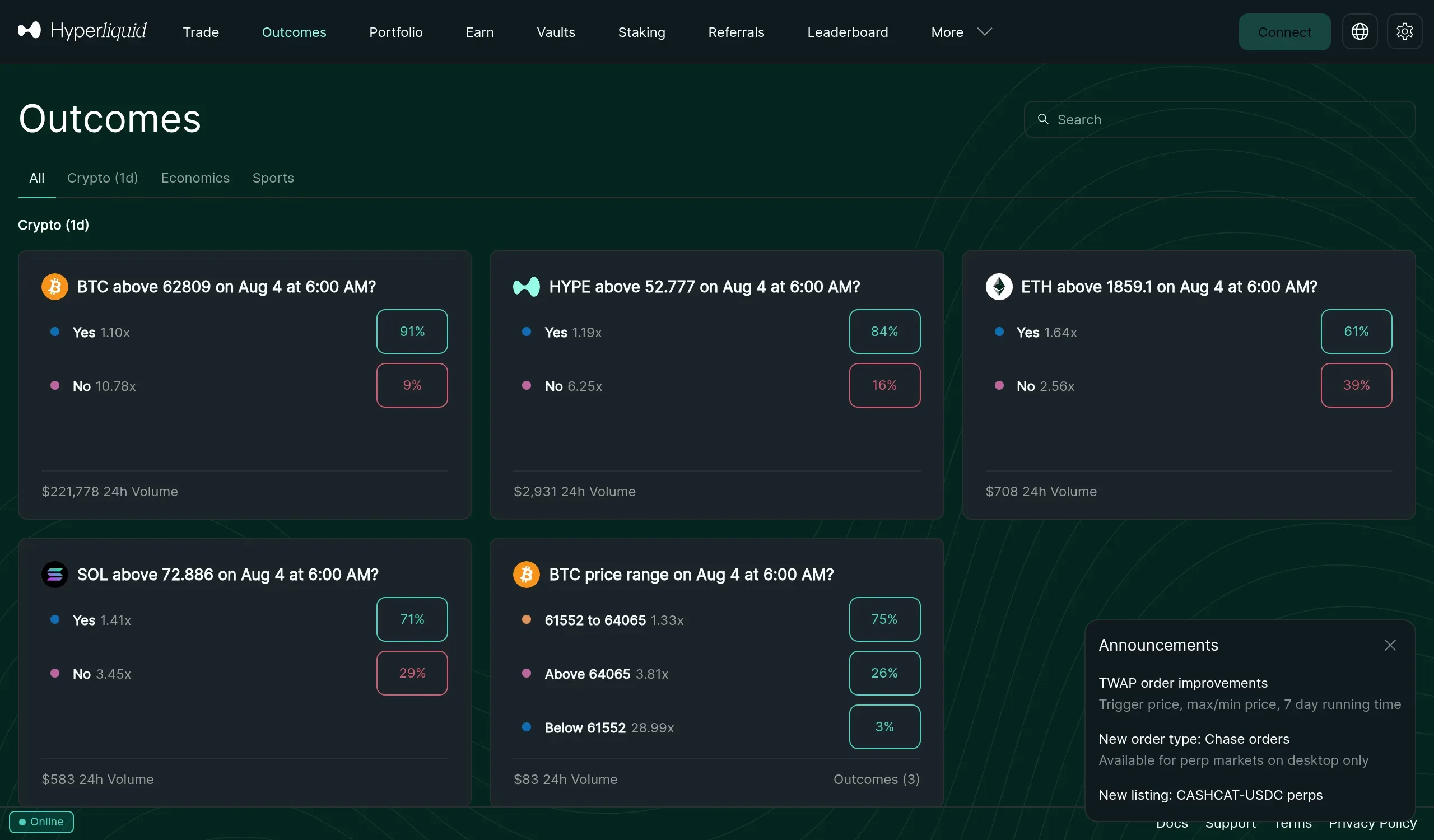
The Outcomes tab on app.hyperliquid.xyz. The Economics and Sports category tabs alongside Crypto are where canonical event markets surface, since those are the contracts that resolve through validator consensus rather than an onchain price feed.
What "Canonical" Means
The word canonical is doing real work here. Hyperliquid distinguishes between markets that are deployed by individual actors and markets that are deployed by the protocol itself:
- HIP-1 spot markets are deployed via Dutch auction — a single deployer wins a slot and lists the asset.
- HIP-3 builder-operated perps are deployed by builders who pay an auction fee for a deployer slot and run their own market parameters.
- HIP-4 canonical outcome markets are deployed by the validator set itself. No auction, no individual deployer, no concentrated counterparty.
When something is canonical on Hyperliquid, it means the validators have collectively voted to deploy and settle it. The market carries the full credibility of the validator set rather than the reputation of a single team. That distinction matters most for prediction markets, where settlement integrity is the entire product — a binary contract is only as good as the process that resolves it.
The Validator Newsfeed
The mechanism that makes canonical markets possible is a piece of automated newsfeed software that validators run as part of regular chain operations. This is not a separate off-protocol service or a third-party oracle bolted on after the fact — it is part of the validator client itself.
What the newsfeed does
The newsfeed watches for real-world events that meet the criteria for an outcome market:
- Scheduled events with clear resolution timing — game finals, election dates, central bank meetings, scheduled economic data releases
- Unambiguous resolution rules — "team A wins the championship" rather than "team A has the best season"
- Verifiable reference data — results that come from public, agreed-upon sources
When the newsfeed identifies a candidate market, it proposes the contract to the validator set: the underlying event, the resolution rules, the expiration time, the reference source. Validators then vote on whether to deploy.
After the event resolves in the real world, the newsfeed surfaces the result back to the validator set, which votes again on the settlement value. The same software that proposed the market now drives its resolution.
Why this is different from an oracle
Traditional oracle designs — Chainlink, UMA, Pyth — sit between the chain and the outside world as a separate trust layer. Reporters submit data, disputes happen in a separate venue, and the chain treats the oracle's output as input to settle markets.
The Hyperliquid approach collapses that into a single layer. The validators are the oracle, because settling a canonical market is just another vote that happens during normal block production. There is no separate set of reporters, no separate dispute application, no escalation game. The chain reaches consensus on the outcome the same way it reaches consensus on every other state transition.
Info
How Validators Vote
Validators vote on canonical markets at two stages: deployment and settlement. The criteria are stated explicitly by the protocol team — markets must clear a bar on each axis to pass.
Deployment vote criteria
When the newsfeed proposes a new market, validators evaluate three dimensions:
-
Unambiguous rules. The resolution criteria must be specific enough that there is no realistic post-hoc dispute. A market on "whether the Fed cuts rates at the June meeting" is fine because the resolution is binary and publicly announced. A market on "whether the economy will improve" is not — there is no agreed-upon definition.
-
Correctness. The proposed reference data has to be verifiable and accurate. If the newsfeed surfaces a game time and a result source, validators check that the time is right, the source is authoritative, and the resolution mapping is correct.
-
Subjective quality. This is the most interesting criterion. Validators consider whether the market is genuinely useful and well-formed — reasonable expiration timing, not trivially manipulable, not too niche to attract liquidity, not a duplicate of something already trading. Validators can vote against a technically valid market simply because they do not think it deserves a slot.
A market only goes live if it passes the deployment vote on all three.
Settlement vote criteria
After the event resolves, the newsfeed surfaces the result, and validators vote again. The settlement vote is mostly a check on correctness — did the event resolve as proposed, was the reference data observed accurately, and does the settlement value map cleanly to the contract's outcome buckets. Edge cases (cancelled events, postponed games, ambiguous results) are surfaced for the validator set rather than handled by hardcoded rules.
Why This Unlocks Event-Driven Trading
Until canonical markets shipped, HIP-4 on Hyperliquid was a powerful primitive without a way to express most of what people actually want to trade. The recurring binary BTC market and the multi-outcome BTC range market are clean test cases, but they both settle to data the protocol already produces — which excludes nearly every interesting prediction market.
Canonical markets fix this in one move. The same primitive that already supports daily-settling BTC, ETH, HYPE, and SOL outcome contracts can now support:
- Sports outcomes — game results, tournament winners, season totals
- Election markets — primary results, general election outcomes, vote shares
- Macro events — Fed rate decisions, CPI releases, GDP prints
- Scheduled news events — earnings surprises, IPO pricing, regulatory decisions
- Crypto-specific milestones — protocol launch dates, governance vote outcomes, network upgrades
Settlement criteria are where this gets hard, and earnings show why. "Did the company beat expectations" is ambiguous, because consensus figures differ by data provider. "Did reported revenue exceed a stated figure" is not. Validators vote on the quality of a proposed rule as well as on the reference data behind it, so the markets that clear that filter will be the ones written against a single published number. For a chip name carrying several scheduled catalysts a year, AMD perpetual futures on Hyperliquid being the obvious example around product launches and quarterly reports, the gap between those two phrasings decides whether a market settles cleanly or ends in argument.
The mechanics are unchanged. Markets are still 100% collateralized with no leverage. They still use the 15-minute opening call auction for price discovery. Split, negate, and merge still work for multi-outcome variants. The only thing different is where the settlement value comes from — and that is the entire reason this category of market has been impossible on Hyperliquid until now.
Trade Outcome Markets on Hyperliquid
Get a 4% lifetime fee discount when you sign up with our referral link.
Start TradingComparison: Hyperliquid vs. Polymarket vs. Kalshi
Canonical markets put Hyperliquid in direct competition with the two largest prediction market venues. The mechanisms are very different.
| Hyperliquid Canonical | Polymarket | Kalshi | |
|---|---|---|---|
| Settlement mechanism | Validator consensus vote | UMA optimistic oracle | Centralized operator (CFTC-regulated) |
| Dispute process | Built into validator voting | Separate UMA bonded dispute | Internal review |
| Quote asset | USDC | USDC | USD |
| Capital efficiency | Cross-margin with perps and spot | Isolated | Isolated |
| Leverage | None — 100% collateralized | None | None |
| Custody | Self-custody onchain | Self-custody onchain (Polygon) | Custodial |
| US availability | Geo-restricted (see VPN guides) | Geo-restricted | Available — CFTC-regulated |
The key structural advantage Hyperliquid has is cross-margin composability. A trader on Polymarket or Kalshi holds an isolated position — capital posted to a binary market is locked there and earns nothing else. A trader on Hyperliquid can offset a canonical outcome position against negatively correlated perp or spot exposure inside the same account, because all of it sits on HyperCore. That is genuinely impossible on a standalone prediction market venue. Our Hyperliquid vs Polymarket comparison breaks down this and every other difference — fees, market creation, and liquidity — in detail.
The key structural advantage Kalshi has is US regulatory access — it is a CFTC-regulated designated contract market and serves US residents directly. Hyperliquid does not, and canonical outcome markets do not change that. Whether that gap narrows is an open regulatory question rather than a product one: see Is Hyperliquid coming to the US? for the CFTC process and what has actually been announced.
Where AQAv2 Fits
The AQAv2 spec announced May 14, 2026 named canonical outcome markets as one of the venues migrating to USDC settlement, and that migration has now shipped. The relevant section of the AQAv2 design treats HIP-4 canonical markets and validator-operated perp markets together — both are protocol-blessed venues, and both use the AQAv2-aligned quote asset.
What this means in practice:
- Today: Canonical markets settle in USDC. Coinbase is the treasury deployer, Circle is the technical deployer, and the AQA rate is shared with the protocol via Coinbase's HYPE stake.
- The USDH sunset is complete: Markets originally settled in USDH, but all USDH-denominated markets on HyperCore have finished settlement. If you still hold USDH, swap it to USDC — feeless via Across on HyperEVM, or on the HyperCore spot order book.
The mechanics described in this article — validator newsfeed, deployment vote, settlement vote, opening call auction — apply identically to USDC-denominated markets. The only thing that changed is the quote asset.
What This Means for HYPE Stakers
Canonical outcome markets are settled by the validator set, and validators are economically anchored by HYPE staking. Three implications worth flagging:
-
Validator responsibility grows. Resolving canonical markets is now part of the job. Validators that vote poorly — approving ambiguous markets, missing settlement disputes, mis-mapping reference data — damage the protocol's most reputation-sensitive product. The same staking economics that secure block production now secure prediction market integrity.
-
Delegators choose carefully. When you delegate HYPE to a validator, you are implicitly signing off on their newsfeed operation and voting record. Over time, the canonical-markets track record becomes a meaningful factor in delegate selection, alongside uptime and fee policy.
-
New revenue surface for the protocol. Canonical market volume generates trading fees and quote-asset yield (via AQAv2) that flow into the protocol's existing revenue model. Analyst estimates of prediction-market addressable market — $1.5–3M monthly from event contracts, plus large adjacent options markets — represent meaningful upside if even a fraction of Polymarket/Kalshi volume migrates.
Stake HYPE and Help Settle Canonical Markets
Delegate HYPE to a Hyperliquid validator and earn rewards while securing the chain — and the canonical markets it now runs.
Get StartedWhat to Watch Next
Three things to track as canonical markets scale out from here:
-
First non-financial canonical market. The launch primitives all settled to onchain price data. The first canonical market that settles on a non-financial event — a sports result, an election, a scheduled news release — is the real proof that the validator newsfeed works under live conditions.
-
Validator disagreement rate. If most settlements pass unanimously, the system is working as intended. If disputes start clustering on specific event types or specific validators, that signals where the mechanism needs refinement.
-
Builder front-end activity. Canonical markets are the validator-blessed default, but the surface is open — builders can wrap canonical markets in branded interfaces. Expect more front-ends to ship as canonical event markets go live.
-
The shift to permissionless deployment has happened. HIP-4 permissionless deployment reached mainnet in the week ending 31 August 2026: a 500k HYPE stake plus validator-voted templates that let anyone deploy their own outcome markets. Validator-deployed canonical markets are expected to become rare from here, "ideally fewer than 10 outcomes or questions per year," with the long tail of markets flowing through permissionless deployers instead. The first outside deployer, running under the venue name
skew, launched with binaries on trade.xyz index perps rather than on anything a validator would have picked. -
Fees have arrived on canonical markets. Validator-deployed outcome markets, canonical ones included, traded with no fee at all until late August 2026. The network upgrade Hyperliquid flagged on August 14 turned fees on, explicitly as preparation for the deployer fee scale that permissionless markets carry. The stated target is an average outcome fee of half ordinary spot trading, and the charge lands on closes and settlements rather than on opening a position.
Sports templates remain testnet-only. Validators approved seven templates for mainnet covering price markets and central bank rate decisions, and left the seven sports families on the test network. So the policyRateDecision family lets a permissionless deployer launch central bank decisions without a validator vote per market, while fixtures still cannot be deployed on mainnet at all. Canonical deployment and template-based deployment are converging on the same event categories, but not yet at the same speed.
The validator newsfeed is the most architecturally novel piece Hyperliquid has shipped in months. It is the difference between HIP-4 being a clean primitive without obvious users and HIP-4 being a direct, scaled competitor to Polymarket and Kalshi on a venue that already does more daily perp volume than most of crypto combined.
Start Trading on Hyperliquid
4% lifetime fee discount, full HIP-4 outcome market access, cross-margin with perps and spot.
Open AccountFrequently Asked Questions
Canonical outcome markets are HIP-4 outcome contracts that are deployed and settled directly by Hyperliquid validators, not by external builders. Validators run automated newsfeed software as part of their normal chain operations, and that software proposes markets based on real-world events. Validators then vote on whether to deploy each market and how to settle it. Canonical means protocol-blessed — these markets carry the full backing of HyperCore's validator set rather than the reputation of an individual deployer.
HIP-3 builder markets are deployed by anyone who wins a Dutch auction for a deployer slot, and the deployer is responsible for setting parameters, listing the market, and managing the order book. Canonical outcome markets bypass the auction entirely. They are proposed by the validator newsfeed, voted on by the validator set, and settled by validator consensus. There is no single deployer, no auction fee, and no concentrated counterparty risk — the validator set itself acts as the coordinator.
Validators run automated software that watches for real-world events suitable for outcome markets — sports results, political milestones, scheduled economic releases, and similar unambiguous events with clear resolution criteria. The software proposes markets to the validator set, which votes on deployment. After the underlying event resolves, the same software surfaces the result, and validators vote again on the settlement value. This is run as part of regular chain operations, not as a separate off-protocol service.
Validators vote based on several factors. The market must have unambiguous rules — the resolution criteria need to be clear enough that there is no realistic dispute. The proposed reference data must be correct and verifiable. And there is a subjective quality dimension: validators consider whether the market is genuinely useful, has reasonable resolution timing, and is not trivially manipulable. Markets that fail any of these tests do not pass the deployment vote.
Yes — that is the entire point. The first HIP-4 markets settled to onchain data (the Hyperliquid BTC mark price) because no oracle was needed. Canonical outcome markets extend the primitive to offchain events by using validator consensus as the resolution mechanism. A canonical market on a sports result, election outcome, or government economic release is possible because validators collectively observe the real-world result and vote on the settlement value. This is the mechanism that makes Hyperliquid a direct competitor to Polymarket and Kalshi for event-driven trading.
Canonical markets settle in USDC, the aligned quote asset under the AQAv2 spec. Coinbase acts as treasury deployer for USDC and shares the AQA rate with the protocol, with Circle as technical deployer. Markets originally settled in USDH, but the USDH sunset is now complete — all USDH-denominated markets on HyperCore have settled, and any remaining USDH should be swapped to USDC.
Polymarket settles markets through UMA's optimistic oracle, where any party can propose a resolution and a separate bonded dispute process resolves contested outcomes. Hyperliquid canonical markets settle through native validator consensus. The Hyperliquid validators are the same set securing billions in perp volume, and they vote on settlement directly as part of normal block production. There is no separate dispute resolution app, no escalation game, and no off-protocol governance — just the same validators who already run the chain reaching consensus on a discrete fact.
Yes. Canonical markets are the validator-blessed default, but the HIP-4 primitive itself is open — builders can wrap canonical markets in custom interfaces and route trades into the same HIP-4 contracts. The distinction is who deploys and settles the contract: canonical markets are validator-operated, while custom builder markets follow the HIP-3 auction model for their parameters. Both can coexist on the same exchange.
Independent resource: Hyperliquid Guide is an independent, third-party resource operated by Concept211. It is not affiliated with, produced by, reviewed by or endorsed by Hyper Foundation, Hyperliquid Labs or any other Hyperliquid-ecosystem entity. "Hyperliquid" and related names and marks belong to their respective owners and are used here only to identify the platform this site documents. Read the full disclaimer.
Not advice: Nothing on this site is legal, tax, financial or investment advice. Descriptions of regulatory status, tax treatment and market availability are general information that varies by jurisdiction and changes over time. Confirm anything that matters to you with a qualified professional and against primary sources. Trading perpetual futures involves substantial risk of loss, and past performance does not indicate future results.
Disclosure: this site contains referral links. Signing up through the 4% lifetime fee discount link earns us a share of the trading fee Hyperliquid already charges, at no extra cost to you.
Ready to Start Trading?
Join Hyperliquid with our referral link and get a 4% lifetime fee discount. No KYC, no email - just connect your wallet and trade.
Start Trading - Save 4%