Hyperliquid vs Polymarket (2026): HIP-4 Outcome Markets vs Prediction Markets
Table of Contents
- Hyperliquid vs Polymarket at a glance
- How each one creates markets
- Polymarket's curated, oracle-resolved model
- Hyperliquid's validator-deployed and (proposed) permissionless model
- Liquidity and execution
- Fees and settlement
- Trader due diligence: evaluating a market before you trade
- Consumer front-ends and UX
- Head-to-head summary
- The verdict: which should you use?
- Who should use each
 Hyperliquidvs
 Polymarket
| Feature | Hyperliquid (HIP-4) | Polymarket |
|---|---|---|
| Primary use | Perps exchange plus outcome markets | Dedicated prediction market |
| Chain / Settlement | Hyperliquid L1 (HyperCore) | Polygon |
| Settlement asset | USDC (AQAv2) | USDC |
| Trading fees | None today; about half of spot after the next upgrade, plus up to a 50% deployer share on permissionless markets | No explicit trading fee |
| Market creation | Validator-deployed on mainnet; permissionless live on testnet since July 31, 2026 | Curated by Polymarket team |
| Resolution | Internal mark price / validator consensus | UMA optimistic oracle |
| Liquidity model | Fully on-chain CLOB, shared with perps | Off-chain order book, on-chain settlement |
| Market breadth | Recurring price outcomes plus canonical events | Thousands of real-world event markets |
| Custody | Self-custody (non-custodial) | Self-custody (non-custodial) |
| KYC | No | No (geo-restricted; regulated US access re-emerging) |
Tip
The one-line difference: Polymarket is the category leader for betting on real-world events, with unmatched breadth and zero trading fees. Hyperliquid's HIP-4 turns outcome trading into a composable instrument that shares margin with your perps, a structural edge no standalone prediction market can match. The trade-off is that Hyperliquid's live market set is narrower today.
Hyperliquid vs Polymarket at a glance
Polymarket is a dedicated prediction market on Polygon where you trade thousands of curated real-world event contracts (elections, sports, culture) with no explicit trading fee and UMA-oracle resolution. Hyperliquid is primarily a perpetuals exchange whose HIP-4 outcome markets add fully collateralized outcome contracts on its own Layer 1, settled to internal price data or validator consensus and margined alongside your perps. Both let you trade discrete outcomes, but Polymarket wins on the breadth of events while Hyperliquid wins on composability and on-chain execution.
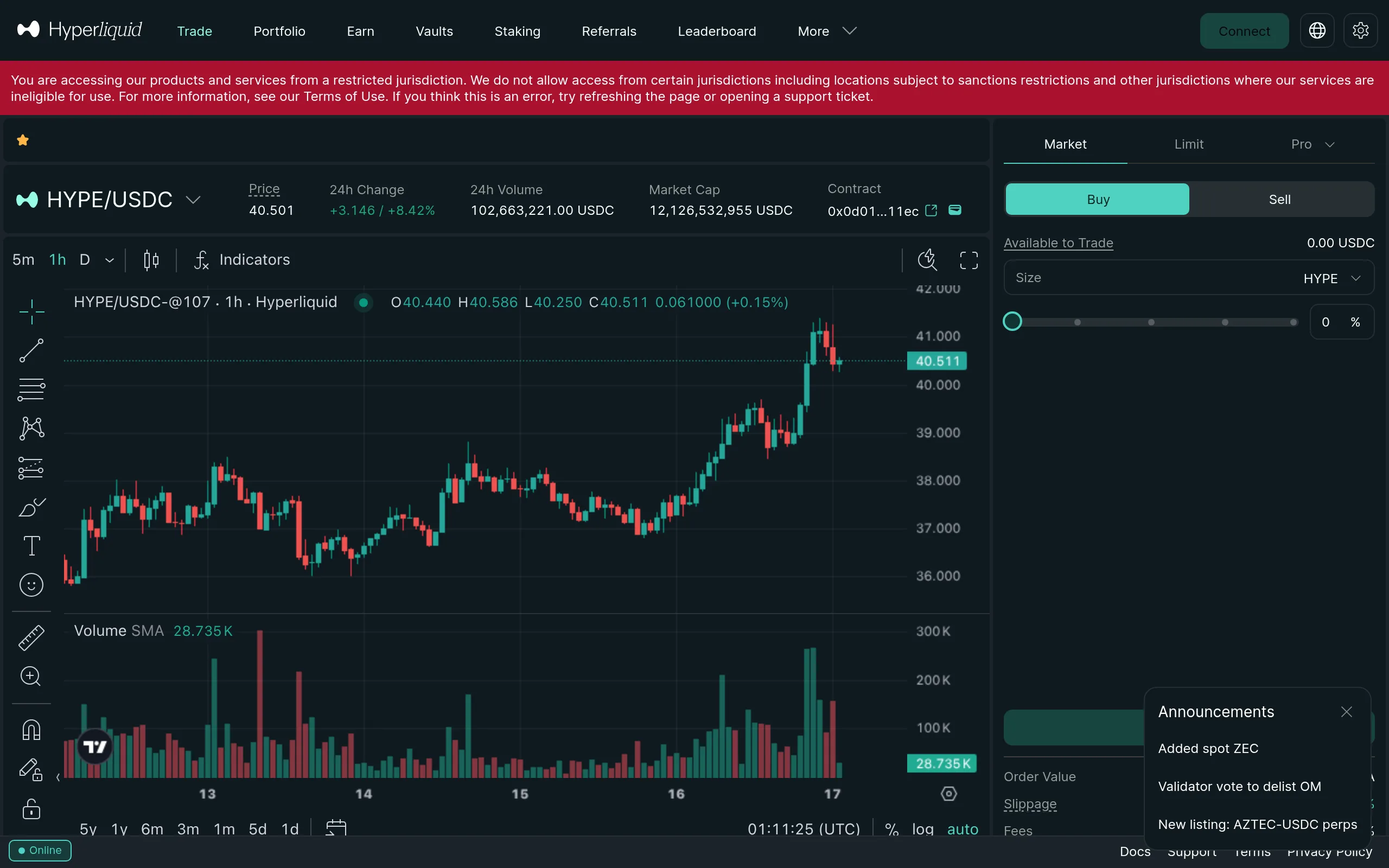
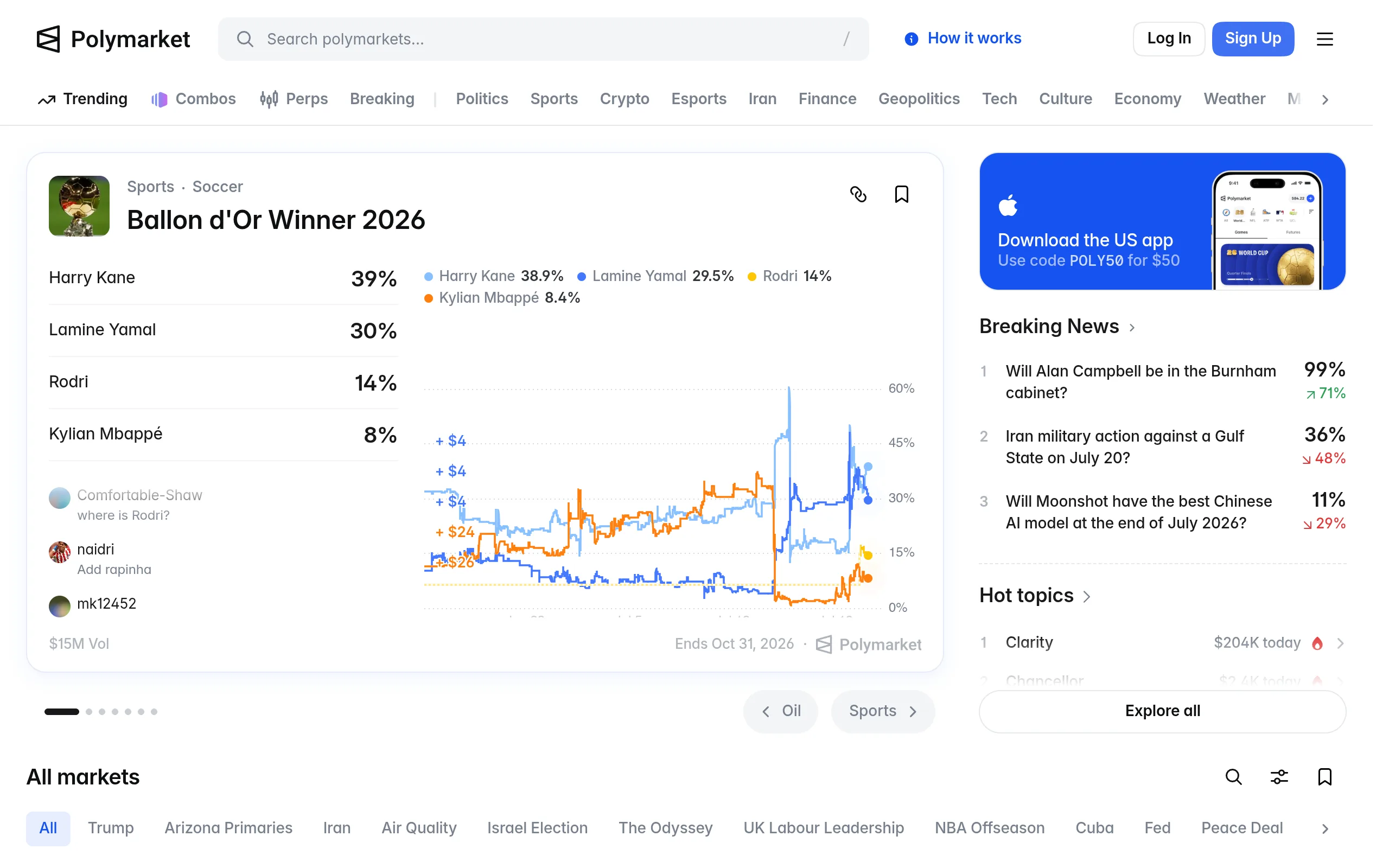
Source: Polymarket — used under fair use for educational purposes
Trade Outcomes and Perps on One Account
Hyperliquid puts perps, spot, and HIP-4 outcome markets in a single margin account. Sign up through our referral link for a 4% lifetime fee discount.
Start Trading - Save 4% on FeesHow each one creates markets
Market creation is the sharpest philosophical split between the two. Polymarket curates: its team defines each market and resolution runs through the UMA optimistic oracle, where a proposed result stands unless someone disputes it within a challenge window. Hyperliquid takes the opposite tack. Outcome markets are deployed by validators on mainnet today, and a permissionless model already running on testnet lets anyone deploy from validator-approved templates. The trade-off is editorial quality control versus open, template-gated deployment.
Polymarket's curated, oracle-resolved model
On Polymarket, you do not deploy your own market; the platform lists them. Each contract is a binary or multi-outcome question ("Will X happen by date Y?") whose shares trade between 0 and 1 USDC and pay out 1 USDC to the winning side at resolution. Resolution leans on UMA's optimistic oracle: a proposer submits the outcome, and it finalizes unless a disputer stakes against it and escalates to UMA's token-holder vote. This works well for clean, well-worded questions, but it has produced contested resolutions when a market's wording is ambiguous, which is the recurring failure mode of oracle-based prediction markets.
Hyperliquid's validator-deployed and (proposed) permissionless model
Hyperliquid's live HIP-4 markets are validator-deployed. The recurring dailies, which are binary and range outcomes on BTC, ETH, HYPE, and SOL, settle to Hyperliquid's own mark price at 06:00 UTC with no external oracle at all. For real-world events, canonical outcome markets let validators deploy and settle markets on offchain events through an automated newsfeed and validator voting.
The bigger shift is HIP-4 permissionless deployment, which went live on testnet on July 31, 2026 and picked up a substantial second release on August 14. Deployers activate, instantiate validator-voted templates, and settle their own markets through a documented actions API, with no gas cost and no auction. The August release added a configurable deployer fee scale, the ability to add outcomes to a question that is already trading, and template families for sports fixtures and central bank rate decisions, which are exactly the categories Polymarket dominates.
Mainnet limits are now published too: 100 concurrent outcomes and 500 deployments per day per deployer at launch, rising to 1,000 and 5,000. Against a 500,000 HYPE stake and slashing for mis-settled markets, that is a real business rather than a hobby. Testnet already carries 47 registered deployers and 321 outcomes, against 8 outcomes on mainnet. Permissionless deployment still has not shipped to mainnet, so today the practical menu of Hyperliquid outcome markets remains much narrower than Polymarket's, but the gap is a rollout schedule rather than a missing feature.
Warning
HIP-4 permissionless deployment is live on testnet, not on mainnet, as of August 2026. The 500k HYPE stake and the slashing terms can still change. What is live on mainnet is the validator-deployed set: recurring price dailies and canonical offchain-event markets, currently trading with no fee at all. Do not assume a Polymarket-scale event menu on Hyperliquid yet.
Liquidity and execution
Both platforms are non-custodial and settle on-chain, but they match orders very differently. Hyperliquid runs a fully on-chain central limit order book. Every order, cancel, and fill lives on its Layer 1, and outcome contracts share the same HyperCore engine and margin system as its perps. Polymarket uses a hybrid model: orders are matched off-chain by Polymarket's operator for speed, then fills settle on-chain on Polygon. Hyperliquid maximizes on-chain transparency; Polymarket optimizes for a snappy, low-friction consumer experience.
Polymarket's liquidity is concentrated where attention is. Marquee markets like a major election or a heavily-covered sports final can carry deep books and tight spreads, while long-tail questions are thin. Hyperliquid's recurring price outcomes inherit liquidity from the assets they track, since BTC, ETH, HYPE, and SOL are its largest perp markets, and a new opening market goes through a 15-minute call auction to establish a fair starting price rather than letting the first trades set it. For a trader, the practical read is simple: Polymarket for depth on the biggest real-world questions, Hyperliquid for clean price-outcome markets that plug into an already-liquid order book.
Info
Explore live Hyperliquid data and the current outcome-market lineup: Markets page · Funding Rates · Open Interest
Fees and settlement
Both platforms settle in USDC, so on payout there is no denomination difference. Fees are closer than they used to be. Polymarket charges no explicit maker or taker trading fee, and right now neither does Hyperliquid: outcome markets on mainnet are free while the primitive is still validator-deployed. That ends at the next network upgrade, which Hyperliquid announced on August 14, 2026 will switch fees on with an average outcome fee of half ordinary spot trading, roughly 0.035% against the 0.070% spot taker base.
Even then the comparison is not a straight rate-against-zero. Hyperliquid charges only when you close or settle, never when you open, so a round trip costs one fee rather than two, and there are no maker rebates in either direction. Permissionless-deployed markets will layer a deployer fee scale between 0 and 10 on top, where the maximum means twenty times the base rate. Polymarket still wins on headline cost once fees arrive, but "free versus expensive" overstates it.
| Hyperliquid (HIP-4) | Polymarket | |
|---|---|---|
| Explicit trading fee | None today; ~half of spot after the next upgrade | None |
| When the fee is charged | Close and settle only, never on open | N/A |
| Deployer fee share | Up to 50%, scale 0 to 10 (permissionless) | N/A (curated) |
| Settlement asset | USDC (AQAv2) | USDC |
| Gas fees | Zero (own L1) | Polygon gas (cents) |
| Cross-margin with perps | Yes, shared collateral | No futures engine |
| Capital efficiency | Prime-brokerage style | Isolated per market |
The honest nuance is that a headline fee is not the whole cost of a position. Hyperliquid's edge is composability: because HIP-4 outcome positions live in the same account as your perps and share collateral, HyperCore can offset negatively correlated risk across the two. If you are long BTC perps and hold a downside outcome contract as a hedge, your total margin requirement is lower than holding each in isolation. Polymarket cannot do this, because it has no futures engine to cross-margin against, so every position is capital-isolated. For a trader who only bets on events, Polymarket's zero fee is the better deal. For a trader running perps and outcomes together, Hyperliquid's capital efficiency can outweigh a small per-trade fee. Run your own numbers against the Hyperliquid fee structure. Get 4% Fee Discount
Trader due diligence: evaluating a market before you trade
Diligence looks different on each platform. On Polymarket, the market already exists and the main risk is resolution ambiguity, so read the exact wording and the resolution source before you trade. UMA disputes almost always trace back to a poorly-worded question rather than a broken oracle. On Hyperliquid, the recurring price dailies are unambiguous, since they settle to a published mark price, but a freshly permissionless-deployed market, once mainnet deployment opens, puts more of the diligence on you: which template it instantiates, the deployer's track record, and the depth of the book.
Before putting real size into any newly-listed outcome market, the checklist from our HIP-4 permissionless deployment guide applies directly:
- State the resolution in one sentence. If you cannot say exactly what makes the market resolve YES or NO and when, do not trade it. This is the single most common way outcome traders get burned, on both platforms.
- Check book depth against your size. A market can post real volume and still have a thin resting book between bursts. Size to the depth you actually see.
- Verify the settlement source. On Polymarket, that is the UMA resolution source. On Hyperliquid, it is the mark price or the template's settlement criteria. Know it before you fund the position.
- Weigh the deployer or lister. On a permissionless HIP-4 market, a deployer with a clean history and 500k HYPE staked against slashing is safer than an anonymous operator's first market. On Polymarket, the market is curated by the platform, which removes this variable.
Tip
When the same outcome exists in more than one place, say a daily BTC price bet, trade the deepest instance, not the first one you find. The version with the tightest spread and thickest book usually gives you a better all-in price than a headline fee number alone suggests.
Consumer front-ends and UX
Polymarket's interface is its superpower: a clean, familiar feed of trending markets across politics, sports, crypto, and culture, with email-wallet onboarding that hides the crypto plumbing entirely. It feels like a mainstream app.
Hyperliquid's Outcomes tab is closer to that than the rest of its interface would suggest. Markets appear as cards with Yes and No odds, an implied percentage, and 24-hour volume, sorted under All, Crypto, Economics, and Sports tabs. You can read the state of a market at a glance without touching an order book. What it does not have is Polymarket's onboarding: you still connect a wallet rather than signing up with an email, and the market count is a fraction of Polymarket's.
The remaining gap is breadth and discovery rather than raw usability, and that is what permissionless deployment is meant to close once it reaches mainnet. Third-party front-ends can also wrap the same HIP-4 contracts in their own interfaces, since the primitive is open to anyone who wants to build on it.
Outcome Markets, Perps, and Spot in One Place
Hyperliquid gives you CEX-level execution with DeFi self-custody, plus outcome contracts that share margin with your perps. Join with our referral link for 4% off all trading fees.
Try Hyperliquid NowHead-to-head summary
| Hyperliquid (HIP-4) | Polymarket | |
|---|---|---|
| What it is | Perps exchange plus outcome markets | Dedicated prediction market |
| Chain | Hyperliquid L1 | Polygon |
| Order matching | Fully on-chain CLOB | Off-chain match, on-chain settle |
| Resolution | Mark price / validator consensus | UMA optimistic oracle |
| Trading fee | None today, ~half of spot soon | None |
| Market breadth | Price dailies plus canonical events | Thousands of event markets |
| Cross-margin with perps | Yes | No |
| On-chain transparency | Full (order book on L1) | Settlement only |
| Permissionless market creation | Proposed (testnet-first) | No, curated |
| Custody | Self-custody | Self-custody |
The verdict: which should you use?
Polymarket is the better platform for betting on real-world events. Nothing on Hyperliquid today matches its breadth of political, sports, and cultural markets, its zero trading fee, or its mainstream-friendly interface. If you want to trade "who wins the election" or "will this happen by year-end," Polymarket is the category leader and the obvious choice.
Hyperliquid's HIP-4 is the better outcome primitive for crypto-native traders. Its defining feature is not the market menu; it is that outcome positions live in the same margin account as your perps and spot, delivering capital efficiency no isolated prediction market can offer. Add a fully on-chain order book, zero gas on its native L1, and USDC settlement, and HIP-4 is the stronger tool for price-outcome trading and hedged, multi-instrument strategies. Its ceiling is high, because permissionless deployment is already running on testnet and the event menu could widen a lot once it reaches mainnet. That has not happened yet, so judge Hyperliquid on what is live on mainnet, meaning recurring price dailies and canonical markets, not on the roadmap.
Choose Polymarket if you want the widest set of real-world event markets, no trading fees, and the simplest way to back a conviction. Choose Hyperliquid's HIP-4 if you already trade perps and want capital-efficient, composable outcome exposure on a fully on-chain order book. They are less direct rivals than complementary tools: Polymarket owns event breadth today, Hyperliquid owns composability, and permissionless HIP-4 is the wildcard that could narrow the breadth gap over time.
Who should use each
- Choose Polymarket if your focus is real-world events like elections, sports, and culture, you want zero trading fees, and you value a mainstream, email-onboarding UX over on-chain purity.
- Choose Hyperliquid (HIP-4) if you already trade perps, want outcome positions that cross-margin with your futures, prefer a fully on-chain order book, and are comfortable with a narrower but growing set of price-based and canonical outcome markets.
Bottom line: Polymarket is the reigning prediction-market leader on breadth and cost, while Hyperliquid's HIP-4 is the composability play for traders who live on an exchange. To go deeper on the mechanics, read our HIP-4 outcome trading explainer and the multi-outcome markets guide. For more matchups, see Hyperliquid vs dYdX, Hyperliquid vs GMX, and Hyperliquid vs Drift. Ready to try it yourself? Set up an account at app.hyperliquid.xyz and lock in a 4% lifetime fee discount.
Ready to Trade Outcomes on Hyperliquid?
Join with our referral link and save 4% on every trade: perps, spot, and HIP-4 outcome contracts. No KYC, no account creation, just connect your wallet.
Start Trading on HyperliquidFrequently Asked Questions
Not exactly. Hyperliquid's HIP-4 primitive adds outcome markets, which are fully collateralized contracts that settle to a fixed result at expiration, to a venue that is primarily a perpetual futures exchange. Polymarket is a dedicated prediction market focused on real-world events like elections, sports, and culture. HIP-4 today runs recurring price-based outcomes (daily BTC, ETH, HYPE, SOL) and validator-deployed canonical markets on offchain events, while Polymarket offers thousands of curated real-world event markets. They overlap on the idea of trading discrete outcomes but serve different market sets.
Both charge nothing today. Polymarket has no explicit maker or taker trading fee, and Hyperliquid's outcome markets are also free on mainnet while the primitive is validator-deployed. Hyperliquid announced on August 14, 2026 that the next network upgrade enables fees, averaging half of ordinary spot trading, or roughly 0.035%. The charge lands only when you close or settle a position, never when you open one, so a round trip costs one fee instead of two. Permissionless-deployed HIP-4 markets will add a deployer fee scale of up to 10 on top. Hyperliquid's counter-advantage is capital efficiency, since outcome positions share margin with your perps.
Polymarket curates its markets. The team defines and lists them, and resolution runs through the UMA optimistic oracle with a dispute window. Hyperliquid's HIP-4 markets are currently validator-deployed: recurring price outcomes and canonical offchain-event markets voted on by validators. Permissionless HIP-4 deployment was announced in July 2026 as a preliminary, testnet-first proposal, under which anyone staking 500,000 HYPE could instantiate validator-voted templates to deploy their own outcome markets.
Both are non-custodial. You keep control of your funds and settle on-chain. Polymarket settles on Polygon and resolves through the UMA optimistic oracle. Hyperliquid runs on its own Layer 1, with outcome contracts matched on a fully on-chain central limit order book and settled by internal mark price or validator consensus. Hyperliquid keeps the entire order book and matching engine on-chain, whereas Polymarket matches orders off-chain and settles the fills on-chain.
To a limited degree on mainnet today. Hyperliquid's canonical outcome markets let validators deploy markets on offchain events using an automated newsfeed and validator voting, but the live market set is far narrower than Polymarket's thousands of political, sports, and culture markets. Permissionless HIP-4 deployment went live on testnet on July 31, 2026 and gained sports and central-bank-rate templates on August 14, which is the step that would let deployers launch a much wider menu of event markets once it reaches mainnet.
On testnet, yes, and it is well past a preview. The initial implementation went live on July 31, 2026, and an August 14 release added a configurable deployer fee scale, the ability to add outcomes to a live question, and sports and central-bank-rate templates. Testnet caps sit at 10 active outcomes and 50 deployments per day per deployer, while mainnet will launch at 100 concurrent outcomes and 500 deployments per day, rising to 1,000 and 5,000. Mainnet has not shipped. Validator-deployed HIP-4 markets are already live there: recurring daily binaries on BTC, ETH, HYPE, and SOL plus canonical offchain-event markets.
Independent resource: Hyperliquid Guide is an independent, third-party resource operated by Concept211. It is not affiliated with, produced by, reviewed by or endorsed by Hyper Foundation, Hyperliquid Labs or any other Hyperliquid-ecosystem entity. "Hyperliquid" and related names and marks belong to their respective owners and are used here only to identify the platform this site documents. Read the full disclaimer.
Not advice: Nothing on this site is legal, tax, financial or investment advice. Descriptions of regulatory status, tax treatment and market availability are general information that varies by jurisdiction and changes over time. Confirm anything that matters to you with a qualified professional and against primary sources. Trading perpetual futures involves substantial risk of loss, and past performance does not indicate future results.
Disclosure: this site contains referral links. Signing up through the 4% lifetime fee discount link earns us a share of the trading fee Hyperliquid already charges, at no extra cost to you.
Ready to Start Trading?
Join Hyperliquid with our referral link and get a 4% lifetime fee discount. No KYC, no email - just connect your wallet and trade.
Start Trading - Save 4%