Hyperliquid vs Robinhood: What Actually Changes (2026)
Table of Contents
 Hyperliquidvs
 Robinhood
If you have only ever used a stock app and Hyperliquid just showed up in your feed, this is the comparison that matters. The two look alike on the surface and are built on completely different foundations, and the differences are the kind that cost money when you find them out late.
Robinhood is a company that holds your money and trades on your behalf. Hyperliquid is software that lets you trade directly from your own wallet, with no company in the middle. Everything else on this page follows from that one distinction.
What Each One Looks Like
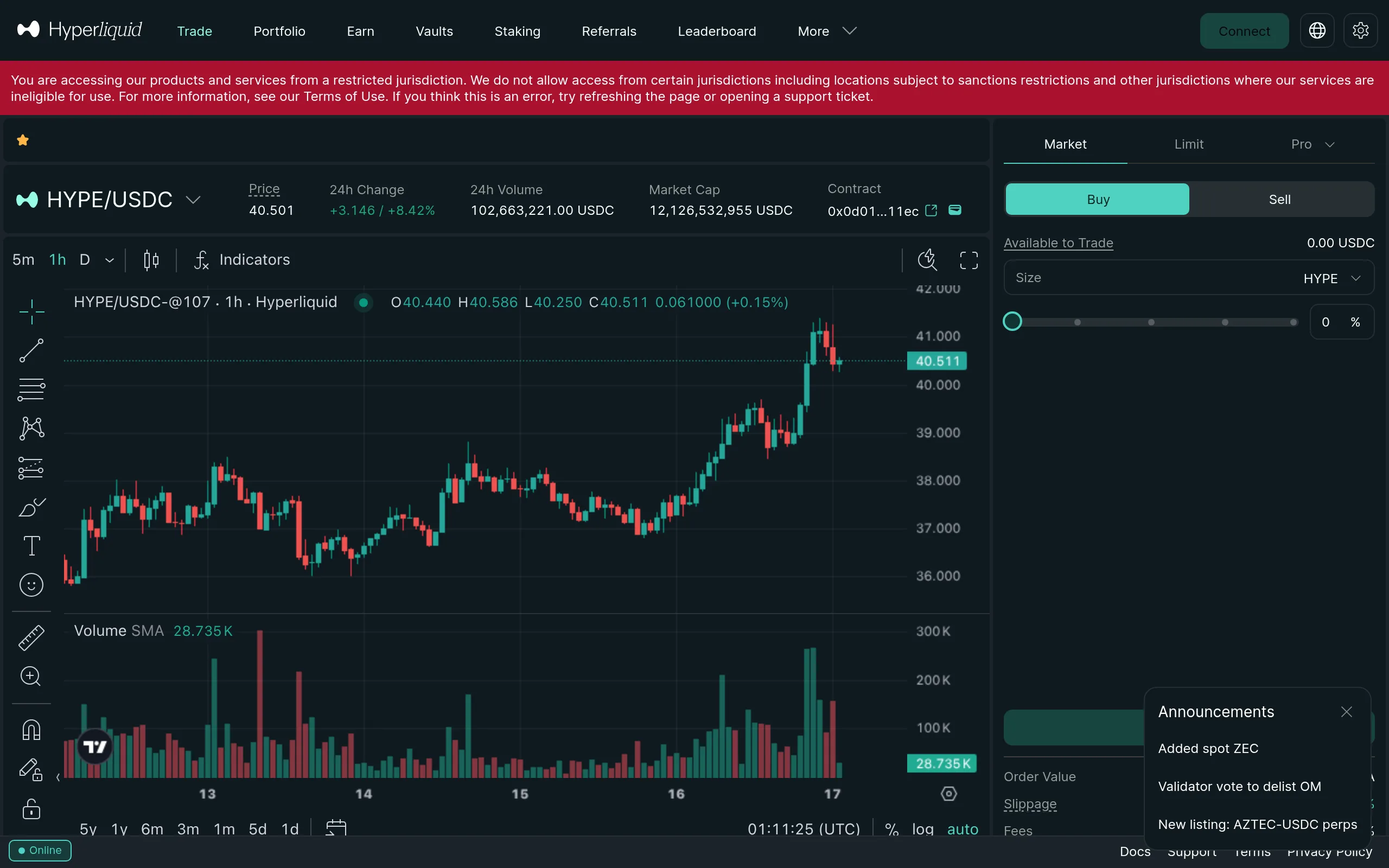

One thing to get straight from the outset: Robinhood is not only a stock app. It offers crypto alongside stocks, ETFs, options and futures. So this is not "the stock one versus the crypto one." It is a regulated brokerage versus a decentralized exchange, and both happen to let you trade crypto.
The Comparison
| Hyperliquid | Robinhood | |
|---|---|---|
| Who holds your money | - | - |
| Account signup | - | - |
| Failure protection | - | - |
| Buy actual shares | - | - |
| Crypto | - | - |
| Leverage on crypto | - | - |
| Bet on prices falling | - | - |
| Trading hours | - | - |
| Fee model | - | - |
| Available to US persons | - | - |
| Recover a lost account | - | - |
Custody Is the Whole Story
When you buy a stock on Robinhood, Robinhood holds it. Your shares sit with the broker and its custodian, your name is on an account record, and if the firm collapsed, SIPC protection exists to make securities customers whole up to its limits. There is a regulated entity, a phone number, and a legal framework built up over decades.
On Hyperliquid, your funds sit in a crypto wallet that only you can open. No company can freeze the account, no company can lose it, and no company can be ordered to hand it over. That appeals to a lot of people, and it is the entire reason the platform is built this way.
The flip side is complete and unforgiving. If you lose your wallet's recovery phrase, the money is gone. Not "gone until you contact support." Gone. If you approve a malicious transaction, there is no reversal. If you send funds to the wrong network, nobody can retrieve them. The protections you have been relying on without noticing are all provided by the company you are leaving behind.
Warning
This is the part to sit with before you deposit anything. Self-custody is not a feature you switch on; it is a responsibility you take over. Read our security guide and set up a hardware wallet before you hold a meaningful amount.
What You Can Actually Trade
Stocks. Robinhood sells you the share. You own a piece of the company, you collect dividends, you can hold it for thirty years. Hyperliquid offers perpetual futures on equities through trade.xyz, which track the price of Nvidia or Tesla without giving you ownership of anything. "Track" is a measurable claim rather than a promise, and we measured it: how closely each Hyperliquid stock perp follows its underlying gives the basis and 30-day tracking error for the whole board. They run 24/7, which matters when news breaks on a Saturday, and they carry leverage and liquidation risk that owning a share does not.
Crypto. Both offer it. The difference is depth. Hyperliquid was built as a perpetuals exchange first, so its crypto derivatives markets are its core product rather than an add-on.
Things Robinhood does that Hyperliquid does not. Retirement accounts. Fractional shares with real ownership. A cash management product. Dividends. If those matter to you, the brokerage is not replaceable by a DEX.
Things Hyperliquid does that a brokerage generally does not. Trading at 3am on a Sunday. Commodities like oil and gold as perpetuals. Vaults that trade on your behalf. Very high leverage, which belongs in the "can" column rather than the "should" column.
Trading Fees, 4% Off For Life
If Hyperliquid is where you are heading, our referral link cuts every trade you make.
Join HyperliquidThe US Question
This is the practical blocker for most people reading this, so it deserves a straight answer.
Hyperliquid's Terms of Service restrict use by US persons, and the front end restricts US IP addresses. Robinhood is a US brokerage built specifically for US residents. If you are in the United States, those two facts are not symmetrical and you should understand them before making plans.
In August 2026 the topic became live again when President Trump said the CFTC chair was working on bringing Hyperliquid into the US in a compliant fashion. No filing, approval or date has followed. We track that situation as it develops on Is Hyperliquid coming to the US?, and the current state of access is covered in Hyperliquid US availability. We report what has been said rather than telling you what is permitted in your situation, which is a question for a qualified attorney. See the disclaimer.
Which One Fits You
Stay with the brokerage if you want to own companies for the long term, you want a retirement account, you value having someone to call, or you would rather not be personally responsible for securing your own assets. None of those are beginner concerns you grow out of. They are legitimate preferences.
Hyperliquid makes sense if you want to trade instead of invest, you want markets that never close, you want to take positions on prices falling, or you specifically want to hold your own assets rather than trust a company with them.
Plenty of people use both, for different purposes, which is probably the sane answer.
If you are leaning toward trying Hyperliquid, do not start with leverage. Read Hyperliquid for Dummies, work out how much money you actually need, and understand whether you can lose more than you put in before you place a single order.
Start With Lower Fees
Open your account through our link for a 4% lifetime discount on trading fees.
Get the DiscountRelated Reading
- Is Hyperliquid a stock? clears up the most common mix-up
- What is Hyperliquid? covers the platform itself
- Is Hyperliquid safe? on the real risks
- Hyperliquid vs Coinbase if you are comparing custodial crypto platforms
- Beginner checklist when you are ready to start
Frequently Asked Questions
They look similar and work very differently underneath. Both give you a fast chart, a buy button and a sell button. The difference is that Robinhood is a licensed US brokerage that holds your assets for you, while Hyperliquid is a decentralized exchange where your funds stay in a wallet you control and no company holds them. That single structural difference drives almost every other difference between the two.
Not straightforwardly. Hyperliquid's Terms of Service restrict use by US persons and its front end restricts US IP addresses. Robinhood is a US-regulated brokerage built for US residents. Whether that situation changes is an open regulatory question following remarks made in August 2026, and we track it on a dedicated page rather than guessing at an outcome here.
No. Robinhood requires identity verification, a Social Security number and an approved account before you can trade, because it is a regulated brokerage. Hyperliquid has no signup form and no identity check; you connect a crypto wallet and trade. That is a genuine convenience difference and also means there is no support desk that can restore access if you lose your wallet keys.
No, and this is the most important difference to understand. Securities held at a US brokerage are covered by SIPC protection if the brokerage fails. Nothing equivalent covers funds on a decentralized exchange. On Hyperliquid there is no company holding your money to fail in the first place, but there is also no insurance scheme, no chargeback, and no one to call. Losses from your own mistakes or from a lost wallet key are permanent.
You can trade contracts that track stock prices, which is not the same as owning shares. Hyperliquid hosts perpetual futures on equities such as Nvidia and Tesla, which follow the share price 24/7 but carry no ownership, no dividends and no voting rights. Robinhood sells you the actual share. If your goal is long-term ownership of a company, the brokerage is the tool designed for that.
They charge in different ways, so a direct comparison is misleading. Robinhood advertises commission-free stock trading and earns revenue through other routes including order flow and its subscription tier. Hyperliquid charges an explicit percentage per trade, starting at 0.045% taker on perpetuals and 0.070% on spot, reducible through referral and staking discounts. Explicit fees are easier to measure, which cuts both ways.
Independent resource: Hyperliquid Guide is an independent, third-party resource operated by Concept211. It is not affiliated with, produced by, reviewed by or endorsed by Hyper Foundation, Hyperliquid Labs or any other Hyperliquid-ecosystem entity. "Hyperliquid" and related names and marks belong to their respective owners and are used here only to identify the platform this site documents. Read the full disclaimer.
Not advice: Nothing on this site is legal, tax, financial or investment advice. Descriptions of regulatory status, tax treatment and market availability are general information that varies by jurisdiction and changes over time. Confirm anything that matters to you with a qualified professional and against primary sources. Trading perpetual futures involves substantial risk of loss, and past performance does not indicate future results.
Disclosure: this site contains referral links. Signing up through the 4% lifetime fee discount link earns us a share of the trading fee Hyperliquid already charges, at no extra cost to you.
Ready to Start Trading?
Join Hyperliquid with our referral link and get a 4% lifetime fee discount. No KYC, no email - just connect your wallet and trade.
Start Trading - Save 4%