Is Hyperliquid Coming to the US? Trump, the CFTC, Payward and ICE (2026)
Table of Contents
- The Quote
- How This Story Got Here
- The HIP-3* Announcement, and What It Doesn't Say
- Payward's Plan: The First Named HIP-3* Deployer
- ICE and trade[XYZ]: The Second Named Plan
- How it differs from Payward's plan
- How HYPE traded on the day
- What Jeff Yan Said on Odd Lots
- The Businessweek profile, November 3
- Why the CFTC and Not the SEC
- What "Coming Onshore" Would Actually Involve
- The Regulation 40.3 Route
- The Intermediary Route
- Why Congress Started Paying Attention
- What This Would and Wouldn't Mean for a US Trader
- What to Watch Next
- Related Reading
- Summary
Info
What changed on August 19, 2026, and what didn't. Speaking at a White House meeting with crypto and prediction-market executives, President Trump said CFTC Chair Mike Selig was working to bring Hyperliquid into the United States "in a fully compliant and legal fashion." No launch, filing, approval, or date has been announced. As of that day the frontend at app.hyperliquid.xyz still restricted US IP addresses and the Terms of Service still restricted use by US persons. This page reports what was said and describes the regulatory process people are referring to. It does not make legal determinations. See the disclaimer.
Updated September 3, 2026. Hyperliquid announced HIP-3*, an optional onchain allowlist for HIP-3 deployers, on testnet. It is being shared as evidence of a US launch. It names no jurisdiction and changes nothing about US access. Details below.
Updated October 20, 2026. Two developments since then. On September 16, Kraken's parent Payward said it intends to run permissioned Hyperliquid perp markets for US clients through its CFTC-regulated exchange Bitnomial, subject to regulatory approval and with no date (details). And on October 15, Jeff Yan used his Odd Lots podcast debut to argue that US rules should land on market deployers rather than on the chain (details). US access to Hyperliquid itself has not changed.
Updated October 26, 2026. Hyperliquid's own account posted about Payward's plan, describing Payward's stated intention to be "the first CFTC-regulated deployer on HIP-3* markets." The same post says HIP-3* is still on testnet and will reach mainnet "in a future network upgrade," with no date. US access to Hyperliquid has not changed.
Updated November 3, 2026. trade[XYZ]'s own post on the ICE deal names the CFTC as the approval it needs, and Bloomberg Businessweek published a profile of Jeff Yan headlined around his wish to break into the US market. October 29, 2026: Intercontinental Exchange (ICE), which owns the NYSE, and trade[XYZ] announced a definitive agreement to bring trade[XYZ]'s Hyperliquid-based perpetual markets to US retail traders, with ICE as the regulated operator and clearer, subject to regulatory approvals and with no date. Hyperliquid's announcement says existing trade[XYZ] HIP-3 markets will remain unchanged. US access to Hyperliquid itself has not changed. Details below.
The Quote
At a White House meeting on August 19, 2026, broadcast live, President Trump said:
"I understand that CFTC Chair Mike Selig is working to bring Hyperliquid into the United States in a fully compliant and legal fashion."
The meeting put executives from crypto and prediction-market firms in a room with  CFTC Chairman Michael Selig and SEC Chairman Paul Atkins. Coverage ahead of the event listed
 Coinbase, Ripple, a16z, Chainlink,
 Kalshi,
 Polymarket and Paradigm among the attendees. The CFTC's own site framed the session as the lead-in to its Innovation Advisory Committee meeting the following day.
Two things got run together in most of the reaction, and they are worth pulling apart.
First, look at what the sentence actually is. A president is relaying his understanding of what an agency head is working on. It is not a rulemaking, a filing, a registration, or an approval, and it does not commit the CFTC to anything.
Second, it did not come out of nowhere. The CFTC has spent 2026 building a route for perpetual futures to trade on regulated US venues, and Hyperliquid has come up by name in a congressional hearing and in the chairman's own comments. That is the part worth paying attention to. The remark is a headline; the track record underneath it is the actual story.
How This Story Got Here
| Date | What happened |
|---|---|
| Feb 2026 | The Hyperliquid Policy Center launches in Washington, led by crypto lawyer Jake Chervinsky, describing its aim as a clear, regulated path for Americans to reach onchain markets |
| Mar 3, 2026 | Selig tells reporters the CFTC will clear a path for US perpetual futures "in coming weeks" |
| Apr 16, 2026 | At a House Agriculture Committee hearing, Rep. Austin Scott (R-GA) presses Selig on Hyperliquid's offshore oil perps. Selig says the goal is to "onshore those markets" |
| May 1, 2026 | Payward, Kraken's parent, completes its acquisition of Bitnomial, a CFTC-licensed exchange, clearinghouse and broker |
| May 29, 2026 | The CFTC approves KalshiEX's bitcoin perpetual contract under Regulation 40.3 and issues a policy statement setting case-by-case review for further perpetuals |
| Jun 2026 | Trade coverage summarizes Selig's position: the question is not whether crypto perps exist, but whether they exist under US oversight |
| Jul 28, 2026 | Reporting describes friction between CME and the CFTC over how onchain perpetual futures should be treated |
| Aug 19, 2026 | Trump's remark at the White House meeting, with Selig and Atkins present |
| Sep 3, 2026 | Hyperliquid announces HIP-3*, an optional onchain allowlist for HIP-3 deployers, on testnet. The announcement names no jurisdiction |
| Sep 16, 2026 | Payward says it intends to offer permissioned Hyperliquid perp markets to US clients, with Bitnomial as HIP-3* deployer and NinjaTrader Clearing carrying accounts, subject to regulatory approval |
| Oct 15, 2026 | Jeff Yan, on Bloomberg's Odd Lots podcast, argues US regulation should sit with market deployers, not the blockchain |
| Oct 26, 2026 | Hyperliquid's account posts about Payward's plan to be the first CFTC-regulated HIP-3* deployer and says HIP-3* will come to mainnet in a future network upgrade |
| Oct 29, 2026 | ICE and trade[XYZ] announce a definitive agreement to bring trade[XYZ]'s Hyperliquid-based perps to US retail traders, with ICE operating the regulated market and clearing and taking a minority stake in trade[XYZ], subject to regulatory approvals |
| Nov 3, 2026 | Bloomberg Businessweek publishes a profile of Jeff Yan, headlined online "Hyperliquid Co-Founder Jeff Yan Would Like to Break Into the US Market" |
Sources: contemporaneous reporting from CoinDesk, Bloomberg, The Block, Decrypt, Fortune, FinanceFeeds and U.Today, plus the CFTC's own announcements. Dates are as reported by those outlets.
The HIP-3* Announcement, and What It Doesn't Say
On September 3, 2026, Hyperliquid's jeff_hl account posted that a future network upgrade will let HIP-3 deployers optionally switch on an onchain allowlist, deciding which addresses are approved to trade on the markets they run. The feature set is called HIP-3*. Its initial release is on testnet, the specifications there are described as preliminary and subject to change, and no mainnet date was given.
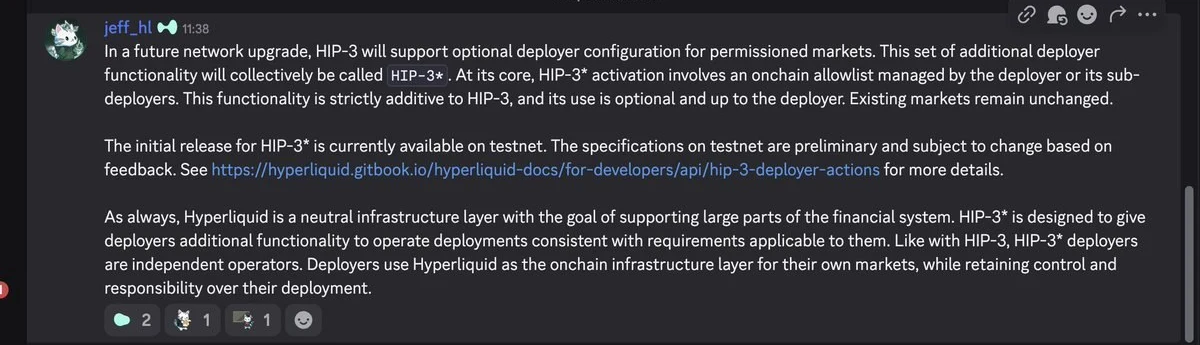
Source: announcement posted by jeff_hl, September 3, 2026, linking the HIP-3 deployer actions documentation.
The post began circulating within hours under captions saying Hyperliquid was preparing to enter the United States. That reading is not in the announcement. Here is everything it says about why the feature exists:
"HIP-3* is designed to give deployers additional functionality to operate deployments consistent with requirements applicable to them. Like with HIP-3, HIP-3* deployers are independent operators."
No country, no agency and no venue appears anywhere in it. "Requirements applicable to them" covers whatever rules bind a given deployer wherever that deployer operates, and HIP-3 builders are not all in one place. An allowlist is a generic control besides. A venue might use one to keep a market open only to institutional counterparties, or to a closed group while it bootstraps liquidity. Neither has anything to do with the United States.
The other distinction worth keeping straight is whose access is being controlled. HIP-3* is a capability handed to builders for the markets they deploy and operate themselves. It is not a change to Hyperliquid's own frontend, its Terms of Service, or the restriction described on the US availability page, all of which stand where they did.
What would actually connect this to the story on this page is a deployer stating it plans to use HIP-3* to serve a specific regulated market. As of September 3 nobody had. On September 16 Payward did, and on October 29 Hyperliquid described the ICE and trade[XYZ] plan as running "via HIP-3*" too. The full technical breakdown of the feature, including what a deployer can do on an approved user's behalf, is in our HIP-3 guide.
 Payward's Plan: The First Named HIP-3* Deployer
On September 16, 2026, Payward, the parent company of  Kraken, published a press release headlined "Payward Intends to Bring Onchain Perpetual Futures to US Clients, Starting on Hyperliquid." Payward describes them as "the protocol's first builder-deployed permissioned perpetual markets."
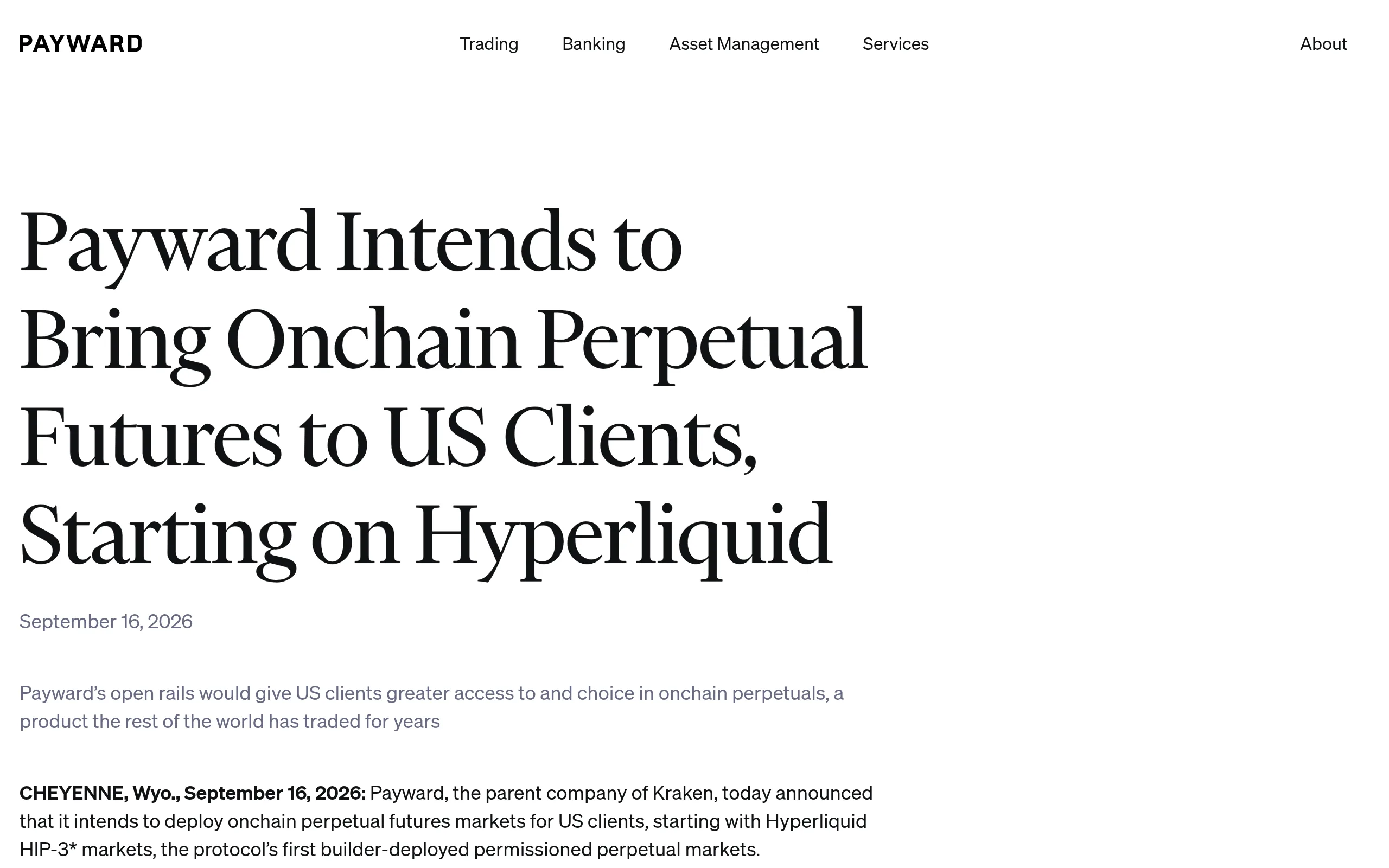
Source: Payward, used under fair use for educational purposes
The release splits the job across two Payward subsidiaries:
| Role | Who, per the release |
|---|---|
| HIP-3* deployer, exchange and clearinghouse | Bitnomial, which "would create, own and administer the market and clear and settle the contracts" |
| Broker holding customer accounts | NinjaTrader Clearing, a CFTC-registered futures commission merchant |
| Who could trade | "Only accounts onboarded by NinjaTrader and on both NinjaTrader and Bitnomial's allowlists" |
| Where trades are matched | "Hyperliquid's public blockchain, whose onchain order book matches and records trades" |
Co-CEO Arjun Sethi said Payward "intends to be the first, holding the keys and carrying the regulatory obligations." Payward completed its acquisition of Bitnomial on May 1, 2026, which is what gives it a CFTC-licensed exchange to do this with.
Hyperliquid's side came five weeks later. On October 26, 2026, its account posted that Payward "announced its intention to be the first CFTC-regulated deployer on HIP-3* markets" and repeated the roles above, again "subject to regulatory approval." The post adds no date, and it says HIP-3* itself is still on testnet, with permissioned markets coming "in a future network upgrade." It also sets out how Hyperliquid describes its own part. It calls itself "a neutral infrastructure layer" and says HIP-3* deployers "are independent operators who use Hyperliquid as the onchain infrastructure layer for their own markets, while retaining control and responsibility over their deployment." Jeff Yan makes the same argument in the Odd Lots interview below.
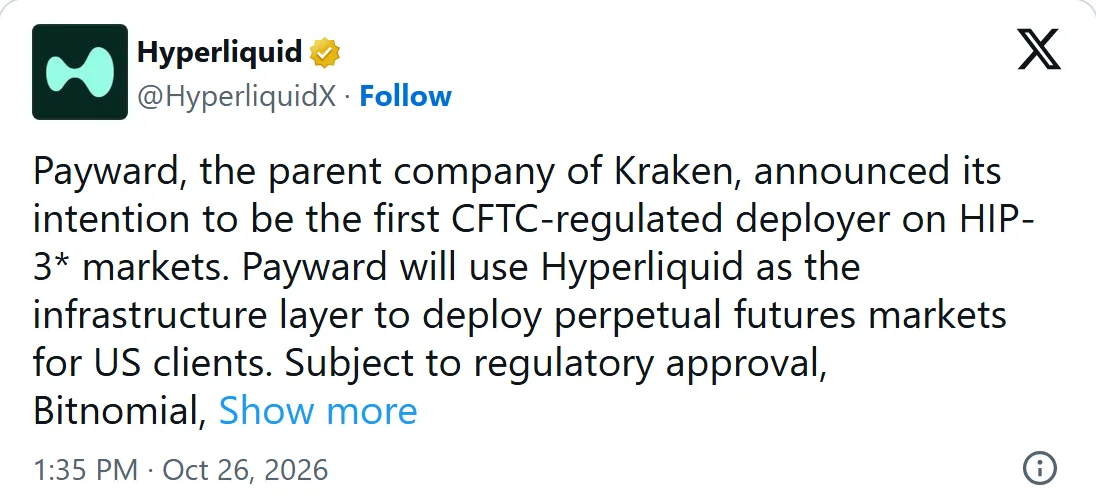
Source: Hyperliquid on X, October 26, 2026
Two things keep this from being a launch. Every step is conditional: "Subject to regulatory approval, onchain perpetual futures will be listed under the rules of Bitnomial Exchange, LLC." And the release gives no date, no market list, no leverage and no fees. Payward is also describing its own markets, deployed and controlled by Bitnomial, not access to the markets already on Hyperliquid. A US client would trade Bitnomial's contracts through a NinjaTrader futures account, rather than connecting a wallet to the existing app.
 ICE and trade[XYZ]: The Second Named Plan
On October 29, 2026, Intercontinental Exchange, the company that owns the New York Stock Exchange, put out a release with  trade[XYZ] headlined "Intercontinental Exchange and Trade[XYZ] to Bring Hyperliquid-Based Perpetual Markets Onshore." The two companies say they have signed a definitive agreement, subject to regulatory approvals.
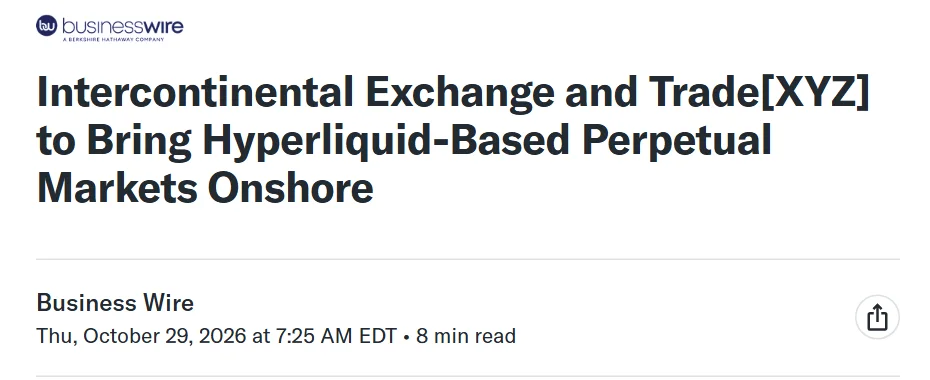
Source: ICE investor relations, release distributed by Business Wire, used under fair use for educational purposes
Hyperliquid's announcements channel posted its own description four hours later, and trade[XYZ] posted a third on X. The three describe the same deal from different sides, so the table keeps track of which one says what:
| What | ICE's release | Hyperliquid's post | trade[XYZ]'s post |
|---|---|---|---|
| Operator | ICE, as "exclusive operator" of trade[XYZ]'s regulated markets, through a new retail market and clearing structure | "ICE operates the regulated market and clearing structure" | ICE and trade[XYZ] "plan to establish a new, dedicated U.S. market" |
| trade[XYZ] | A Hyperliquid perp deployer that ICE is making a minority strategic investment in, size undisclosed | "designs and implements the markets" | Brings "the product development, market design, and technology"; ICE is making "a strategic investment" |
| Hyperliquid | Not described beyond "Hyperliquid-based" | "the underlying technology infrastructure via HIP-3*" | "novel exchange and clearing infrastructure built on Hyperliquid" |
| Who trades | KYC and AML-verified customers, through futures commission merchants that join as members | "US traders" | US traders, with "access through participating brokers and platforms" |
| Assets | Crypto, equities, commodities, FX and other real-world assets | The same list | Equities, indices, commodities, FX and crypto |
| Current markets | Not addressed | "will remain unchanged" | Built "in parallel with our existing HIP-3 markets," which it will "continue to expand" |
| Date | None. Subject to regulatory approvals, including for leveraged trading | None | None. "Subject to CFTC approval," with products, eligibility and timing to follow "as approvals progress" |
ICE also names a distribution route. It expects the regulated contracts to be offered through its joint venture with  OKX, among other brokers and platforms, and says that venture's distribution depends on its own pending approvals as a US-registered broker-dealer and FCM. ICE chair and CEO Jeffrey Sprecher is quoted as saying "we see these perp markets as additive to our futures markets, not a replacement for them." ICE says the investment is not expected to have a material effect on its 2026 adjusted results.
trade[XYZ]'s post adds two things the others leave out. It says its markets on Hyperliquid have passed $650 billion in volume in just over a year (trade[XYZ]'s own figure), and that investor Stan Druckenmiller is joining alongside ICE. It is also the only one of the three to name the regulator: the plan is "subject to CFTC approval." The post signs off "Anything. Anytime. On ICE[XYZ]." None of the three documents gives a launch date.
Source: trade[XYZ] on X, October 29, 2026, quoted in Hyperliquid's post on X
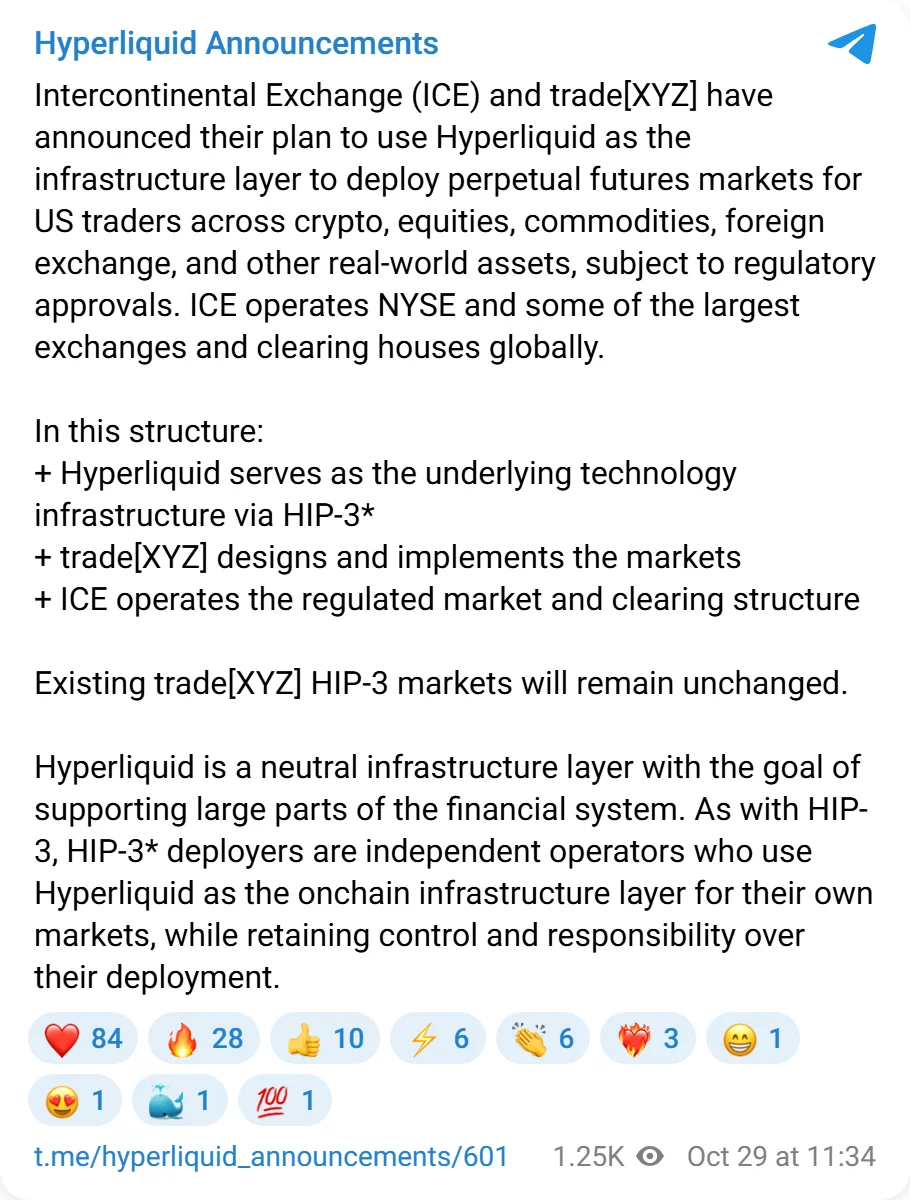
Source: Hyperliquid Announcements on Telegram, October 29, 2026
Hyperliquid's post repeats the framing from its Payward post. It calls Hyperliquid "a neutral infrastructure layer" and says that HIP-3* deployers "are independent operators who use Hyperliquid as the onchain infrastructure layer for their own markets, while retaining control and responsibility over their deployment."
How it differs from Payward's plan
Both plans put a regulated US operator in front of markets that match on Hyperliquid, and both are waiting on approval. The difference is who they start from. Payward is a broker group bringing its own exchange (Bitnomial) and its own FCM (NinjaTrader Clearing). The ICE plan starts from an existing Hyperliquid deployer: trade[XYZ] already runs most of the stock, index, FX and commodity markets on Hyperliquid, as the HIP-3 registry shows. ICE would run a separate regulated version for US customers, while the offshore markets carry on as they are.
The markets you can see on Hyperliquid today, such as the S&P 500 perp, are trade[XYZ]'s existing HIP-3 markets. They are not the planned ICE markets, and nothing in either announcement opens them to US users.
How HYPE traded on the day
HYPE's hourly candles on the Hyperliquid API show it at $79.28 at 10:00 UTC on October 29 and about $94 by 15:50 UTC, roughly 19% higher. The rise began in the 10:00 to 11:00 UTC hour, up about 8%, which is before the 7:25 AM EDT (11:25 UTC) timestamp on the Business Wire release. A price move is sentiment, not a filing.
What Jeff Yan Said on Odd Lots
Hyperliquid Labs CEO Jeff Yan made his podcast debut on Bloomberg's Odd Lots on October 15, 2026, in an episode titled "Jeff Yan's Plan to Bring the Entire Financial Industry Onto Hyperliquid." Bloomberg's companion story was headlined "Hyperliquid Founder Yan Seeks US Rules That Spare Its Blockchain."
His argument, as reported by CoinDesk, was that the chain is infrastructure and the obligations belong to whoever controls a market. Asked whether deployers, rather than the protocol, could be the regulated party, he said he could "very much see that world," comparing the chain to internet protocols such as TCP/IP that carry financial traffic without being regulated themselves. In CoinDesk's quote, "the regulation sits at the layer where there are controls," and on HIP-3 the deployers are the ones exercising them. That matches how Payward describes its own role.
He also said, according to the episode transcript:
- The Terms of Service of hyperliquid.xyz and many other interfaces bar US users from the derivatives on the protocol, and Americans using a VPN to get around that are breaking those terms and shouldn't.
- The current administration and the CFTC want to take a proactive approach to onchain rails, while regulators remain "more conservative, slower to see it, but beginning to see it."
- Hyperliquid is "not trying to displace" existing exchanges. On the show's headline ambition, he said "even 90% of all of finance would be a huge success and we're a long way away."
He gave no timeline for US access and named no filing.
 The Businessweek profile, November 3
Bloomberg followed up with a Businessweek feature by Ryan Weeks, published online on November 3, 2026 as "Hyperliquid Co-Founder Jeff Yan Would Like to Break Into the US Market" and in the magazine as "The Crypto Mogul Behind Trading Powerhouse Hyperliquid." Weeks interviewed Yan in Washington, DC.
The piece is paywalled, and we have read only its opening. There, Yan repeats the Odd Lots line in different words: Hyperliquid isn't an exchange but "a layer on which exchanges can be deployed," and Weeks writes that Yan likens it to the internet, with the checks and balances left to whoever builds on top. On his own priorities Yan is quoted saying "I just work all the time. For me, work is all-consuming." The headline frames the US as something Yan wants. Nothing in the part we could read describes a filing, an approval or a date, and nothing about access has changed.
Source: Bloomberg Businessweek, November 3, 2026
Why the CFTC and Not the SEC
Hyperliquid's core product is the perpetual future, a derivatives contract with no expiry date, held open indefinitely and pulled toward the spot price by periodic funding payments. In the United States, derivatives sit under the Commodity Futures Trading Commission and the framework built around the Commodity Exchange Act. That is the whole reason the CFTC keeps showing up in this story while the SEC mostly does not.
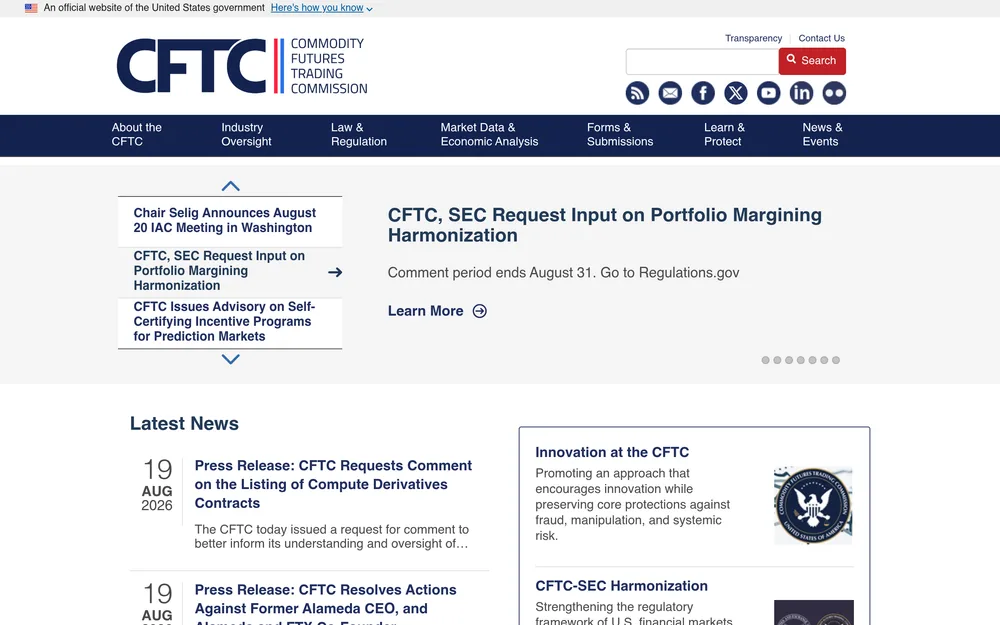
Source: cftc.gov, screenshot captured August 19, 2026
Perpetual futures grew up almost entirely offshore. US venues did not list them, so the liquidity went elsewhere, the product design evolved elsewhere, and eventually the users followed. Closing that gap is what the CFTC's 2026 work has been aimed at.
What "Coming Onshore" Would Actually Involve
This is the part most coverage skips, and it is the part that decides whether anything real happens.
The Regulation 40.3 Route
A designated contract market (a CFTC-registered exchange) can bring a new contract to market two ways. It can self-certify, filing with the CFTC that the contract complies with the rules. Or it can use Regulation 40.3, the voluntary approval process, and ask the agency to approve the listing outright.
On May 29, 2026 the CFTC approved KalshiEX's BTCPERP contract under Regulation 40.3. Reporting at the time described it as the first perpetual futures contract the agency had approved for listing through that mechanism. KalshiEX's argument, as summarized in legal analysis of the decision, was that what makes a contract a future is an ongoing payment obligation determined in the future, not whether it terminates on a fixed date. The approval leaned heavily on the bitcoin spot market specifically: its depth, its liquidity, and the fact that it trades continuously worldwide, all of which matter to whether a funding-rate mechanism can work without being pushed around.
Alongside the approval, the CFTC issued a policy statement establishing that perpetuals get reviewed case by case. Contracts referencing anything other than digital commodities (think equities, metals, agricultural products) were directed through the Regulation 40.3 process rather than self-certification.
The Intermediary Route
There is a second path, and it does not require the venue itself to register at all. A futures commission merchant, with Coinbase Financial Markets the example most often cited, can intermediate customer access to perpetuals listed elsewhere and hold the margin collateral. In that shape the regulated entity is the broker standing between the customer and the venue.
Coverage of Hyperliquid's own posture has described a preference for something along these lines: licensed intermediaries acting as the regulated access point, while the chain continues to handle execution, clearing and settlement, instead of rebuilding the architecture as a registered contract market. That is a characterization drawn from public reporting and from the Hyperliquid Policy Center's stated aims. Payward's plan, described above, combines both routes: a CFTC-registered exchange as the deployer and a registered FCM as the access point.
Warning
No CFTC approval of any Hyperliquid-based contract has been announced. Payward's plan is expressly subject to regulatory approval. Everything in this section describes mechanisms that exist and have been used by other venues. Which of them applies to Hyperliquid, if any, is not something this site can tell you, and anyone quoting you a date is guessing.
Trading Where You're Eligible
Hyperliquid offers self-custody perps with no identity verification in the jurisdictions it serves. Use our referral link for a 4% fee discount on your first $25M of volume.
Join Hyperliquid - Save 4%Why Congress Started Paying Attention
The April 16, 2026 House Agriculture Committee hearing is where Hyperliquid stopped being a niche topic in Washington.
The trigger was oil. Hyperliquid's oil perps trade around the clock, including at hours when regulated US futures markets are shut, and during the spring 2026 volatility they pulled in traders who had no particular interest in crypto. They wanted exposure to crude, and this was where they could get it at 2am. Rep. Austin Scott (R-GA) put the concern to Selig directly:
"If the volume that I'm seeing is correct, it has the potential to be detrimental to the U.S. consumer."
Scott's point was jurisdictional rather than technical. The contracts sit offshore, outside the CFTC's reach, while the price discovery happening on them can still matter to a domestic economy. He pushed the agency to find a way to hold the venue to the standards a registered American futures exchange has to meet.
Selig's answer, as reported, was that he was watching those markets and that the goal was to "onshore those markets" so they would fall under US regulation. Worth noting that the same hearing saw bipartisan criticism of the agency over prediction markets and staffing levels. This was not a friendly setup for the chairman, and the Hyperliquid exchange was one thread in a contentious morning.
What This Would and Wouldn't Mean for a US Trader
Nothing has been approved, so everything below is a set of open questions rather than predictions. They are also the right questions to put to any claim you see about this.
Would it be the same product? A CFTC-regulated perpetual and an offshore perpetual are not automatically the same instrument. The KalshiEX approval covered one contract, on one asset, with a specific spot-market profile behind it. Leverage limits, margin treatment, position limits, the list of eligible assets: a US framework would have something to say about all of it, and those details are what determine whether a regulated version resembles what traders use today.
Would it require KYC? Registered US derivatives intermediaries operate under customer identification obligations. Hyperliquid today requires no identity verification because you connect a wallet instead of opening an account. Any route running through a registered intermediary would bring that intermediary's own onboarding requirements with it. What that would mean for the protocol's existing non-custodial design is not something anyone has published a design for.
Would fees change? Hyperliquid's current fee schedule reflects the structure it has now. Regulated venues and intermediaries carry costs that a permissionless protocol does not, including clearing and capital requirements. There is no basis yet for putting numbers on that, so this page will not.
Would it happen at all? Regulatory processes stall. The CFTC has faced reported vacancy and staffing constraints, the CLARITY Act has not moved, and there is documented friction with incumbent exchanges over how onchain perps should be handled. A statement of intent in August removes none of that.
For now the practical position is unchanged, and it is covered in detail on the US availability page. The frontend restricts US IP addresses, the Terms of Service restrict US persons, and any reader with a specific situation should be talking to a qualified attorney rather than reading a guide.
What to Watch Next
These are the signals that would mean the story has actually moved, as opposed to another round of commentary:
- A Regulation 40.3 submission naming Hyperliquid or a Hyperliquid-linked contract. This is the concrete, checkable one. CFTC filings and approvals are published at cftc.gov.
- A DCM registration application, if the route taken turns out to be the venue registering as an exchange itself rather than working through intermediaries.
- An FCM announcement, meaning a registered futures commission merchant stating it will intermediate access to Hyperliquid-listed contracts.
- CFTC guidance or an advisory addressing onchain venues and perpetual futures as a category, rather than one contract at a time.
- Bitnomial's contract terms and approval. Payward has named its plan. The next checkable step is Bitnomial publishing contract specifications for its Hyperliquid markets and the CFTC approving them.
- ICE's approvals. ICE says it will seek approvals for a new retail market and clearing structure, including for leveraged trading. Filings or approvals for that structure, and contract specifications for the trade[XYZ] markets it would list, are the checkable steps.
- The ICE-OKX joint venture's registration. ICE says distribution through the venture depends on its pending approvals as a US-registered broker-dealer and FCM.
- HIP-3* reaching mainnet. Payward's design depends on the allowlist feature, which was on testnet when it was announced, and Hyperliquid describes the ICE and trade[XYZ] plan as using it too.
- Publications from the Hyperliquid Policy Center, which is the entity doing the Washington-facing work on this.
- Legislative movement on the CLARITY Act, which Selig has publicly said would otherwise leave regulators "writing all the rules."
- How the listed proxies trade. HYPE rose about 19% on the day of the ICE announcement (details above). Earlier, Benzinga reported Hyperliquid Strategies (NASDAQ: PURR) up 33% and HYPE up 22% on the August 19, 2026 remark. Equity markets price regulatory expectations in a way the token alone does not, so a sustained move in the stock relative to HYPE is a signal worth reading, even though it is sentiment rather than a filing.
Every one of those is verifiable from a primary source. A screenshot of someone reporting that someone said something is not, and this page gets updated when the former happens rather than the latter.
Related Reading
- Is Hyperliquid available in the US?: what the current restriction covers at a technical level
- Hyperliquid KYC requirements: why there is no identity verification today
- Institutional access to Hyperliquid: Bloomberg Terminal, Copper and Paxos, the institutional side of the same push
- Hyperliquid vs. Coinbase: a regulated US venue compared feature by feature
- Canonical outcome markets on Hyperliquid: the prediction-market side of the same regulatory conversation
- Hyperliquid tax reporting: exporting trade history, which none of this affects
- How to trade on Hyperliquid: the mechanics, for readers who are eligible
- PURR stock (NASDAQ: PURR): the listed HYPE treasury that reacted hardest to the August 19 remark
Get the 4% Fee Discount
If you're eligible to use Hyperliquid, signing up through our referral link takes 4% off every trade on your first $25M of volume.
Start TradingSummary
On August 19, 2026 President Trump said, in remarks broadcast from a White House meeting, that CFTC Chair Mike Selig was working to bring Hyperliquid into the United States in a fully compliant and legal fashion. That remark sits on top of a documented year: Selig's March comments about clearing a path for US perpetual futures, the April House Agriculture Committee exchange where Hyperliquid came up by name, the CFTC's May approval of a bitcoin perpetual on a registered exchange, and the Hyperliquid Policy Center's Washington work since February.
The one protocol-side development since then, the HIP-3* announcement of September 3, names no jurisdiction and hands an optional allowlist to independent market deployers rather than changing anything about Hyperliquid's own access rules. On September 16 Payward said it intends to use that feature, through its CFTC-regulated exchange Bitnomial and broker NinjaTrader Clearing, to offer its own permissioned perp markets to US clients, subject to regulatory approval. On October 15 Jeff Yan argued on Odd Lots that this is where regulation belongs: on the deployers, not the chain. On October 26 Hyperliquid's own account described Payward's plan, with HIP-3* still on testnet and no mainnet date. On October 29 ICE, the owner of the NYSE, and trade[XYZ] announced a definitive agreement for ICE to operate a regulated US version of trade[XYZ]'s Hyperliquid markets for KYC-verified retail customers through FCMs, with a minority ICE investment in trade[XYZ]. Hyperliquid said trade[XYZ]'s existing HIP-3 markets will remain unchanged. trade[XYZ]'s own post said the plan is subject to CFTC approval. On November 3 a Bloomberg Businessweek profile of Yan was headlined around his wish to break into the US market, with no new filing or date.
What has not happened, for either plan, is any approval or announced date. US access remains restricted at the frontend and under the Terms of Service. This page reports statements and describes public regulatory mechanisms. It does not determine what is lawful for any reader, and it is not legal or tax advice. For anything that turns on your own situation, talk to a qualified attorney or tax professional, and read the disclaimer for the full scope of what this site does and does not represent.
Frequently Asked Questions
No launch, approval, or date has been announced. On August 19, 2026, in remarks broadcast from a White House meeting with crypto and prediction-market executives, President Trump said he understood that CFTC Chair Mike Selig was working to bring Hyperliquid into the United States in a fully compliant and legal fashion. That is a statement about an ongoing process, not an announcement that access has changed. On September 16, 2026, Kraken's parent company Payward said it intends to offer permissioned Hyperliquid perps to US clients through its CFTC-regulated subsidiaries, subject to regulatory approval and with no date. On October 29, 2026, Intercontinental Exchange (ICE), which owns the NYSE, and trade[XYZ] announced a definitive agreement to bring trade[XYZ]'s Hyperliquid-based perpetual markets to US retail traders, with ICE operating the regulated market and clearing, also subject to regulatory approvals and with no date. As of October 20, 2026 the frontend at app.hyperliquid.xyz still restricted US IP addresses and the Terms of Service still restricted use by US persons.
In remarks broadcast live on August 19, 2026 from the White House meeting, Trump said: 'I understand that CFTC Chair Mike Selig is working to bring Hyperliquid into the United States in a fully compliant and legal fashion.' CFTC Chair Michael Selig and SEC Chair Paul Atkins were both present at the meeting.
The frontend at app.hyperliquid.xyz restricts connections from US IP addresses, and Hyperliquid's Terms of Service separately restrict use by US persons. Nothing announced in August 2026 changed either of those. Whether any particular activity is lawful for any particular person is a question this site does not answer. Consult a qualified attorney in your jurisdiction.
Public CFTC actions point at a route through the existing derivatives framework. On May 29, 2026 the CFTC approved KalshiEX's bitcoin perpetual contract for listing under Regulation 40.3, the voluntary approval process, and issued a policy statement setting case-by-case review for further perpetuals. Registered futures commission merchants such as Coinbase Financial Markets can also intermediate customer access to foreign-listed perpetuals. Whether either route is applied to any specific venue is a matter for the CFTC, not for this site.
No. On September 3, 2026 Hyperliquid announced HIP-3*, an optional set of controls that lets a HIP-3 deployer run an onchain allowlist over the markets it operates. The announcement names no country, no regulator and no venue, and describes deployers as independent operators running deployments consistent with requirements applicable to them. It does not change Hyperliquid's frontend restriction or its Terms of Service. The first deployer to say how it would use the feature is Payward, which announced on September 16, 2026 that its exchange Bitnomial would be a HIP-3* deployer for US clients, subject to regulatory approval. On October 29, 2026, Hyperliquid described ICE and trade[XYZ]'s planned US markets as using Hyperliquid via HIP-3* as well.
On October 29, 2026, Intercontinental Exchange (ICE), the owner of the NYSE, and trade[XYZ] said they signed a definitive agreement to bring trade[XYZ]'s Hyperliquid-based perpetual markets to the US, subject to regulatory approvals. ICE's release says ICE would be the exclusive operator of the regulated markets, plans a new retail market and clearing structure, and is making a minority strategic investment in trade[XYZ] of undisclosed size. KYC and AML-verified customers would reach the markets through futures commission merchants. Hyperliquid's announcement says Hyperliquid would serve as infrastructure via HIP-3*, trade[XYZ] would design and implement the markets, and existing trade[XYZ] HIP-3 markets will remain unchanged. trade[XYZ]'s own post says the plan is subject to CFTC approval and that the US market would be built in parallel with its existing HIP-3 markets. No date was given.
On September 16, 2026, Payward, the parent company of Kraken, said it intends to deploy onchain perpetual futures markets for US clients, starting on Hyperliquid. Its CFTC-regulated exchange and clearinghouse Bitnomial would be the HIP-3* deployer and would create, administer, clear and settle the markets. Its futures commission merchant NinjaTrader Clearing would carry client accounts, and only accounts onboarded by NinjaTrader and on both firms' allowlists could trade. Payward said listing is subject to regulatory approval and gave no date. Hyperliquid's own account described the plan on October 26, 2026, and said HIP-3* will reach mainnet in a future network upgrade.
On Bloomberg's Odd Lots podcast, released October 15, 2026, Hyperliquid Labs CEO Jeff Yan said regulation should sit with the deployers that control markets rather than with the underlying blockchain, comparing the chain to internet protocols like TCP/IP. He said the Terms of Service of hyperliquid.xyz and many other interfaces bar US users from the derivatives, told American listeners not to use a VPN to get around that, and said Hyperliquid is not trying to displace existing market operators. He gave no timeline.
Michael Selig is the Chairman of the Commodity Futures Trading Commission, the US regulator with jurisdiction over derivatives markets including futures. He was nominated to the role by President Trump and was previously a partner at the law firm Willkie Farr & Gallagher. Perpetual futures are Hyperliquid's primary product, which is why the CFTC rather than the SEC is the agency most often named in coverage of this topic.
Independent resource: Hyperliquid Guide is an independent, third-party resource operated by Concept211. It is not affiliated with, produced by, reviewed by or endorsed by Hyper Foundation, Hyperliquid Labs or any other Hyperliquid-ecosystem entity. "Hyperliquid" and related names and marks belong to their respective owners and are used here only to identify the platform this site documents. Read the full disclaimer.
Not advice: Nothing on this site is legal, tax, financial or investment advice. Descriptions of regulatory status, tax treatment and market availability are general information that varies by jurisdiction and changes over time. Confirm anything that matters to you with a qualified professional and against primary sources. Trading perpetual futures involves substantial risk of loss, and past performance does not indicate future results.
Disclosure: this site contains referral links. Signing up through the 4% fee discount link earns us a share of the trading fee Hyperliquid already charges, at no extra cost to you.
Ready to Start Trading?
Join Hyperliquid with our referral link and get a 4% fee discount on your first $25M of volume. No KYC, no email - just connect your wallet and trade.
Start Trading - Save 4%