Unit Protocol: How to Deposit Native BTC, ETH & SOL to Hyperliquid
Table of Contents
 Unit
Unit
What Is Unit Protocol?
Hyperliquid settles everything in USDC, which is great for perpetual futures but leaves an obvious gap: there is no native Bitcoin, Ethereum, or Solana sitting on the exchange. If you want spot BTC on Hyperliquid, something has to carry real Bitcoin from the Bitcoin network onto HyperCore. Unit (branded as Hyperunit, at hyperunit.xyz) is the piece that does that.
Unit is the asset tokenization layer for Hyperliquid. It runs a lock-and-mint bridge: you send a native asset on its home chain, Unit locks it, and a matching token is minted to your Hyperliquid account as a spot balance you can trade, use as collateral, or withdraw back to the origin chain. It is what lets a Bitcoin holder move real BTC onto Hyperliquid without touching a wrapped-token issuer or routing through a centralized exchange.
Unit is not the only way a major asset reaches Hyperliquid spot. NEAR arrived in September 2026 by a different route: an EVM-linked HIP-1 token whose launch NEAR Protocol announced on September 22. The NEAR spot guide covers how that market works and why buying with USDC is the simpler route in.
Info
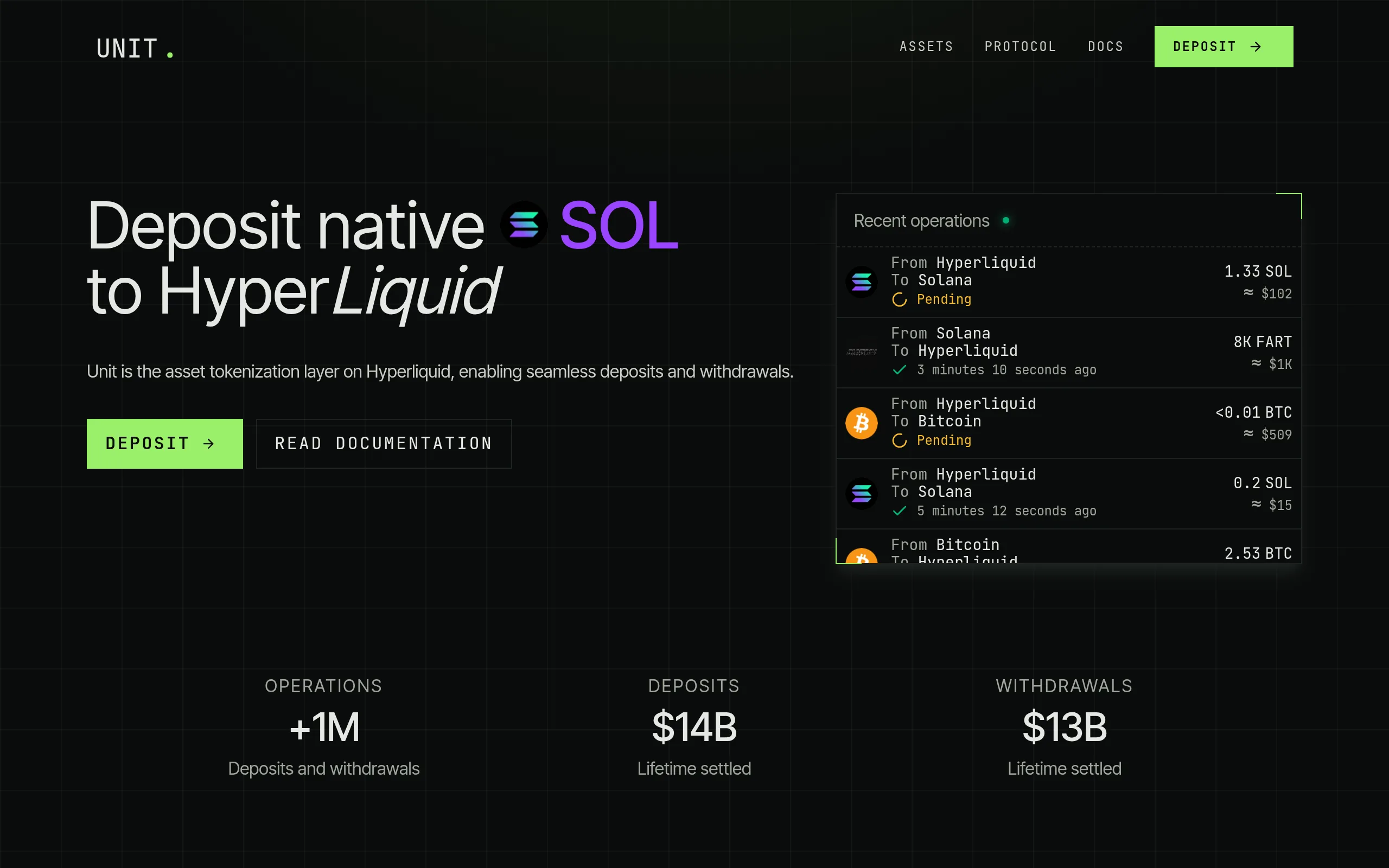
Per Unit's own homepage, the bridge has settled well over $14 billion in lifetime deposits and a similar figure in withdrawals across more than a million operations. This is not a fringe tool; it is one of the main on-ramps into the Hyperliquid spot ecosystem.
Trade Native Assets on Hyperliquid
Bridge BTC, ETH, or SOL through Unit and trade them on Hyperliquid spot. Sign up with our referral code for a 4% lifetime discount on trading fees.
Join Hyperliquid with 4% OffWhich Assets Does Unit Support?
Unit launched with the three assets most people want on a spot exchange and has been adding more over time. The confirmed core is Bitcoin (uBTC), Ethereum (uETH), and Solana (uSOL).
Beyond those, Unit has bridged in a rotating set of Solana-based tokens and newer assets. Names like FARTCOIN, PUMP, SPX6900, BONK, and Plasma (XPL) have appeared as deposits, withdrawals, and spot trading went live for each. The list changes often, especially on the Solana memecoin side, so treat any snapshot as a point in time and check the live asset list in the app before you plan around a specific token.
The most recent addition to make noise was ANSEM, the Solana memecoin tied to the trader of the same name. Its spot trading, deposits, and withdrawals went live on Hyperliquid in July 2026, bridged in through Unit's Solana support. It is a good illustration of how quickly a token can go from a Pump.fun launch to a native Hyperliquid spot market once Unit supports the chain it lives on.
How Deposits Work
The deposit flow is a classic lock-and-mint, and the mechanics matter because a mistake at the wrong step can lose funds.
Open the deposit flow
Connect your wallet on app.hyperliquid.xyz or on hyperunit.xyz and choose the asset you want to bring over (BTC, ETH, SOL, etc.).
Get your unique deposit address
Unit's guardian network generates a deposit address that is permanently and deterministically tied to your Hyperliquid account. The same address always maps back to you, with no memo or tag juggling.
Send the native asset
From any wallet or exchange, send the real asset on its home chain (for example, BTC on the Bitcoin network) to that address. Double-check the chain and amount. The deposit minimum for BTC is 0.0003 BTC, and sending less means permanent loss.
Wait for confirmations
The guardians watch the source chain and wait for finality: two block confirmations for Bitcoin, native explorer finality for ETH and SOL. Bitcoin is the slowest at roughly 30 minutes, while Solana clears in about a minute.
Receive your tokenized balance
Once confirmed, the guardians mint the matching uAsset (uBTC, uETH, or uSOL) straight to your Hyperliquid spot balance, ready to trade or move into HyperEVM.
uBTC, uETH, uSOL: What the Tokens Actually Are
The tokens Unit mints are prefixed with a lowercase "u" (uBTC, uETH, uSOL), and each is a 1:1 claim on the native asset Unit is holding for you. In Hyperliquid's spot order books and in the HyperEVM DeFi protocols that accept them, the same assets show up as uppercase tickers: UBTC, UETH, USOL. They are the same thing. "uBTC" is the branding and "UBTC" is how it reads as a market ticker.
This is why Unit sits underneath so much of the ecosystem. When Felix Protocol lets you post UBTC as collateral to mint feUSD, or when HyperLend accepts UBTC in a lending market, that Bitcoin got there through Unit. The same balance you can trade on spot is the one you can deploy across HyperEVM DeFi.
How Withdrawals Work
Withdrawing reverses the process:
- Select the asset and enter a destination. On the withdraw screen, choose your uAsset, the amount, and the address on the native chain where you want the real asset sent.
- Sign on Hyperliquid. You sign a Hyperliquid transaction that burns or sends the uAsset back to Unit. Hyperliquid finalizes this in roughly ten seconds.
- Guardians release the native asset. Once Hyperliquid finalizes, the guardian network signs and broadcasts the transfer of the real asset to your destination address on its home chain.
Withdrawals are generally faster than deposits because you are not waiting on multiple source-chain confirmations up front, though the guardian step and native-chain broadcast still take a few minutes.
The Guardian Security Model
Any bridge is only as trustworthy as its custody design, so this is the part worth understanding before you move real money.
Unit secures assets with a 2-of-3 MPC threshold signature scheme (TSS). Three guardians each hold an independent share of the signing key, generated through distributed key generation. A full private key never exists in one place; the shares are combined only transiently, inside secure enclaves, at the moment a signature is needed. Any critical action (minting a uAsset, releasing a native asset) requires at least two of the three guardians to agree.
Around that core, Unit's docs describe several safeguards: key shares encrypted at rest with KMS, out-of-band identity checks between guardians, end-to-end encrypted guardian-to-guardian communication so relay servers never touch key material, full operation logging, and circuit breakers that pause the system if a guardian detects conflicting or abnormal activity.
Warning
Fees and Confirmation Times
Unit's fee model is refreshingly simple: there is no Unit protocol fee. You pay only the network fees for the two underlying transactions, your deposit on the source chain plus the transaction the guardians broadcast on withdrawal. Unit exposes a live fee-estimation endpoint, so the app shows you the current rate and ETA before you commit.
The figures below are illustrative snapshots from Unit's fee endpoint. They move with network conditions, so read them as ballpark, not fixed:
| Asset | Deposit cost (approx.) | Deposit ETA | Withdrawal cost (approx.) | Withdrawal ETA |
|---|---|---|---|---|
| BTC | ~2,600 sats | ~30 min (2 confirmations) | ~700 sats | ~14 min |
| ETH | ~0.0006 ETH | ~3 min | ~0.00006 ETH | ~7 min |
| SOL | ~0.015 SOL | ~1 min | fraction of a cent | ~4 min |
Warning
How It Shows Up in the Hyperliquid App
You do not have to go to a separate site to use Unit. There are two entry points into the exact same rails:
- app.hyperliquid.xyz lists the Unit-powered assets right in the spot deposit flow. Pick BTC, ETH, or SOL and Hyperliquid surfaces your Unit deposit address inline, so you never leave the trading interface.
- hyperunit.xyz offers the same deposit and withdraw flows directly, plus the recent-operations feed and fee estimates.
Either way, the deposit address is generated by Unit's guardian network and bound to your Hyperliquid account, and the resulting balance lands in your Hyperliquid spot wallet as UBTC, UETH, or USOL. If you have never funded a Hyperliquid account before, start with our guide to depositing USDC and the beginner walkthrough, then come back to Unit when you want native spot assets alongside your USDC.
You will need a connected wallet either way.  MetaMask or
  Rabby both work fine with the Hyperliquid interface.
Put Native Assets to Work on Hyperliquid
Bridge in with Unit, then lend, borrow, or trade across the HyperEVM ecosystem. Start with a 4% lifetime fee discount using our referral code.
Get 4% Off FeesRisks and Caveats
Unit is genuinely useful infrastructure, but it is a bridge, and bridges concentrate risk. Keep these in mind:
- Custody and bridge risk. Your funds sit behind a 2-of-3 guardian set. Collusion or compromise of two guardians is the theoretical worst case. There is no publicly confirmed audit, and the guardians are not named, which is a real trust assumption rather than a formality.
- The irreversible-minimum trap. BTC below 0.0003 is gone for good. Deposit addresses are asset- and user-specific, so sending the wrong asset or using the wrong chain can also mean permanent loss.
- Confirmation delays and circuit breakers. Bitcoin deposits wait on two confirmations, and the guardians' circuit breakers can pause operations, delaying a withdrawal exactly when markets are moving.
- Thin liquidity on newer assets. Many of the freshly bridged memecoins carry extreme volatility and shallow spot books. The bridge working perfectly does not make the token a good trade.
- Token and airdrop speculation. You will see chatter about a future "UNIT" token or airdrop for bridge users. Nothing official is confirmed. Do not bridge funds you would not otherwise move on the assumption that it earns you an airdrop.
Where Unit Fits in the Hyperliquid Ecosystem
Unit is one of those pieces of plumbing you stop noticing once it works, but almost every "native asset" experience on Hyperliquid runs through it. Spot BTC, ETH, and SOL trading, UBTC collateral on Felix and HyperLend, and the steady drip of new spot listings all depend on Unit carrying the real asset onto the chain first.
The uAssets themselves are ordinary HIP-1 tokens with an EVM system address linked to them, which is what lets a balance move between HyperCore and HyperEVM by transferring to that address. Unit is no longer the only asset-backed token standard on HyperCore. In August 2026  xStocks listed ten share-backed equity tokens on Hyperliquid spot, using the same HIP-1 mechanics but with a Jersey issuer and a regulated distributor holding the underlying instead of a guardian network holding a private key. Unit already carries an older wrapper of its own in that category, the USPYX "Unit SP500 xStock" ticker listed in July 2025. The two models are worth comparing before you trust either one with size, because the thing you are relying on differs: Unit's is cryptographic custody, and xStocks' is a redemption right against a company.
That makes Unit a natural companion to the rest of the HyperEVM DeFi ecosystem. USDC gets you into perps; Unit gets you into everything denominated in actual crypto. Once your BTC or ETH is on Hyperliquid as a uAsset, it behaves like any other spot balance: tradable, usable as collateral, and redeemable back to its home chain whenever you want out. For traders who want to keep Bitcoin exposure while trading perps in the same account, or who want to lend spot ETH into a HyperEVM market, Unit is the bridge that makes it possible without leaving the ecosystem.
Start Trading on HyperliquidFrequently Asked Questions
Unit (also called Hyperunit) is the asset tokenization layer for Hyperliquid. It uses a lock-and-mint model to bring native crypto assets like Bitcoin, Ethereum, and Solana onto Hyperliquid as spot-tradable balances. You send real BTC on the Bitcoin network and receive uBTC on Hyperliquid, redeemable 1:1 back to native BTC at any time. It is built by an independent team that works closely with Hyperliquid's infrastructure.
Open the deposit flow on app.hyperliquid.xyz or hyperunit.xyz, select BTC, and Unit generates a unique Bitcoin deposit address tied permanently to your Hyperliquid account. Send BTC to that address from any wallet or exchange. After two Bitcoin block confirmations, Unit's guardian network mints uBTC to your Hyperliquid spot balance. The minimum deposit is 0.0003 BTC, and anything below that is lost permanently.
They are Unit's tokenized versions of Bitcoin, Ethereum, and Solana on Hyperliquid. Each one is a 1:1 claim on the native asset locked by Unit's guardian network. They trade on Hyperliquid spot, can be used as collateral in HyperEVM DeFi protocols like Felix and HyperLend, and can be redeemed back to the native chain. In Hyperliquid's interface the tickers appear in uppercase (UBTC, UETH, USOL).
Unit secures deposits with a 2-of-3 MPC threshold signature scheme, meaning no single party ever holds a full private key and at least two of three guardians must sign any mint or withdrawal. That said, it is a bridge with a small permissioned guardian set, the guardians are not publicly named, and there is no publicly confirmed third-party security audit. Treat it like any bridge: understand the custody trust assumption before moving large sums.
Unit does not charge a protocol fee of its own. You pay only the network fees for the two underlying transactions: the deposit transaction on the source chain and the withdrawal transaction the guardians broadcast. These vary with network conditions. Bitcoin costs a few thousand sats and settles slowest, while Solana costs a fraction of a cent and settles in about a minute.
Independent resource: Hyperliquid Guide is an independent, third-party resource operated by Concept211. It is not affiliated with, produced by, reviewed by or endorsed by Hyper Foundation, Hyperliquid Labs or any other Hyperliquid-ecosystem entity. "Hyperliquid" and related names and marks belong to their respective owners and are used here only to identify the platform this site documents. Read the full disclaimer.
Not advice: Nothing on this site is legal, tax, financial or investment advice. Descriptions of regulatory status, tax treatment and market availability are general information that varies by jurisdiction and changes over time. Confirm anything that matters to you with a qualified professional and against primary sources. Trading perpetual futures involves substantial risk of loss, and past performance does not indicate future results.
Disclosure: this site contains referral links. Signing up through the 4% lifetime fee discount link earns us a share of the trading fee Hyperliquid already charges, at no extra cost to you.
Ready to Start Trading?
Join Hyperliquid with our referral link and get a 4% lifetime fee discount. No KYC, no email - just connect your wallet and trade.
Start Trading - Save 4%