Hyperliquid Delisting Explained - What Happens to Your Position
Table of Contents
- What Settlement Day Actually Does to Your Account
- Why the Settlement Price Is a TWAP and Not the Last Trade
- Who Decides: The On-Chain Validator Vote
- How a Coin Ends Up on the List
- Not Every Delisting Is a Verdict on the Coin
- VINE, as a Worked Example From Start to Finish
- A Flag Is Not a Queue
- Listings Run on the Same Clock
- HIP-3 Markets Do Not Work This Way
- HyENA Is Winding Its DEX Down
- Checking Your Own Exposure
- If Your Coin Gets Flagged
- Quick Recap
Most guides to perpetual futures assume the market you are trading will still be there tomorrow. On Hyperliquid that is usually true, but not always, and the exception has a fixed schedule and a settlement price you do not choose.
Validators periodically vote on whether to remove a perp from the venue. When a vote passes, every open position in that market is closed at a price the protocol calculates, and every resting order disappears. If you were long a thin memecoin and stopped checking your open positions, you find out afterwards.
What Settlement Day Actually Does to Your Account
The Hyperliquid documentation is short on this, and worth quoting directly:
If validators vote to delist an asset, the perps will settle to the 1 hour time weighted spot oracle price before the scheduled delisting voting time.
When an asset is delisted, all positions are settled and open orders are cancelled. Users who wish to avoid automatic settlement should close their positions beforehand. After settlement, no new orders will be accepted.
Three consequences follow from that, and they catch people out in different ways.
Your stop loss will not save you. Resting orders are cancelled, not filled. A stop sitting below the market does nothing during settlement, because settlement is not a trade that sweeps the book. It is an accounting event applied to every open position at once.
Leverage does not change the outcome, but it changes the size of it. Settlement realizes your unrealized PnL at the TWAP. If you were 3x long and the TWAP sits 15% below your entry, you take a 45% hit to the margin backing that position. Nothing about a delisting adds a penalty on top, and nothing softens the move either. Our leverage guide covers how that math compounds.
The margin comes back, the exposure does not. After settlement the USDC lands in your account as ordinary collateral. If that position was a hedge against something else you hold, the hedge is gone and you may not notice until the other leg moves.
Warning
Why the Settlement Price Is a TWAP and Not the Last Trade
A one-hour time-weighted average of the spot oracle is a boring number, and boring is the useful property here.
The perps being delisted are, almost by definition, the ones with the thinnest books. Settling those at a single last-traded price would mean the last few thousand dollars of flow before the cutoff sets the exit price for everyone still holding. Averaging over an hour of oracle readings makes that far more expensive to influence.
Note that it uses the spot oracle price, not the perp mark. If the perp has drifted away from spot because funding has been extreme or the book is one-sided, settlement pulls you back to spot rather than honoring the perp's own price. That gap is where the surprises live. On a market trading at a persistent premium, settlement is a haircut for longs even if nothing dramatic happened in the last hour.
Trade Markets That Are Not Going Anywhere
Deep books on the majors, a 4% lifetime fee discount, and no settlement surprises on BTC or ETH.
Join Hyperliquid - Save 4%Who Decides: The On-Chain Validator Vote
Hyperliquid announced in March 2025 that delisting votes run fully on-chain:
When a quorum of stake has voted for a delisting, the action automatically triggers onchain.
In practice that means a delisting is not a private decision announced after the fact. The vote is weighted by staked HYPE, the result is recorded on the L1, and execution follows automatically once quorum is reached. If you run a node or watch the chain, you can see it happen rather than reading about it later. Staking HYPE is what gives a validator weight in that vote.
Announcements land in the Hyperliquid announcements channel and on the announcement pages inside app.hyperliquid.xyz, typically several days before the scheduled vote. The wording is formulaic, which makes it easy to scan for. The VINE notice read:
Validators will vote on whether to delist VINE around 9:30 UTC on 26 Aug based on stalequant's methodology.
How a Coin Ends Up on the List
Recent delisting announcements reference a scoring framework published by stalequant, an independent quantitative analyst. It is not a Hyperliquid product, and the dashboard says plainly that its output is indicative rather than firm guidance. It is still the closest thing to a public early warning system, and it is free to read.
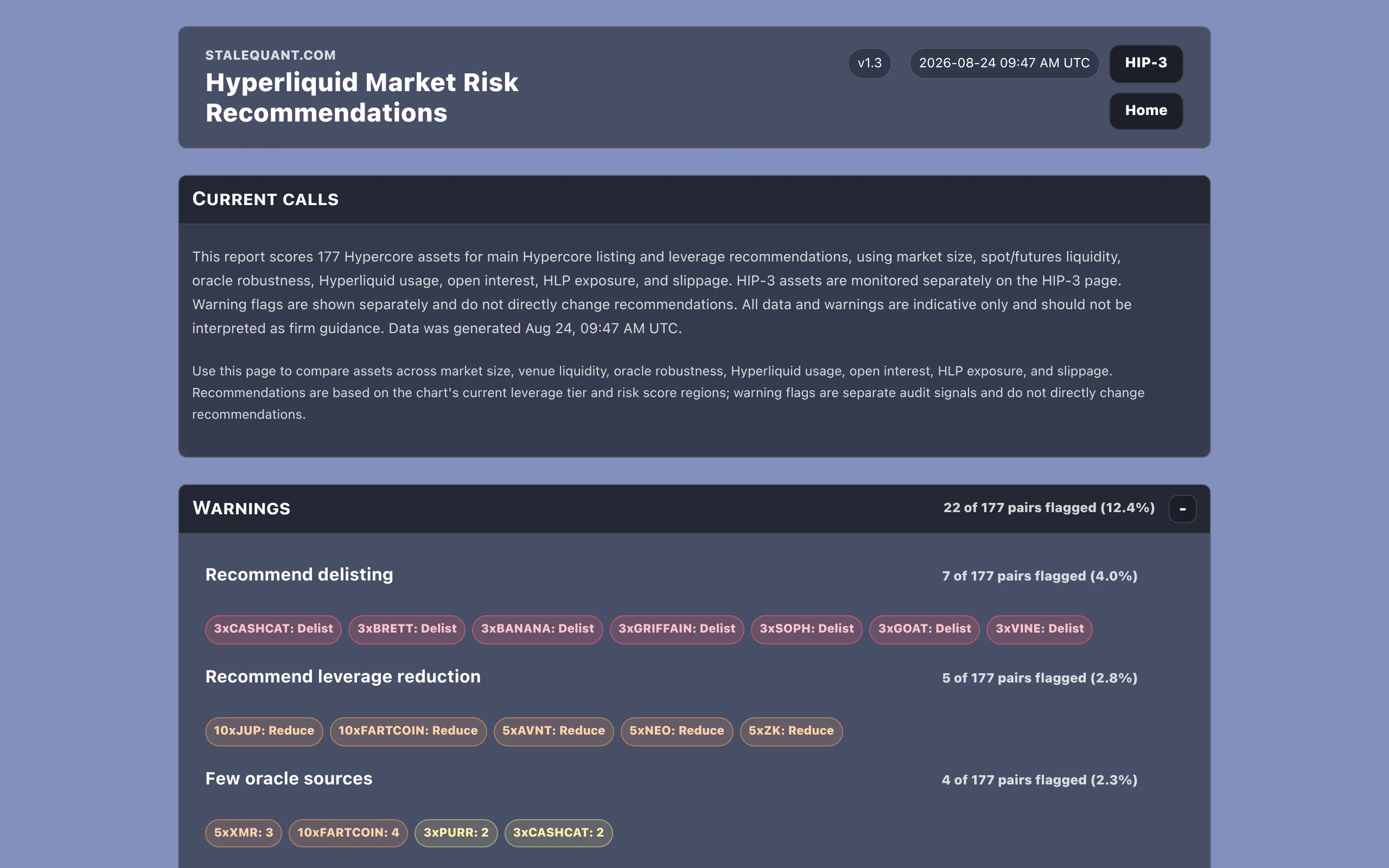
Source: stalequant.com — screenshot taken 24 August 2026, used under fair use for educational purposes
The methodology scores each listed asset out of 100 across ten factors worth ten points each:
| Factor | What it measures |
|---|---|
| Market cap | Exponential scale, $1M to $5B |
| Spot volume | Daily notional across Binance, Bybit, OKX, Hyperliquid, Kraken, Coinbase |
| Spot liquidity | One-way slippage on a $10K order |
| Oracle score | Venue-weighted oracle coverage |
| Futures volume | Daily notional across Binance, Bybit, OKX, Hyperliquid |
| Futures liquidity | One-way slippage on a $100K order |
| Hyperliquid volume | Daily notional on Hyperliquid alone |
| Hyperliquid open interest | Median open interest |
| HLP OI share | What share of open interest sits with HLP, lower being better |
| Hyperliquid slippage | One-way slippage on a $10K order |
Assets are bucketed by their maximum leverage tier, and each bucket has its own downgrade threshold. The bottom bucket is where delisting enters the picture: an asset in the 3x tier scoring at or below 30 points gets a delist recommendation, while assets in higher tiers get a leverage reduction recommendation instead.
That last detail explains something people find confusing. A coin does not usually go from 25x to delisted. It gets stepped down through leverage tiers first, and only once it is already in the 3x bucket does removal become the recommendation. If a coin you hold has had its max leverage cut, that is the early signal. Check the current tier on any market before sizing a position.
As of 24 August 2026 the dashboard flagged 22 of 177 HyperCore assets (12.4%), of which seven carried a delist recommendation: CASHCAT, BRETT, BANANA, GRIFFAIN, SOPH, GOAT, and VINE. All seven sit in the 3x bucket. Five more (JUP, FARTCOIN, AVNT, NEO and ZK) were flagged for leverage reduction. Those figures move daily, so read the live dashboard rather than this snapshot. The section on VINE below tracks what actually happened to those twelve over the following week.
Not Every Delisting Is a Verdict on the Coin
This is the most common misreading, and it matters if you are using the delisted list as a quality signal.
Query the API for the full universe and you find a long history:
curl -s -X POST https://api.hyperliquid.xyz/info \
  -H 'Content-Type: application/json' \
  -d '{"type":"meta"}' | jq '[.universe[] | select(.isDelisted)] | length'
On 31 August 2026 that returned 56 delisted entries out of 233 total, leaving 177 active perps. The delisted names include MATIC, RNDR, FTM, IP and AI16Z. The active count held steady across the week because a listing and a delisting landed together, which is the normal pattern rather than a coincidence.
None of those five were removed for being low quality. Each followed a public rebrand or ticker migration by the project itself: Polygon moved MATIC to POL, Render moved RNDR to RENDER, Fantom became Sonic, Story Protocol announced IP was becoming DATA, and ai16z rebranded to ElizaOS. The delisting announcement for IP said so outright. The old ticker gets retired and the market reopens under the new one.
So the 56 figure is not a count of failed coins. It is a mix of rebrands, projects that faded, and one incident: JELLY, removed in March 2025 following an oracle manipulation episode.
Info
VINE, as a Worked Example From Start to Finish
VINE was the live case when this page first went up, with a vote scheduled around 09:30 UTC on 26 August 2026. The vote passed and VINE is now delisted, which makes it a complete example rather than a hypothetical one.
Here is what the API returned before and after:
| Metric | 24 August 2026 (flagged) | 31 August 2026 (delisted) |
|---|---|---|
isDelisted | absent | true |
| Max leverage | 3x | 3x |
| 24h notional volume | $82,249 | $0 |
| Open interest | 41.23M VINE | 0 |
| Oracle price | $0.007991 | $0.007451 |
| Mid price | quoted | null |
| Funding rate | accruing | 0 |
The right-hand column is what settlement does to a market. Open interest goes to zero because every position was closed for its holder. Volume goes to zero because no new orders are accepted. midPx and impactPxs come back null because there is no book left to quote from. The oracle price keeps updating, since it tracks spot rather than the perp, but nothing on Hyperliquid trades against it any more.
Eighty-two thousand dollars of daily volume was the number to sit with beforehand. That is a market where a single mid-sized order moves the price meaningfully, which is exactly what the slippage and volume factors in the scoring are built to catch. Combine that with an oracle price under a cent and 41 million tokens of open interest, and the exit problem is obvious: holders trying to close in the final hours were competing for very little liquidity.
Which is the practical argument for closing early rather than at the deadline. The TWAP is calculated from the spot oracle, so it is not affected by a crowded perp exit, but your own fill certainly is. Our guide to slippage covers how to size an exit in a thin book, and order types covers using limit orders rather than market orders when you have days rather than seconds.
A Flag Is Not a Queue
The follow-up is as useful as the case itself. Seven assets carried a delist recommendation on 24 August: CASHCAT, BRETT, BANANA, GRIFFAIN, SOPH, GOAT and VINE. A week later only VINE had been removed. The other six were still trading, still capped at 3x. The five flagged for a leverage cut had not been cut either: JUP and FARTCOIN were still on 10x, AVNT, NEO and ZK still on 5x.
So a delist flag tells you an asset is in the zone where removal becomes possible. It does not tell you a vote is coming, and it does not put the asset in a queue. Treat it as a reason to check your exposure and your leverage tier, not as a countdown.
Listings Run on the Same Clock
The same week VINE came off, PONS was listed. It is worth putting the two side by side, because the gap says more about the scoring than the methodology write-up does:
| VINE (delisted 26 Aug) | PONS (newly listed) | |
|---|---|---|
| 24h notional volume | $82,249 | $40.7M |
| Open interest | 41.23M VINE | 29.48M PONS |
| Max leverage | 3x | 3x |
Both sat in the 3x bucket, which is where new listings start and where delisting candidates end up. What separates them is roughly 500x the daily volume. A new listing enters at the bottom of the leverage ladder and either earns its way up on the scoring factors or drifts toward the bottom of them, and the 3x tier holds both populations at once. Seeing a 3x cap on a market tells you which bucket it is in, not which direction it is heading.
HIP-3 Markets Do Not Work This Way
Worth stating clearly, because the two get conflated. Everything above applies to validator-operated perps: the crypto markets native to HyperCore.
HIP-3 markets are deployed and operated by independent builders who stake HYPE for the right to run them. trade.xyz runs the equity and commodity perps, Felix runs its own set, and so on. The decision to stop running one of those markets sits with that deployer, and the mechanics they use are theirs to define. stalequant's dashboard monitors HIP-3 assets on a separate page for the same reason.
 HyENA Is Winding Its DEX Down
The live example of that arrived in the week ending 31 August 2026. HyENA announced it is sunsetting its HIP-3 DEX, with wind-down details published at docs.hyena.trade. No validator vote was involved, and nothing about it appeared through the mechanism described in the rest of this article.
The wind-down is visible in the API. Querying the hyna universe on 31 August 2026 returns 25 markets, 13 of them already flagged isDelisted, including the BNB, SUI, XMR, LINK, ADA, BCH, GOLD and SILVER contracts. Twelve were still trading, with BTC and ETH carrying most of what remained of the volume. If you hold a position on one of those twelve, the deployer's own documentation is the only place the timetable exists.
Warning
isDelisted flag on the builder DEX universe as well as the native one, using a meta request with the dex field set.The deployer's authority over its own venue is set to widen. On September 3, 2026 Hyperliquid announced HIP-3*, an optional package that adds an onchain allowlist plus the ability for a deployer to cancel orders and place reduce-only orders for approved users on its markets. It is on testnet with preliminary specs, but it is one more reason to read what the operator of a builder market publishes about how it runs that market.
If you trade equity perps or commodity perps, follow the deployer's announcements. A quiet week on the Hyperliquid announcements channel tells you nothing about a market you are trading on someone else's HIP-3 deployment.
Get a 4% Lifetime Fee DiscountChecking Your Own Exposure
Three checks, in the order worth doing them.
Look at your max leverage tier
Open the market on Hyperliquid and check the ceiling on the leverage selector. Anything capped at 3x is in the bucket where delisting is on the table, and a cap that has been cut recently is the strongest single signal you get.
Read the live risk dashboard
Check stalequant's dashboard for a delist or reduce flag on your ticker. It updates daily and is indicative rather than firm guidance, but it flagged VINE before the vote was announced.
Watch the announcements channel
Delisting notices post several days ahead with a fixed time. If you hold anything outside the majors, that channel is worth a scan each week.
For anyone running automated strategies, the isDelisted flag in the meta response is the field to key off. A bot that does not check it will happily keep sizing orders into a market that no longer accepts them. The API guide covers the endpoint, and the trading bot setup guide covers where to put the check.
If Your Coin Gets Flagged
You have days, not minutes, which is the advantage of a scheduled on-chain vote over an exchange emailing you on a Friday afternoon.
Work out whether you actually want the exposure at all. If the answer is no, close it and move on. If the answer is yes and the thesis is intact, the underlying spot token still exists and still trades elsewhere. The perp going away removes your ability to use leverage and to short it on Hyperliquid, not the asset.
Size the exit rather than dumping it. Volume in a flagged market is thin by construction, so a market order for the full position is the expensive way out. Limit orders worked over a couple of days will usually beat the TWAP and will certainly beat a panicked exit in the final hour.
And if you decide the TWAP is fine, that is a legitimate choice. Settlement at a one-hour spot average is a reasonable outcome for a position you were ambivalent about. Just make it on purpose.
Warning
Quick Recap
Delisting on Hyperliquid is a scheduled, on-chain, publicly announced process, which makes it one of the more predictable risks in perps trading. Positions settle to the 1-hour time-weighted spot oracle price taken before the vote, open orders are cancelled, and nothing new is accepted afterwards. Validators vote, weighted by stake, and recent votes have referenced stalequant's public scoring.
The leverage tier is your early warning: a cut to 3x puts a market in the bucket where removal is the next step. The delisted list is not a list of failures, since rebrands and ticker migrations make up a large share of the 55 entries. And none of this covers HIP-3 markets, which are the deployer's call.
Trade Where the Books Are Deep
Majors with real liquidity, transparent on-chain governance, and a 4% lifetime discount on every trade you make.
Start Trading on HyperliquidFrequently Asked Questions
It is closed for you. Per the Hyperliquid docs, positions settle to the 1-hour time-weighted spot oracle price taken before the scheduled voting time, open orders are cancelled, and no new orders are accepted afterwards. You do not get to choose the exit price, so closing beforehand is the only way to control your fill.
Validators do, by on-chain vote, and only for validator-operated perps. Hyperliquid announced on-chain delisting votes in March 2025: when a quorum of staked weight votes yes, the delisting triggers automatically. Recent announcements have referenced the public scoring methodology published by the independent analyst stalequant.
Not by itself. Settlement closes your position at the 1-hour TWAP of the spot oracle, so you realize whatever profit or loss that price implies. The risk is that thin books around the settlement window make the TWAP differ from where you hoped to exit, and that you no longer get to pick the moment.
Query the public API. Post a meta request to https://api.hyperliquid.xyz/info and read the isDelisted flag on each entry in the universe array. On 31 August 2026 that returned 233 entries, 56 of them flagged as delisted, leaving 177 active perps.
No. HIP-3 perps are deployed and operated by independent builders, so the decision to stop running one of those markets sits with that deployer, not with a validator vote on Hyperliquid's own perps. Check the deployer's own announcements for markets you trade there.
Yes. Validators voted around 09:30 UTC on 26 August 2026 and the delisting passed. VINE now returns isDelisted true in the API, with zero open interest, zero volume and a null mid price. It had been flagged in the 3x leverage bucket by stalequant's public dashboard two days before the vote was announced.
Not automatically. Seven assets carried a delist recommendation on 24 August 2026: CASHCAT, BRETT, BANANA, GRIFFAIN, SOPH, GOAT and VINE. A week later only VINE had been removed and the other six were still trading. A flag marks an asset as being in the zone where removal is possible, not as being next in line.
Yes, and often in the same week. PONS was listed around the time VINE was delisted. New perps enter in the 3x leverage bucket, which is the same bucket delisting candidates end up in, so a 3x cap on its own tells you nothing about which direction a market is heading.
Independent resource: Hyperliquid Guide is an independent, third-party resource operated by Concept211. It is not affiliated with, produced by, reviewed by or endorsed by Hyper Foundation, Hyperliquid Labs or any other Hyperliquid-ecosystem entity. "Hyperliquid" and related names and marks belong to their respective owners and are used here only to identify the platform this site documents. Read the full disclaimer.
Not advice: Nothing on this site is legal, tax, financial or investment advice. Descriptions of regulatory status, tax treatment and market availability are general information that varies by jurisdiction and changes over time. Confirm anything that matters to you with a qualified professional and against primary sources. Trading perpetual futures involves substantial risk of loss, and past performance does not indicate future results.
Disclosure: this site contains referral links. Signing up through the 4% lifetime fee discount link earns us a share of the trading fee Hyperliquid already charges, at no extra cost to you.
Ready to Start Trading?
Join Hyperliquid with our referral link and get a 4% lifetime fee discount. No KYC, no email - just connect your wallet and trade.
Start Trading - Save 4%