papertrade on HyperEVM: 1000x Synthetic Perps, Fees and Risks Explained
Table of Contents
- How papertrade Works
- The price comes from Hyperliquid's book
- The other side of your trade is a pool
- Every position stands alone
- What It Costs to Trade
- Worked example: $100,000 of BTC
- Liquidation at 1000x
- The Pool, the Queue and PAPER
- An LP that starts at zero
- PAPER: a token minted from losses
- How much is in it
- Risks the Docs Spell Out
- Price manipulation
- Admin keys
- One relayer
- Launch congestion
- Getting Started
- How It Compares with HLP
- Should You Use It?
 papertrade
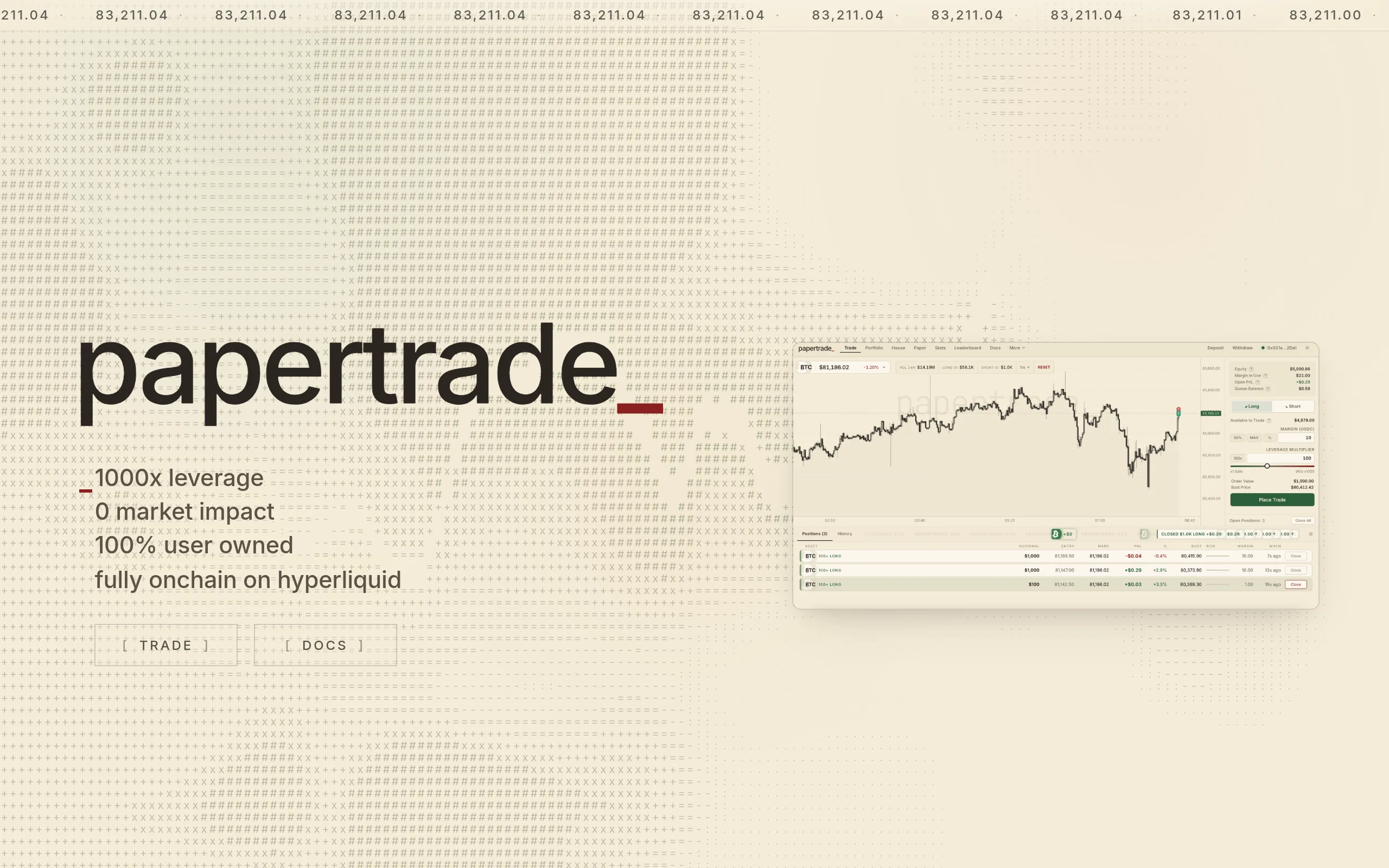
papertrade went live on HyperEVM at 14:00 UTC on October 10, 2026, right after a scheduled network upgrade. Its pitch fits on one line: BTC and ETH perps with up to 1000x leverage, no trading fee, no funding and no slippage, all fully onchain.
It is not another front end for Hyperliquid's order book. Nothing you open on papertrade becomes a position on HyperCore. The protocol borrows Hyperliquid's price and builds a different kind of market around it, with a pool on the other side of every trade and a fee that only shows up when you win.
This guide covers how that works, what it costs compared with trading BTC directly on Hyperliquid, and the risks its own documentation spells out.
How papertrade Works
Source: papertrade.xyz, used under fair use for educational purposes
papertrade's trading logic is a set of contracts on HyperEVM, the smart-contract layer that runs alongside Hyperliquid's native exchange. Your USDC never leaves Hyperliquid, but it sits in the protocol's account on HyperCore, and the contracts move it with the CoreWriter interface.
The price comes from Hyperliquid's book
HyperEVM contracts can read live HyperCore state through precompiles, which are fixed-address system contracts. papertrade calls the one that returns the best bid and best ask for an asset and takes the midpoint as its price. According to the docs, "that's the whole pricing stack."
So there is no separate oracle network and no price signer. The trade-off is that papertrade can only list assets that already trade on Hyperliquid's native book. The docs say that could later include HIP-3 markets, but at launch it is BTC and ETH only.
The other side of your trade is a pool
On Hyperliquid, every perp you open is matched against another trader or a market maker. On papertrade there is no order book and no matching engine. Every position is a swap between you and the protocol's LP, a USDC balance that pays winners and collects from losers.
That is why papertrade can promise no slippage. A $10 position and a $10 million position both fill at the midpoint, subject to per-market caps on new open interest (set at launch to about $1 billion of headroom per side) and a $10 million limit on any single position's notional.
It also explains why there is no funding rate. Funding exists to keep a perp's price tied to spot when longs and shorts are unbalanced. papertrade's price is Hyperliquid's price by definition, so there is nothing to pull back into line.
Every position stands alone
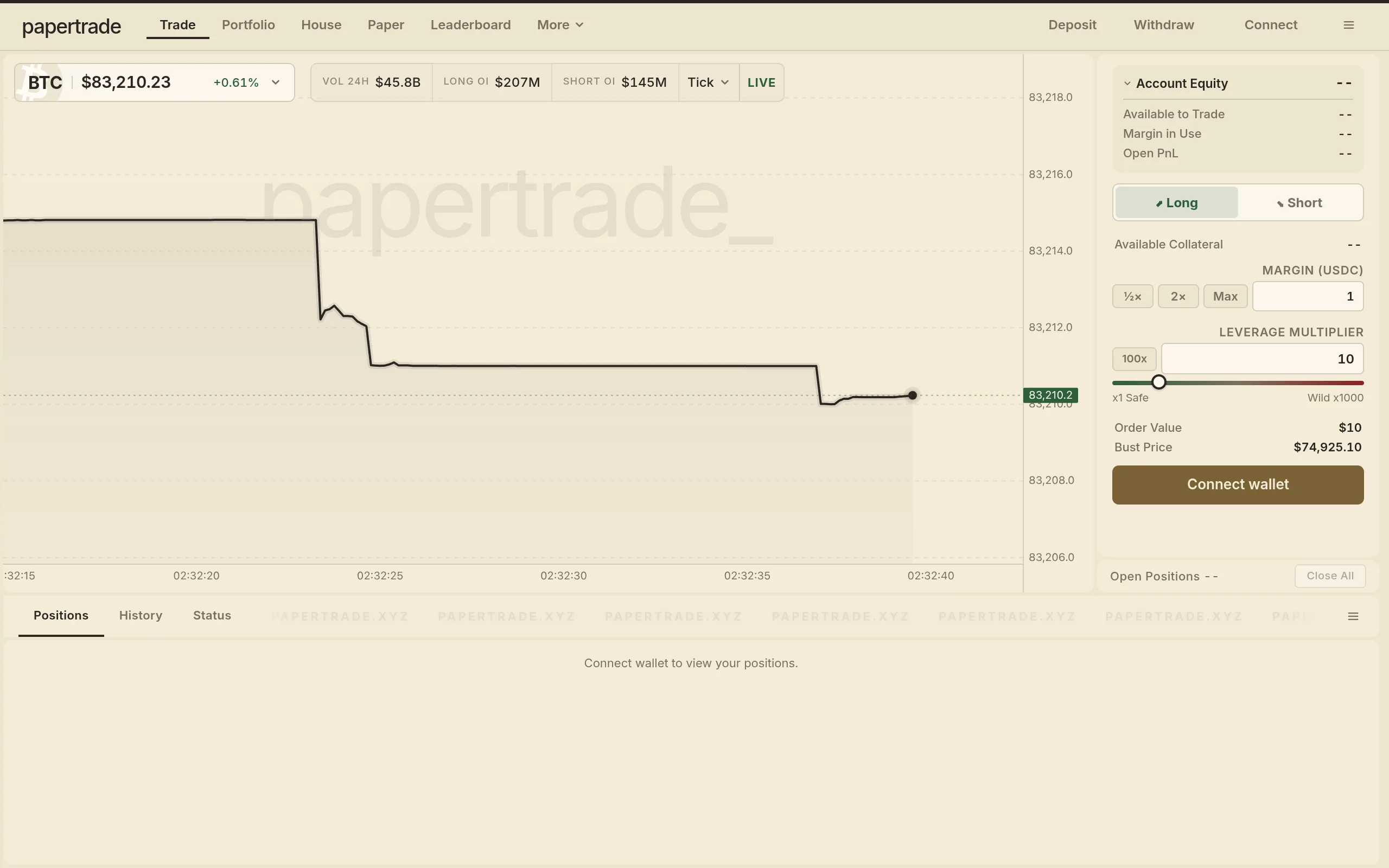
Each trade is its own isolated position, closer to a bet slip than an account. You cannot add margin to push back a liquidation, take margin out, or change leverage after opening. You cannot close part of a position either. To scale in, you open a second one. To reduce, you close it and open a smaller one. Compare that with Hyperliquid, where isolated and cross margin are both available and you can top up a position at any time.
Trading itself needs one wallet signature. The app registers a session key that signs your opens and closes for 30 days, and papertrade's relayer pays the gas. The session key cannot withdraw, stake or claim. Those still need your wallet.
Source: papertrade exchange, used under fair use for educational purposes
Prefer an Order Book?
Trade BTC, ETH and hundreds of other perps on Hyperliquid directly, with partial closes, cross margin and limit orders. Sign up through our link for a 4% fee discount.
Join HyperliquidWhat It Costs to Trade
The docs say papertrade charges "no notional swap fee, no spread, and no funding cost." The protocol's cut comes out of winning trades in three steps:
- Your gain is measured as if you had exited 0.2 basis points (0.002%) worse. A win smaller than that pays nothing.
- What remains is scaled down by an "asymmetric impact" curve that takes the most from small price moves and less from big ones. At launch the curve never lets you keep more than 90% of a raw gain.
- A 2% win fee comes off whatever is left.
Losing trades pay the loss and nothing more. papertrade also takes a 2% fee on losing closes and liquidations, but that comes out of the pool's side of the trade, not yours. The docs credit the idea to Rollbit's market-impact model, with one change: papertrade's haircut depends on how far the price moved, not on how big your position is.
Worked example: $100,000 of BTC
We ran the published formula with the launch parameters for BTC. Take a $100,000 position (for example, $1,000 of margin at 100x) that closes in profit. On Hyperliquid, the same position at base-tier fees costs $90 for a round trip with taker orders on both legs, or $30 with maker orders on both. Hyperliquid charges that whether the trade wins or loses.
| BTC move | Raw gain | You keep | Fee taken | Hyperliquid taker fees |
|---|---|---|---|---|
| 0.05% | $50 | 60.7% | $20 | $90 |
| 0.1% | $100 | 72.4% | $28 | $90 |
| 0.2% | $200 | 79.7% | $41 | $90 |
| 0.5% | $500 | 84.6% | $77 | $90 |
| 1% | $1,000 | 86.4% | $136 | $90 |
| 2% | $2,000 | 87.3% | $254 | $90 |
| 5% | $5,000 | 87.8% | $608 | $90 |
Moves are in your favor. Hyperliquid taker fees are for a full round trip. Percentages include the deadband, the impact haircut and the 2% win fee. ETH's curve is slightly steeper: about 68% kept on a 0.1% move and 86% on a 1% move. Hyperliquid figures are before any fee tier or referral discount and exclude funding.
The break-even sits at a move of roughly 0.6% on BTC. Below that, papertrade costs less than crossing the spread twice on Hyperliquid. Above it, the cut keeps growing with your profit while Hyperliquid's fee stays flat. On a 5% winning move, papertrade's share is almost seven times the taker round trip.
The other side of the ledger matters as much. A losing trade on papertrade costs only the loss, while on Hyperliquid you pay fees on losers too. Which venue is cheaper for you depends on how often you win and how far price moves when you do.
Info
Liquidation at 1000x
Hyperliquid caps native BTC at 40x and ETH at 25x. papertrade allows 1000x on both, which means your whole margin covers a 0.1% price move. With BTC near $83,000, that is about $83.
Liquidation on papertrade is what the docs call a "hard bust." Each position has a displayed bust price set about 5 basis points (0.05%) closer to your entry than the point where your margin would actually run out. Once the midpoint crosses it, the keeper removes the position and you lose all of the margin, even if a manual close a moment earlier would have returned some of it.
At low leverage that buffer barely registers. At 1000x it decides the trade. The docs work through it: liquidation fires after a move of about 0.052%, at which point a voluntary close "would still return nearly half your margin." In other words, at 1000x a $43 move in BTC can end the position.
Hyperliquid's liquidation process is different. It first tries to close your position with orders on the book, can close just part of a large position, and when a book liquidation brings the account back above maintenance margin, the collateral left over stays with you. If you are new to any of this, read our leverage guide before touching a slider that goes to 1000.
The Pool, the Queue and PAPER
An LP that starts at zero
papertrade's LP had no seed capital. The docs say it "starts at $0" and "grows over time from cumulative user losses." Nobody can deposit into it directly.
That raises the obvious question of what happens when traders win more than the pool holds. papertrade's answer is a payout queue. Any profit the pool can't pay right away goes into a first-in, first-out queue and is paid out as later traders lose. The docs call this the Martingaler mechanism and link a paper titled A Bootstrapping Mechanism for Sustainable Asynchronous Speculation Games of Chance.
It is less alarming than it sounds, for two reasons. Your margin is never queued: when you close a position, your collateral comes back to your balance immediately, and only the profit can wait. And queued balance is spendable. The app shows an available balance and a queued balance, and you can use either as margin for new trades.
Still, a winning close on papertrade is not the same as cash in hand when the pool is short. On Hyperliquid, a profitable close is settled at once.
PAPER: a token minted from losses
PAPER is the claim on the pool's future revenue, and the only way to get it is to lose. Every losing close or liquidation mints PAPER to the trader. While the pool's tracked balance is under $2 million, including any time it is underwater, the rate is a flat 100 PAPER per dollar of loss. Above $2 million the rate decays and never recovers.
Staked PAPER earns USDC from two sources:
- Half of every 2% fee (the other half goes to a dev fee recipient)
- Any pool surplus once tracked LP climbs past $5 million
The docs describe PAPER as a fair launch with no pre-mint, team allocation, investors or airdrop. At launch it can be staked and unstaked but not transferred between wallets.
How much is in it
Hyperliquid's public API shows the USDC in papertrade's Exchange contract account on HyperCore. On October 13, 2026 that was about $66.2 million. That figure covers everything the contract holds, including traders' own balances and open margin, not just the LP. The BTC trade screen the same day showed $45.8 billion of 24-hour volume and about $352 million of open interest. Those are papertrade's own numbers for positions against its pool, not volume on Hyperliquid's order book.
Risks the Docs Spell Out
papertrade's documentation includes a risk page, which is worth reading in full. The main points:
Price manipulation
Because the price is the raw midpoint of Hyperliquid's book, someone could nudge the best bid or ask for a block and trade papertrade against the distorted price. The docs say the price feed has no maximum-deviation check, no time-weighted average and no lookback, and that this is "a real residual risk." The deadband, the impact curve and the open-interest caps reduce the payoff. The docs say they do not "guarantee that a manipulation strategy is unprofitable."
Admin keys
A 2-of-3 multisig owns a timelock that owns the contracts. The tweet announcing launch named the three signers as izebel_eth, blurr and UngusTrade. Owner actions (changing fee parameters, listing markets, swapping keepers, upgrading contracts) wait 7 days. The contracts are upgradeable, and the docs say plainly that "in principle the owner can do anything the implementation can be rewritten to do." A separate guardian can pause new trades or permanently retire a market at once. Positions in a retired market can still be closed at the price frozen when it was retired.
One relayer
Every open and close goes through papertrade's relayer. A third-party front end can sign intents but still has to submit them through it. Withdrawals don't depend on the relayer: you can call the withdrawal function directly from your wallet.
Launch congestion
The launch post warned of long confirmation times at first, "especially for smaller notional trades." It also said HyperEVM would look only half used during launch, because filling more of each block would push gas fees to "unpayable prices" within minutes.
For comparison, our guide on whether Hyperliquid is safe covers the equivalent questions for the native exchange.
Getting Started
You need an EVM wallet such as  MetaMask or
  Rabby and at least 10 USDC. Deposits are accepted from Hyperliquid, HyperEVM, Ethereum, Arbitrum and Solana, plus USDG from Robinhood Chain. Each user gets a personal deposit address. Transfers from Hyperliquid credit within seconds, while other chains also wait for their bridge.
Two fees apply. Your first deposit pays a one-time 1 USDC activation fee, and routes from other chains pay the bridge's fee. The minimum withdrawal is 10 USDC, and withdrawals can go back to Hyperliquid, HyperEVM, Ethereum, Arbitrum or Solana.
If your USDC is already on Hyperliquid, that route is the fastest. If it is on another chain, our guide to bridging to HyperEVM explains the options. papertrade also says it plans builder codes for other front ends, paying them 1% from the protocol's revenue share rather than adding to what you pay. That is a different design from Hyperliquid's builder fees, which are charged on top of your trade.
How It Compares with HLP
The closest thing on Hyperliquid itself is HLP, the protocol vault that makes markets and takes over liquidated positions. Both are pools that profit when traders lose on balance. The differences are bigger than the similarity:
| HLP | papertrade LP | |
|---|---|---|
| Can you deposit? | Yes, in USDC | No. Exposure only through PAPER |
| How it trades | Quotes on Hyperliquid's order book | Takes the other side of every papertrade position |
| Starting capital | Funded by depositors | Started at $0 |
| When short of cash | Not applicable; trades settle on the book | Winners wait in a payout queue |
| Who it serves | All Hyperliquid traders, as one of many market makers | Only papertrade traders |
If you like the idea of being on the house side, HLP lets you deposit directly. With papertrade, the only way onto the house side is to lose trades and stake the PAPER you receive.
Should You Use It?
papertrade is honest about what it is: a high-leverage game priced off a real market. The docs say so, the risk page is detailed, and the fee formula is published. That makes it easier to judge than most new venues.
It suits short trades that try to catch small moves, where paying nothing on losers and a modest cut on winners can work out cheaper than Hyperliquid's taker fees. It suits large winners less, because papertrade's share grows with your profit. It also gives you less control: no partial closes, no adding margin, no order types beyond buy and sell, and a liquidation that takes your whole margin.
For anything else, including holding a position through a real price swing, the native exchange is the better tool. For more of what is being built on HyperEVM, see our HyperEVM ecosystem map.
Trade BTC on Hyperliquid's Order Book
Up to 40x on BTC, partial closes, stop and limit orders, and a fee you can cut further with maker orders. Get a 4% lifetime fee discount with our referral link.
Start TradingFrequently Asked Questions
papertrade is a perpetuals exchange built as smart contracts on HyperEVM, Hyperliquid's EVM layer. It launched on October 10, 2026. Trades are not placed on Hyperliquid's order book. Instead, the contract reads the best bid and ask on Hyperliquid's native book, fills you at the midpoint, and settles your profit or loss against its own liquidity pool. It offers BTC and ETH with up to 1000x leverage.
No. papertrade is a separate protocol whose contracts are controlled by a 2-of-3 multisig behind a 7-day timelock. It reads prices from Hyperliquid and holds USDC on HyperCore, but positions you open there are not Hyperliquid perps and do not appear on app.hyperliquid.xyz.
No fee on notional, no spread, no funding and no gas. The cost sits entirely on winning trades: a 0.2 basis point deadband, an impact haircut that takes more from small price moves than large ones, then a 2% fee on what is left. Losing trades pay nothing beyond the loss. On BTC a winning close keeps roughly 72% of the raw gain on a 0.1% move and about 86% on a 1% move.
PAPER is minted to traders who close at a loss or get liquidated, at 100 PAPER per dollar of loss while the pool's tracked balance is under $2 million. Staked PAPER earns half of the protocol's 2% fees plus pool surplus above $5 million, paid in USDC. At launch it cannot be transferred between wallets.
It can delay one. The pool started at zero and grows only from trader losses. If it cannot cover a win, the unpaid profit goes into a first-in, first-out queue that is paid as later losses come in. Your margin is returned straight away; only the profit can wait.
Independent resource: Hyperliquid Guide is an independent, third-party resource operated by Concept211. It is not affiliated with, produced by, reviewed by or endorsed by Hyper Foundation, Hyperliquid Labs or any other Hyperliquid-ecosystem entity. "Hyperliquid" and related names and marks belong to their respective owners and are used here only to identify the platform this site documents. Read the full disclaimer.
Not advice: Nothing on this site is legal, tax, financial or investment advice. Descriptions of regulatory status, tax treatment and market availability are general information that varies by jurisdiction and changes over time. Confirm anything that matters to you with a qualified professional and against primary sources. Trading perpetual futures involves substantial risk of loss, and past performance does not indicate future results.
Disclosure: this site contains referral links. Signing up through the 4% lifetime fee discount link earns us a share of the trading fee Hyperliquid already charges, at no extra cost to you.
Ready to Start Trading?
Join Hyperliquid with our referral link and get a 4% lifetime fee discount. No KYC, no email - just connect your wallet and trade.
Start Trading - Save 4%