Market Making on Hyperliquid: Maker Fees, Rebates, Growth Mode and Rate Limits
Table of Contents
Market making on Hyperliquid looks simple from outside: post a bid and an ask, collect the spread. The economics underneath are less obvious. Most makers pay a fee rather than earn a rebate. The cheapest markets to quote count for a tenth toward your fee tier. And your API allowance grows with the volume you trade, so a new account starts out rate-limited.
This guide is for people running or evaluating a quoting bot on Hyperliquid. It covers what a maker pays at each tier, how the maker-share rebates work, why HIP-3 growth mode changes the math, the rate and order limits a quoting bot runs into, and how to set up accounts. Near the end there's a profile of a real maker account on trade.xyz, built from public API data.
How a Maker Gets Paid on Hyperliquid
A maker earns from three places: the spread between the prices it buys and sells at, any rebate, and sometimes funding on the inventory it holds. Against that it pays maker fees, and it loses money when the price moves through its quotes before it can adjust (adverse selection). On Hyperliquid the fee side looks like this, from the fee docs:
| Tier | 14-day weighted volume | Perps taker | Perps maker |
|---|---|---|---|
| 0 | under $5M | 0.045% | 0.015% |
| 1 | over $5M | 0.040% | 0.012% |
| 2 | over $25M | 0.035% | 0.008% |
| 3 | over $100M | 0.030% | 0.004% |
| 4 | over $500M | 0.028% | 0.000% |
| 5 | over $2B | 0.026% | 0.000% |
| 6 | over $7B | 0.024% | 0.000% |
Below tier 4, every maker fill costs money. A bot quoting $1M a day at the base tier pays $150 a day in maker fees before it earns anything, so its spread capture has to beat 1.5 basis points per filled dollar to break even on fees alone. Spot volume counts double toward these tiers, and HYPE staking takes 5% to 40% off both columns.
The maker-share rebates
Rebates are a separate schedule, based on your share of all maker volume on the exchange over 14 days, not on your own dollar volume:
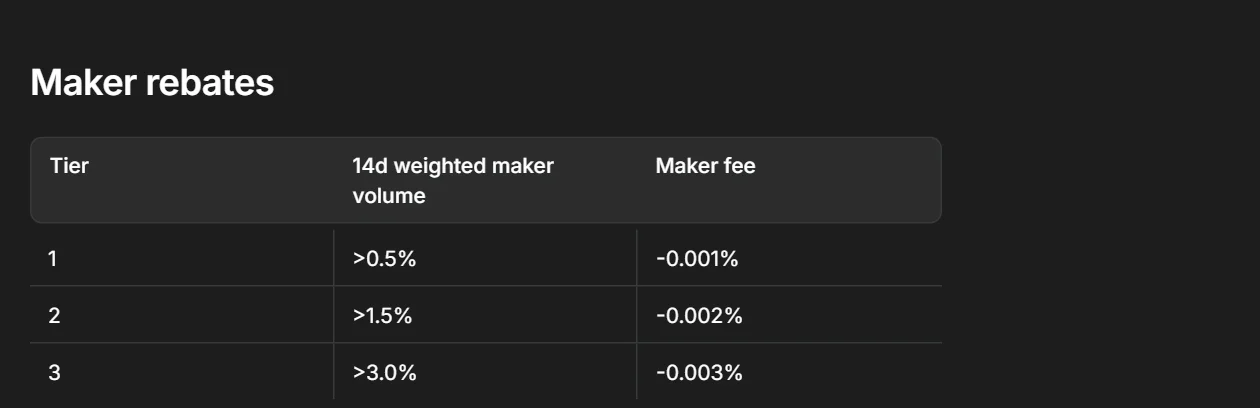 Hyperliquid fee docs table of maker rebate tiers: above 0.5% of 14-day weighted maker volume earns -0.001%, above 1.5% earns -0.002%, above 3.0% earns -0.003%
The threshold moves with the exchange. Hyperliquid's userFees endpoint reports daily exchange volume, and it summed to about $77 billion over the two weeks to October 28, 2026. Every trade has one maker, so 0.5% of that is roughly $385 million of credited maker volume in 14 days, or about $27 million a day. That's firm-sized. For most independent bots, the realistic goal is to climb the dollar tiers until the maker fee reaches zero, not to earn a rebate.
The fee calculator takes your 14-day volume, maker share and staking tier and shows which schedule applies.
Native Perps vs HIP-3 Growth Mode
Hyperliquid has two kinds of perp market, and they pay makers very differently. Native perps (BTC, ETH, HYPE and the rest of the validator-operated list) use the table above. HIP-3 markets are deployed by builders such as  trade.xyz, and most of them run in growth mode, which cuts all-in fees, rebates, volume credit and rate-limit credit by at least 90%.
Here is what $1M of maker volume costs and earns in each, at the base tier with no staking:
| Native perp | HIP-3, no growth mode (fee scale 1.0) | HIP-3, growth mode | |
|---|---|---|---|
| Maker fee paid | $150 | $300 | about $30 |
| Volume credited toward fee tiers | $1M | $1M | about $100K |
| Address rate-limit credit | 1M actions | 1M actions | about 100K actions |
The fees in the middle column follow Hyperliquid's HIP-3 fee docs: at a deployer fee scale of 1.0 a builder market charges double the native rate. The growth-mode column applies the docs' 90% reduction. On October 29, 2026, trade.xyz's USDJPY order panel showed a maker fee of 0.0030%, which matches.
So growth mode lowers a maker's fee bill and slows everything that depends on volume. A bot that quotes only growth-mode markets can trade a lot and stay at tier 0. It also earns rate-limit headroom slowly, which matters for a strategy that cancels and replaces often.
HIP-3 markets behave differently
Fees aren't the only difference. Many trade.xyz markets are isolated margin only: in the API's meta response, USDJPY, EUR, GBP, JP225, KR200, Hyundai and Samsung carry onlyIsolated: true. Each position then holds its own margin, so a maker quoting ten FX and index markets needs ten separate margin buckets instead of one cross-margined account. Our isolated vs cross margin guide covers what that does to capital efficiency.
The reference price also works differently. HIP-3 oracles are run by the deployer, and equity and index markets keep trading when the underlying exchange is closed. Our after-hours trading guide and stock perps tracking study measure how far marks drift from the reference outside market hours. For a maker that's inventory risk with no hedge venue open.
Open a Hyperliquid Account for Your Bot
Accounts opened through our link get 4% off fees on the first $25M of volume. It doesn't carry over to sub-accounts or vaults, so sign up with the master wallet.
Join HyperliquidRate Limits and Order Caps
Most quoting bots run into Hyperliquid's limits before they run out of capital. The rate-limit docs set limits in three places.
Per address. Each address can send one action per $1 of volume it has traded since it was created, plus a starting buffer of 10,000 requests. An address that hits the limit gets one request every 10 seconds. Cancels have extra room, min(limit + 100000, limit * 2), so a bot can still pull its quotes after it's limited. Growth-mode volume builds this allowance at a tenth of the normal rate.
Per IP. REST requests share 1,200 weight per minute. An exchange action weighs 1 + floor(batch_length / 40), so a batch of 40 orders costs 2. On WebSockets you get 10 connections, 1,000 subscriptions and 2,000 messages a minute, with at most 100 posts in flight.
Open orders. Each account can hold 1,000 open orders, plus one more for every $5 million of volume, up to 5,000. Once an account has 1,000 open orders, new reduce-only and trigger orders are rejected.
Batching matters. A batched action with n orders counts as one request against the IP limit and n against the address limit. During congestion its weight scales with both the batch size and a constant per action, so batching orders and cancels together uses less of the limit. During congestion the docs also cap each address at twice its previous day's maker share of block space, scaled the same way as volume credit. The docs add that it helps not to resend cancels whose results have already come back.
Our API guide covers signing, nonces and the WebSocket feeds. The trading bot guide has a working Python quoting loop.
Order Types That Matter to Makers
ALO (add liquidity only). Hyperliquid's post-only time-in-force. An ALO order that would cross the spread is canceled instead of filled as a taker, so a maker never pays taker fees by accident. The order types guide lists the other options.
Queue priority. Since July 2026, ALO orders can carry a priority fee, paid in HYPE from undelegated stake. It doesn't speed the order up. It sorts your order ahead of others at the same price that are less than 400 ms old. The fee is charged on resting notional whether you fill or not, so it only pays if the better spot in the queue turns into fills.
Cancels go first. Under the priority-fee rules, cancels are processed before orders that would fill immediately, whatever those orders paid. A maker pulling a stale quote isn't beaten by a taker who paid for speed.
No gas. Placing and canceling orders costs nothing on Hyperliquid (zero gas fees explained). The rate limits above are the real cost of a busy quoting loop.
Accounts: Master, Sub-Accounts, API Wallets and Vaults
API (agent) wallets sign orders for an account without being able to withdraw. Run each bot process on its own agent wallet so nonces don't collide. The API guide covers the setup.
Sub-accounts let you split strategies or markets while keeping one fee tier. The fee docs say "all sub-accounts share the same fee tier," so volume on any of them helps the whole group. For address-based rate limits, each sub-account is a separate user with its own allowance. The referral discount doesn't apply to sub-accounts.
Vaults are treated as separate accounts. Vault volume doesn't count toward the leader's own tier, and the referral discount doesn't apply. Hyperliquid's own market-making vault, HLP, is the largest example. Our vaults guide covers how a vault strategy is structured for depositors.
Account mode affects margin. Standard, Unified and Portfolio Margin accounts treat collateral differently, which matters if your bot holds inventory in several markets. See the unified accounts guide.
A Real Maker Account on trade.xyz
To see how this works in practice, we read the public API data for one maker account in late October 2026. We aren't naming it. Everything below comes from Hyperliquid's public info endpoints, which anyone can query for any address.
- Markets: almost entirely trade.xyz growth-mode markets. By fill notional the biggest were USDJPY, the S&P 500 perp, the Nikkei 225 (JP225), the KOSPI 200 (KR200), EUR and GBP, then Hyundai and Samsung. Its only native perp in the sample was PAXG.
- Style: about 84% of fill notional was passive (maker), across roughly 600 fills a day averaging about $2,100 each.
- Size: about $150,000 of account equity, and about $36 million of volume over the previous 30 days.
- Fee tier: the
userFeesendpoint credited it with about $3 million of volume over the previous two weeks, so it sat at tier 0 despite trading several times that.
That last line is growth mode at work. On native perps the same trading would put the account in tier 1, but almost all of its volume counts for a tenth. Since it pays only about 0.003% per maker fill, staying at tier 0 costs it little. Climbing tiers would take native perp volume. Its credited maker volume was nowhere near the 0.5% share needed for a rebate.
Warning
Choosing Where to Quote
A rough way to think about it, based on the numbers above:
- Growth-mode HIP-3 markets suit small and mid-sized makers who want low fees and don't need tier progress. Watch the isolated-only margin, off-hours oracle behavior and the slower growth of your rate limit. The growth mode list shows which markets have it.
- Native perps suit makers who want to climb tiers or reach the rebate schedule. You pay 0.015% at the start, but every dollar counts in full toward tiers and rate limits.
- Mixing both works if you track credited volume separately. Use the
userFeesendpoint for what Hyperliquid credits you, not your own fill totals.
Our trading strategies guide covers inventory skewing and other quoting techniques. For tiers, rebates, infrastructure and the referral terms on one page, see Hyperliquid for pro traders and market makers.
Start Quoting on Hyperliquid
Sign up through our link for 4% off fees on your first $25M of volume, then stake HYPE for up to 40% more.
Open a Hyperliquid AccountFrequently Asked Questions
Only to accounts with a large share of exchange maker volume. Hyperliquid's fee docs list three rebate tiers based on 14-day weighted maker volume share: above 0.5% earns -0.001%, above 1.5% earns -0.002% and above 3% earns -0.003%. Below that, makers pay a fee: 0.015% at the base tier, falling to 0% from the $500M 14-day volume tier upward.
The first rebate tier needs more than 0.5% of 14-day maker volume. Hyperliquid's userFees endpoint showed about $77 billion of exchange volume over the two weeks to October 28, 2026, so 0.5% was roughly $385 million of credited maker volume in 14 days. Volume on growth-mode HIP-3 markets is credited at about a tenth.
On growth-mode markets, yes. A maker pays about 0.003% there, against 0.015% on native perps at the base tier and 0.03% on a HIP-3 market without growth mode. The trade-off is that growth-mode volume counts about 90% less toward fee tiers, rebate tiers and address rate limits.
Each address gets one action per $1 of cumulative traded volume plus a 10,000-request starting buffer, and cancels get extra headroom. Each IP gets 1,200 weight per minute on REST, and a batched order action counts as one request for the IP limit but as one request per order for the address limit. Open orders are capped at 1,000 plus one per $5 million of volume, up to 5,000.
Yes. Hyperliquid's fee docs say all sub-accounts share the same fee tier as the master account. Vault volume is counted separately. For address-based rate limits, sub-accounts count as separate users, and the referral discount does not apply to sub-accounts or vaults.
Independent resource: Hyperliquid Guide is an independent, third-party resource operated by Concept211. It is not affiliated with, produced by, reviewed by or endorsed by Hyper Foundation, Hyperliquid Labs or any other Hyperliquid-ecosystem entity. "Hyperliquid" and related names and marks belong to their respective owners and are used here only to identify the platform this site documents. Read the full disclaimer.
Not advice: Nothing on this site is legal, tax, financial or investment advice. Descriptions of regulatory status, tax treatment and market availability are general information that varies by jurisdiction and changes over time. Confirm anything that matters to you with a qualified professional and against primary sources. Trading perpetual futures involves substantial risk of loss, and past performance does not indicate future results.
Disclosure: this site contains referral links. Signing up through the 4% fee discount link earns us a share of the trading fee Hyperliquid already charges, at no extra cost to you.
Ready to Start Trading?
Join Hyperliquid with our referral link and get a 4% fee discount on your first $25M of volume. No KYC, no email - just connect your wallet and trade.
Start Trading - Save 4%