What Happened to XMR1? Wrapped Spot Token Risk on Hyperliquid
Table of Contents
 Wagyu
XMR1 was a token that stood in for Monero on Hyperliquid's spot market, issued by a bridge called Wagyu. On November 20, 2026 its deployer account moved 5.2 million of them, and 369,623 were sold into the order book for about $13.5 million, according to Bitquery's on-chain investigation. In the Hyperliquid API, the price went from about $497 to $1 in two hours.
Key takeaways
- What broke was the issuer's token supply. The account holding most of XMR1 was used to send out tokens that were then sold.
- Wagyu backed the token, so its price depended on that one issuer paying out Monero.
- Native tokens such as HYPE, and Unit assets such as UBTC, have different issuers and different backing.
- Before buying a wrapped token, look up its deployer, who holds the supply, and where you can redeem it.
If you hold XMR1, start with the issuer's November 23 post. It says most affected people have been refunded, and the thread names a support contact for anyone missed. Open that contact from the thread itself so you don't end up with an impostor.
What XMR1 is and who issued it
XMR1 is a HIP-1 token whose full name in the Hyperliquid API is "XMR - Wagyu.xyz." Wagyu's documentation described the bridge this way: a deposit sends native XMR and mints XMR1, and a withdrawal sends XMR1 back and pays out native XMR.
In the API, all 20 million units went to the deployer's account at launch. Bridging in meant that account sent you some. Anyone controlling it could send out the rest, whether or not any Monero had arrived.
That account was not a multisig. A keyword search of the Wagyu docs found no description of reserves, custody or who controlled the keys.
Timeline (UTC)
| Time | What happened | Source |
|---|---|---|
| Nov 20, 04:46 to 05:16 | The deployer account sends out 5.2M XMR1 in three transfers | Bitquery |
| Nov 20, 04:49 to 10:28 | 369,623 XMR1 are sold to 420 buyers for $13.51M | Bitquery |
| Nov 20, 04:00 hour | XMR1 opens at $496.54 and trades as low as $85 | Hyperliquid API |
| Nov 20, 05:00 hour | XMR1 closes at $1.00 | Hyperliquid API |
| Nov 20, 12:48 | Wagyu's founder publishes a post-mortem and promises refunds | X post |
| Nov 22, 18:03 | A replacement token, HXMR, is deployed | Hyperliquid API |
| Nov 23, 19:01 | Wagyu says it is back live | X post |
Hourly closes on November 20, 2026, log scale. The XMR perp, a separate native market, stayed above $460 at each close shown. Hyperliquid API.
Three quarters of the sales hit bids that were already resting on the book, per Bitquery. One buyer paid $3.56 million.
What is confirmed and what is not
The transfers, the sales, the price collapse and the new token are all visible on-chain or in the API.
The hosting company, an Icelandic firm called 1984, shut its services after a cyberattack. Iceland Review reported on November 21 that investigators "have not confirmed who was responsible or whether data were stolen."
How the key got out rests on the issuer's account. The founder, who posts as PerpetualCow, wrote that "the XMR1 deployer key was held on an OLD server on there that I DELETED, but somehow the logs/files were still kept." Bitquery notes that "the chain cannot show where a key came from."
The refunds are also the issuer's account. The founder says most people were repaid and a few large holders are on payment plans. Crypto Times reported that this "could not be independently verified."
Nobody has publicly established who did it, how much has been repaid, or how much Monero Wagyu holds, in the sources I read.
XMR1 and HXMR are different tokens
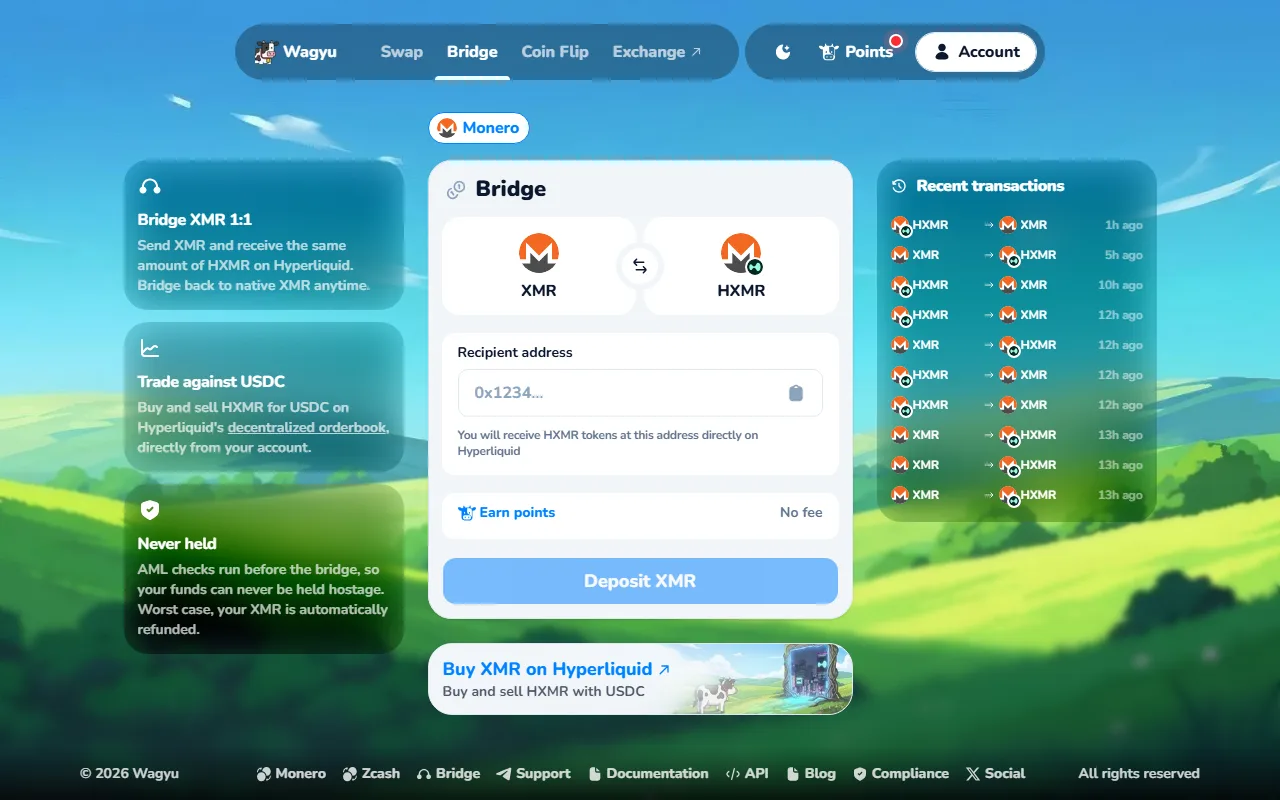
The Wagyu bridge now lists HXMR only. It says each HXMR "can be redeemed 1:1 for native XMR on this bridge at any time (minus the withdrawal fee)." I found no published way to turn XMR1 into XMR or HXMR.
| XMR1 | HXMR | |
|---|---|---|
| Spot pair | @260 | @1193 |
| Deployed | December 17, 2025 | November 22, 2026 |
| Deployer account | Not a multisig | 2-of-3 multisig |
| Mark price, November 24 | $0.013 | $493.56 |
| On the Wagyu bridge | No | Yes |
A 2-of-3 multisig means two signatures are needed to move the supply. It does not show who the signers are or how much Monero is in reserve. Crypto Times reported that no reserve attestation had been published.
Other tokens use similar names, including XMR2, XMRN and FXMR, from other issuers. HIP-1 names have "no uniqueness constraints," in the words of the Hyperliquid docs.
Three kinds of spot token
| Type | Example | Who issues it | What backs it | What can fail |
|---|---|---|---|---|
| Native HIP-1 token | HYPE, PURR | Its own deployer or genesis | Nothing external to redeem | Market price, holder concentration |
| Unit-bridged asset | UBTC, UETH, USOL | Unit | Native coins locked by the Unit bridge | The bridge, its guardians, its keys |
| Third-party wrapped token | XMR1, HXMR | A separate bridge operator | The operator's promise to redeem | The operator, its keys, its reserves |
Hyperliquid's docs say spot deployments are permissionless. A token trading on the order book tells you someone deployed it. You still have to find out who backs it.
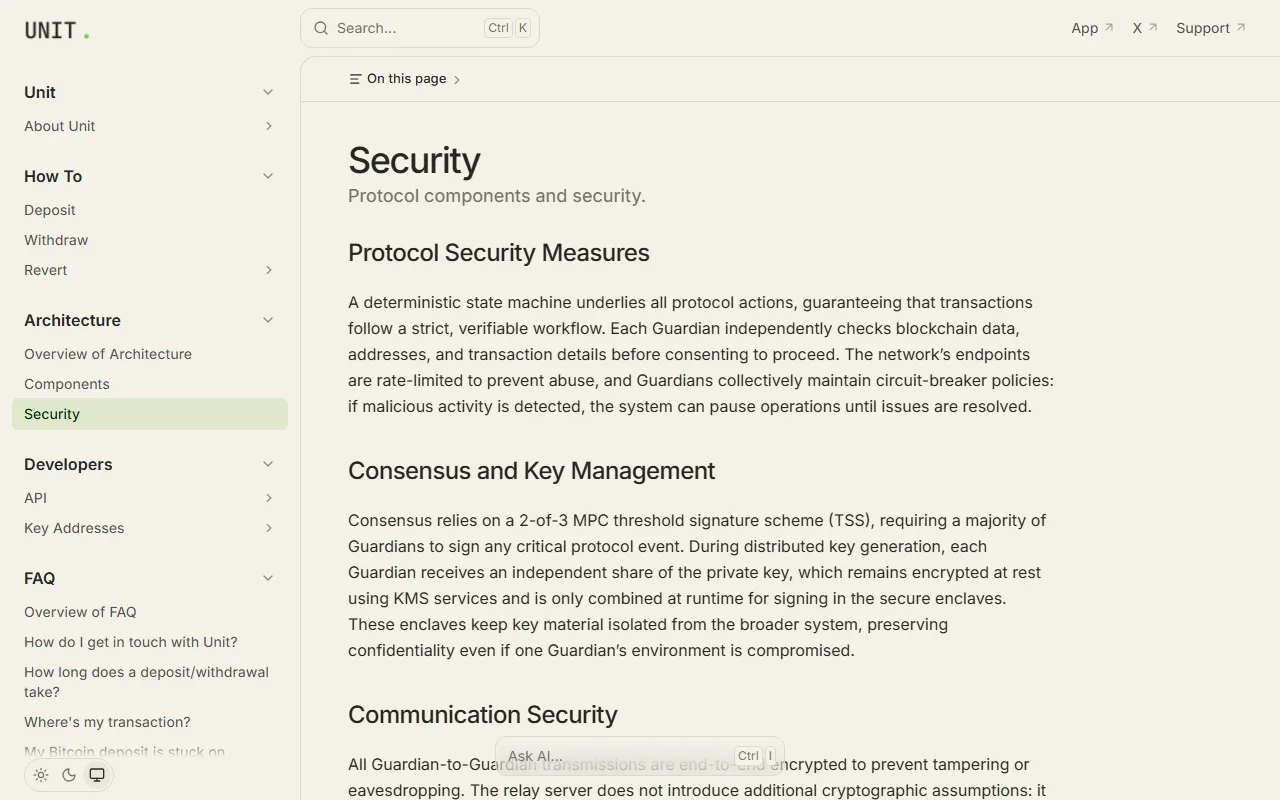
Unit's security page says its consensus uses "a 2-of-3 MPC threshold signature scheme," so a majority of guardians has to sign any critical event. Unit also publishes its treasury addresses. Monero is not on its supported list. Our Unit guide covers how deposits work, including the trust that remains.
How to check who backs a spot token
- Get the exact token. Query spotMeta on the Hyperliquid API and note the tokenId and full name. The ticker alone is not enough.
- Look at the deployer. tokenDetails returns the deployer address, deploy date and supply.
- Check the keys. userToMultiSigSigners returns the signers if the deployer is a multisig, and null if it is not.
- Check who holds the supply. One account with most of it can sell into your bid. The XMR1 deployer held 93% beforehand, per Bitquery.
- Find the redemption page. Read the fee and the minimum, then redeem a small amount before holding a large one.
- Look for reserves. Published addresses or an attestation let you compare backing with supply.
- Pull old limit orders. Most of the XMR1 sold went to resting bids.
The API guide shows how to send these requests, and the spot trading guide covers order types and fees.
What holders can do
Save your trade and transfer history first, with times and amounts. Then compare any refund you received with it, and use the contact in the founder's thread if something is missing. Never give anyone a seed phrase or private key to receive a refund.
Be careful about trading what is left. At 08:28 UTC on November 24 the XMR1 book showed about $436 of bids in total, with a bid of $0.0122 and an ask of $0.05.
For the tax side of a loss, ask a professional in your country.
The XMR perp is a separate market
The XMR perpetual is native to Hyperliquid and kept trading. It fell to $456.00 in the 04:00 hour and closed the next hour at $477.06. Nobody holding the perp holds XMR1.
The sources above do not describe any effect on Unit assets or HYPE. For the broader picture, read our Hyperliquid safety guide.
Sources and reuse
On-chain figures are Bitquery's, updated November 20. Prices, supply, deployer and multisig details were read from the Hyperliquid API at about 08:30 UTC on November 24, 2026. Issuer statements are quoted from the founder's own posts. This page will be updated if Wagyu publishes a claim process or a reserve report.
You may reuse this timeline with attribution and a link to this page.
Quoting a figure? Cite this pageShowHide
Plain-text citation
For articles, reports, and reference lists.
HTML link
Drop-in anchor tag with the page title and update date.
Where the figures come from. Token supply, deployer, multisig and price data come from the Hyperliquid API, read November 24, 2026. Sale counts and amounts come from Bitquery's on-chain investigation. The page is updated by hand when the issuer publishes new information. Figures and editorial context were last reviewed ; this page has been published since 2026.
Reuse. You may republish these figures with attribution and a link to hyperliquidguide.com/ecosystem/what-happened-to-xmr1.
Related reading: how HIP-1 auctions work, and the Hyperliquid DeFi ecosystem for other projects built on the chain.
Independent resource: Hyperliquid Guide is an independent, third-party resource operated by Concept211. It is not affiliated with, produced by, reviewed by or endorsed by Hyper Foundation, Hyperliquid Labs or any other Hyperliquid-ecosystem entity. "Hyperliquid" and related names and marks belong to their respective owners and are used here only to identify the platform this site documents. Read the full disclaimer.
Not advice: Nothing on this site is legal, tax, financial or investment advice. Descriptions of regulatory status, tax treatment and market availability are general information that varies by jurisdiction and changes over time. Confirm anything that matters to you with a qualified professional and against primary sources. Trading perpetual futures involves substantial risk of loss, and past performance does not indicate future results.
Disclosure: this site contains referral links. Signing up through the 4% fee discount link earns us a share of the trading fee Hyperliquid already charges, at no extra cost to you.
Ready to Start Trading?
Join Hyperliquid with our referral link and get a 4% fee discount on your first $25M of volume. No KYC, no email - just connect your wallet and trade.
Start Trading - Save 4%