Is Hyperliquid Centralized? Validators, Priority Fees and What the Critics Get Right
Table of Contents
 Hyperliquid
 is not centralized in the way a custodial exchange is, because no company holds your deposits. It is concentrated, though. On November 17, 2026, five validators named Hyper Foundation held 47.49% of staked HYPE, and the protocol auctions off faster access to market data. Whether that counts as "centralized" depends on what you need to trust.
Key takeaways
- Custody is self-custody. Your wallet signs every order and withdrawal. No exchange operator holds a pool of user funds.
- Stake is concentrated. In a live read of the validator set on November 17, 2026, 27 validators were active, the five named Hyper Foundation held 47.49% of stake, and the top 10 held 76.51%.
- Priority access is real and paid. Three gossip auctions run every three minutes, each slot worth about 20 ms of data latency per Hyperliquid's docs. Orders can also pay to jump ahead. The fees are burned and anyone can bid.
- The bridge rests on the same validators. USDC leaves through the Arbitrum bridge only with signatures from more than two thirds of validator power.
Using the referral link gives a 4% discount on trading fees for your first $25M of volume.
What the critics said
Around November 15, 2026, DFINITY founder Dominic Williams posted on X that Hyperliquid is in effect a centralized exchange. Pluang reported it on November 15, 2026, and TradingView News carried a Binance News write-up that attributes the comments to Odaily. Neither article quotes him directly. Both paraphrase the argument as follows:
- Selling priority access to particular trading firms is what many centralized exchanges do. He compared it to the New York Stock Exchange selling server cross-connects to hedge funds.
- In his view, an onchain, open-source protocol updated by a DAO would not sell that kind of access.
He was not the first to raise it. crypto.news reported on November 13, 2026, citing a Bloomberg report and data from Loris Tools, that market maker Wintermute won roughly 76% of the auctions for Hyperliquid's top data slot over the previous month. The same article says DRW founder Don Wilson questioned the fairness of the system in an October 31 post on X. Wintermute declined to confirm its share. Its CEO, Evgeny Gaevoy, told the outlet that "firms invest in low latency networks, microwave towers and colocation." A Hyperliquid Labs spokesperson said "priority fees make latency competition open and transparent."
Most of that can be checked against public data, so we did.
How many validators run Hyperliquid and who runs them
Hyperliquid runs its own chain, secured by HyperBFT, which the Hyperliquid docs describe as "a variant of HotStuff consensus" where "blocks are produced by validators in proportion to the native token staked to each validator." If you want the plain-English version of how blocks and the order book fit together, see how Hyperliquid works.
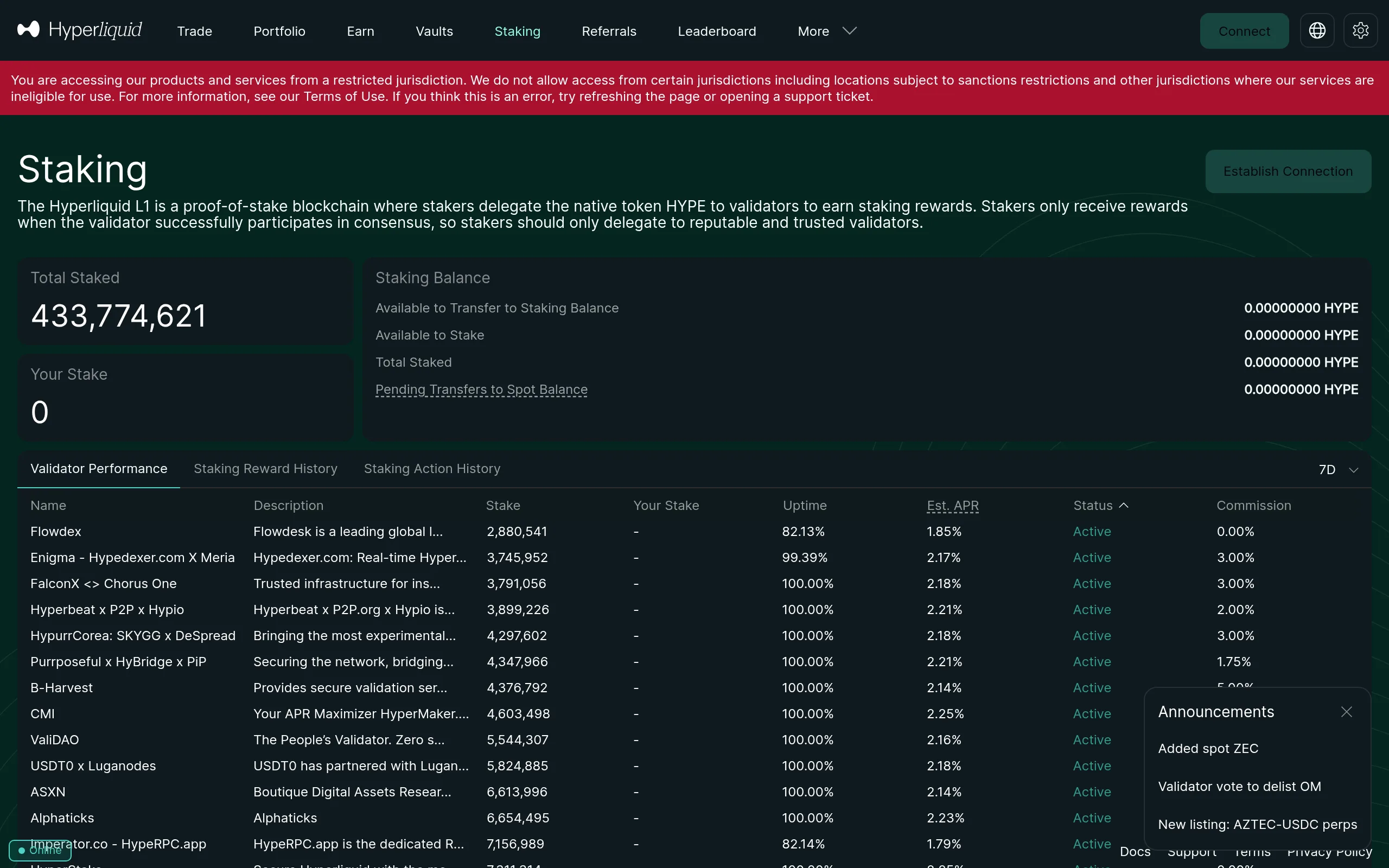
We read the validator set from the public API (POST https://api.hyperliquid.xyz/info with {"type":"validatorSummaries"}) at 08:56 UTC on November 17, 2026. Stake is reported in units of 10-8 HYPE. Here is what came back:
- 35 validators registered, 27 active. Eight were inactive, and six of those were jailed.
- 438,295,002 HYPE staked across all of them, almost all of it (438,236,783 HYPE) on active validators.
- Top 1: 12.41% of stake (Hyper Foundation 2).
- Top 5: 52.92%.
- Top 10: 76.51%.
- Validators named Hyper Foundation 1 through 5: 208,130,471 HYPE, or 47.49% of all stake.
- The three largest validators together pass one third of stake. The eight largest pass two thirds.
The largest validator without "Hyper Foundation" in its name was Hyperliquid Strategies x Unit at 8.89%. Further down were Anchorage By Figment (5.92%), Hypurrscanning (5.30%), Nansen x HypurrCollective (4.90%) and infinitefield.xyz (4.01%), followed by a long tail of independent operators, each under 2.3%.
Two caveats on reading that list. First, the names are labels the operators chose, and the API shows who runs a node, not who owns the HYPE delegated to it. Any holder can delegate to any validator. Second, the set changes. The figures above are a snapshot from one read, not a permanent state.
| Measure | Figure | Source (read Nov 17, 2026) |
|---|---|---|
| Active validators | 27 of 35 registered | Hyperliquid API, validatorSummaries |
| Stake held by top 1 / top 5 / top 10 | 12.41% / 52.92% / 76.51% | Hyperliquid API, validatorSummaries |
| Stake on validators named Hyper Foundation | 47.49% (5 validators) | Hyperliquid API, validatorSummaries |
| Validators needed for more than 1/3 and 2/3 of stake | 3 and 8 | Hyperliquid API, validatorSummaries |
| Arbitrum bridge withdrawal signatures | More than 2/3 of validator power | Bridge2.sol, hyperliquid-dex/contracts on GitHub |
| USDC in the legacy Arbitrum bridge | 69,654,595 USDC | Arbitrum One, USDC balanceOf on the bridge contract |
| Sequencing priority for sale | 3 data slots every 3 min; per-order rate for IOC and ALO | Hyperliquid docs, Priority fees |
| Automatic slashing | Not implemented | Hyperliquid docs, Staking |
The one-third and two-thirds lines matter because of how BFT voting works. In consensus of the HotStuff family, blocks need sign-off from more than two thirds of voting power, so anyone holding more than a third can stop the chain from finalizing by going offline or refusing to vote. Hyperliquid's own staking docs use the same two-thirds quorum for jailing: a validator is jailed when votes from more than two thirds of total stake agree. On the November 17 read, the five Foundation-named validators sat above one third and below two thirds.
The staking rules matter here too. Per the docs, a validator needs a 10,000 HYPE self-delegation to become active, locked for one year. Delegations have a one-day lockup, moving HYPE from staking back to spot takes seven days, and "there is currently no automatic slashing implemented." If you stake, the Hyperliquid staking guide shows how to pick a validator, and spreading delegation away from the largest ones is the one lever an ordinary HYPE holder has over concentration.
What priority fees actually buy
The critique centers on Hyperliquid priority fees, which went live in April 2026. The Priority fees page in Hyperliquid's docs describes two separate products.
Gossip (read) priority is an auction for receiving data sooner.
- There are three independent Dutch auctions on a three-minute schedule. Lower slots are strictly prioritized over higher ones.
- Nodes that respect the ordering send block data to winning IP addresses first. The docs put the effect at "roughly 20 ms" of latency reduction per slot on mainnet.
- Each auction opens at ten times the previous winning price for that slot, with a 0.1 HYPE floor. "Any address can bid for any IP."
- The fees are burned.
- It only applies to nodes that choose to respect it. The docs say "the Foundation non-validator" node opts in.
We read the live auction with {"type":"gossipPriorityAuctionStatus"} at 08:58 UTC on November 17, 2026. The top slot's round had opened at 5.18 HYPE, which under the ten-times rule means the previous round cleared at about 0.52 HYPE. The third slot sat at the 0.1 HYPE floor.
Order (write) priority is a rate attached to an individual order.
- It applies to immediate-or-cancel (IOC) orders and to post-only (ALO) orders on non-outcome assets.
- For IOC orders, each basis point of fee buys about 45 ms of end-to-end latency, up to 8 bps. All cancels are still processed before any order that can execute immediately.
- For ALO orders, the fee moves an order up the queue at its price level within a 400 ms window.
- The fee is charged in HYPE from the trader's undelegated staking balance and burned.
So yes, speed is for sale, in slices of tens of milliseconds. An order sent from the app without a priority rate pays nothing extra. It also has no way to beat someone who paid to see the data first and react to a price move before you.
Where the criticism holds
A few firms buy most of the speed. The comparison to colocation is fair on the mechanics. Paying for earlier data is close to what exchanges charge for cross-connects. If the Loris Tools figures reported by crypto.news are right, one market maker won about three quarters of the top data slot over a month, so the open auction has not produced a wide field of winners.
Stake also sits with a handful of validators. Five validators carrying one name held 47.49% of stake on November 17. That is enough to halt finality if they all stopped, and three validators together cross the same line. Twenty-seven active validators is a small set, and the stake inside it is lopsided.
The data auction also leans on node operators' settings. Gossip priority works because nodes opt in, and the docs name the Foundation non-validator as one that does. That is a policy choice by a node operator, not a rule of consensus.
And there is no automatic slashing yet. The docs say slashing is reserved for provably malicious behavior such as double-signing, and that it is not automatically implemented today. The economic penalty for misbehavior is weaker than the phrase "proof of stake" suggests.
Where it does not
Custody is the big one. On a custodial exchange the company controls the wallets. On Hyperliquid each account is controlled by its own wallet signature, and the Is Hyperliquid safe? guide covers what that does and does not protect you from. The critique is about ordering and governance, not custody.
The access is also not sold privately to chosen firms. Per the docs, any address can bid for any slot, the auction state is public through the API, and results are onchain. The crypto.news report quotes a Hyperliquid Labs spokesperson making the same point. You can disagree with selling speed at all, but the sale is visible to everyone.
Nobody pockets the fees, either. Both kinds of priority fee are burned according to Hyperliquid's docs. With colocation, the exchange operator collects the fee. Here it reduces HYPE supply.
And the order book is public. Every order, cancel and fill is a transaction on the chain, and anyone can run a non-validating node and check them. A centralized matching engine does not offer that.
Whether those points outweigh the concentration is a judgment call. We think "concentrated and openly priced" describes it better than "centralized exchange", but readers who weigh validator count first could reasonably land elsewhere. For background on the team behind the protocol, see who created Hyperliquid.
Trade With Your Own Keys
Hyperliquid keeps custody in your wallet. Join with our referral link for a 4% fee discount on your first $25M of volume.
Start Trading - Save 4% on FeesWhat it means for your funds
Deposits and withdrawals rely on validators. The legacy Arbitrum bridge contract, Bridge2.sol, releases USDC only when signatures from more than two thirds of validator power approve a withdrawal. Withdrawals then wait out a dispute period, during which validators registered as lockers can vote to pause the bridge. Unlocking needs a quorum of cold-wallet signatures. On November 17, 2026, an eth_call to the USDC contract on Arbitrum showed 69,654,595 USDC held by the bridge. The Hyperliquid bridge docs say USDC is now natively minted on Hyperliquid through Circle's CCTP and that the legacy bridge "holds less than 10% of the USDC supply on HyperCore."
In plain terms, the same concentrated validator set that orders trades also signs withdrawals. If a supermajority of stake went offline, withdrawals would wait. Our withdrawal guide covers the normal flow and what a delay looks like.
No validator can sign an order or a withdrawal from your account, which leaves your own keys as the risk you control most directly. A hardware wallet protects against the failure you can actually prevent. Our hardware wallet guide compares the options.
What we would do with this:
- Keep on Hyperliquid what you are actively trading, and move the rest back to a wallet you control.
- If you stake HYPE, consider delegating to a smaller, well-run validator with good uptime.
- If you trade by hand, place resting orders a little away from the touch rather than racing paid flow at the best price.
- Check the validator list yourself. The query above is public and free.
Regulatory questions are a separate track. DRW's Don Wilson linked his fairness concerns to how US regulators might view priority fees. That bears on US-facing plans described on our US tracker, not on how the chain runs today. Current access rules are on the US availability page. None of this is legal advice.
Decide With the Data, Then Trade
You have seen the validator numbers and the priority fee rules. If the trade-offs work for you, open your account with a 4% fee discount on your first $25M of volume.
Start Trading - Save 4% on FeesFrequently Asked Questions
It depends on which part you measure. Custody is not centralized: funds sit in accounts controlled by user wallets and no company holds a pool of deposits. Validation is concentrated: on November 17, 2026, Hyperliquid's validatorSummaries API listed 27 active validators, five of them named Hyper Foundation, and those five held 47.49% of all staked HYPE. The three largest validators held more than a third of stake and the eight largest more than two thirds.
Hyperliquid's documentation describes two optional priority fees paid in HYPE. Gossip priority is three Dutch auctions every three minutes for faster delivery of block data, worth roughly 20 milliseconds per slot. Order priority lets an API order pay a per-order rate to be processed sooner. The docs say any address can bid and that both kinds of fee are burned.
The validator list from the Hyperliquid API names each operator. On November 17, 2026 it showed 35 registered validators, 27 of them active. Five active validators were named Hyper Foundation 1 through 5. The rest carried names of independent teams and companies such as Anchorage By Figment, Nansen x HypurrCollective, B-Harvest and Bitwise. Stake delegated to a validator can come from any holder, so the list shows who operates each node, not who owns the stake.
Validators do not hold user private keys, and every trade or withdrawal needs a signature from the account's own wallet. They do control the chain and sign bridge withdrawals: the Arbitrum bridge contract releases USDC only when validators holding more than two thirds of validator power sign. That makes the honesty and uptime of a supermajority of stake a real dependency for anyone holding funds on Hyperliquid.
Independent resource: Hyperliquid Guide is an independent, third-party resource operated by Concept211. It is not affiliated with, produced by, reviewed by or endorsed by Hyper Foundation, Hyperliquid Labs or any other Hyperliquid-ecosystem entity. "Hyperliquid" and related names and marks belong to their respective owners and are used here only to identify the platform this site documents. Read the full disclaimer.
Not advice: Nothing on this site is legal, tax, financial or investment advice. Descriptions of regulatory status, tax treatment and market availability are general information that varies by jurisdiction and changes over time. Confirm anything that matters to you with a qualified professional and against primary sources. Trading perpetual futures involves substantial risk of loss, and past performance does not indicate future results.
Disclosure: this site contains referral links. Signing up through the 4% fee discount link earns us a share of the trading fee Hyperliquid already charges, at no extra cost to you.
Ready to Start Trading?
Join Hyperliquid with our referral link and get a 4% fee discount on your first $25M of volume. No KYC, no email - just connect your wallet and trade.
Start Trading - Save 4%