Hyperliquid vs Kraken - Permissionless DeFi vs Regulated CEX
Table of Contents
- Hyperliquid vs Kraken: DeFi Speed Meets Institutional Trust
- Custody and Security: Two Models, Two Trade-Offs
- Kraken: Custodial with a Stellar Track Record
- Hyperliquid: Self-Custody by Design
- KYC and Access
- Hyperliquid: No KYC, Instant Access
- Kraken: Full KYC, Strong US Presence
- Fee Comparison
- Fee Calculation: $500K Monthly Volume
- Trading Features
- Perpetual Futures Depth
- Kraken's Broader Product Suite
- Hyperliquid's Ecosystem Edge
- Speed and Execution
- Hyperliquid
- Kraken
- Practical Difference
- Regulatory Landscape
- Kraken: Compliance Leader
- Hyperliquid: Permissionless Protocol
- Liquidity and Volume
- Who Should Choose Which?
 Hyperliquidvs
 Kraken
Hyperliquid vs Kraken: DeFi Speed Meets Institutional Trust
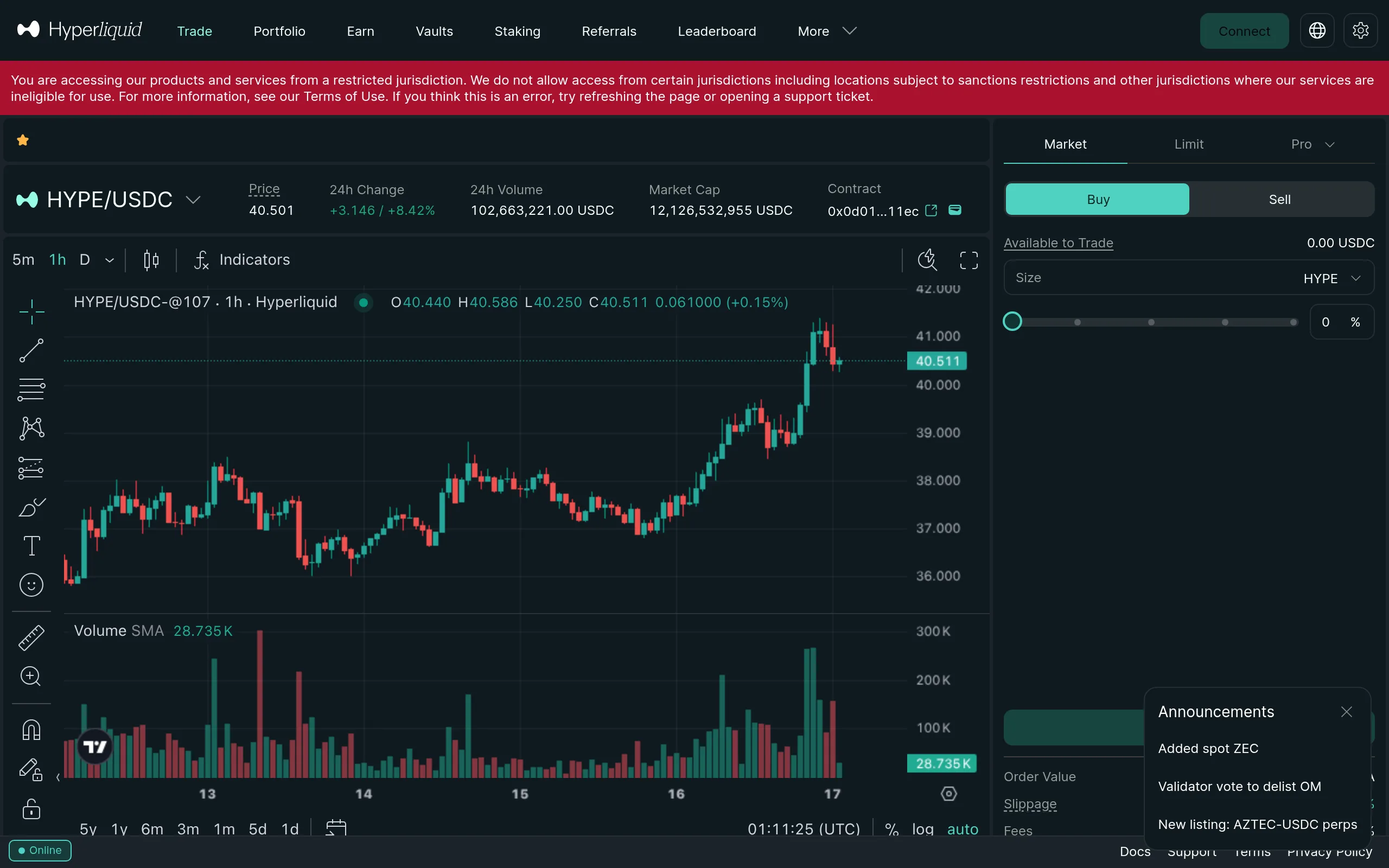
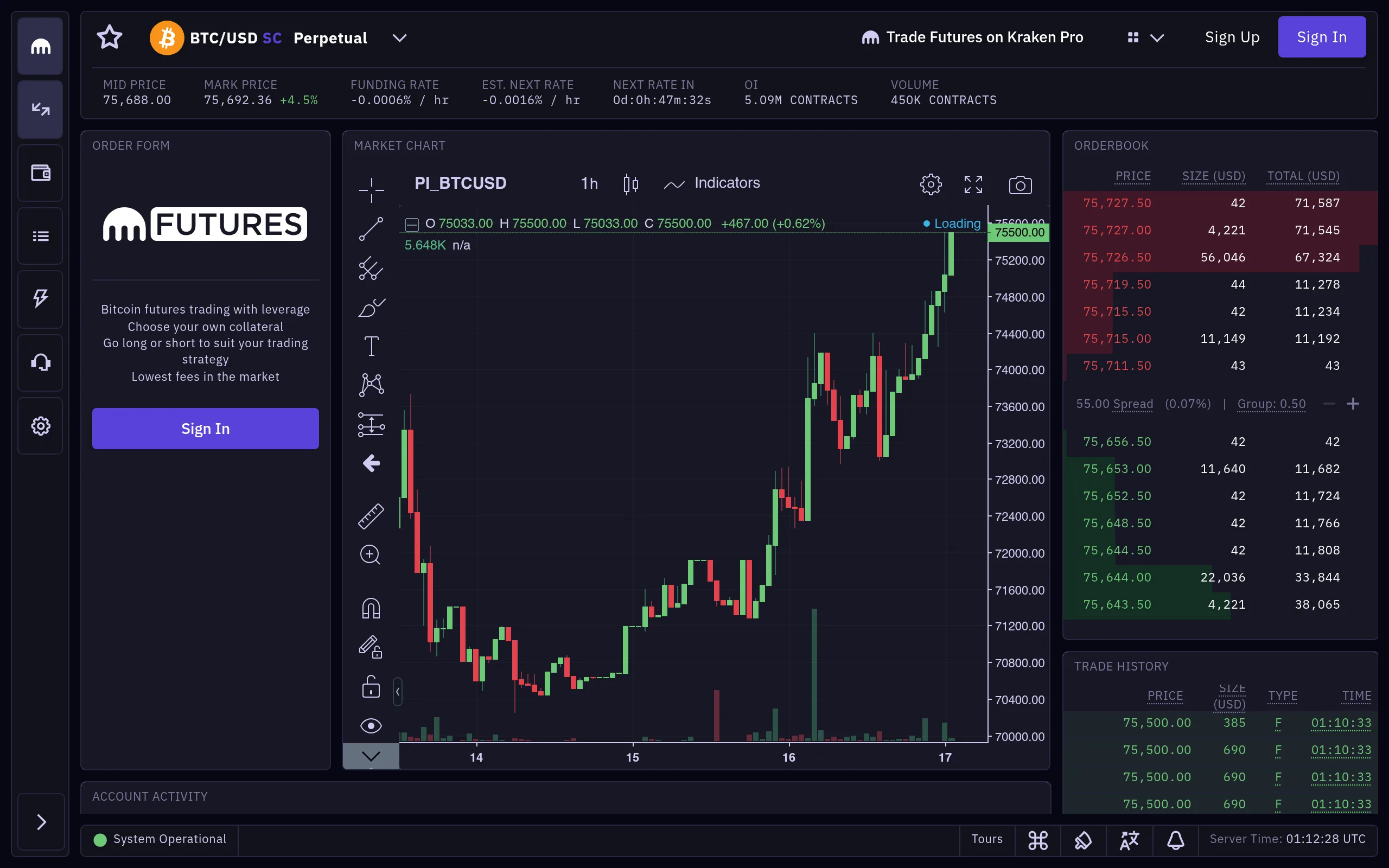
Kraken is one of the oldest centralized exchanges in crypto, a licensed platform with no publicly reported major exchange breach and a reputation built on security and transparency. Hyperliquid is the new generation: a decentralized perpetual futures exchange running on its own Layer 1 blockchain, processing around ~$7B in daily volume with no KYC and full self-custody.
This comparison pits two fundamentally different philosophies against each other. Kraken says: trust us, we are regulated and secure. Hyperliquid says: trust the protocol, not the company. Both have merit, and the right choice depends entirely on what matters most to you as a trader.
Lower Fees, No KYC, Self-Custody
Hyperliquid offers institutional-grade perps trading without the institutional red tape. Use our referral code for a 4% lifetime fee discount.
Try Hyperliquid - Save 4%Custody and Security: Two Models, Two Trade-Offs
The most important difference between these two platforms is how they handle your money.
Kraken: Custodial with a Stellar Track Record
Kraken is a custodial exchange - when you deposit funds, Kraken holds them. Its security record is a large part of its reputation: founded in 2011, Kraken has no publicly reported major breach of the exchange in that time. It maintains proof of reserves, conducts regular audits, and was an early adopter of comprehensive cold storage practices. As with any custodial venue, absence of a reported breach is not a guarantee about the future.
Kraken is registered with FinCEN in the United States and has pursued a federal bank charter, signaling its commitment to operating within the regulatory framework. For institutional traders, compliance-focused funds, and anyone who prioritizes regulatory clarity, Kraken's approach is compelling.
The trade-off remains the same as any custodial platform: your funds are only as safe as Kraken's operational integrity. You are trusting a third party, even if that third party has earned significant trust.
Hyperliquid: Self-Custody by Design
On Hyperliquid, you connect your own wallet (MetaMask, Rabby, or similar) and deposit USDC to your margin account. Your funds are secured by on-chain logic and your own private keys. No intermediary can freeze your account, block withdrawals, or mismanage your assets.
The responsibility shifts to you: lose your private keys, and there is no customer support to help. But you also eliminate every form of exchange counterparty risk. For traders who remember Mt. Gox, QuadrigaCX, or FTX, self-custody is not a preference - it is a requirement. Our security guide covers best practices for protecting your wallet.
KYC and Access
Hyperliquid: No KYC, Instant Access
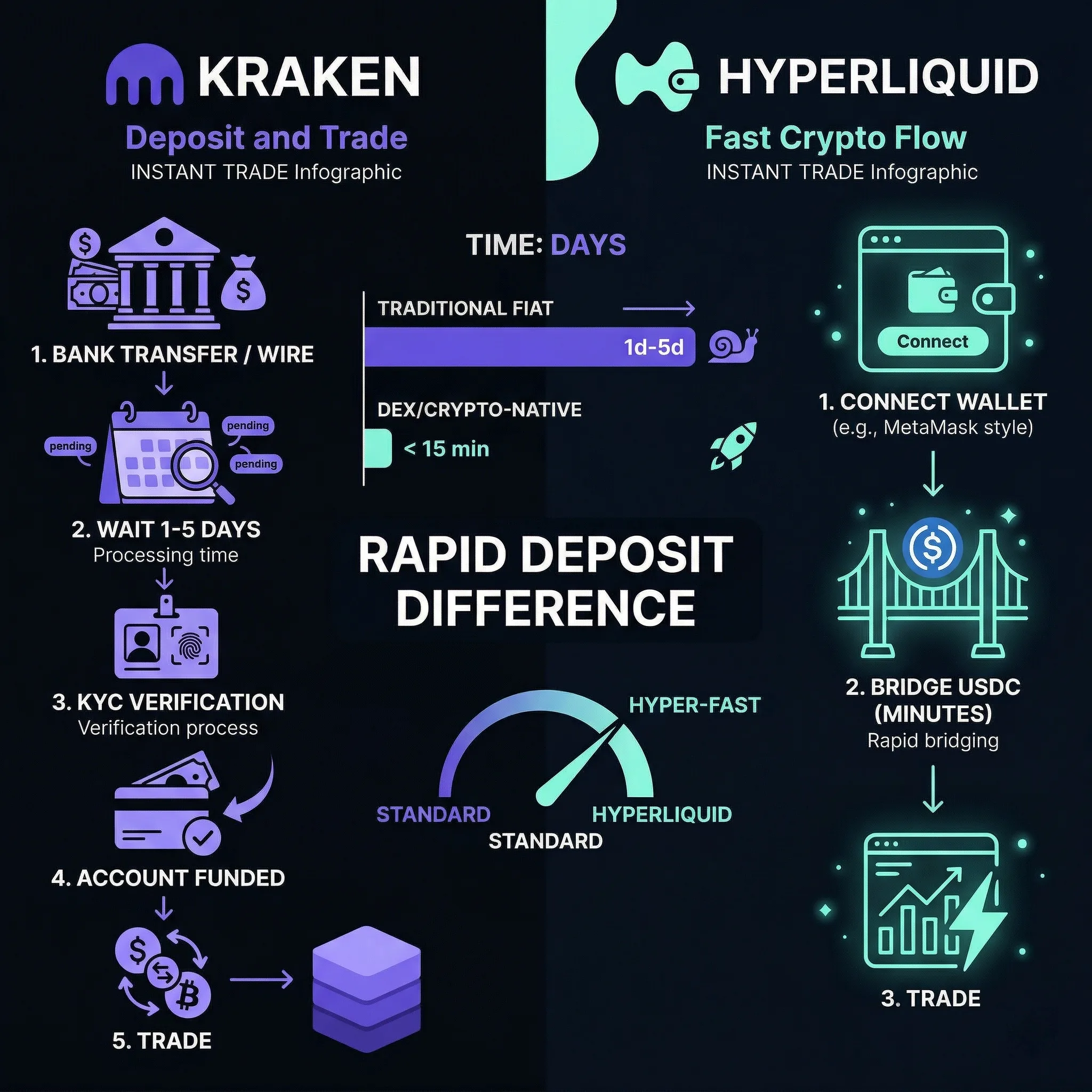
Hyperliquid requires nothing. No email, no identity verification, no waiting period. Connect a wallet, bridge USDC, and you can place your first trade within minutes. There are no geographic restrictions on the primary frontend, and your privacy is fully preserved.
Kraken: Full KYC, Strong US Presence
Kraken requires full KYC for all users - government ID, personal information, and in many jurisdictions, proof of address. Verification typically takes a few hours but can extend to days during peak demand.
The upside of Kraken's KYC compliance is clear US availability. Unlike many exchanges that have pulled out of or restricted US access, Kraken is fully operational for American users (though certain futures products have limitations). For US-based traders who need a compliant platform with fiat access, Kraken is one of the top choices.
For traders who value privacy, trade from restricted jurisdictions, or simply do not want to hand over personal documents to use a trading platform, Hyperliquid's permissionless model is the clear winner.
Fee Comparison
Fees are where Hyperliquid pulls meaningfully ahead. For a complete breakdown, see our fee structure guide.
| Hyperliquid | Kraken Futures | |
|---|---|---|
| Maker Fee (Base) | 0.015% | 0.020% |
| Taker Fee (Base) | 0.045% | 0.050% |
| Gas/Network Fees | Zero | Zero (internal) |
| Referral Discount | 4% lifetime | Varies |
| Staking Discount | Up to 40% (HYPE staking) | None |
| VIP Tiers | Yes (volume-based) | Yes (volume-based) |
Hyperliquid wins on both maker and taker fees at base tier - 0.015%/0.045% vs Kraken's 0.020%/0.050%. On a $10,000 taker trade, that is $4.50 on Hyperliquid vs $5.00 on Kraken. The gap widens further when you factor in Hyperliquid's staking discounts and VIP tiers.
Hyperliquid's HYPE token staking discount (up to 40% at Diamond tier) stacks with the 4% referral discount, driving effective fees well below Kraken's best rates. Kraken has no equivalent token-based discount system. Get Your 4% Discount
Fee Calculation: $500K Monthly Volume
| Platform | Monthly Fee Cost (Taker) |
|---|---|
| Hyperliquid (base + 4% referral) | $216 |
| Hyperliquid (base + referral + HYPE staking) | $130 - $216 |
| Kraken (base tier) | $250 |
| Kraken (Pro tier) | $200 |
Over a year, the savings on Hyperliquid compound into meaningful money - potentially thousands of dollars that stay in your trading account rather than going to exchange fees.
Lower Fees Than Kraken - Guaranteed
Hyperliquid beats Kraken on both maker and taker fees at every tier. Use referral code for an additional 4% lifetime discount.
Start Saving on FeesTrading Features
| Hyperliquid | Kraken | |
|---|---|---|
| Perpetual Pairs | 200+ | ~100 |
| Spot Pairs | Growing | ~200 |
| Max Leverage | Up to 40x | Up to 50x |
| Order Types | Market, Limit, Scaling, TWAP, TP/SL, Trailing Stop | Market, Limit, Stop, Trailing Stop |
| API Trading | Yes (REST + WebSocket) | Yes (REST + WebSocket) |
| Fiat On-Ramp | No (bridge USDC) | Yes (bank wire, ACH) |
| Staking | HYPE staking | Multi-asset staking |
| NFT Marketplace | No | Yes |
| DeFi Ecosystem | HyperEVM (lending, vaults, DEXs) | No |
Perpetual Futures Depth
For perpetual futures specifically - the core product both platforms offer - Hyperliquid has a clear advantage in pair count. With 200+ perpetual pairs vs Kraken's roughly 100, Hyperliquid gives traders access to more markets, including emerging tokens, memecoins, and even commodity and equity perpetuals via HIP-3 builder markets.
Hyperliquid's order types include scaling orders and TWAP - advanced execution tools that Kraken does not offer. For traders who want precise position entry across a price range or time-weighted execution, Hyperliquid provides more sophisticated tooling.
Kraken's Broader Product Suite
Kraken has the advantage in product breadth. It offers spot trading across roughly 200 pairs, multi-asset staking (ETH, DOT, SOL, and others), an NFT marketplace, and margin trading. Kraken also recently acquired NinjaTrader, signaling its ambition to expand into traditional derivatives markets.
The biggest practical advantage for many traders is fiat on-ramps. Kraken supports bank wire transfers, ACH deposits, and other fiat payment methods. This means you can go from a bank account to a trading position without touching any other platform. Hyperliquid requires you to already have USDC in a crypto wallet, which means an extra step if you are starting from fiat.
Hyperliquid's Ecosystem Edge
Where Hyperliquid pulls ahead is its growing DeFi ecosystem. HyperEVM enables lending, borrowing, liquid staking, and vault strategies directly on the Hyperliquid chain. You can lend your USDC, stake HYPE, or participate in vaults - all without leaving the ecosystem. Kraken, as a centralized platform, does not and cannot offer this kind of composable, permissionless financial infrastructure.
Speed and Execution
Hyperliquid
Sub-second finality on its custom L1 blockchain. Orders are matched and confirmed in under one second. The trading experience genuinely feels like using a centralized exchange - order placement, modification, and cancellation are all instant and free. No gas fees on any action.
Kraken
Kraken's matching engine is fast and reliable, though it has historically been less focused on ultra-low-latency execution compared to some competitors. Kraken has invested heavily in infrastructure upgrades, and execution is smooth for both retail and professional traders.
Practical Difference
For manual traders, both platforms feel responsive and fast. Neither will leave you waiting for order confirmation. For algorithmic traders, Hyperliquid's sub-second finality is more than sufficient for most strategies, and its API is well-documented with both REST and WebSocket endpoints. Kraken also offers strong API support, though its rate limits and WebSocket implementation differ.
Regulatory Landscape
Kraken: Compliance Leader
Kraken has built its brand on regulatory compliance. It is registered with FinCEN, operates licensed entities in multiple jurisdictions, and has been pursuing a federal bank charter in the United States. For institutional traders, funds, and compliance-conscious individuals, Kraken offers one of the clearest regulatory pictures in the industry.
This compliance comes with trade-offs: KYC for all users, potential restrictions on certain products by jurisdiction, and the possibility of account freezes or reporting obligations tied to regulatory requirements.
Hyperliquid: Permissionless Protocol
Hyperliquid operates as a decentralized protocol with no centralized entity controlling user funds or access. There is no KYC, no geographic restrictions on the primary frontend, and no intermediary that can freeze accounts or block trades.
The regulatory future of decentralized exchanges is uncertain. US regulation could evolve to impose requirements on DEX frontends or DeFi protocols directly. But architecturally, a non-custodial, permissionless protocol occupies a fundamentally different regulatory category than a centralized exchange.
For a deeper look at how US traders approach Hyperliquid, see our US availability guide.
Liquidity and Volume
Hyperliquid processes approximately ~$7B in daily perpetual futures volume, making it one of the highest-volume DEXs in existence. Kraken's futures volume is lower - it is a respected exchange, but futures have not been its primary growth driver the way spot and staking have been.
On major pairs like BTC and ETH perpetuals, both platforms offer tight spreads and reasonable depth. For mid-cap and small-cap perpetual pairs, Hyperliquid generally offers more markets and comparable or better liquidity than Kraken's futures desk.
Kraken's spot liquidity is strong, particularly for fiat pairs (BTC/USD, ETH/EUR, etc.) where it benefits from direct fiat on-ramps and institutional flow. If spot trading with fiat pairs is important to you, Kraken has a meaningful advantage.
Info
Explore live Hyperliquid data: Funding Rates · Open Interest · Volume Rankings
Who Should Choose Which?
Choose Hyperliquid if you value:
- Lower fees - Hyperliquid wins on both maker and taker at base tier, and stacking discounts widen the gap
- No KYC - trade immediately with just a wallet connection
- Self-custody - your assets stay in your wallet, not on an exchange
- More perp pairs - 200+ perpetuals vs Kraken's ~100
- DeFi composability - lending, vaults, and staking on HyperEVM
- Advanced order types - scaling orders, TWAP, and free order modifications
Choose Kraken if you value:
- US regulatory compliance - FinCEN registered, clear legal standing
- Fiat on-ramps - bank wire, ACH, and card deposits
- Security track record - no publicly reported major exchange breach in over a decade
- Spot trading breadth - 200+ spot pairs with fiat quotes
- Multi-asset staking - stake ETH, DOT, SOL, and more directly on the platform
- Institutional reputation - trusted by funds and corporate treasuries
For perpetual futures traders who prioritize low fees, privacy, and self-custody, Hyperliquid is the stronger choice. For traders who need fiat access, regulatory clarity, and a broader product suite, Kraken remains an excellent platform. Many traders use both - Kraken as a fiat gateway and spot venue, Hyperliquid as their primary perps platform.
See how Hyperliquid stacks up against other major exchanges in our Hyperliquid vs Binance, Hyperliquid vs Gate.io, and Hyperliquid vs Crypto.com comparisons.
Trade Perps the DeFi Way
Lower fees than Kraken, no KYC, and full self-custody. Join Hyperliquid with referral code and save 4% on every trade for life.
Get 4% Off - Join HyperliquidFrequently Asked Questions
Yes, at base tier. Hyperliquid charges 0.015% maker and 0.045% taker, while Kraken charges 0.02% maker and 0.05% taker. Hyperliquid also offers a 4% referral discount and up to 40% HYPE staking discount, making its effective fees significantly lower. Neither platform charges gas fees on trades.
Yes. Kraken requires full identity verification (KYC) for all users, including government-issued ID and proof of address in many jurisdictions. Hyperliquid requires no KYC, no email, and no account creation - you simply connect a crypto wallet and start trading.
The security models are fundamentally different. Kraken is a custodial exchange with a long-standing reputation for security and no publicly reported major breach of its exchange since launching in 2011, but you are trusting Kraken with your funds. Hyperliquid uses a self-custody model where your assets stay in your own wallet, which removes exchange counterparty risk and replaces it with responsibility for your own keys.
Kraken is fully available to US users with KYC verification, though certain futures products may be restricted. Hyperliquid has no KYC or geographic restrictions on its primary frontend, but US regulatory status for decentralized exchanges remains a gray area. Kraken is the more clearly regulated option for US-based traders.
For perpetual futures, yes. Hyperliquid offers over 200 perpetual pairs, while Kraken offers around 100 futures contracts. Kraken has more spot pairs at around 200, but Hyperliquid's spot market is growing rapidly alongside its expanding HyperEVM ecosystem.
Independent resource: Hyperliquid Guide is an independent, third-party resource operated by Concept211. It is not affiliated with, produced by, reviewed by or endorsed by Hyper Foundation, Hyperliquid Labs or any other Hyperliquid-ecosystem entity. "Hyperliquid" and related names and marks belong to their respective owners and are used here only to identify the platform this site documents. Read the full disclaimer.
Not advice: Nothing on this site is legal, tax, financial or investment advice. Descriptions of regulatory status, tax treatment and market availability are general information that varies by jurisdiction and changes over time. Confirm anything that matters to you with a qualified professional and against primary sources. Trading perpetual futures involves substantial risk of loss, and past performance does not indicate future results.
Disclosure: this site contains referral links. Signing up through the 4% lifetime fee discount link earns us a share of the trading fee Hyperliquid already charges, at no extra cost to you.
Ready to Start Trading?
Join Hyperliquid with our referral link and get a 4% lifetime fee discount. No KYC, no email - just connect your wallet and trade.
Start Trading - Save 4%